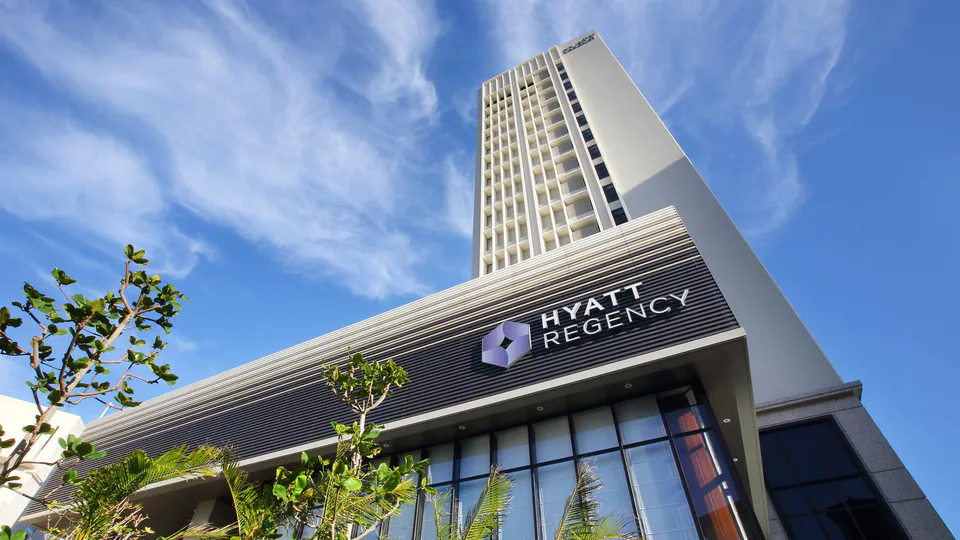

Hyatt Regency Naha Okinawa is a strong central-Naha hotel when you will use the neighbourhood more often than you use the monorail. Hyatt currently puts Makishi Station about eight minutes away on foot, but Kokusai Street about three minutes away, Tsuboya Yachimun Street about one minute away and Makishi Public Market about four minutes away. The hotel therefore trades station-door convenience for repeated walkability inside the part of Naha many visitors actually use after check-in.
That trade is easy to misread. An eight-minute station walk can feel like a weakness on airport day, but it may be paid only a few times. The three-minute Kokusai Street walk can be used every morning, afternoon reset and dinner. The right question is which walk repeats more often on your actual itinerary?
The 30-second verdict
↔ Scroll table left or right
Your Naha stay | Verdict | Why |
2–3 nights, repeated Kokusai / Makishi / Tsuboya evenings | Strong fit | The neighbourhood walk repeats more than the station walk |
Yui Rail is used several times every day | Compare a station-door hotel | The 8-minute Makishi walk compounds across every departure and return |
Late-flight first night, leave early for rental car | Weak use of the premium | No airport shuttle; little time to use pool, Club or walkable city location |
Return car, then spend final 2 nights in Naha | Gets stronger | The hotel can become a car-free city base after the road-trip section is finished |
Club Room but all-day sightseeing | Recalculate | Club Twin is still 28 m²; much of the premium is lounge access rather than extra room space |
Turn the 8-minute station walk into a repeat count
Hyatt’s current transport page says Makishi Station is about eight minutes away on foot and that there is no airport shuttle. That makes the station penalty measurable.
If you arrive by Yui Rail, leave by Yui Rail and make one additional monorail round trip during the stay, you make four hotel–station walks. At the hotel’s published estimate, that is roughly 32 minutes of pure hotel-to-station walking across the stay.
If the itinerary uses Yui Rail for three separate sightseeing days as well as arrival and departure, the count can reach eight one-way station walks — roughly 64 minutes of pure walking before waiting, platforms, summer heat or luggage are considered.
These are ValueNavi calculations from Hyatt’s eight-minute published walking estimate, not measured door-to-door trip times.
Now compare that with how often you use the immediate neighbourhood. Hyatt lists Kokusai Street at about three minutes, Tsuboya Yachimun Street at about one minute and Makishi Public Market at about four minutes. If the stay repeatedly returns to the hotel between shopping, market visits and dinner, the location can pay back many times without another train.
This is why I would not call the hotel simply “convenient” or “inconvenient.” It is city-convenient and station-conditional.
Taxi arrival can remove the biggest station disadvantage
Hyatt currently gives about 20 minutes by car from Naha Airport under normal conditions and explicitly says there is no airport shuttle. For two travellers with large luggage, pricing an airport taxi can change the whole hotel comparison.
If you take a taxi on arrival and departure, the eight-minute station walk no longer carries the suitcases. It only matters on the days you voluntarily use Yui Rail. That can make the hotel much easier to justify for a short premium city stay.
The opposite is true for a budget-first traveller who plans to use Yui Rail for every airport and sightseeing movement. A hotel beside a monorail station may save more repeated friction even if it is slightly farther from the middle of Kokusai Street.
The standard 28 m² room is already the baseline to beat
The current standard Twin is 28 m²; Deluxe Twin is 32 m² and can be configured with an extra bed for up to three guests. For two adults, I would start with 28 m² rather than assume the Deluxe label is necessary.
The extra four square metres become more valuable when a third guest is added, luggage is heavy or the room is used for daytime resets. They are less valuable when the room is only a place to sleep after long road-trip days.
Club Twin is also 28 m². That matters because a Club upgrade is primarily buying the higher-floor placement and Regency Club access, not more floor area. If room size is the reason you are upgrading, compare the 32 m² Deluxe categories rather than automatically choosing Club.
Regency Club is a timetable product, not a room-size product
Hyatt’s current official page confirms that the Regency Club Lounge on the 18th floor is for Club and Suite guests and provides breakfast, light refreshments and evening cocktails. The value depends on how often you are actually back at the hotel for those windows.
A useful Club pattern is: city morning → return mid-afternoon → lounge/reset → Kokusai dinner → hotel. A weak pattern is: leave at 08:00 for Onna/Motobu → return after 21:30 → sleep. In the second itinerary, the lounge exists but does not improve the trip.
Because Club Twin remains 28 m², apply a deletion test: remove the lounge from the booking. Would you still pay the same premium for a higher floor? If not, the number of usable lounge sessions should determine whether Club is worth it.
The pool has a hard seasonal and clock boundary
The current outdoor pool operates March 1 through November 30 from 09:00 to 20:00, with last entry at 19:00. The jet bath operates year-round from 07:00 to 20:00. Staying guests use these facilities without a separate pool admission fee.
This makes the pool useful for a planned afternoon reset but poor as a late-evening backup. A family that returns at 20:30 cannot count the pool as an evening benefit even though the hotel is marketed as a city resort.
For December through February, remove the outdoor pool from the room-value calculation. The year-round jet bath remains, but it is not the same product.
The best timing may be after the rental-car portion, not before it
Hyatt is particularly logical when the road-trip section has ended. Return the car, move into central Naha, then use walking, taxi and Yui Rail for the final city days. That lets the hotel’s local position do the work it is good at.
Using it as a one-night airport bookend before immediately collecting a car is weaker. You absorb the city transfer, maybe walk from Makishi with luggage, sleep and leave before the pool/Club/neighbourhood can contribute much.
If the first night is only a late arrival, compare late-arrival hotels near Naha Airport. If Naha will have two complete city days, use the Naha no-car itinerary to test whether Hyatt’s location repeats enough to justify the rate.
Sunday driving can temporarily change the access geometry
Hyatt’s transport page notes that part of Kokusai Street becomes pedestrian-only on Sundays from 12:00 to 18:00. Drivers should therefore not assume the weekday car route and access pattern will be identical on a Sunday afternoon.
The hotel’s tower parking is first-come, first-served; oversized vehicles or a full facility can push guests to nearby paid coin parking. If most Okinawa days are still self-drive days, these details can matter more than the three-minute walk to Kokusai Street.
Three practical stay patterns
Two nights after returning the rental car
Strong. Taxi or city transfer in, then Makishi Market, Tsuboya, Kokusai Street and evening dining repeat around the hotel. Station friction is limited.
Three nights, monorail every morning and evening
Conditional. The 8-minute walk compounds. Price a station-adjacent alternative before paying Hyatt’s neighbourhood premium.
One late-arrival night
Weak. No airport shuttle, little facility time and almost no opportunity to use the walkable Naha position. Buy the city-resort premium only if the room itself matters.
Final verdict
Hyatt Regency Naha is worth paying for when the hotel is your base for walking central Naha, not when Makishi Station is your real front door. Count station walks. Four one-way hotel–station legs equal about 32 minutes at Hyatt’s current published estimate; eight equal about 64 minutes. If that sounds like your trip, compare a station-door hotel. If you use a taxi for luggage and repeatedly walk Kokusai Street, Tsuboya and Makishi Market, Hyatt’s three- to four-minute neighbourhood access can be the more valuable kind of convenience.
References
Hyatt Regency Naha — transport and parking · Nearby attractions and walking references · Pool and Regency Club information. Checked August 25, 2026. Facility hours and access conditions can change; verify the exact stay date.