
For most Naha Airport buffer nights, do not pay by station number alone. Yui Rail currently publishes only a one-minute ride-time difference between Naha Airport–Akamine (4 minutes) and Naha Airport–Oroku (5 minutes). Tsubogawa is nine minutes from the airport. That means a better four-person room in Oroku can easily beat Akamine for a family, and a Tsubogawa hotel with an in-room washer-dryer can justify five extra train minutes when it deletes an evening of laundry and repacking.
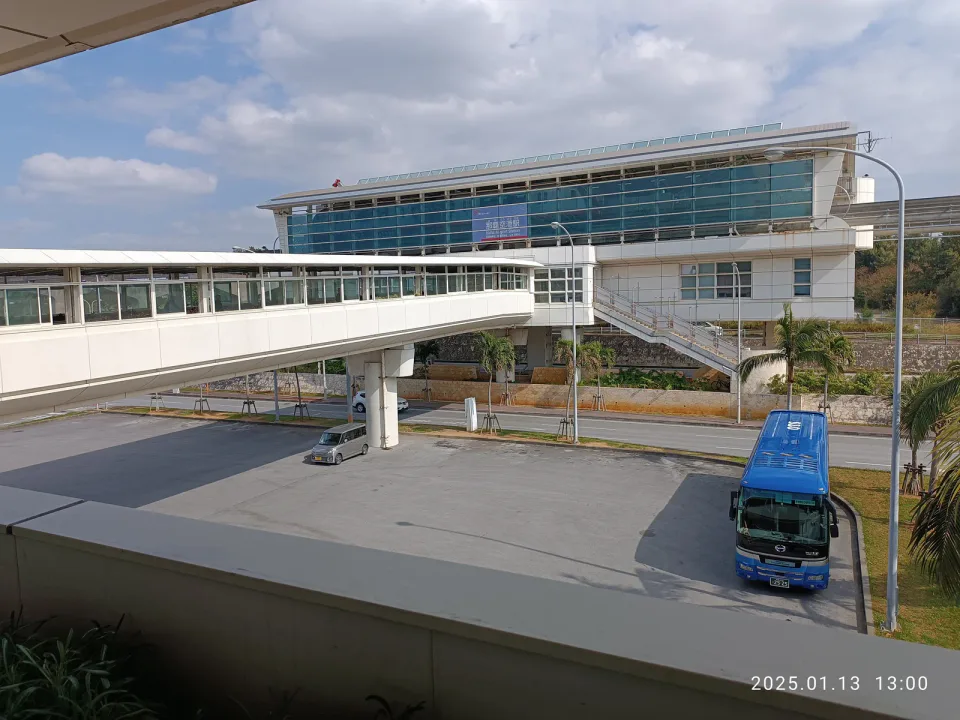
The terminal also matters. Naha Airport says the monorail station is reached through the Domestic Flight area’s second-floor connecting passage. For an international departure, “arrive at Naha Airport Station” is therefore not the same as “arrive at the international airline counter.” Add the indoor terminal walk to the airline buffer, especially for a very early flight.
↔ Scroll table left or right
Your real constraint | Start with | Why |
Solo/couple, one sleep-only night | Akamine | Official scheduled ride time to Naha Airport is about 4 minutes |
Family needs a true four-person room / more luggage floor | Oroku | It is only about one scheduled rail minute farther than Akamine |
Laundry + repacking is the final-night job | Tsubogawa can win | About 9 minutes to the airport; extra five minutes versus Akamine can buy a room that closes unfinished trip tasks |
International flight | Add terminal-interior time | The monorail station connects through the Domestic 2F passage rather than placing you at the international airline counter |
Flight requires arrival before the first useful train | Taxi / confirmed road transfer | A hotel one station closer cannot create an earlier train |
Rental-car pickup next morning | Exact branch first | Walking to the branch can matter more than a one-minute rail difference |
Akamine vs Oroku is a one-minute rail question, not a location hierarchy
Yui Rail’s current station table lists Naha Airport to Akamine at four minutes and JPY 250, and Naha Airport to Oroku at five minutes and JPY 250. That is a useful correction to hotel lists that rank Akamine automatically above Oroku because it is one stop closer.
One scheduled minute is too small to outweigh a materially better room. For a family of four, ask whether the Oroku hotel provides:
four real sleeping surfaces rather than a cramped bed-sharing plan;
enough floor for several suitcases and a stroller;
bath/toilet separation or other morning-parallel features;
a simpler hotel-to-station walk.
If those differences are meaningful, Oroku can be the more efficient airport hotel even though it is technically farther down the line.
Tsubogawa has to repay about five extra train minutes
Yui Rail currently lists Naha Airport to Tsubogawa at about nine minutes, versus four minutes to Akamine. That five-minute scheduled difference is finally large enough to demand a reason—but it is still small compared with several hours of hotel use.
Tokyu Stay Okinawa Naha is a good example. An in-room washer-dryer can turn the last night into a beachwear/laundry/repacking reset. If that removes a laundromat stop, wet clothing problem or early-morning packing task, five extra train minutes have bought real operational value.
The red-team is just as important: if you check in after midnight and leave before dawn, the washer-dryer, kitchenette and larger living space may barely be used. In that case Tsubogawa is paying the extra minutes without consuming the benefit.
ValueNavi rule: the farther hotel must delete a task. If you cannot name the task, stay closer.
International departures need a terminal-interior buffer
Naha Airport’s current passenger-terminal guidance says access to Naha Airport Station is via the connecting passage from the Domestic Flight area on the second floor. Domestic passengers therefore have the most direct station-to-terminal relationship.
International passengers are in the same integrated terminal complex, but they still need to continue through the building to the international check-in/security area. The airport does not publish one universal station-to-counter walking time because the airline counter and exact route vary.
Do not invent a fixed number. Instead add a separate step to the plan:
hotel → Yui Rail → Naha Airport Station → Domestic 2F connection → International area → airline check-in.
For a normal morning departure this is a modest indoor-walking issue. For a flight already sitting near the first-train boundary, it can be the difference between a comfortable plan and a fragile one. If public transport only reaches the station at the moment you wanted to reach the airline counter, use a road transfer.
For an early flight, the airline target comes before the train
Work backward:
required airline check-in / bag-drop time;
domestic or international terminal-interior walking;
Naha Airport Station arrival;
exact first useful Yui Rail service for that date;
hotel-to-station walk and checkout.
Yui Rail publishes weekday, holiday, temporary and extra-service patterns. The operator also warns that special/extra schedules can be cancelled. A first-train minute saved in an old screenshot is therefore not a permanent fact.
Open the timetable for the exact departure date. If the first useful service does not protect the airline deadline, stop moving hotels by one station and book a taxi/confirmed transfer instead.
Late arrival should use landside-with-bags time
The same logic runs backward at night. Scheduled landing is not the moment you reach Yui Rail. Taxiing, deplaning, baggage claim and immigration/customs where applicable all consume the margin before the final train.
If the remaining rail option only works when every step is fast, a taxi to Akamine, Oroku or Tsubogawa is often more resilient than racing the station. The airport-corridor hotel is supposed to reduce the number of fragile steps; it should not create a last-train gamble.
Returning the rental car can matter more than all three hotel areas
An early-flight morning with a rental car can include fuel, traffic, inspection, unloading, branch opening time and a rental-company shuttle before airline check-in. None of the three Yui Rail hotel areas removes those tasks while the car is still with you.
Compare two chains:
Keep car overnight: hotel → fuel → branch → inspection → shuttle → terminal.
Return car previous evening: branch → hotel → sleep → Yui Rail/taxi → terminal.
For a dawn or early-morning flight, the second pattern can be much more robust. Use the OTS vs Toyota vs ORIX comparison because airport-area branches within the same brand have different hours, shuttle times and return rules.
Do not leave an Onna resort for one saved airport minute
A last-night airport move should have a burden of proof. If the flight leaves in the afternoon, leaving a useful resort evening, packing early and checking into another hotel can cost more than the morning transfer it simplifies.
I would move only when the new night deletes at least two real risks or chores: dawn flight + rental return, laundry + repacking, difficult family room + early transport, or another comparable pair. If the only benefit is “closer to Naha Airport,” keep the original hotel and travel in the morning.
Final verdict
Akamine: best for the pure sleep buffer and the shortest published monorail ride.
Oroku: often the better family compromise because the official ride is only one minute longer; let room geometry beat station ranking.
Tsubogawa: worth the nine-minute airport ride when the room genuinely closes unfinished tasks such as laundry and repacking.
International departures: add a terminal-interior walking step because the monorail connection enters through the Domestic 2F passage. Do not use Naha Airport Station arrival as the airline-counter deadline.
Very early flights: the exact first service is the hard gate. If rail starts too late, a taxi is the transport answer; moving one station closer is not.
Okinawa Travel Guide: First-Time Itinerary, Hotels and Transport
Okinawa Trip Cost: 5-Day Budget for Hotels, Car and Activities
Okinawa Hotels With Washer-Dryers: On a 3-Night Trip, the Kitchen Usually Matters Less
Okinawa Powered Paragliding vs Parasailing 2026: Which Short Flight Fits Your Trip?
Okinawa Resort Hotels: If You’re Out All Day, Stop Paying for Empty Afternoons
References
Yui Rail — Naha Airport station fares and travel times · Yui Rail — Akamine · Yui Rail — Tsubogawa · Naha Airport Passenger Terminal — monorail connection through Domestic Flight area 2F. Checked August 25, 2026. Yui Rail special/extra schedules and airline terminal procedures can change; verify the exact travel date.