
For most travellers, an early KIX flight is not a reason to move the whole Osaka stay. First write down the airline’s required or recommended airport-arrival time and confirm whether the flight uses Terminal 1 or Terminal 2. Then work backward from the first service you can actually use. Nankai’s current timetable lists the first Namba-bound-for-KIX Airport Express at 05:15, while the first Rapi:t does not leave until 06:00. If even the 05:15 Airport Express is too late for your flight—especially when Terminal 2 adds another airport shuttle—moving from Umeda to Namba has not solved the problem. Move farther airport-side to Rinku Town or the airport island, or use a confirmed road transfer.
The same logic works after a late arrival. Do not use scheduled landing time. Decide when you are landside with your bags, then ask which final service reaches your actual hotel area without another fragile connection. Namba is not the only late-night city endpoint: KIX currently lists a direct limousine bus from Terminal 2 at 00:02 and Terminal 1 at 00:15 to Hankyu Sanbangai by Osaka Station at 01:13. For a traveller whose real base is Umeda, that can be a better final service than forcing a late Namba arrival and another transfer. A hotel move is justified when it removes a real aviation risk, not merely because one station is closer to the airport line.
↔ Scroll table left or right
Your real constraint | Best starting point | Why |
Your current Osaka base reaches KIX with a comfortable buffer | Keep the hotel | A checkout, luggage move and second check-in would solve very little |
Your current base needs an awkward early transfer, but Namba’s first train still works comfortably | Namba or Shin-Imamiya | The move can delete the first city transfer and simplify the final morning |
Namba’s first train is still too late or too tight | Rinku Town | Current early-morning airport buses leave Rinku before Namba rail can deliver passengers to KIX |
You need maximum certainty or a very short pre-flight night | KIX airport island | You remove the city-to-airport journey entirely; Terminal 1 and Terminal 2 still have different final approaches |
Late KIX arrival, Namba is your real base and the 23:55 Airport Express is comfortably reachable | Continue to Namba | You finish the hotel move once and wake up in the real trip base |
Late KIX arrival, Umeda is your real base and the current late bus is comfortably reachable | Continue directly to Umeda | The 00:02 T2 / 00:15 T1 bus reaches Hankyu Sanbangai at 01:13 and can remove a late Namba-to-Umeda transfer |
Neither the useful city train nor the useful city bus has a real buffer | KIX island or Rinku first night | The alternative is no longer a normal city transfer; it is a fragile last-service plan or taxi |
Start with the terminal, not the hotel
Kansai Airport Station is directly connected to Terminal 1 and Aeroplaza, but Terminal 2 is a separate final leg. KIX currently operates a free shuttle between Aeroplaza and Terminal 2 with a published travel time of about 7–9 minutes. That figure is the bus ride itself; a real itinerary also needs the walk to the stop and some waiting margin.
This is why “arrive at KIX Station at 06:00” is not one universal outcome. For a Terminal 1 flight, the station is already connected to the terminal building. For a Terminal 2 flight, you still need the shuttle. If your airline’s check-in or bag-drop target is tight, those extra minutes can reverse the hotel decision.
Do not use a generic “international flights need X hours” rule here. Use the airline’s actual instructions for your flight, add your own security margin, then work backward through the terminal-specific route.
The fastest train is the wrong metric for a very early flight
Nankai advertises Rapi:t between Namba and Kansai Airport in as little as 34 minutes, while the Airport Express takes about 45 minutes. That makes Rapi:t look like the obvious early-flight answer—until you check the first departure.
The current Namba timetable lists an Airport Express for Kansai Airport at 05:15 on both weekday and weekend/holiday patterns. The first Rapi:t is not until 06:00. For the earliest departures, the useful question is therefore not “Rapi:t or Airport Express?” It is “does the 05:15 Airport Express create enough airport buffer?”
If yes, Namba can be a legitimate last-night move. If no, moving from another Osaka district to Namba is a false optimisation: you have accepted the cost of changing hotels without moving the hard transport boundary early enough.
Do not assume an old Namba airport-bus timetable creates an earlier backup. KIX’s current late-night/early-morning access page lists the Namba limousine-bus service as suspended. The practical early boundary from central Namba in this comparison is therefore the live rail schedule unless you deliberately book another confirmed road transfer.
When moving to Namba is actually worth it
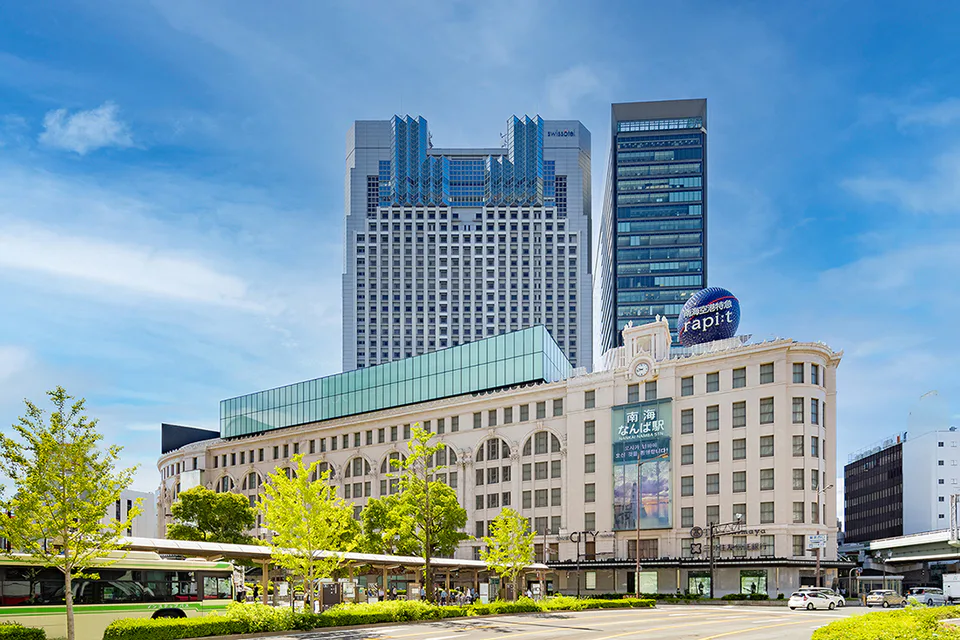
A Namba move is strongest when it performs at least two jobs. For example, your final evening is already Dotonbori or Shinsaibashi, and the next morning you want a direct Nankai run to KIX. In that case the hotel move improves both sides of midnight.
It is also stronger with large luggage when the current base would require an early Metro or JR transfer before reaching the airport railway. Removing one pre-dawn platform change can be more valuable than shaving ten minutes from the train itself.
But Namba should not become the whole-trip base just because KIX appears twice on the itinerary. If most ordinary days are Kyoto, Kobe or Himeji trips from Osaka Station, Namba vs Umeda should still be decided by the repeated days. KIX normally deserves influence over the first or last night, not automatic control over five nights.
Swissôtel Nankai Osaka is the clearest station-adjacency example when Namba itself also suits the final evening.
Swissôtel is useful because it removes the Namba last mile—not because every early flight needs a luxury hotel
Swissôtel Nankai Osaka sits above Nankai Namba Station. Its practical premium is therefore easy to define: it reduces the hotel-to-platform uncertainty on the final morning. For two travellers with large suitcases, older parents or anyone who dislikes navigating an unfamiliar station before dawn, that can be worth paying for.
The boundary condition is equally clear. If the first Namba train is already too late for your flight, being directly above the station does not rescue the plan. And if your final evening is in Umeda and the flight has a comfortable later departure, moving south only to sleep above Nankai can cost more trip time than it saves.
For the room-level trade-offs, use the Swissôtel Nankai Osaka airport-access guide. The hotel should solve a station-friction problem; the brand name alone is not the reason to move.
Rinku Town is not just a cheaper airport hotel area—it moves the transport boundary earlier
Rinku Town becomes strategically different when Namba’s first train does not provide enough margin. KIX’s current late-night/early-morning access page lists buses from Rinku Town at 03:30, reaching Terminal 1 at 03:41, and another at 04:35, reaching Terminal 1 at 04:46 and Terminal 2 at 04:55.
That is the important distinction: Rinku is not merely “closer to the airport.” It has published early road access that operates before a traveller leaving Namba on the first 05:15 Airport Express could arrive at KIX.
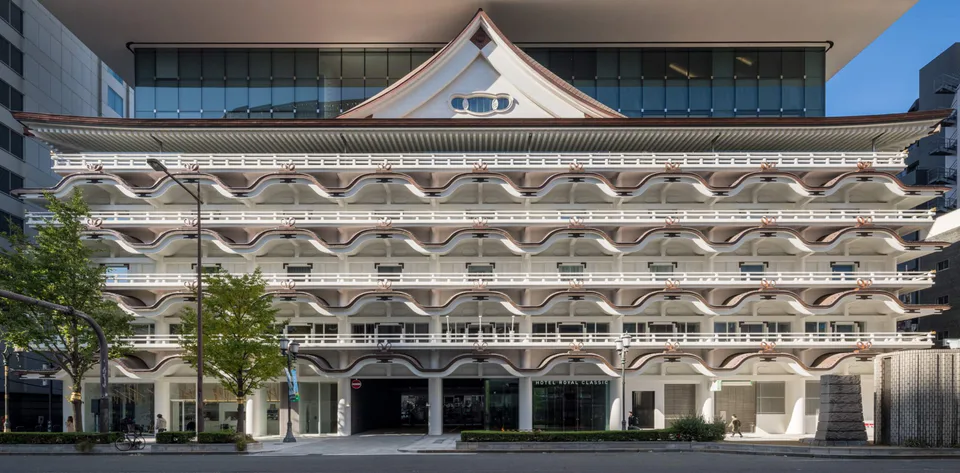
Use Rinku when the flight is early enough that Namba remains marginal but you still want a normal off-airport hotel area. The trade-off is that you have already surrendered the final Osaka evening as a city-base night, and you still depend on a short airport transfer the next morning.
KIX island is the maximum-certainty option—but Terminal 2 still matters
For the shortest possible pre-flight chain, stay on the airport island. Hotel Nikko Kansai Airport is in Aeroplaza and is directly connected by pedestrian routes to Terminal 1 and Kansai Airport Station. That removes the city railway, traffic and early transfer from the final morning.
Terminal 2 is still different. Even from Aeroplaza, KIX directs Terminal 2 passengers to the free shuttle. So an airport-island hotel does not turn T2 into “walk straight downstairs to the gate.” It simply removes the much larger Osaka-to-airport leg.
This option is strongest when a missed train would have serious consequences, the pre-flight night is very short, the group has heavy luggage or the airline requires an airport arrival time that city rail cannot support comfortably. It is weaker when the flight is late enough that Namba works easily and your final Osaka evening still has real value.
For a late KIX arrival, compare the Namba train with the Umeda late bus
Nankai’s current Kansai Airport timetable lists a final Airport Express at 23:55 for Namba, arriving at about 00:39. That can make a late city transfer entirely reasonable—but only if you are already through immigration, baggage claim and customs with enough margin to board calmly.
There is now a second city endpoint that materially changes the decision. From March 29, 2026, KIX’s official late-night access page lists a limousine bus leaving Terminal 2 at 00:02 and Terminal 1 at 00:15, reaching Hankyu Sanbangai by Osaka Station at 01:13. If your hotel is genuinely in Umeda, this can be better than racing for Namba and then making another late transfer north.
The terminal changes the value again. Terminal 2 has no rail station, so a direct T2 bus at 00:02 may be operationally cleaner than taking the inter-terminal shuttle to Aeroplaza and then trying to build a rail journey. Terminal 1 passengers, meanwhile, may still have the 00:15 Umeda bus after the 23:55 Nankai departure has ceased to be realistic.
Do not turn the Umeda bus into a new universal safety net. A scheduled 22:45 landing is not evidence that you will be at the bus stop by 00:15. Taxiing, immigration, checked luggage and walking can consume the buffer. The decision still happens landside with your bags.
Also note the asymmetry: KIX currently marks the late-night/early-morning Namba limousine-bus service as suspended. So a traveller whose real base is Namba should not assume there is a road backup identical to Umeda’s current direct late service.
The practical late-arrival order is therefore: choose the useful endpoint first. Namba base + comfortable 23:55 train → go to Namba. Umeda base + comfortable 00:02/00:15 bus → go directly to Umeda. Neither service has a real margin → stay on the airport side rather than creating an improvised 01:00 transfer chain.
Count hand-offs when travelling with children, parents or several large bags
Airport transfers look deceptively simple on a route map because every transfer is represented by a small dot. For a family, each dot can mean waking a child, unloading bags, finding an elevator and rebuilding the group on another platform.
Count the whole chain:
checkout and hotel-to-station walk;
Metro or JR transfer if the hotel is not already on the airport corridor;
Nankai, limousine bus or another airport service;
Kansai Airport Station to the correct terminal when using rail;
Terminal 2 shuttle if required by the chosen rail/hotel route.
The more hand-offs in that chain, the more rational it becomes to pay for a last-night location that deletes one. This is also why a move that looks wasteful for a solo traveller can be sensible for four people with two children and four large cases.
A last-night hotel move should pass a two-job test
I would not change hotels merely to save a small number of minutes the next morning. A strong last-night move should normally do at least two useful jobs:
remove a major transfer or ugly first-mile;
create a meaningful aviation buffer;
and ideally also put the final evening somewhere you actually want to be.
Umeda → Namba can pass when the final night is already in Minami and the Nankai departure meaningfully improves the morning. It fails when the only gain is a slightly shorter airport trip but you sacrifice half an afternoon to packing, storage and check-in.
Namba → Rinku can pass when the first Namba train is not early enough. Rinku → KIX island can pass when even the Rinku transfer leaves too much operational risk. The correct move is therefore not “closer is always better”; it is move only until the hard constraint is comfortably solved.
OMO7 and Shin-Imamiya are a middle-city solution, not an airport substitute
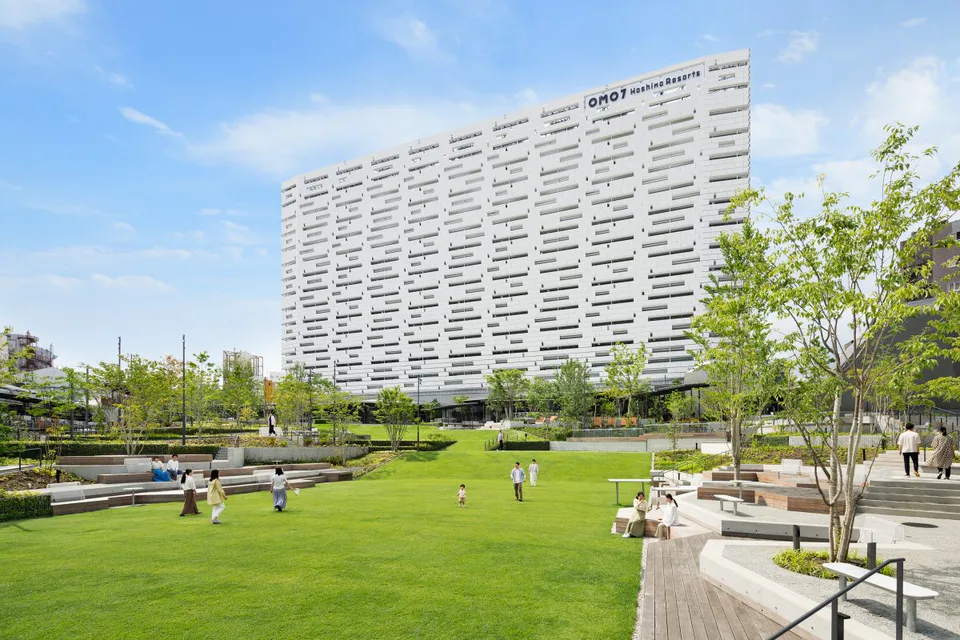
Shin-Imamiya can reduce some Namba-area friction because Nankai airport services also use the corridor, and OMO7 Osaka is directly in front of the station. It can be a good answer when the hotel experience itself—Miya-green, public spaces and the bath—will still be used.
But a flight schedule can delete those benefits. If you arrive near midnight and leave before dawn, the hotel is functioning mainly as a bed beside the line. In that case compare the final price with a simpler station hotel, Rinku or the airport island rather than paying automatically for facilities you will not consume.
Shin-Imamiya is useful when it also fits the Osaka stay; it is not a replacement for Rinku or an airport-island hotel when city rail is too late.
Five examples that show when the answer reverses
Example 1: 10:30 Terminal 1 international flight, four nights in Namba. If the airline’s required arrival time leaves a comfortable margin from the first trains, keep the Namba hotel. Moving to Rinku creates an extra hotel change without solving a real problem.
Example 2: very early Terminal 2 flight. Work backward from the airline’s target, then add the T2 shuttle after Kansai Airport Station. If Namba’s 05:15 first Airport Express is already too late, moving from Umeda to Namba is not enough. Rinku or the airport island becomes the relevant comparison.
Example 3: late arrival, five-night Namba stay. If you are landside with bags in time to catch the 23:55 Airport Express comfortably, go to Namba and finish the move once. If the final service has become a sprint, sleep airport-side and protect the first night instead.
Example 4: late arrival, five-night Umeda stay. If you miss the useful Namba rail window but are comfortably in time for the current 00:15 Terminal 1 / 00:02 Terminal 2 direct bus, go to Umeda rather than moving the first night to Namba and changing hotels again. If that bus is also tight, use the airport side.
Example 5: family based in Umeda for Kyoto and Kobe day trips, moderately early KIX departure. Do not move the whole stay to Namba for one airport morning. Either keep Umeda if the airport plan is robust, or move only the final night if that move deletes a real transfer and the family can handle the hotel change more easily than the early commute.
Final verdict: move only as far toward KIX as the flight actually requires
Keep your normal Osaka base when it already reaches the correct terminal with a comfortable buffer. Move to Namba or Shin-Imamiya when deleting the first city transfer materially improves the morning and the first Nankai service is still early enough. Move to Rinku Town when Namba’s first train is the hard limit; current early buses make Rinku operationally different from central Osaka. Stay on the KIX island when the pre-flight chain needs maximum certainty or the night is so short that another airport transfer has little upside.
For late arrivals, do not assume “Osaka” means one final service. Namba currently has the 23:55 Airport Express, while Umeda has a direct late limousine bus from T2 00:02 / T1 00:15 to Osaka Station at 01:13. Choose the endpoint that matches the hotel you actually intend to keep. If neither service has a comfortable margin, sleep airport-side.
The most important correction is simple: the 34-minute Rapi:t headline does not decide a very early flight, “KIX Station” does not mean the same thing for Terminal 1 and Terminal 2, and the last train to one Osaka district is not the last useful city connection to every Osaka district. Work backward from the flight, terminal and first/last usable service. Only then decide whether changing hotels buys enough risk reduction to justify losing part of the final Osaka day.
Okinawa Guys’ Trip Hotels: The Best Base Is Where You Can Stop Driving at Night
Sapporo Hotels for Couples: Choose the View, Bath or Winter Convenience You’ll Actually Use
Ryukyu Hotel & Resort Nashiro Beach: Is the Last Night by the Sea Worth Moving Hotels?
Osaka Kuromon Market Food Tour 2026: You’re Paying for a Guide, Not the Food
References
Nankai Electric Railway — current Namba/Kansai Airport timetable and train types · Kansai International Airport — Terminal 2 shuttle · Kansai International Airport — late-night and early-morning access · Kansai International Airport — rail access and terminal connection · Hotel Nikko Kansai Airport — airport-island access. Checked August 25, 2026. Train and bus schedules, terminal assignments and airline check-in requirements can change; verify the exact travel date and flight before committing to the final-night move.