
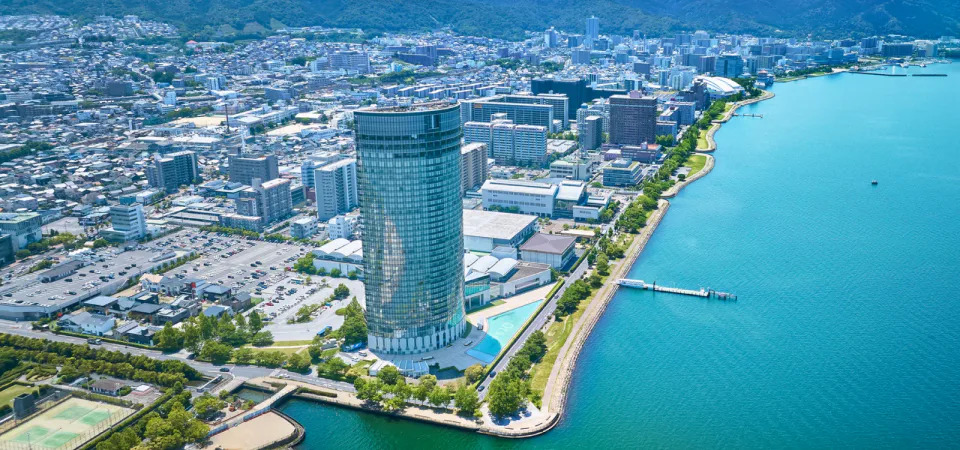

Lake Biwa Otsu Prince Hotel is worth leaving central Kyoto for when the hotel is buying you something you will repeatedly use: a genuinely larger room, a Lake Biwa view from every guest room, a quieter lakeside evening, or a Shiga-focused day that starts from the lake rather than Kyoto. It is a weaker choice when most of your waking hours are still in Kyoto. The headline “Kyoto to Otsu in about 10 minutes” is true at station level, but the hotel itself is another roughly 10-minute shuttle or taxi ride from JR Otsu Station. That last mile is paid again every time you go back into Kyoto.
For two travellers with large luggage, the 36.2 m² standard rooms are a real comfort advantage. For four travellers, the same published area needs more scrutiny: the Lake Floor Twin uses two regular beds plus up to two extra beds. If four people want a room that still functions as living space rather than simply sleeping capacity, the 59.5 m² Japanese Modern category is the more meaningful space benchmark. The question is therefore not “Is 36.2 m² big?” but how many people, how many beds, how many nights, and how often will you leave the lake to return to Kyoto?
↔ Scroll table left or right
Your trip pattern | My call | Why | What reverses it |
Two adults, two large suitcases, one or two nights around Otsu/Lake Biwa | Strong fit | 36.2 m² plus lake view solves a real room-space problem | You will spend almost every useful hour back in Kyoto |
Family of four using a 36.2 m² Twin | Conditional | Official capacity is four, but the room becomes two regular beds plus two extra beds | You need genuine common floor space; compare the 59.5 m² category |
Kyoto sightseeing on two consecutive full days | Usually stay in Kyoto instead | Every Kyoto day repeats the hotel–Otsu Station shuttle at both ends | The room-size or lake-view premium is itself a major part of the trip |
One Shiga day + one Kyoto day | Much stronger | The hotel now works as a true regional base instead of a remote Kyoto bedroom | Your Shiga sights are actually easier from another station or town |
Late arrival + early departure | Weak fit | You pay the shuttle dependency while barely using the lake, room or hotel | A specific event or family-room need outweighs the transfer cost |
The biggest planning mistake is calling this a “10-minute-from-Kyoto hotel”
The hotel’s official access page says Kyoto Station to Otsu Station takes about 10 minutes on the JR Biwako Line. It also says Otsu Station to the hotel takes about 10 minutes by free shuttle bus or taxi. Those two facts should not be collapsed into one neat “20-minute” promise.
Door to door, you still have to leave the Kyoto platform, wait for the train, reach Otsu, exit the station, find the shuttle, wait for its departure, ride to the hotel and then reach the room. On the return, the same sequence runs in reverse. The train is frequent enough that the rail leg is not the main problem; the hotel-specific last mile is.
This matters because a hotel base is paid for repeatedly. One Kyoto day creates two hotel–station shuttle decisions: one in the morning and one at night. Two full Kyoto days create four. A family with a stroller, an older traveller or two large suitcases feels that dependency more sharply than a couple travelling light.
My rule is simple: do not choose Lake Biwa Otsu Prince merely because Otsu Station is close to Kyoto Station. Choose it because the hotel or Shiga side of the itinerary is doing enough work to justify the extra last mile.
When the shuttle premium is worth paying
The shuttle is easiest to justify when it replaces a worse compromise rather than creating a daily chore.
Two adults with substantial luggage: one shuttle transfer on arrival can be a fair price for a 36.2 m² room that is much easier to live in than a compact central-city room.
A family using the hotel itself: lake views, a larger room, on-site dining and seasonal facilities can make the property part of the holiday rather than only a place to sleep.
A Shiga-focused day: if Lake Biwa, Otsu or another east-of-Kyoto stop is part of the itinerary, the hotel stops fighting the geography.
A deliberate decompression night: after several dense Kyoto days, one lakeside night can buy a different evening and morning rather than another hotel in the same urban rhythm.
The same shuttle is hard to defend when you leave immediately after breakfast, spend the entire day in Kyoto, return after dinner and repeat the process the next morning. In that schedule, the room is large but the base is operationally misaligned.
For four guests, 36.2 m² is capacity—not automatically spaciousness
The official Lake Floor Twin is 36.2 m², has a maximum occupancy of four, and starts with two 110 × 203 cm beds. When four people occupy the room, up to two extra beds measuring 97 × 188 cm are added. The Sky Floor Twin uses the same 36.2 m² footprint and can also accommodate up to four in applicable rooms.
That produces an important distinction between published room area and usable free floor after bedding is deployed. At four-person occupancy, 36.2 m² works out to 9.05 m² of gross published area per guest. That is not a usable-floor measurement, but it is a useful warning against comparing the room with a two-person 36.2 m² stay as though the experience were identical.
The 59.5 m² Lake Floor Japanese Modern room also accommodates four and uses two regular beds plus up to two extra beds. Published area is therefore 23.3 m² larger—about 64% more floor area on paper than the 36.2 m² Twin. At four-person occupancy, that is roughly 14.9 m² of gross published area per guest instead of 9.05 m².
Those figures do not tell you exactly where every suitcase will sit. They do tell you when the upgrade question should change. If four people are staying one night and mostly sleeping, the 36.2 m² Twin may be perfectly rational. If four people are staying two or three nights, opening several suitcases, using extra beds and expecting real common space, the 59.5 m² category is the more relevant comparison than simply moving to a higher floor.
Higher floor does not automatically mean a bigger or better family room
The hotel’s room hierarchy is easy to misread because floor, view, design and capacity do not rise together.
↔ Scroll table left or right
Room type | Published area / capacity | What the premium mainly buys |
Lake Floor Twin | 36.2 m² / up to 4 | Large baseline room and lake view |
Sky Floor Twin | 36.2 m² / up to 4 in applicable rooms | Higher floor, design and outlook—not more area |
EIZAN Floor Twin | 36.2 m² / 2 | High-floor design and atmosphere; it is not a four-person upgrade |
Lake Floor Japanese Modern | 59.5 m² / up to 4 | Actual space increase for a family/group |
Every room already faces Lake Biwa according to the hotel. That makes the usual “upgrade to get any view at all” logic much weaker here. If two people are satisfied with the Lake Floor outlook, a higher-floor premium should be justified by how much you value elevation, design and the more panoramic feel—not by an assumption that the lower floors have no lake view.
For a family of four, the upgrade order should usually be bed layout and usable area first, floor prestige second. A 59.5 m² lower-floor room can solve a more important problem than a 36.2 m² premium-floor room that does not even accept the same party size.
One night works only when the evening or morning is genuinely lakeside
A one-night move has a high burden of proof because you pay checkout, luggage movement, another check-in and then another departure almost immediately.
I would use one night here when it buys a scarce window that central Kyoto cannot give you: an evening by Lake Biwa, an event in Otsu, a family reset in a larger room, or a Shiga morning that would otherwise require backtracking from Kyoto.
I would not move here for a schedule such as Kyoto sightseeing until 20:00 → hotel at 21:00 → sleep → leave for Kyoto again at 08:00. In that version, the hotel’s strongest assets—view, space and lakeside location—barely enter the trip. The shuttle remains, but the payoff disappears.
The useful test is to count awake hotel/lake windows. Arrival afternoon, sunset, dinner, a relaxed morning, a lake walk or a slow breakfast are separate windows. If your one-night schedule contains two or three of them, the move can earn its keep. If it contains only sleep, stay closer to the transport you actually use.
Two nights are stronger when at least one full day belongs to Shiga
Two nights remove the “move hotel for one sleep” problem, but they do not automatically make this a good Kyoto base. The decisive question is what happens between those nights.
Strong two-night pattern: arrival and lake evening → one Shiga/Lake Biwa day → second relaxed night → Kyoto or onward travel. The hotel is aligned with both accommodation and sightseeing.
Acceptable mixed pattern: one Kyoto day and one Shiga-oriented day. You pay the shuttle dependency once for the Kyoto excursion, but you also use the hotel’s location for another part of the trip.
Weak two-night pattern: Kyoto both days, hotel only for sleeping. You have effectively chosen a remote Kyoto hotel with larger rooms. That can still be rational if the family-room saving is substantial, but the price comparison must include time and shuttle friction rather than room rate alone.
The Kyoto Station luggage counter can change arrival-day friction—but check the current charge
Prince currently operates a Welcome Counter beside Kyoto Station’s Shinkansen Hachijo Gate for guests of Lake Biwa Otsu Prince Hotel and Prince Kyoto Takaragaike. The official page lists operating hours of 09:00–12:30 and 13:30–18:00, with hotel-delivery luggage accepted until 14:00 on the arrival date.
This can materially improve a Shinkansen arrival: leave an eligible closed suitcase at Kyoto Station, sightsee in Kyoto without dragging it around, then reach Otsu later. It does not remove the hotel shuttle, but it changes the arrival-day burden.
There is one reason to verify before relying on it: the current official page contains both a notice saying a ¥500-per-item fee was introduced from April 2025 and older wording elsewhere on the same page describing the service as free. Treat the service itself as current, but confirm the actual charge and acceptance conditions for your date rather than copying an old “free delivery” claim.
Summer pool value is date-specific—and currently not included automatically
For 2026, the hotel’s official pool page lists the outdoor pool season from July 18 to September 23, with September operation limited to specified weekends/holiday dates. Standard overnight guests currently pay ¥3,000 per adult and ¥1,500 per child aged 4–12 unless a qualifying membership or package changes the charge.
That matters because a family can easily overvalue a resort pool by assuming “hotel pool” means free and always open. If your stay is outside the operating dates, remove the pool entirely from the comparison. If the pool is central to the booking, add the family’s actual admission cost to the room total before deciding whether the lakeside premium is worth it.
Drivers solve the shuttle problem but create a different comparison
A car removes dependence on the Otsu Station shuttle, which makes the hotel easier to use for a Shiga road trip. It does not automatically make the property a good base for central Kyoto. Driving into Kyoto introduces parking, traffic and destination-specific restrictions that can be less attractive than rail.
For drivers, I would value the hotel most when the next day continues around Lake Biwa or deeper into Shiga. For a Kyoto-heavy trip, the car does not magically turn Nionohama into a central Kyoto address.
Who should deliberately choose this over a central Kyoto hotel?
Choose Lake Biwa Otsu Prince Hotel when: two adults want substantially more room than a compact Kyoto stay; a family needs a four-person room and values hotel space; a lake view is part of the experience; at least one day belongs to Shiga; or the trip deliberately includes a slower lakeside night.
Choose Kyoto instead when: both mornings and both evenings are in Kyoto, you need to return to the hotel during the day, your next two days begin around Kyoto Station/Higashiyama/Arashiyama, or you dislike fixed shuttle dependencies.
Choose a hotel near JR Otsu Station instead when: you want Otsu as the base but value rail simplicity more than lakefront space and resort facilities. That is the missing third option in a false “Kyoto hotel vs Otsu Prince” comparison.
Before paying, compare the exact product—not just “lake view”
Because every room is already lake-facing, compare the dimensions that genuinely change the stay: number of permanent beds, extra-bed use, published floor area, maximum occupancy, floor, cancellation terms, breakfast and whether the family will actually use seasonal facilities.
For four people, do not compare a 36.2 m² four-bed configuration against a two-person Kyoto room and conclude that the Otsu room is automatically spacious. Compare it against another legal four-person configuration. For two people, the 36.2 m² baseline is much more obviously a space advantage.
Check Lake Biwa Otsu Prince Hotel room types on Trip.com
Compare the same dates and room setup on Booking.com
Final verdict: buy the room and lake—not the “10 minutes from Kyoto” headline
I would choose Lake Biwa Otsu Prince Hotel for two adults with luggage, a family that genuinely benefits from larger rooms, or a trip where at least one meaningful block belongs to Lake Biwa/Shiga. I would not use it as a default cheaper substitute for central Kyoto when both days still revolve around Kyoto. The station-to-station train is fast; the repeated hotel shuttle is what changes the base decision.
For two guests, 36.2 m² plus a lake view can make the extra transfer worthwhile. For four guests, check the two-extra-bed geometry before calling that same room spacious; the 59.5 m² Japanese Modern category is the more honest upgrade when common space matters. And if a higher floor is the only thing changing, remember that every room already faces the lake: pay for elevation because you value elevation, not because you think the cheaper room has no view.
References
Lake Biwa Otsu Prince Hotel — official access and shuttle guidance · official guest-room overview · Lake Floor Twin specifications · Lake Floor Japanese Modern specifications · Kyoto Station Welcome Counter · 2026 outdoor-pool operation. Checked August 25, 2026. Shuttle schedules, pool operation, room inventory and luggage-counter conditions can change; verify the actual travel date.