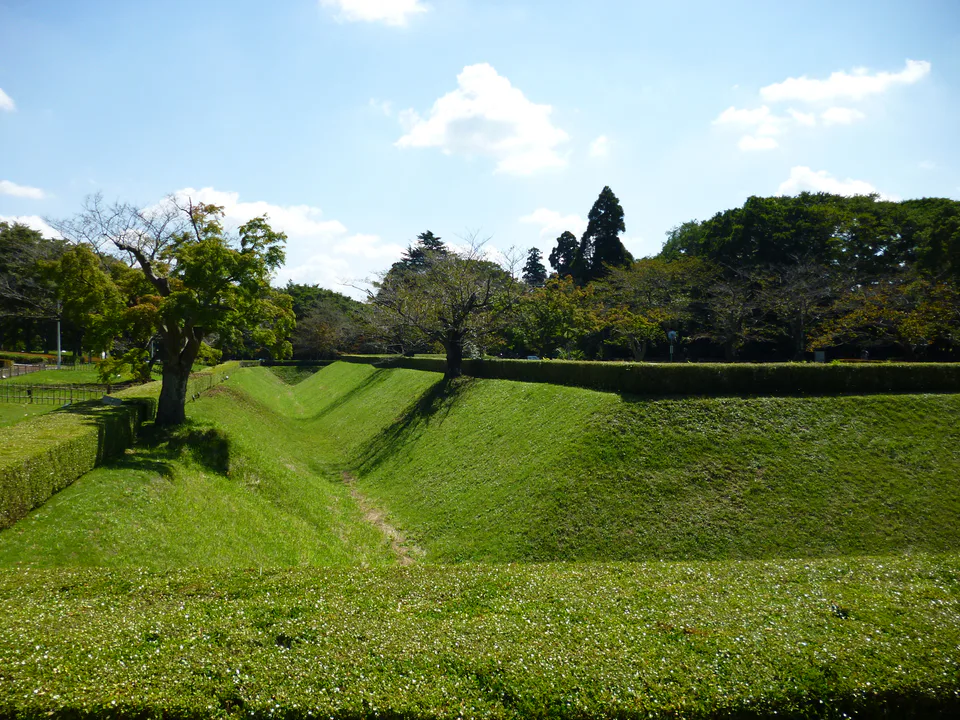
Sakura Castle is an easy place to misjudge because the most convenient thing about it — a Japan 100 Famous Castles stamp available 24 hours a day — is not the reason to travel from Tokyo. The reason to go is the surviving earthwork layout: the large umadashi dry moat, deep cuts in the plateau, honmaru and outworks. If those features sound abstract rather than exciting, Sakura is better treated as a stamp stop or paired with the National Museum of Japanese History than as a stand-alone Tokyo day trip.
ValueNavi verdict: first-time Tokyo visitors with only one spare excursion should usually skip Sakura unless they collect castle stamps or actively enjoy earthwork castles. Castle specialists should do the opposite: arrive in daylight, give the ruins 60–90 minutes, and decide separately whether the museum deserves another few hours. The 24-hour stamp solves a logistics problem; it does not turn the ruins into a 24-hour attraction.
Choose the trip before you choose the train
↔ Scroll table left or right
Your actual goal | Best plan | Why | What you give up |
100 Famous Castles stamp only | Go straight to the Sakura Castle Ruins Park management centre | The outdoor stamp is available 365 days, 24 hours | You miss the reason Sakura is historically interesting if you leave immediately |
First castle-focused visit | Management centre → large umadashi → honmaru → one southern/western outwork | This sequence shows entrance defence, core enclosure and outer defence without chasing every marker | A 60–90 minute route is selective rather than comprehensive |
Japanese-history day | Ruins plus the National Museum of Japanese History | The museum gives far broader historical context than a castle-only interpretation centre | The real cost is several hours of scarce trip time, not the ¥900 admission |
Short first Tokyo trip | Skip unless the stamp or earthworks are a priority | The rail ride plus final 20–25 minute approach creates a large opportunity cost | You give up a specialist site, not a universal Tokyo essential |
Already travelling through Chiba / Narita | Consider Sakura as a route-fit stop | The detour can be more rational when you are already east of central Tokyo | Luggage storage and the wrong rail branch can erase the apparent convenience |
ValueNavi Score: excellent stamp resilience, only moderate first-trip efficiency
This score uses the same seven 10-point dimensions across ValueNavi attraction decisions. Higher is better. “Booking / access resilience” and “weather resilience” are deliberately positive scores: 10 means the visit is hard to derail, not high risk. The overall score is an editorial planning tool, not an official rating.
↔ Scroll table left or right
Dimension | Score | Reason |
Money value | 9.2/10 | The castle park is free; the optional national museum is ¥900 (about US$5.65 at the 27 Aug 2026 reference rate) |
Time efficiency | 6.0/10 | Reasonable once in Sakura, but a Tokyo-origin visit carries rail time plus the final walk or bus |
Booking / access resilience | 10.0/10 | The outdoor castle stamp is available 24/7; no timed castle ticket is required |
Weather resilience | 5.5/10 | The defining features are outdoor earthworks; rain makes slopes and wooded sections less pleasant |
Crowd resilience | 8.0/10 | The large park disperses visitors, although blossom and iris seasons put pressure on roads and parking |
Route fit | 6.5/10 from central Tokyo; 8.5/10 on a Chiba/Narita day | The answer changes more with itinerary direction than with ticket price |
Uniqueness | 8.2/10 | A legible earthwork castle beside a major national history museum is a distinctive combination |
Overall planning score: 7.6/10. That number should not be read as “Sakura is a 7.6/10 attraction for everyone.” Its route-fit score changes sharply by itinerary. A stamp collector passing through Chiba can rationally rate the same stop much higher than a first-time visitor sacrificing half a Tokyo day.
The stamp is genuinely 24/7 — but daylight still matters
Sakura City keeps the official Japan 100 Famous Castles stamp at the management centre on the eastern side of Sakura Castle Ruins Park. There is an indoor stamp and an outdoor stamp stand at the entrance; the outdoor one is available 365 days a year, 24 hours a day. The management-centre building itself keeps normal daytime hours, so separate “stamp access” from “building access” in your plan.
The failure mode is obvious once you separate those two facts: a late arrival may still complete the stamp but get very little from the castle. Sakura’s deep dry moats, wooded slopes and changes in ground level are much easier to read in daylight. Use the 24-hour arrangement as schedule insurance, not as a recommendation for a night walk.
If there is no keep, what should you actually look at?
Sakura works best when you stop asking “where is the main building?” and instead read three defensive ideas. First, the large umadashi around the Shiinoki Gate area shows how an entrance could be protected by forcing and controlling movement. Second, the honmaru gives you the core enclosure. Third, the southern or western outworks show how water, moat lines and the edge of the plateau extend the defence beyond the centre.
That makes a short visit more useful than a monument-collecting walk. If you have only 60–90 minutes, management centre → large umadashi → honmaru → one outwork is a better information route than trying to touch every named point. Sakura City does not publish a promise that this is an official 60-minute course; it is a ValueNavi time-budget framework built around the features that most change your understanding of the site.
Keisei Sakura or JR Sakura? Choose by the rest of the day, not a five-minute walking difference
Sakura City lists the castle at about 20 minutes on foot from Keisei Sakura Station and about 25 minutes from JR Sakura Station. Buses from both sides can reduce the final walk, with stops near the National Museum of Japanese History followed by roughly five minutes on foot.
Five minutes is too small a difference to choose your entire railway plan around. Keisei Sakura is usually the cleaner fit if your wider route already uses Keisei services or continues toward the Narita side. JR Sakura is the more natural fit when your day is anchored to Tokyo Station and the Sobu corridor. The hidden cost is changing rail systems merely to save a few minutes at the end.
If you have large luggage, recalculate the stop from door to door. “Sakura is on the way to Narita” can be true on a map and still be a bad travel day if you add baggage storage, a station change and a return to the wrong line. Route fit is the decision; the castle admission price is not.
Is the National Museum of Japanese History worth ¥900? The ticket is cheap; the time is expensive
From 17 March 2026, general adult admission to the National Museum of Japanese History is ¥900, roughly US$5.65 at the 27 August 2026 reference exchange rate; university admission is ¥500. Exchange rates move, so the US-dollar figure is only orientation. From March through September the museum opens 09:30–17:00 with final admission at 16:30; from October through February it closes at 16:30 with final admission at 16:00. Mondays and published maintenance closures still matter.
At this price, “is ¥900 worth it?” is almost the wrong question. The museum is a major institution covering Japanese history, archaeology and folk culture, not a small Sakura Castle gallery. If those subjects are a core interest, adding it can turn Sakura into a strong history half-day. If you only want the castle stamp and earthworks, forcing in the museum because it is next door can consume the time you were trying to save.
Decision rule: add the museum because you want a national history museum, not because you are afraid the castle visit is incomplete without it.
The easiest navigation mistake is going to Moto-Sakura Castle instead
Sakura Castle and Moto-Sakura Castle are different historic sites in Chiba, and the latter belongs to the Continued 100 Famous Castles rather than the original 100. Autocomplete, copied Japanese names and similarly worded search results make this a real failure mode. For this article, save “Sakura Castle Ruins Park” or the Sakura Castle management centre before travelling; do not rely on typing “Sakura castle” at the last minute.
Season changes the companion value more than the castle value
Sakura Castle Ruins Park has cherry trees, iris, plum, peony and autumn colour. These make the park easier to sell to a companion who does not care about castle earthworks. They also change transport friction: Sakura City specifically warns that parking can fill and surrounding roads can become congested during cherry-blossom and iris seasons, when public transport becomes the more resilient choice.
But flowers do not change what kind of castle this is. If you want a surviving keep, ornate interior or skyline viewpoint, spring blossom does not fix that mismatch. If you already like terrain and moats, blossom is a bonus rather than the justification.
Final verdict: specialist detour from Tokyo, strong fit on the right Chiba day
Sakura Castle is most convincing when three things line up: you enjoy earthwork castles, you value the 100 Famous Castles stamp, or your route already passes through Chiba. Its unusually resilient 24-hour stamp makes collecting easy, but the castle itself deserves daylight and attention to the ground rather than the absent architecture.
The red-team case is a first-time Tokyo visitor with one free excursion and no particular interest in castle archaeology. For that traveller, Sakura’s free admission does not make it low-cost: the opportunity cost is the half-day. In that situation I would skip it. For a collector or history traveller who also wants the National Museum of Japanese History, the answer reverses and Sakura becomes one of the more efficient specialist history combinations east of Tokyo.
Official facts to recheck before travel
Time-sensitive details in this guide were checked against Sakura City’s 100 Famous Castles stamp page, Sakura Castle Ruins Park access information, and the National Museum of Japanese History’s current hours and admission page. Recheck them for closures, events and transport changes immediately before visiting.