Yame is worth a dedicated day from Fukuoka when tea is one of the reasons you are travelling—not when you simply want to buy good matcha or gyokuro. For a first visit, choose one anchor: Hoshino Tea Culture Museum for tasting and hands-on tea, Yame Central Grand Tea Plantation for landscape, or a confirmed factory visit for production. With a car, two anchors can make a coherent full day. Without one, trying to “cover Yame” often produces more transport than tea.
The hidden cost is geography. Yame is not one walkable tea district around a station; the municipality stretches from central areas into mountain villages such as Hoshino. A JPY 1,000 workshop (about US$6.30) can therefore have a much larger door-to-door cost than its ticket suggests. The useful question is not “which activity is cheapest?” but how many distinct tea experiences will this travel day actually return?
ValueNavi decision table: what are you actually going to Yame for?
↔ Scroll table left or right
Real goal | Start with | What it buys | What reverses the choice |
Taste premium gyokuro and learn preparation | Hoshino Tea Culture Museum | Tasting, food and several workshops in one place | The last-mile journey is too large for your available Fukuoka days |
Photograph a large tea landscape | Yame Central Grand Tea Plantation | About 70 hectares of hillside tea scenery | Rain, low visibility or no practical car/taxi plan |
Understand leaf processing | Confirmed factory tour | Production context rather than another tasting | Your date falls outside the visitor season or the factory itself is not operating |
Full day with rental car | One anchor + one supporting stop | Two genuinely different tea products | A third distant stop turns the day into a driving checklist |
No car | One area | More time tasting and learning, less timetable management | Pre-arranged taxi/private transport removes the last-mile constraint |
The ValueNavi Tea-Day Yield model
For Yame, I use a simple editorial metric:
Tea-Day Yield = distinct tea experiences actually used ÷ non-tea logistics blocks.
This is not an official tourism metric. It is a way to catch an itinerary that looks rich in map pins but poor in usable experience. Hoshino alone can return tasting + workshop + food/exhibits after one large access commitment. Plantation + Hoshino can work very well with a car because the driving unlocks two different products. Plantation + factory + Hoshino without a car can look “complete” while spending much of the day on connections.
The counter-intuitive result is important: removing a stop can increase the amount of tea you actually experience.
Hoshino is the strongest one-stop answer
Hoshino Tea Culture Museum currently opens from 10:00 to 17:00 with free general admission. Its strongest advantage is concentration: the same facility combines tea tasting, exhibits, a restaurant and hands-on options, so the long last mile can be amortised across several activities.
Current workshop examples include:
matcha grinding: JPY 1,000 (about US$6.30);
hojicha making: JPY 1,000 (about US$6.30);
blended hojicha: JPY 1,200 (about US$7.55);
hand-rolled green tea: JPY 2,000 (about US$12.60).
The hand-rolling session creates a hard scheduling edge because it is currently offered at 11:00 and 14:00 with capacity for eight people per session. If that is the reason you are travelling to Hoshino, build the day around the session rather than treating it as a walk-up extra.
Deeper experiences also have group rules. The museum currently lists advance-reservation programs such as tea-tasting competition and sencha brewing with minimum group sizes, while formal tea-ceremony plans require a larger group or minimum charge. Solo travellers and couples should therefore verify eligibility rather than assuming every item on the activity page is bookable individually.
The Grand Tea Plantation is a scenery purchase, not a tasting substitute
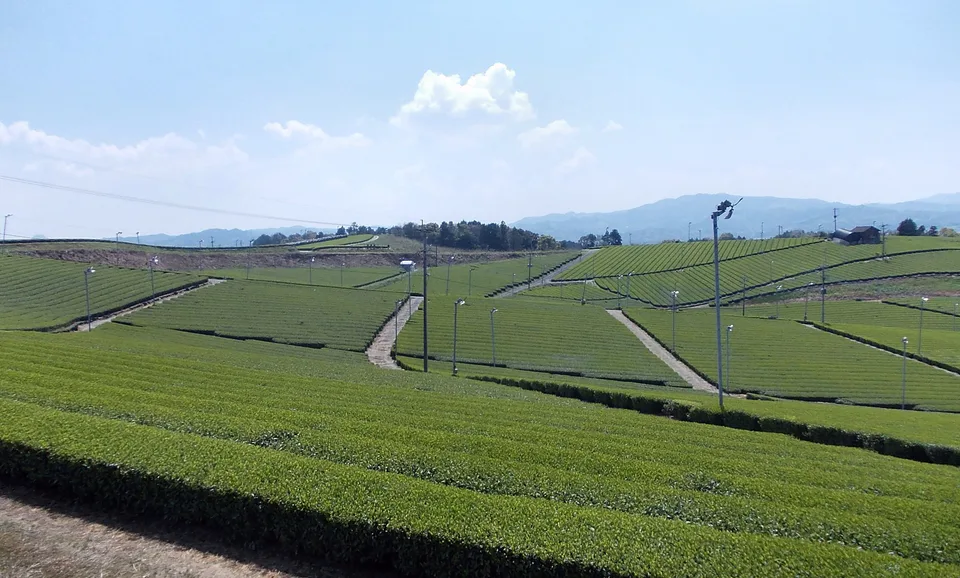
Yame Central Grand Tea Plantation covers roughly 70 hectares. Fukuoka’s official tourism information lists it as free, open all day and about 25 minutes by car from Yame IC. On a clear day, the view can extend toward the Ariake Sea and Shimabara Peninsula.
Its product is visual context: rows of tea, scale, geography and photography. The tourism authority particularly highlights April to mid-May around the new-tea season. That seasonal value should not be rewritten into a promise that tea-picking or new-tea events exist on every visit.
Use a weather red-team: if cloud or rain removes the panorama, would the journey still be worth making? If not, do not let the plantation be the only reason for a difficult no-car day.
A factory tour is only valuable if the factory product exists on your date
“Tea factory tour” is not a permanent year-round category. Ushijima Seicha, for example, currently suspends normal factory tours through the summer period to September 30 and offers a reservation-only indoor tea tasting instead. A 30–40 minute tasting is a legitimate product, but it is not the processing visit a traveller may think they booked.
There is another terminology trap: a tea factory is not automatically a matcha factory. Matcha requires tencha production and grinding. An operator may teach sencha processing without showing stone-ground matcha. If grinding matcha is the actual intent, Hoshino’s workshop is the cleaner fit.
True Time Cost: treat Yame as a day block, not an activity ticket
↔ Scroll table left or right
Version | Planning block | Why |
Central-Yame short tasting | Substantial half-day including access | The Fukuoka transfer remains material even when the tasting is short |
Hoshino as destination | Large half-day to full day | You need enough on-site depth to justify the last mile |
Plantation + Hoshino by car | Full day | Official model routes themselves contain several 15–25 minute road legs |
Three areas without a car | Usually reject | Waiting and last-mile movement start owning the day |
That last row is the important one. “Reachable” does not mean “good itinerary sequence.” If the official tourism model is car-based, a no-car version should usually be simplified instead of copied.
ValueNavi Score: which Yame product is most resilient?
Editorial score, not an official rating. 10 means lower friction or stronger usefulness for the named decision.
Dimension | Hoshino | Grand Plantation | Factory |
|---|---|---|---|
Money Cost | 9/10 | 7/10 | |
Time Cost | 6/10 car, 3/10 no car | 5/10 | |
Booking Risk | 10/10 | 4/10 | |
Weather Risk | 4/10 | 9/10 when indoor visit is confirmed | |
Crowd Risk | 8/10 | 8/10 | |
Route Fit from Fukuoka | 5/10 | 6/10 depending on site | |
Uniqueness | 8/10 | 9/10 when production is actually visible |
Do not average the rows blindly. Hoshino wins when weather resilience and concentration matter. The plantation can win on a clear driving day. A factory can be the most distinctive option when the production calendar actually aligns.
The no-car two-deletion rule
If your first draft contains Hoshino + plantation + factory, delete at least two before finalising public transport. That sounds severe, but it protects the actual purpose of the day. A one-area plan can include tasting, food and a workshop; a three-area plan can turn every tea experience into a rushed checkpoint.
If tea is a high priority, a pre-arranged taxi can make sense for two to four travellers. Treat the taxi as part of the experience price. Do not mentally price the day using only workshop fees and then pretend the last mile is free.
ValueNavi last-minute card
Is the exact activity running on your date? Factory visits and harvest events are seasonal.
Is your workshop bookable for your group size? Some Hoshino programs have minimums.
Would the plantation still be worth it in poor visibility? If not, keep it flexible.
Have you solved the last mile? Getting toward Yame does not automatically get you to Hoshino.
More than two areas without a car? Simplify before departure.
Final verdict
For a first specialist tea day, Hoshino is the most defensible default because it converts one difficult access commitment into several tea experiences. Choose the Grand Plantation when landscape is the priority and weather/transport are favourable. Choose a factory when production is the goal and the operator confirms a real visitor program for your date.
The recommendation reverses if tea is secondary. On a short first Fukuoka trip, buying excellent Yame tea in the city can be more rational than spending a full day on rural logistics. Yame earns the day when place + production + tasting are the product you actually want.
Official sources
Hoshino Tea Culture Museum — hours, workshops and reservations · Fukuoka Tourism — Yame Central Grand Tea Plantation · Visit Yame — access and transport
Seasonal programs, prices and operating days can change. USD conversions are approximate using the August 26, 2026 reference rate.