
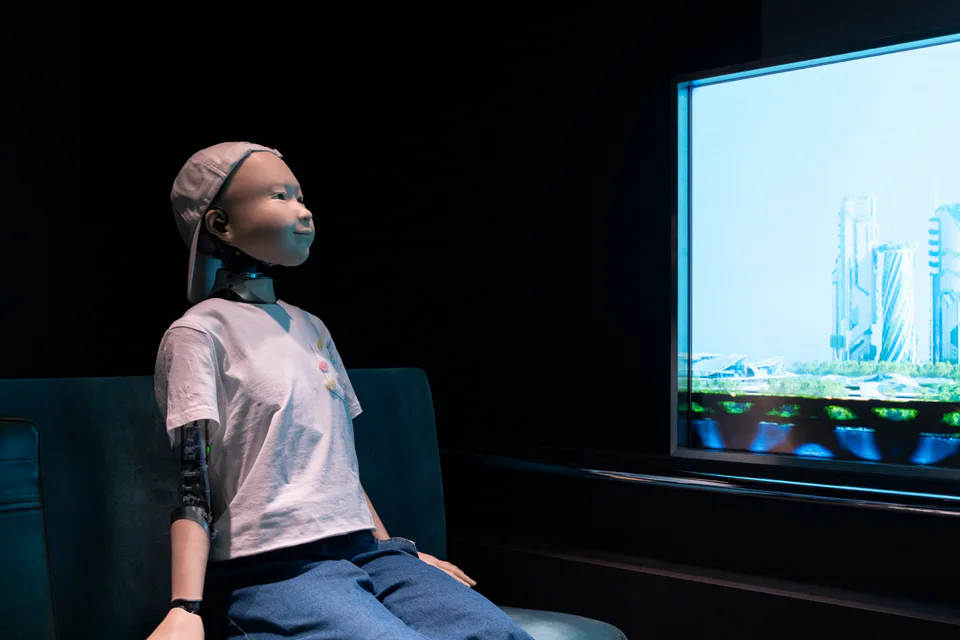
Takanawa Gateway is one of those Tokyo districts that can feel half like a destination and half like a preview of the future. In 2026 that changed quickly: MoN Takanawa opened in March, and on July 25 it added FUTURE OF LIFE+, a Tokyo reworking of Hiroshi Ishiguro’s signature pavilion from Expo 2025 Osaka, Kansai. The useful thing to know before booking is that this is not a conventional exhibition where you wander until you get tired. It is a roughly 45-minute, headphone-led narrative with timed entry, androids, theatre staging and a new scenario set 50 years beyond the Expo story.
That format makes it easy to place into a Tokyo day. Allow about an hour for the core experience including entry, then decide whether to stay for another MoN exhibition, add the separate Soseki Android 2.0 interaction, eat inside Takanawa Gateway City, or get back on the Yamanote Line.
This is a 45-minute staged experience, not a gallery you drift through
FUTURE OF LIFE+ asks the same large questions that drove Ishiguro’s Expo pavilion: what makes a human being human, and what happens to “life” when technology can extend presence beyond the body. The Takanawa version retains the android-driven narrative and futuristic staging, with characters including Yamatoroid and a future version of Momo, but it is not simply a transfer of the Osaka set.
The “plus” matters because Tokyo adds a new scenario set 50 years after the Expo, built around choices concerning the future of life. Returning Expo visitors therefore have a reason to see it again, while first-time visitors are not expected to know the Osaka pavilion scene by scene.
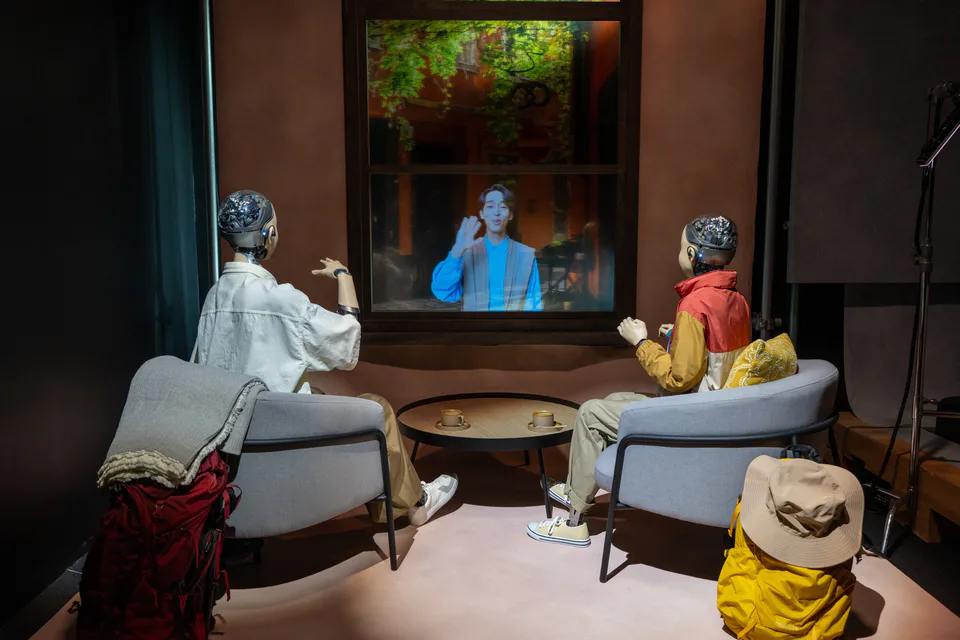
Official FUTURE OF LIFE+ exhibition image. ©FUTURE OF LIFE
The experience takes about 45 minutes and uses headphones. Admission is sold in 30-minute time slots, and several groups may move through the venue under staff guidance. Arriving late can mean waiting before admission, and the venue specifically advises using the restroom before putting on the headphones.
Pair this with: “Tokyo’s New YURAKUCHO MUSEUM Opens with Pingu: What’s Inside and How to Fit It into Ginza” for another newly opened 2026 exhibition space that works as a compact indoor stop.
The 10:00 slot is different if you need English audio
Regular sessions use Japanese audio with English text support. The 10:00 session is the exception: it is presented with English audio. For international visitors who want to follow the story primarily by listening, that is a functional language choice rather than merely an early start.
From Tokyo Station, Takanawa Gateway is about eight minutes by JR Keihin-Tohoku Line; from Shibuya about 14 minutes on the Yamanote Line, and from Shinjuku about 21 minutes. For the English-audio session, leave a buffer for the six-minute walk from Takanawa Gateway’s North Gate and for finding Box1000. Visitors comfortable with Japanese audio or English text support can use later slots and have much more flexibility.
Ticket prices reward a weekday more than an early queue
General advance tickets cost ¥3,500 on weekdays and ¥4,000 on weekends and public holidays. Same-day general tickets are ¥4,000 and ¥4,500 respectively. U25 admission is ¥2,500 regardless of day, junior-high-school age and younger is ¥1,500, and children aged three and under enter free. August 13 and 14 use weekend/holiday pricing even though they are weekdays.
Advance tickets through e+ and the MoN ticket service are generally sold until 6 p.m. the previous day. Fever continues sales until shortly before a session, subject to availability. Same-day tickets are sold at the first- and second-floor counters only when a session still has space.
Period 1 covers July 25 to August 17, with August 3 listed as an off-date. Period 2 runs August 19 to September 7 and goes on sale August 4. Period 3 runs September 9 to 25 and goes on sale August 27. A later date may therefore be unavailable simply because its sales window has not opened.
Takanawa Gateway is the six-minute approach; Sengakuji is even closer
MoN Takanawa is at 3-16-1 Mita, Minato-ku, inside TAKANAWA GATEWAY CITY. It is directly connected to JR Takanawa Gateway Station and about a six-minute walk from the North Gate. Sengakuji Station on the Toei Asakusa and Keikyu lines is about three minutes from Exit A4.
The station deck leads into the museum’s second-floor entrance lobby. MoN’s standard hours are 10:00 to 21:00, although programs, shops and restaurants keep their own hours; the rooftop Hanami Terrace, MoN Shrine and MoN Farm close at 20:00. That makes FUTURE OF LIFE+ easy to combine with an early dinner without inventing another cross-city attraction.
Wheelchair users can reach the museum from Takanawa Gateway via an accessible route. For FUTURE OF LIFE+ specifically, visitors who wish to view in a wheelchair or need an accompanying person are asked to contact the venue before buying tickets.
Soseki Android 2.0 is a separate conversation, with a separate ticket
The Soseki Android 2.0 interaction is not included in the 45-minute main experience. It needs a separate ¥1,000 ticket per slot, with one slot admitting one group of up to three people. The android, based on Natsume Soseki, uses updated AI to conduct autonomous dialogue and answer questions related to the writer.
Do not place the two bookings back to back. The museum asks visitors combining them to avoid Soseki slots within 60 minutes after the main admission time. If your FUTURE OF LIFE+ ticket is for 11:00, choose Soseki before 11:00 or at 12:00 or later.
Official FUTURE OF LIFE+ exhibition image. ©FUTURE OF LIFE
The venue also sells returning Expo merchandise and new Tokyo products. Adult T-shirts are ¥5,500, kids’ sizes ¥3,500, and the official illustrated catalogue ¥3,300. Stock can change, so merchandise works better as an optional final stop than as the anchor for a timed itinerary.
A second exhibition can make MoN a half-day destination
Visitors holding a same-day general ticket for FUTURE OF LIFE+ can currently receive ¥1,000 off “Guruguru Exhibition – The Ever-Evolving Story of Humanity.” Show the FUTURE OF LIFE+ ticket or purchase screen at the first- or second-floor counter.
The restriction is easy to miss: the discount applies to general tickets, not U25 or junior-high-and-younger tickets, and during the first sales period the discounted ticket is handled at the physical counter. For travellers already curious about MoN’s approach to technology and humanity, this creates a coherent half day. For someone mainly curious because the Expo pavilion came to Tokyo, the core experience plus a meal is probably enough.
Related guide: “Is Miraikan’s Grand Antarctica Exhibition Worth It? Real Ice, Meteorites and an Odaiba Plan” takes the opposite approach—physical science objects, real Antarctic ice and a larger Odaiba visit.
Why this works particularly well on a hot or wet Tokyo afternoon
Late July through September can make an outdoor Tokyo route feel much longer than it looks. FUTURE OF LIFE+ has unusually clear boundaries: a reserved entry slot, about 45 minutes indoors, and an immediate choice between staying in the complex or returning to the city. On a rainy or very hot day, that predictability is genuinely useful.
More to read: “Tokyo Rainy-Day Indoor Itinerary: Tokyo Station to Ginza Without Getting Soaked” is the stronger choice when weather, rather than one exhibition, is shaping the whole day.
There is an appealing time collision here. Inside Box1000, the story asks you to imagine life decades into the future. Outside, Takanawa Gateway City is still a visibly new piece of Tokyo, with fresh pedestrian decks and a district identity that has not had decades to settle. The Expo may have ended, but its questions now sit inside a 45-minute slot in a neighbourhood that is itself still becoming something.
Where to Stay
Mitsui Garden Hotel Ueno vs NOHGA: Station Access or More Room?
Hotel Gracery Shinjuku vs HOTEL GROOVE SHINJUKU: JR Walk or Airport Bus?
Hotel Metropolitan Tokyo Marunouchi vs Hotel Ryumeikan Tokyo: Early Shinkansen or 32.5m² Room?
Hotel Metropolitan Tokyo Marunouchi: Is Tokyo Station Access Worth It Before an Early Shinkansen?
Tokyo Station Hotel Comparison: Hotel Metropolitan Tokyo Marunouchi vs karaksa hotel TOKYO STATION
MAPPA EXPO 15th Anniversary Tokyo Guide: Tickets, Timed Entry and Yurakucho Access
Tokyo Disney Attraction Tickets vs Premier Access: Which Is Better in 2026?
NOHGA HOTEL UENO TOKYO vs HOTEL GROOVE SHINJUKU: Which Base Saves More Friction?
Where to Stay for Tokyo Events: Dome, Ariake or Makuhari
Tokyo Game Show 2026: Tickets, Public Days, Hotels and Hall Plan
Tokyo Dome Hotel: Is Walking Back After a Concert Worth the Premium?
Tokyo Dome Hotel Comparison: Tokyo Dome Hotel vs sequence SUIDOBASHI vs Hotel Niwa