
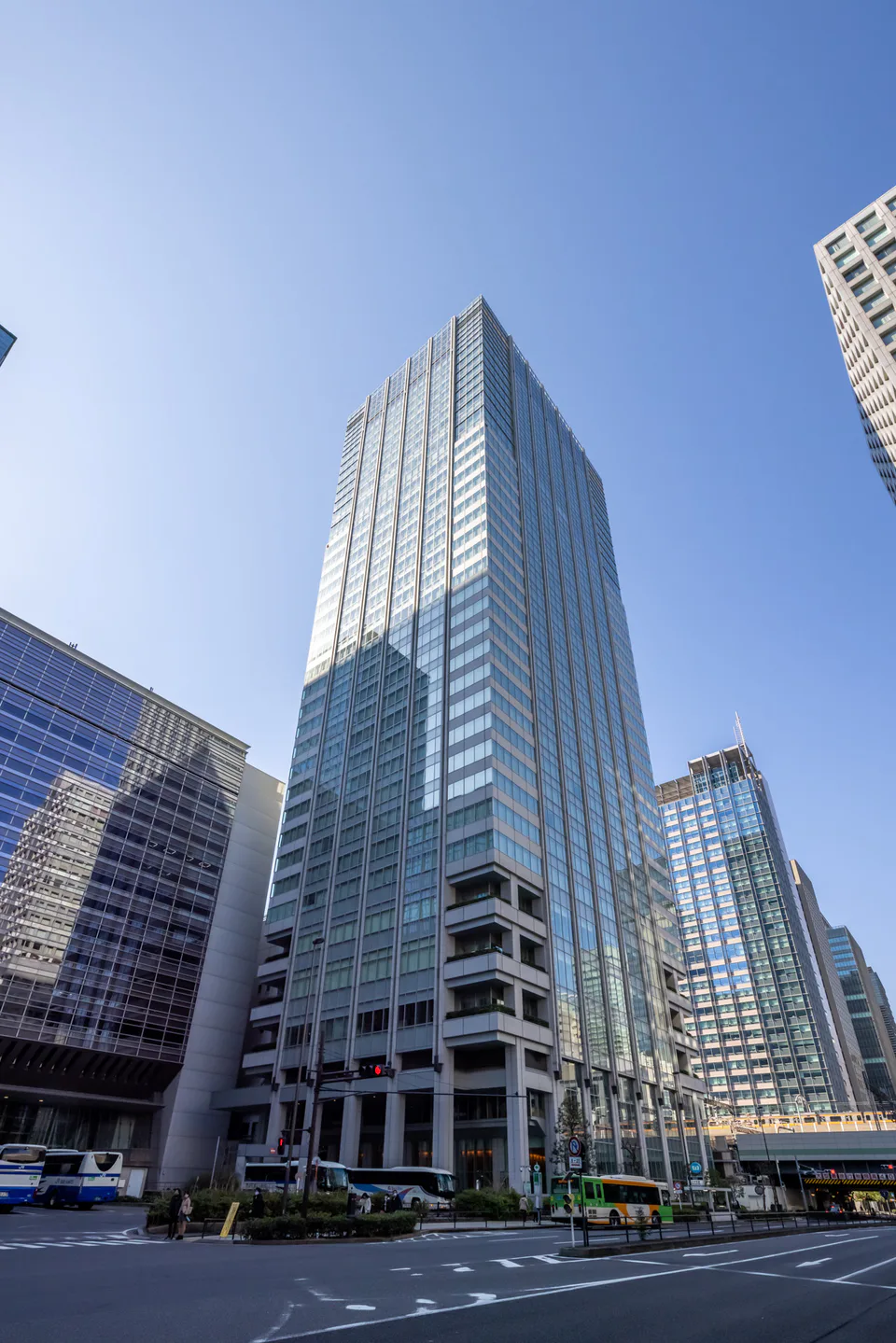
If you have an early Shinkansen from Tokyo Station the next morning and two people are each carrying a large suitcase, the difference between these hotels is more specific than “both are near Tokyo Station.” Hotel Metropolitan Tokyo Marunouchi concentrates its value in a direct connection to JR Tokyo Station’s Nihombashi Exit, removing one street-level segment when you arrive and leave. Hotel Ryumeikan Tokyo is about a three-minute walk from the Yaesu North Exit, but its named Standard Twin is officially listed at 32.5m² with a large wardrobe, making it a much clearer candidate for two travellers managing substantial luggage. My core decision is this: an early Shinkansen puts friction before you leave the hotel, while a multi-night stay with large luggage puts friction after you return to the room. Do not ask which hotel is universally better; ask which kind of friction will repeat on this trip.
Hotel Metropolitan Tokyo Marunouchi vs Hotel Ryumeikan Tokyo: 30-second winner table
↔ Scroll table left or right
Situation | My pick | Decision reason and trade-off |
Early Shinkansen + two large suitcases | Hotel Metropolitan Tokyo Marunouchi | Direct Nihombashi Exit connection removes one outdoor segment. The trade-off is that station access is not the same thing as having the roomiest floor plan. |
Two or more nights + daily large-luggage organisation | Hotel Ryumeikan Tokyo Standard Twin | The named 32.5m² Standard Twin and large wardrobe provide more room margin. The trade-off is the roughly three-minute outdoor walk from Yaesu North Exit. |
If the early train is part of a longer route, compare the departure logic in Tokyo to Hakone by Romancecar, JR and Shinkansen and Tokyo to Kawaguchiko by train, highway bus or tour. Those routes make it obvious why the right Tokyo departure point can matter more than a generic “central hotel” label.
Main comparison matrix: what actually changes the stay
↔ Scroll table left or right
Comparison | Metropolitan | Ryumeikan |
Tokyo Station entrance | Directly connected to Nihombashi Exit | About 3 minutes on foot from Yaesu North Exit |
Room-space decision | Must be judged by the exact room category and rate | Standard Twin: 32.5m² with a large wardrobe |
Check-in / check-out | 15:00 / 12:00 | 14:00 / 11:00 |
Breakfast starts | 06:00 | 06:45 |
Laundry | 27F, 24 hours; all-in-one wash/dry cycle 120 min, ¥600 | 10F / 12F; wash ¥200, dry ¥100 per 30 min |
ONE BIG DECISION: is avoiding the last 3-minute walk worth trading room space?
The decision is simple: is removing the final roughly three minutes of street-level walking in the morning worth giving up some room margin? Tokyo Station itself is enormous, so I would never turn any “X minutes from the station” claim into room-door-to-platform time. You still have the hotel lift, station navigation, the correct Shinkansen gate and the correct platform. Metropolitan’s direct connection removes the final outdoor segment; it does not erase Tokyo Station. Ryumeikan adds the Yaesu-side street walk, but gives you a clearly named 32.5m² Standard Twin option. Rain, dawn, two large suitcases or slower walking make that outdoor segment more expensive; returning to the room, opening luggage, sorting purchases and preparing the next day makes usable floor space more valuable. For a weather-sensitive arrival, the Tokyo rainy-day route around Tokyo Station and Ginza shows how much indoor continuity can matter. If you are travelling with older family members or children, the Japan travel guide for seniors and children is also useful for judging how much value to place on removing one more luggage-heavy walk.
Hotel Metropolitan Tokyo Marunouchi: it wins when you leave
Metropolitan’s advantage is concentrated in the moment you leave the hotel. The hotel’s official access information says it is directly connected to JR Tokyo Station’s Nihombashi Exit, so an early Shinkansen day starts without another outdoor search from hotel to station. Current hotel information lists check-in at 15:00 and check-out at 12:00. If your final day is not an early-train day, that noon check-out gives you an extra hour to organise luggage. Breakfast currently starts at 06:00, which gives more room before a train in the 07:00 range than a breakfast that begins at 06:45. The self-service laundry on the 27th floor is available 24 hours; the current published specification is an all-in-one 120-minute wash-and-dry cycle for ¥600 with detergent dispensed automatically. The common thread is time control: you can handle laundry after returning late, breakfast begins early, and the station approach is simplified. take: if Metropolitan costs only a modest premium under the same date and cancellation conditions, I treat that difference as insurance against the final outdoor approach. If the premium is large, or you are staying three or four nights and opening two large suitcases every evening, the station connection should not automatically defeat room space. For peak rail dates, the release-order logic in Japan autumn reservations for hotels and trains is worth checking before paying a large non-refundable station premium.
Hotel Ryumeikan Tokyo: it wins after you return to the room
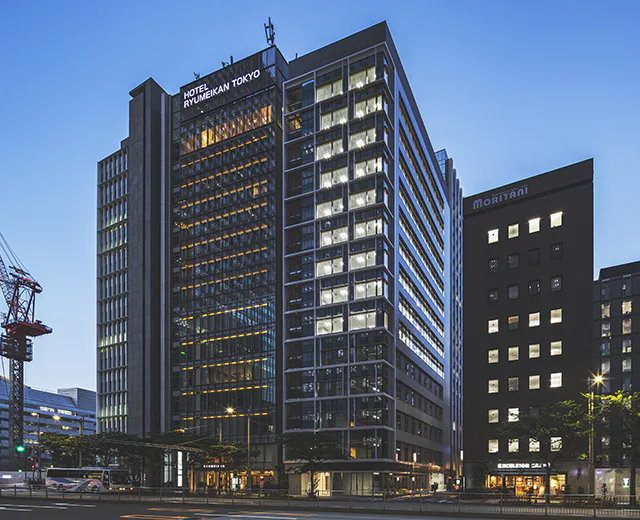
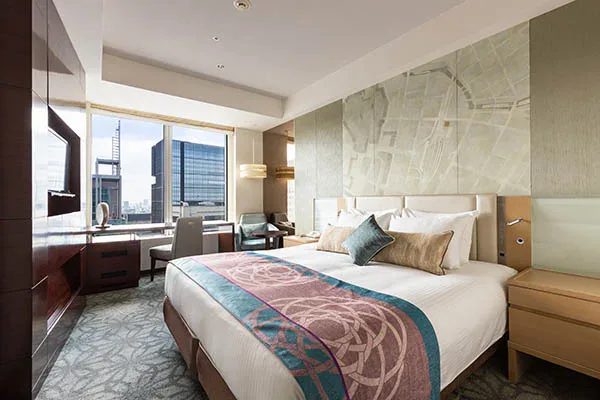
Ryumeikan’s strength is the opposite: it concentrates value after you come back. The hotel’s official access information lists about three minutes on foot from Tokyo Station’s Yaesu North Exit; it is not station-connected. In light luggage and clear weather, that is a small difference, but dawn, rain and two large suitcases make it more noticeable. In exchange, the named Standard Twin provides a very specific space option: the hotel lists 32.5m², two 120×205 cm beds, capacity for one or two guests, and a large wardrobe, explicitly making it a sensible candidate for two travellers with more luggage. I would not turn 32.5m² into a claim that two 28-inch suitcases will definitely lie fully open with a fixed-width aisle—the hotel does not publish enough geometry to prove that for every packing arrangement. The safer conclusion is that the Standard Twin gives more margin. Just as importantly, 32.5m² belongs to this named room type; do not treat every Hotel Ryumeikan Tokyo room as 32.5m². Breakfast currently runs 06:45–10:00 with last order at 09:45 and is currently ¥2,800; the hotel has announced ¥3,200 from October 1, 2026. Laundry is on the 10th and 12th floors, currently ¥200 per wash and ¥100 per 30 minutes of drying. take: if you choose Ryumeikan, lock the Standard Twin first. If it is not available, the entire “trade three minutes for space” thesis changes. When comparing refundable rates, the cancellation strategy in when to book hotels for Japan’s peak autumn season is a useful way to avoid overpaying too early for the wrong room category.
Large luggage and the trade-off: location and room space become costs at different times
Large luggage turns location and room space into costs at different moments. When you first reach Tokyo Station, the hard part is getting from platform to gate, lift and hotel; this is where Metropolitan’s connection feels strongest. Once you are settled, the cost moves inside the room: do the cases stay open, where do shopping bags go, and can two people organise tomorrow’s hand luggage at the same time? Ryumeikan Standard Twin’s 32.5m² and large wardrobe answer the second problem more clearly. If Tokyo is only a middle stop on a longer Japan trip, the next leg matters too. When luggage forwarding is part of the plan, separating shipped bags from what you carry onto the next train may be more valuable than saving a few minutes in the morning; if every bag is going straight onto the Shinkansen with you, direct station access becomes valuable again. The same principle appears in the Tokyo, Kawaguchiko and Hakone three-day itinerary, where luggage strategy changes which base is practical. One night before a 07:00-something train often favours direct access because the large room is used briefly; three nights with shopping every evening can reverse the answer because room space is used repeatedly.
Breakfast, laundry and check-out: the difference is timing, not a feature count
Put breakfast, laundry and check-out on one timeline and the positioning becomes clearer. Metropolitan starts breakfast at 06:00 and checks out at 12:00, which suits a hotel being used as a transport node. Ryumeikan starts breakfast at 06:45 and checks out at 11:00; if you have booked the 32.5m² Standard Twin, the larger private space is more about getting two people and their luggage organised before moving. If you leave at 05:50, neither breakfast matters. If you never wash clothes, the laundry price is irrelevant. If you are out by 09:00, an 11:00 versus 12:00 check-out difference disappears. Pay for the friction reduction you will actually use. That same timing logic is why Tokyo to Nikko transport planning should start with the departure station and train rather than the hotel brand.
Pair this with
If Tokyo Station is only one part of the trip, compare Tokyo autumn leaves by area and timing to see whether Tokyo Station is even the right base. For a Fuji side trip, how many nights to stay at Lake Kawaguchi helps decide whether a final Tokyo night is worth moving hotels for, while Lake Kawaguchi vs Lake Yamanaka shows how access and hotel space can pull in different directions outside Tokyo too.
Decision tree: three questions are enough
First: do you genuinely have an early Shinkansen and two people with large luggage? If yes, start with Metropolitan, then decide whether the rate premium is acceptable for the direct connection. Second: if the train is not especially early, are you staying at least two nights and reorganising two large suitcases every day? If yes, lock Hotel Ryumeikan Tokyo’s 32.5m² Standard Twin first and confirm availability. Third: if neither condition applies, stop letting “direct connection” or “32.5m²” dominate the decision. Compare the same dates, guest count, bed type, breakfast, taxes and cancellation deadline. For high-demand dates, Japan autumn hotel and train reservation order is a useful framework for deciding what to lock first without turning a hotel feature into a sunk-cost trap.
Fix the date and room type first, then compare all three platforms
Compare the same stay: identical check-in date, guest count, named room, bed type, breakfast, taxes and cancellation deadline. Ryumeikan’s 32.5m² claim belongs specifically to the Standard Twin; do not compare that room with another platform’s cheapest compact category. Metropolitan should also be compared at the same room tier. The buttons below point to the specific hotels; recheck the final room name and conditions before payment.
Hotel Metropolitan Tokyo Marunouchi
Booking.com — compare refundable Metropolitan Marunouchi rooms
Trip.com — compare Metropolitan Marunouchi rooms and breakfast
Agoda — compare Metropolitan Marunouchi on the same dates
Hotel Ryumeikan Tokyo
Booking.com — compare Ryumeikan Standard Twin and other rooms
Trip.com — compare Ryumeikan Standard Twin and breakfast plans
Agoda — compare Hotel Ryumeikan Tokyo on the same dates
Final verdict: which one would I book?
↔ Scroll table left or right
Decision | Core condition, reason and trade-off |
I’d book | Metropolitan for an early Shinkansen with large luggage; Ryumeikan when two people are staying multiple nights and have actually secured the 32.5m² Standard Twin. The first buys departure-time certainty; the second buys room margin. |
I’d reconsider | If Metropolitan’s station-connection premium becomes large, or Ryumeikan’s Standard Twin is sold out and only smaller rooms remain, I would rerun the comparison rather than preserve the original winner. |
I’d skip both as an automatic choice | If Tokyo Station is not the trip’s main hub, there is no early train, and you do not need two-person large-luggage space. In that case, another Tokyo neighbourhood may solve the itinerary better. |
My final positioning is simple: an early train puts friction before the hotel door; a longer stay with large luggage puts friction behind it. Hotel Metropolitan Tokyo Marunouchi suits travellers willing to pay for the Nihombashi Exit connection, 06:00 breakfast and 12:00 check-out. Hotel Ryumeikan Tokyo becomes the stronger room-space choice only when you actually book the 32.5m² Standard Twin and are comfortable with the roughly three-minute Yaesu-side walk. Do not ask which hotel is better overall. Ask which friction will happen repeatedly on your trip.
Hotel Metropolitan Tokyo Marunouchi vs Hotel Ryumeikan Tokyo FAQ
Which hotel is better before a very early Shinkansen?
Hotel Metropolitan Tokyo Marunouchi has the clearer advantage because it is directly connected to Tokyo Station’s Nihombashi Exit, removing the outdoor hotel-to-station segment. You still need enough time for lifts, station navigation, the correct Shinkansen gate and the platform.
Is every room at Hotel Ryumeikan Tokyo 32.5m²?
No. The 32.5m² figure in this comparison refers specifically to the named Standard Twin. Check the exact room category before using the space advantage in your decision.
Which hotel starts breakfast earlier?
Metropolitan currently starts breakfast at 06:00, while Hotel Ryumeikan Tokyo currently starts at 06:45. If your train is earlier than both schedules allow, breakfast should not influence the booking.
Which hotel has the later check-out?
Metropolitan currently lists check-out at 12:00; Ryumeikan lists 11:00. That one-hour difference only matters if you are actually staying in the room late on departure day.
How do the laundry facilities differ?
Metropolitan currently lists 24-hour laundry on the 27th floor with a 120-minute all-in-one wash-and-dry cycle for ¥600. Ryumeikan lists machines on the 10th and 12th floors, with washing at ¥200 and drying at ¥100 per 30 minutes.
Is Hotel Ryumeikan Tokyo connected directly to Tokyo Station?
No. The hotel currently lists about a three-minute walk from Tokyo Station’s Yaesu North Exit. That is still close, but it leaves a street-level segment that Metropolitan’s Nihombashi Exit connection removes.
Japan Autumn Leaves December: Tokyo, Kyoto, Osaka, Nara and Kyushu
Japan Autumn Leaves Late November: Kyoto, Tokyo, Nara, Miyajima and Kyushu

Sources
Hotel Metropolitan Tokyo Marunouchi official websiteHotel Ryumeikan Tokyo official websiteRoom, access, breakfast and laundry details are preserved from the verified Chinese source draft and its cited official hotel pages.