
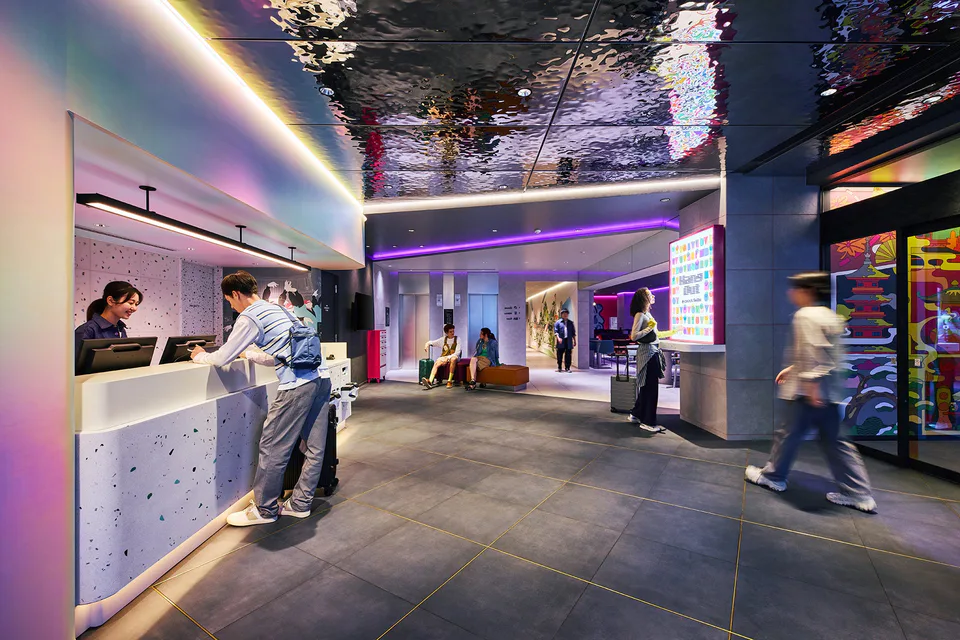
CROSS Suites Tokyo Asakusa is most compelling for groups that would otherwise need two Tokyo hotel rooms, but maximum occupancy is not the same thing as a comfortable bed plan. For three adults, start with the 32 m² Superior Triple because three proper beds solve the core problem without buying suite space. For four adults, the 39–40 m² Deluxe Triple can work if one person accepts a sofa bed, while the 54 m² Asakusa Tatami Room gives four equal futons. For five or six adults, the 56–63 m² suites are the serious comparison because they combine four fixed semi-double beds with additional stacking or sofa beds, dining space and in-room laundry.
The useful question is not “How many people can this room legally hold?” It is how many regular sleeping surfaces, open suitcases, bathroom turns and shared-room hours your group can tolerate. A six-person room can still be a poor six-adult room if two people dislike auxiliary beds or everyone needs the bathroom at the same time. Conversely, one 56–63 m² apartment-style room can be much better value than two small Asakusa rooms when staying together, laundry and shared evening space are genuinely useful.
↔ Scroll table left or right
Your party | Start with | Why | Main veto |
2 adults, short stay | 25 m² Standard or 30 m² Superior | No need to buy group-room space you will not use | Standard has a shower rather than the bathtub offered in larger categories |
3 adults who want equal beds | 32 m² Superior Triple | Three regular beds match the party instead of relying on a sofa bed | Long stays with three large cases may justify more floor area |
4 adults | 39–40 m² Deluxe Triple or 54 m² Tatami Room | Choose compact western-bed efficiency or four equal futons | Deluxe Triple uses an auxiliary bed for the fourth guest; Tatami requires everyone to be happy sleeping on futons |
5 adults | 54 m² Deluxe Family first | Four regular beds plus an auxiliary sleeping surface, dining space and more circulation | Confirm the exact fifth-bed setup and bathroom routine |
6 adults / long stay | 56 m² Suite or 63 m² Premium Suite | Four fixed beds, additional beds, living/dining space and washer-dryer | Six-person capacity still does not mean six equal beds or multiple bathrooms |
Start with bed equality, not square metres
CROSS Suites opened on July 3, 2026 with 78 rooms across 11 room types. The official room inventory ranges from 25 m² to 63 m² and accommodates up to six guests. That sounds simple until you look at how capacity is created.
The official Premium Suite is 63 m² and sleeps up to six using four 110 cm semi-double beds plus two 97 cm stacking beds. The 56 m² Suite also sleeps six, but its current layout uses four 110 cm semi-double beds, one 97 cm stacking bed and one 90 cm sofa bed. These are excellent examples of why “sleeps six” should not end the booking decision.
For a family with children, the auxiliary beds may be completely acceptable. For six adults paying equal shares, the same layout creates a fairness problem: four people get the main beds and two get the secondary sleeping surfaces. If equal beds are non-negotiable, two rooms can beat one large suite even when the suite is cheaper overall.
Use this order before looking at price:
How many guests need a regular bed?
Who is willing to use a stacking bed, sofa bed or futon?
How many large suitcases need to be open at once?
Will everyone leave at the same time each morning?
How many nights will the room function as living space rather than only a place to sleep?
Two people: the 25–30 m² rooms are usually enough
The official Standard Room is 25 m² for up to three guests and uses a shower booth plus the room’s sink-and-microwave setup. The Superior is 30 m² and adds a bathtub. For two adults staying one or two nights, that difference is more useful than jumping immediately to a family room.
I would choose Standard when price matters, both travellers are light packers and a shower is enough. I would move to Superior when a bathtub, extra luggage circulation or a longer stay matters. Do not pay a family-suite premium simply because the hotel’s marketing is built around group travel.
The mini-kitchen also needs correct expectations. ORIX states that every room has a sink-style worktop, microwave, refrigerator/freezer and tableware, but there is no IH or gas hob. This is a reheating-and-simple-breakfast setup, not a full apartment kitchen. If cooking proper meals is the reason you want an apartment hotel, the property may not solve that requirement.
Three adults: the 32 m² Superior Triple is the cleanest fit
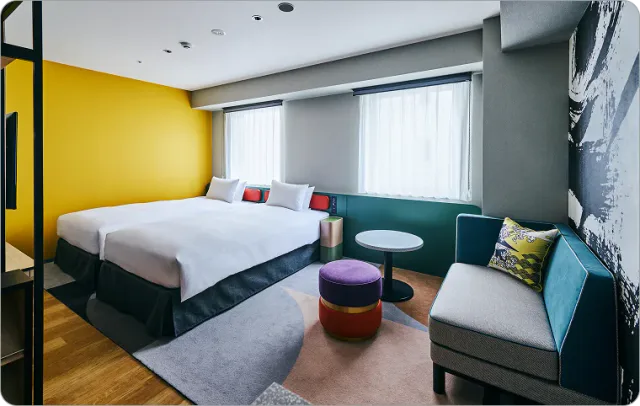
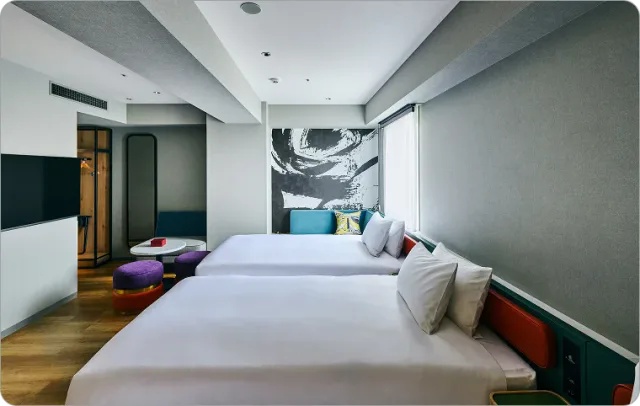
For three adults, the most important improvement is often not more total floor area but three normal beds. The Superior Triple is 32 m² and is explicitly designed as a triple-bed room. That makes it a cleaner baseline than squeezing three people into a cheaper room whose third sleeping position is secondary.
The upgrade question then becomes luggage and stay length. Three adults with three 28–30 inch cases staying five nights use the room differently from three friends carrying cabin bags for one weekend. If the floor has to hold open luggage, shopping and laundry for several days, the 39–40 m² Deluxe Triple can become worth comparing even before a fourth guest appears.
Four adults: Deluxe Triple and Tatami Room solve different problems
The 39–40 m² Deluxe Triple accommodates up to four. Current room information lists three 110 cm semi-double beds plus a 90 cm sofa bed. It is a sensible compact choice when the fourth person is comfortable with that trade-off.
The 54 m² Asakusa Tatami Room is a completely different product. ORIX lists four 97 cm futons and a tatami living area, with a view toward Senso-ji. Its advantage is sleeping-surface equality: all four guests use the same general type of bedding. Its trade-off is equally obvious—everyone must actually want to sleep on futons.
For four adults, I would therefore not ask “western room or Japanese room?” I would ask:
Does one person mind taking the sofa bed?
Does anyone have knee, back or mobility issues that make floor-level sleeping less attractive?
Will the group use the larger common area enough to justify 54 m²?
Is the Senso-ji-facing concept part of the experience, or just a room label you will see after dark?
The cheapest answer is not automatically the best; the fairest answer is not automatically the cheapest.
Five people: 54 m² starts to make operational sense
The Deluxe Family Room is 54 m² and accommodates up to five. The hotel markets it around a dining table and group meals, which matters more than it sounds. Five people in Tokyo need somewhere to put takeaway breakfast, convenience-store food, phones, chargers and shopping without using every bed as furniture.
The group should still confirm the exact fifth sleeping surface before paying. Maximum occupancy tells you that five guests are allowed; it does not tell you that all five beds are identical. If the fifth guest is an adult who will resent the auxiliary bed, compare the total cost of two conventional rooms before treating one family room as the obvious saving.
Six people: Suite vs Premium Suite is a 7 m² and bed-type decision, not simply “bigger is better”
The regular Suite is 56 m² and the Premium Suite is 63 m². Both currently accommodate up to six and include a washer-dryer. The Premium gives an additional 7 m² and replaces the Suite’s sofa-bed sixth position with a second stacking bed. It also separates living, dining and sleeping zones more clearly.
That does not make Premium automatically worth the upgrade. Ask what the extra 7 m² will do during the hours you are awake:
Can two suitcases stay open without blocking the group?
Will some people stay up while others sleep?
Will you eat breakfast or takeaway dinner in the room?
Will the washer-dryer run while six people are also trying to dress and repack?
If the answer is yes to several, the extra living separation can be more valuable than the raw 12.5% increase in published floor area. If the group is out from breakfast until late evening every day, the cheaper Suite can deliver almost the same sleeping function.
One large room vs two rooms: compare privacy as well as price per person
Apartment-style hotels are often sold on the idea that one large room is cheaper per person. That can be true, but price per person ignores privacy and morning congestion.
Use a two-room crossover test:
One-suite value = suite total + shared-living value + laundry value − privacy cost − auxiliary-bed cost.
Two-room value = two-room total + second-bathroom/privacy value − split-group inconvenience.
This is editorial analysis rather than a hotel formula, but it exposes the real trade-off. Five friends who want to talk until midnight may love one 54–63 m² room. A multigenerational family with different sleep schedules can prefer two rooms even when the combined floor area is smaller. Two bathrooms can also be worth more at 07:30 than another 10 m² of lounge space.
The hotel’s public room descriptions should not be read as a promise of multiple bathrooms in the larger suites. If bathroom count is critical for a five- or six-person group, verify the exact floor plan or ask the property directly before booking.
Laundry matters only in the room categories that actually include it
The hotel is designed for longer stays, but the washer-dryer is not universal. ORIX says some rooms have laundry, and the current room page explicitly lists washer-dryers in the 56 m² Suite and 63 m² Premium Suite. Do not carry that amenity across the whole hotel because one marketing paragraph mentions long stays.
This creates a practical threshold. For a one- or two-night stay, in-room laundry may be irrelevant. For a family halfway through a two-week Japan trip, it can replace a laundromat visit, reduce packing and let children’s clothes run while everyone is inside the room. That is a real upgrade function.
If laundry is the reason for choosing the hotel, save the exact room name and confirm that the washer-dryer is listed on the rate you are about to book.
Asakusa location: “Asakusa Station” is four different last-mile problems
CROSS Suites is exceptionally close to Senso-ji—the hotel currently lists the temple at about two minutes on foot—but it is not equally close to every railway labelled Asakusa.
The hotel’s current official access times are:
Tokyo Metro Ginza Line Asakusa, Exit 6: about 5 minutes on foot.
Toei Asakusa Line Asakusa, Exit A5: about 8 minutes.
Tobu Skytree Line Asakusa, North Exit: about 8 minutes.
Tsukuba Express Asakusa, Exit A1: about 8 minutes.
For sightseeing, that difference is minor. With six people and six cases, it is not. The route from Narita or Haneda should therefore be planned to the correct Asakusa line and exit, not to a generic station pin.
This also affects the base decision. Ginza Line access is useful for Ueno and central Tokyo. Toei Asakusa Line access can be valuable for airport-oriented through services. If most of the trip is Shinjuku, Shibuya and western Tokyo, the group-room advantage has to compensate for repeated cross-city travel. Use Where to Stay in Tokyo for First-Time Visitors before letting a large room choose the wrong half of Tokyo for the whole trip.
When the hotel is worth the Asakusa location premium
I would give CROSS Suites extra credit when at least two of these are true:
four to six people genuinely want to stay in one room;
the trip lasts three or more nights and common living space will be used;
a washer-dryer in the chosen category removes a real laundry task;
early Senso-ji or quiet Asakusa evenings are part of the itinerary;
the group wants takeaway breakfasts or simple reheated meals together;
splitting into two nearby rooms is materially more expensive or separates children from adults.
I would reduce the premium when the party is only two people, every day is spent in western Tokyo, nobody will use the dining/laundry space, or six adults require equal regular beds and two bathrooms. In those cases, the feature that makes the property unusual is not solving the trip’s actual problem.
Final verdict: choose the smallest room that solves the group’s first hard constraint
Two guests: start at 25–30 m². Three adults: start with the 32 m² Superior Triple. Four adults: choose between the compact Deluxe Triple and the four-futon 54 m² Tatami Room based on bed fairness and mobility. Five guests: the 54 m² Deluxe Family is where one-room living starts to make sense. Six guests: compare the 56 m² Suite with the 63 m² Premium Suite, but do not call either “six equal beds.”
The most expensive room is not automatically the best group room. Buy the smallest category that solves your first hard constraint—bed equality, luggage, laundry, common space or privacy—then compare that final total against two conventional rooms. That is the point at which CROSS Suites either becomes unusually good value or stops being the right Asakusa hotel.
Compare CROSS Suites Tokyo Asakusa room types for your dates
Tokyo Disney Hotels vs Official and Partner Hotels: Which Is Worth It?
MiraCosta Terrace Room vs Balcony Room: Which Outdoor Room Is Worth It?
References
CROSS Suites Tokyo Asakusa — official room types, capacity, bed sizes and facilities · CROSS Suites Tokyo Asakusa — official access · ORIX HOTELS & RESORTS — opening release and room/facility overview. Checked August 25, 2026. Room inventory, rate plans, bed setup and operating details can change; confirm the exact room name and final booking conditions before payment.