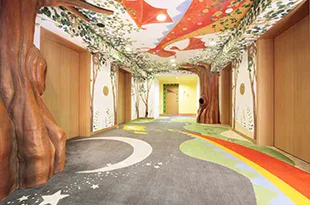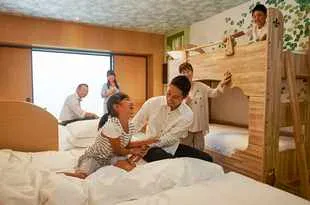
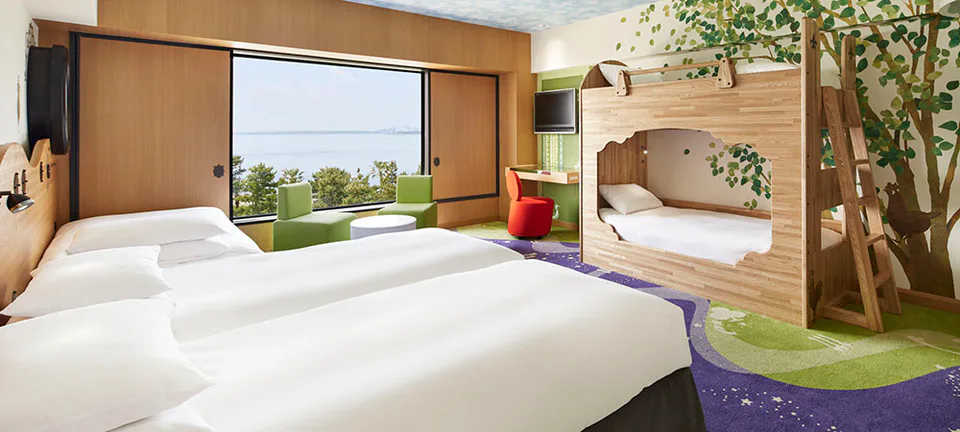
Hilton Tokyo Bay Happy Magic vs Family Happy Magic is not an ordinary “standard room versus larger family room” upgrade. Both categories are currently published at roughly 35–40 m². Family Happy Magic uses that similar footprint to add a bunk bed and raise capacity to five or six guests. For a four-person family, that means the standard Happy Magic Ocean room can already be the cleaner choice if an Ocean-side room is acceptable. Family Happy Magic becomes more compelling when you need five or six sleeping places, specifically want the bunk-bed experience, or four guests insist on the Park side.
The useful rule is simple: buy Family Happy Magic for capacity or bunk-bed value, not because you expect materially more floor space. If the room costs more on your dates, ask which extra function the premium is buying. If the answer is “nothing we need,” the word “Family” is not a reason to upgrade.
Checked August 25, 2026. Hilton currently lists Happy Magic rooms at about 35–40 m² for 3–4 guests and Family Happy Magic at 35–40 m² for 5–6 guests. Hilton’s current global room list separates capacity by side: Happy Magic Park sleeps 3, Happy Magic Ocean 4, Family Happy Magic Park 5 and Family Happy Magic Ocean 6. Family Happy Magic includes an original bunk bed, and Hilton states that the upper bunk may only be used by a guest aged 10 or older. Children aged 6 or older are charged at the adult rate and should be entered in the adult guest count. Room inventory and sellable configurations can change, so verify the exact room on your booking date.
Happy Magic vs Family Happy Magic: the 30-second decision
↔ Scroll table left or right
Your group | Start with | Why | Main catch |
3 guests | Happy Magic | Both Park and Ocean versions can cover the party | Do not pay for unused bunk capacity |
4 guests, Ocean side is acceptable | Happy Magic Ocean | Current listed capacity is four without moving to Family Happy Magic | If Park side matters, this answer changes |
4 guests who insist on Park side | Family Happy Magic Park | Standard Happy Magic Park currently sleeps three | You are buying view-side capacity, not extra floor area |
5 guests | Family Happy Magic Park or Ocean | Family category is designed around the larger party | Someone aged 10+ must be able to use the upper bunk if that bed is needed |
6 guests | Family Happy Magic Ocean | Current Hilton room list shows Ocean as the six-person version | Six people still share only about 40 m² |
4 adults who mainly want conventional sleeping comfort | Often neither themed category | Capacity is not the same as four equal adult beds | Compare non-themed Hilton rooms or a true four-bed hotel room |
Family Happy Magic buys two more sleeping positions, not a bigger room
This is the most important distinction in the comparison. Hilton currently publishes Happy Magic at about 35–40 m² with capacity for three to four, while Family Happy Magic is also about 35–40 m² but supports five to six. In other words, the Family category is primarily a capacity conversion: it fits more people into roughly the same floor-area band by adding the bunk-bed layout.
That makes the premium easy to test. If Family Happy Magic costs an extra amount of money on your dates, the value is not “more space.” On the Park side, you are buying two additional listed sleeping positions compared with Happy Magic Park. On the Ocean side, you are also buying two additional listed positions compared with Happy Magic Ocean. If your four-person family does not need those positions and does not specifically want the bunk bed, most of that capacity premium is unused.
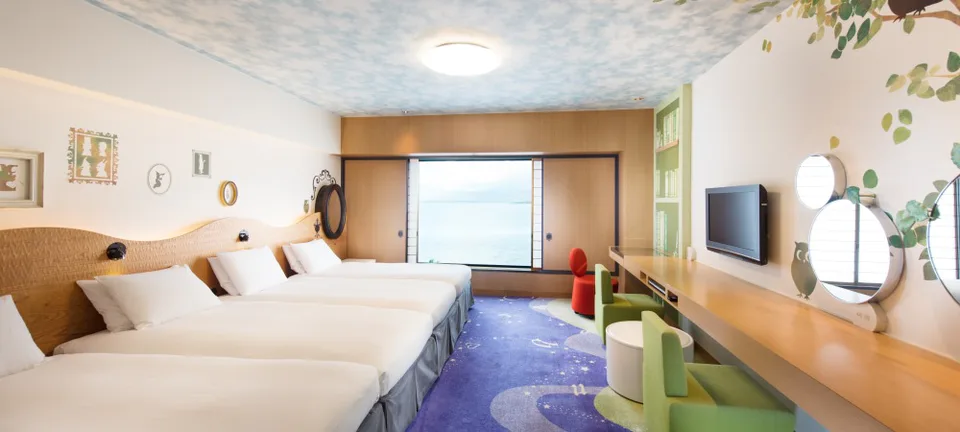
For four guests, Park versus Ocean is a capacity decision
The last word in the room name matters more than it looks. Hilton’s current global room list shows Happy Magic Park sleeping three and Happy Magic Ocean sleeping four. Family Happy Magic Park sleeps five; Family Happy Magic Ocean sleeps six.
That means a four-person family does not have one universal answer. If Ocean is acceptable, standard Happy Magic already meets the published capacity and avoids paying for family-room capacity that may not be needed. If Park side is non-negotiable, standard Happy Magic Park does not currently cover four guests, so Family Happy Magic Park becomes the relevant product even if the family never intended to use five sleeping places.
This is a useful example of why “view preference” can become a functional hotel decision. The Park/Ocean choice changes who can legally fit in the room before it changes whether you prefer the scenery.
The upper-bunk age rule changes who should sleep where
Family Happy Magic’s defining feature is its original bunk bed. Hilton states that the upper bunk may only be used by guests aged 10 or older. Do not read this as “your child must be 10.” An adult or older teenager can use the upper bunk. The real planning question is whether your actual party has a 10+ guest who is willing and able to take that sleeping position.
This matters especially for five- and six-person groups. A room can satisfy the headline capacity and still create a poor sleeping plan if the only people who would enjoy the bunk are too young for the upper level and the adults do not want it. Map each traveler to an actual sleeping position before treating “sleeps six” as solved.
Six guests in about 40 m² is a capacity win and a circulation trade-off
Family Happy Magic Ocean can solve a six-person “one room or two rooms?” problem, which can be valuable for parents who do not want to split the family. But six-person capacity inside roughly 40 m² creates a different hidden cost: six park bags, shoes, chargers, clothes and suitcases still occupy the same room.
For a one- or two-night Disney stay with carry-ons, that may be a very good trade. For a long-haul Japan trip with four large suitcases plus children’s gear, the room can be functionally full even though the occupancy is valid. A six-person room prevents a second room charge; it does not automatically provide six-person floor space.
If the party is four adults rather than parents with children, compare Grand Nikko vs Hilton Tokyo Bay. A true four-permanent-bed Family Room can solve adult sleep equity in a way that extra capacity inside the Hilton themed room does not.
Children aged 6 or older change the booking search before they change the room
Hilton’s current booking guidance says children aged six or older are charged at the same rate as adults and should be included in the adult guest count. If a younger child requires a separate bed, Hilton also instructs guests to include that child in the paid guest count. The hotel separately allows bed-sharing for children under the applicable rules, generally one co-sleeping child per bed.
The practical lesson is not to search “2 adults” and mentally add school-age children later. Enter the real ages first. Otherwise a price or room that looks available for two adults can disappear once the booking engine receives the party that will actually stay.
For international families, use this order: actual ages → paid guest count → Park/Ocean preference → listed capacity → bunk-bed assignment → cancellation terms → total price. Price comes after the room is valid.
For four adults, Family Happy Magic can solve the wrong problem
Four adults do not need a room whose main advantage is raising capacity from four to six. They usually need comparable sleeping surfaces, enough luggage circulation and a morning routine that does not feel like a dormitory. Happy Magic Ocean technically fits four under the current Hilton room list, but that does not mean it is the strongest four-adult room in the resort.
If everyone values the themed room, there is nothing wrong with choosing it. But if the theme is secondary, widen the comparison. A non-themed Hilton Ocean room may fit the party more naturally, while Grand Nikko’s true Family categories provide four permanent adult-size beds. The right decision can therefore be “neither Happy Magic category.”
Do not use Disney park count to justify capacity you do not need
Two consecutive park days can justify staying at Hilton Tokyo Bay because repeated late returns and early starts make the Bayside location useful. They do not automatically justify Family Happy Magic over standard Happy Magic. The room-category question remains the same: how many people must sleep here, and which sleeping surfaces do they need?
If Disney is only one day inside a longer Tokyo stay, question the resort hotel move before debating room categories. Use Stay Near Tokyo Disney or in Tokyo? and 1 or 2 Days at Tokyo Disney upstream.
The “Family” label should not outrank the exact rate
On some dates the Family category may price close to standard Happy Magic; on others the gap may be meaningful. Do not invent a permanent upgrade hierarchy. Compare the exact room that fits your party on the exact date.
If four guests can use Happy Magic Ocean, define the Family Happy Magic premium as:
Family Happy Magic total − Happy Magic Ocean total.
Then ask what that difference buys. If it buys a Park-side preference you genuinely care about, a bunk bed the children will remember, or capacity the party actually needs, the premium may be rational. If it buys only two unused sleeping positions inside the same approximate floor-area band, I would keep the cheaper valid room.
Happy Magic Suite is the overlooked escape hatch when space, not capacity, is the problem
If a five- or six-person group likes the Happy Magic theme but 35–40 m² feels too compressed, the comparison does not have to end at Family Happy Magic. Hilton currently lists a Happy Magic Suite at roughly 70–80 m² for four to six guests. That moves the decision into a different price tier, but it is the correct product to compare when the problem is genuinely floor area rather than basic capacity.
This is also why Family Happy Magic should not be described as the “larger Happy Magic room.” It is the higher-capacity version. The Suite is the product that materially changes the amount of space.
One date-specific veto: January 18, 2027
Hilton Tokyo Bay currently announces a hotel-wide power shutdown and temporary closure from 15:00 on January 18, 2027 until 07:00 on January 19. If your stay touches that window, ordinary room-category logic is secondary to the operating notice. Recheck the hotel’s live guidance before booking around those dates.
Compare the exact room for the real guest ages
Once the sleeping plan works, compare the same date, same guest ages, same meal basis and similar cancellation terms. Do not compare a cheap three-person Happy Magic Park listing against a five-person Family Happy Magic booking and conclude that the latter carries an excessive premium; they are solving different capacity problems.
Booking.com — compare Hilton Tokyo Bay room types
Agoda — check Hilton Tokyo Bay family rooms
Trip.com — compare Hilton Tokyo Bay rooms
Final verdict: buy the function, not the room name
Choose Happy Magic for three guests, or for four guests when Happy Magic Ocean fits. Choose Family Happy Magic when you need five or six sleeping places, when four guests require the Park-side capacity, or when the bunk bed itself is part of the family experience. Do not choose Family Happy Magic expecting a meaningfully larger room: both categories sit in roughly the same 35–40 m² band. For four adults, or any group whose real complaint is floor space rather than capacity, step outside this two-room comparison instead of paying for the wrong solution.
MiraCosta Harbor Room: Harbor View vs Piazza View — Which Is Worth It?
Hotel Keihan Namba Grande: Family Room or Connecting Rooms for 4–5 People?
Tokyo Family Hotels: “Sleeps Four” Is Not the Same as “Works for Four”
Tokyu Stay Hida-Takayama Musubi no Yu: Which Room Works for Two Suitcases and Three Nights?
NOHGA HOTEL UENO TOKYO: Which Ueno Route Works with Large Luggage?