
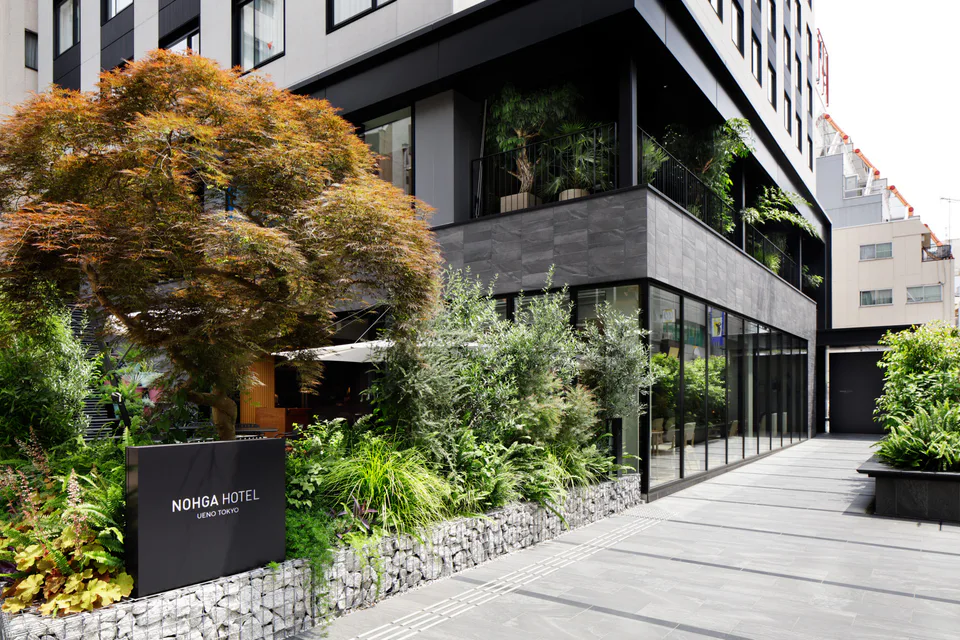

NOHGA HOTEL UENO TOKYO makes the most sense when Ueno keeps paying you back after the airport transfer. From Narita, the hotel officially lists about a 7-minute walk from Keisei Ueno; from JR Ueno it is about 5 minutes, and from Tokyo Metro Ueno about 3 minutes. Those are three different luggage routes, not one universal “three minutes from Ueno” claim.
For two travellers with large suitcases staying three to five nights, I would start by pricing the 24–26 m² Twin rather than letting the 18 m² Double define the hotel. I would then ask one bigger question: will at least half the trip repeatedly use east Tokyo—Ueno, Asakusa, Akihabara, Tokyo Station or nearby districts? If yes, the location, 24-hour laundry and Narita geometry can work together. If most late nights are in Shinjuku or Shibuya, the same hotel solves the airport day but creates repeated cross-city returns.
↔ Scroll table left or right
Your situation | My decision | Why |
Narita arrival + 3–5 nights + east-Tokyo-heavy itinerary | Strong fit | The 7-minute Keisei Ueno surface walk is paid once; the east-side location can repay it on several later days |
Two travellers + two large cases | Price 24–26 m² Twin first | The 18 m² Double is the entry room, not the only way to buy the hotel |
One-night Narita transit stop | Compare again | You pay the luggage walk but use almost none of the multi-night location or laundry value |
Most evenings in Shinjuku / Shibuya | Usually choose another base | Repeated west-to-east returns can cost more than the airport arrival convenience saves |
Need a noticeably larger room | Compare 36 m² Deluxe Twin across hotels | Once you climb the room ladder, loyalty to one property matters less than the total same-date price |
The first correction: “Ueno Station” is three different arrival problems
NOHGA’s current official access material separates the routes clearly:
Tokyo Metro Ueno: about 3 minutes on foot from Exit 3.
JR Ueno: about 5 minutes on foot from the Asakusa-side route.
Keisei Ueno: about 7 minutes on foot from the Front Exit.
For a Narita arrival, the 7-minute Keisei route is the relevant one. That sounds worse than the hotel’s shortest headline, but the comparison should be against the alternative you would actually use. If the alternative is another rail transfer with two hard-shell suitcases, a clear seven-minute surface walk can still be the lower-friction chain.
The hotel’s access guide also matters because the shortest-looking stairs are not always the best luggage route. For Tokyo Metro arrivals, the hotel specifically points large-luggage users toward the elevator between exits 2 and 3 on the Showa-dori side. JR Ueno likewise requires choosing the correct gate and level before the street walk begins. A route planner normally hides that indoor navigation cost.
ValueNavi rule: compare the last easy hand-off, not the smallest walking number. A seven-minute walk with no extra rail transfer can beat a three-minute walk that exists only after another station change.
Narita should not decide four Tokyo nights by itself
Ueno is one of the cleanest Tokyo bases for a Narita arrival, but the airport is only one journey. If you choose NOHGA solely because the Skyliner ends at Keisei Ueno, then spend the next four days around Shibuya, Shinjuku, Harajuku and Kichijoji, you have simply moved the transport cost into every later day.
I would use a repayment test. Count how many later days naturally begin or end on the east side:
Ueno Park and museums;
Asakusa and Kappabashi;
Akihabara;
Tokyo Station / Marunouchi;
east-side rainy-day or evening plans.
If at least half the itinerary benefits from that geography, the one-time Keisei walk is easy to justify. If only arrival day benefits, compare Ueno vs Shinjuku before locking the hotel.
Room choice: use a ladder, not an 18 m² panic reaction
NOHGA’s current room list gives a much more useful progression than “small room versus big room”:
↔ Scroll table left or right
Room | Published area | Best fit | Decision risk |
Double | 18 m² | Solo or short two-person stay with controlled luggage | Two large open cases can dominate the daily workflow; the hotel publishes no suitcase-clearance guarantee |
Superior Double | 20 m² | Couple wanting a king bed and a little more room | Only +2 m²; do not treat the word “Superior” as a major space upgrade |
Deluxe Double | 23 m² | Couple wanting a more meaningful step up while keeping one bed | Same-date price may overlap with twin categories that solve luggage circulation better |
Corner Double / Deluxe King | 26 m² | Couple prioritising more floor area; Deluxe King can take an extra bed for a third guest | Three-person capacity does not mean three people plus large luggage will feel spacious |
Twin – Shower Only | 24 m² | Two travellers who want separate beds and can give up the bathtub | Officially shower-only; do not borrow bathroom assumptions from another category |
Twin | 24–26 m² | Two travellers with luggage, friends, or a 3–5-night stay | Capacity up to three uses an extra bed; compare the exact occupancy layout |
Deluxe Twin | 36 m² | Two travellers prioritising a materially larger room or a three-person stay | Once the price rises this far, compare other Ueno hotels instead of auto-upgrading |
The hotel also has a 64 m² NOHGA Suite, but that is a different product with a kitchenette and living area. It should not distort the normal two-person comparison.
The important analytical point is that square metres are a risk indicator, not proof that two 28-inch suitcases will fit open in a particular assigned room. NOHGA publishes floor area, bed sizes and photos, but not a measured two-suitcase clearance test. For a short stay, opening bags one at a time can make the 18 m² Double perfectly rational. For five nights with shopping, the same compromise repeats every day.
The Narita premium test: pay for space only if the location keeps winning
Two upgrades can happen at once: you pay for Ueno because it suits Narita, then pay again for a larger room because the entry room is too tight. That is where travellers should reopen the whole comparison instead of assuming the hotel is already chosen.
I would use this sequence:
Choose the Tokyo base first. Does east Tokyo genuinely suit the itinerary?
Choose the arrival route. Are you comfortable with the roughly 7-minute Keisei Ueno walk with luggage?
Choose the minimum workable room. For two large cases over several nights, price the 24–26 m² Twin tier.
Reopen the hotel comparison. If that Twin costs as much as a materially larger or more conveniently connected competing hotel, the NOHGA name should not lock you in.
This prevents a common booking error: starting from an attractive 18 m² entry rate, discovering the room is too small, then climbing several categories without checking what the same money buys elsewhere.
Four or five nights: laundry is a packing feature, not an amenity badge
NOHGA currently lists guest laundry as available 24 hours. The official facilities information lists washing at JPY 400 per cycle, dryers at JPY 100 per 30 minutes, automatic detergent, plus an iron, microwave and ice machine in the laundry area. The gym is also open 24 hours for guests, subject to its rules.
That has almost no value on a one-night transit stay. By night four or five, it can change how much clothing you need to pack and how easily the room handles luggage. A traveller who deliberately packs lighter because laundry is available is using the facility to reduce suitcase pressure. A traveller who brings the same amount of clothing anyway should not assign the laundry the same value.
ValueNavi rule: facilities should be priced by the number of realistic use sessions, not by how many icons appear on the hotel page.
Breakfast: the current 2026 window is 07:00–10:00
Current 2026 Bistro NOHGA notices list breakfast from 07:00 to 10:00. This corrects older wording in the article that extended the window to 10:30.
The practical decision is straightforward. If you are leaving around 06:30 for an early day trip, an included breakfast has almost no operational value that morning. If the itinerary starts after 08:00, it is much easier to use. Check the actual restaurant notice for your dates because the hotel publishes selected closure or altered-service days for Bistro NOHGA; some dates remain breakfast-only even when later restaurant service is closed.
For a Fuji day, work backward from the train you actually plan to catch using the Fuji Excursion booking guide. Do not buy breakfast simply because the room rate makes it look discounted.
Large luggage: when the 7-minute Keisei walk stops being a reasonable trade
The recommendation changes for reduced mobility, very heavy luggage, a stroller plus several cases, or severe weather. A seven-minute outdoor walk is not the same task for every party.
If the group can comfortably roll luggage across the surface section, avoiding another train transfer can be attractive. If the group would realistically take a taxi for that final segment, include the taxi and loading time in the comparison. If even that feels awkward, a hotel directly integrated with the arrival station or a different Tokyo base may be worth a higher room rate.
The same logic applies when leaving Tokyo. If the trip continues to Kawaguchiko or Hakone, decide whether every large case must move with you. The Japan luggage-forwarding guide and Kawaguchiko/Hakone luggage guide can change the room-size requirement for the Tokyo portion.
Three traveller profiles
Couple, Narita arrival, four nights, east Tokyo first trip
I would shortlist NOHGA. The Keisei Ueno walk is a known one-time cost, while Ueno/Asakusa/Akihabara/Tokyo Station can repeatedly use the east-side base. Price the 24–26 m² Twin against the Double tiers if both travellers have full-size luggage.
Couple, Narita arrival, four nights, nightlife in Shibuya and Shinjuku
I would not let the airport decide the hotel. The arrival chain is attractive, but repeated late west-to-east returns can become the larger cost. Compare a western Tokyo base before buying a NOHGA room just because the Skyliner ends at Ueno.
Solo traveller, two nights, carry-on only
The 18 m² Double becomes much more rational. Room-space risk falls sharply, and the same access plus east-Tokyo location can be bought without paying for a larger category you will barely use.
Final verdict
I would book NOHGA HOTEL UENO TOKYO when the trip uses Ueno as a repeated base, not merely as the end of the Narita train. The current official route is about 7 minutes from Keisei Ueno, 5 minutes from JR Ueno and 3 minutes from Tokyo Metro Ueno. For two travellers with large luggage staying three to five nights, the 24–26 m² Twin is the room tier I would price first; for a solo or short stay, the 18 m² Double can be enough.
The recommendation breaks when the itinerary is west-heavy, the Keisei surface walk is unacceptable for the party, or the room upgrade pushes the total price into a stronger competing hotel. In those cases, the right response is not another NOHGA upgrade. It is to reopen the Tokyo base decision.
Check NOHGA HOTEL UENO TOKYO rooms for your dates
Tokyo Bay Private Cruise 2026: Yacht, Yakatabune or Dinner Cruise? Start With Group Size
Where to Stay in Tokyo With Parents: I’d Eliminate These “Convenient” Hotels First
Kobe Budget Eats: Gashoken vs ENISHI vs Red Rock — Which Fits Your Route?


References
NOHGA HOTEL UENO TOKYO official website · Official rooms and facilities · Official access map and airport routes. Access, room information, laundry and 2026 Bistro NOHGA hours rechecked August 25, 2026. Room rates and restaurant operations can change by date.