
Use Japan luggage forwarding when the suitcase creates more transfer friction than the delivery delay creates inconvenience. For most travellers, the strongest pattern is not simply “send every bag to the next hotel.” It is to choose between four tools: send the main case when two or more difficult transport hand-offs disappear; store it when you still need the same bag later that day or next morning; carry it when delivery uncertainty would be more expensive than handling it yourself; or skip one hotel by forwarding the main case past a one-night mountain/onsen stop and travelling with an overnight bag.
Yamato’s ordinary TA-Q-BIN network offers next-day delivery to many areas of Japan, but that should not be read as a nationwide guarantee for every route. Remote islands, mountain areas, weather and traffic can add time. Same-day luggage delivery exists only at selected counters and within limited service areas. The right question is therefore not “Does Japan have luggage forwarding?” It is which bag can safely leave your hands, for how long, and where should it rejoin you?
↔ Scroll table left or right
Your situation | Best default | Why | Main failure mode |
Tokyo → Kyoto/Osaka, staffed hotel to staffed hotel | Forward the main suitcase | You remove Shinkansen, station and hotel last-mile handling | The receiving hotel cannot match or accept the parcel |
Tokyo → one night Hakone/Kawaguchiko → Kyoto | Forward Tokyo → Kyoto and carry one-night bag | The suitcase skips the most awkward stop instead of following you everywhere | You forget medication/clothes that must remain with you |
Day trip with same hotel tonight | Store, do not forward | Delivery solves no future transfer and only separates you from the bag | Large lockers are full; identify staffed storage as backup |
Flight home in 2–3 days | Airport TA-Q-BIN only after confirming deadline and terminal counter | You can travel hands-free through the final cities | Sending too late or to the wrong airport/terminal counter |
Need the bag at the next hotel tonight | Carry unless a counter explicitly offers same-day service for that route | Ordinary TA-Q-BIN is not a universal same-day hotel transfer | Assuming “luggage forwarding” means arrival before check-in |
The best use case is often forwarding past one hotel, not to every hotel
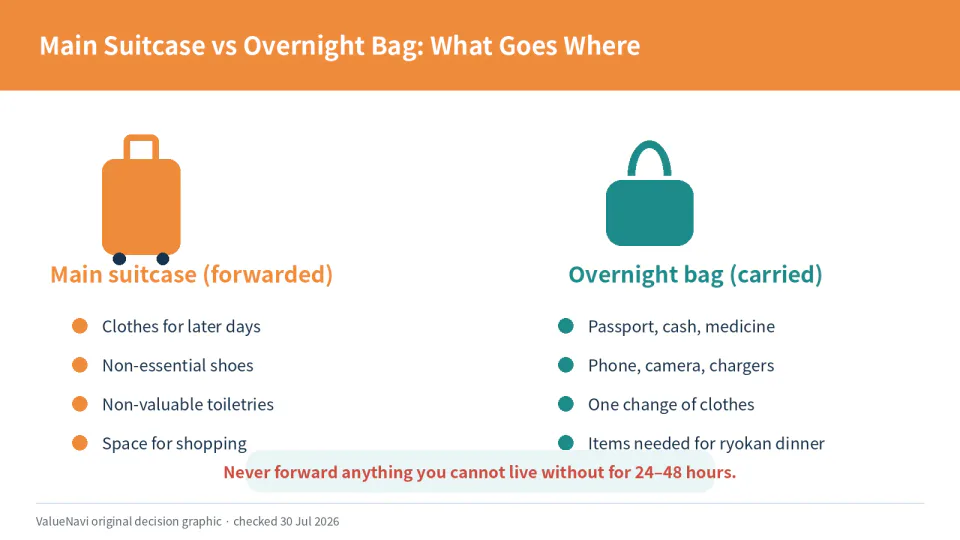
The most useful luggage strategy in Japan is often a skip-one-hotel transfer. Imagine a route such as Tokyo → Hakone → Kyoto, Tokyo → Kawaguchiko → Osaka, Takayama → one night in Shirakawa-go → Kanazawa, or Fukuoka → Yufuin → Beppu. The worst version is making a 29-inch suitcase follow every bus, local transfer, ryokan pickup and stairway simply because the hotel sequence has three addresses.
Instead, send the main case from the staffed city hotel to the hotel after the difficult one-night stop. Carry a small bag containing only the items you will actually need for one or two nights. The courier consumes calendar time while you use that same time to travel through the awkward segment.
This is a different type of value from “the suitcase arrives faster than I do.” The suitcase may arrive later. The gain is that you do not have to handle it during the part of the route where handling it is most expensive.
Use this pattern when: the skipped stop is one or two nights, the next receiving hotel has confirmed parcel acceptance, and you can live comfortably from a small bag.
Do not use it when: important medication, specialist clothing, children’s equipment or activity gear would make the small-bag compromise unrealistic.
Hotel-to-hotel forwarding starts with the receiving hotel, not the courier counter
Before sending anything, confirm that the destination hotel accepts prepaid luggage before check-in. Staffed business hotels and major chains often do; apartments, vacation rentals and lightly staffed properties can be completely different.
Yamato’s current guidance for private lodging is explicit: when an Airbnb-style accommodation has no reception staff, normal pickup/delivery service to that property is not available. You can drop luggage at a Yamato sales office or participating convenience store for shipment, but the receiving solution should be a staffed hotel or a Yamato sales office—not a convenience store used as a pickup address.
Give the sender the exact hotel name, branch, postal address, phone number, reservation name and check-in date. If your booking uses a different Romanisation from your passport or the reservation sits under another traveller’s name, tell the hotel in advance. The courier can deliver the parcel correctly and the hotel can still fail to identify whose suitcase it is.
“Next day” is a route property, not a promise you should copy into every itinerary
Yamato describes TA-Q-BIN as a next-day delivery network and says most areas can receive ordinary parcels the following day. But its own conditions and travel guidance make the boundary clear: islands, mountain regions, distance, bad weather and traffic can extend delivery.
This creates a simple planning rule: the more expensive it would be for the suitcase to arrive one day late, the larger your clothing/medication buffer should be.
For a normal Tokyo → Kyoto hotel transfer, keeping one day of essentials may be enough for a traveller comfortable with the route. For a cross-region route, ski trip, remote island or mountain stay, carry 24–48 hours of genuinely necessary items even if the estimated delivery date looks comfortable.
Do not use courier tracking as a substitute for a contingency bag. Yamato warns that bad weather and congestion can cause delays and that inconvenience caused by those delays is not necessarily compensated.
Same-day luggage delivery is a special product, not a default feature of Takkyubin
Selected Yamato counters offer same-day delivery, but the service area, acceptance cutoff and arrival window differ by counter. This makes “Can I send my suitcase from Tokyo hotel to Kyoto hotel this morning and use it tonight?” the wrong generic question.
The correct sequence is:
Find a specific counter that lists same-day delivery.
Confirm that the destination falls inside that counter’s service area.
Check the acceptance cutoff for your date.
Ask what happens if weather, traffic or luggage volume delays delivery.

If the trip only works when the suitcase is waiting at the next hotel by 18:00, ordinary hotel-to-hotel forwarding is not the right tool unless the operator explicitly confirms that timing. Carrying the bag may be less elegant but more resilient.
Airport delivery should be planned backward from the flight
Airport TA-Q-BIN is one of the highest-value uses of luggage forwarding because it can remove the suitcase from the last two or three days of a trip. It is also one of the easiest to misuse because the meaningful deadline is days before departure, not the morning of the flight.
Yamato currently instructs travellers to drop airport luggage off two days before departure, or three days before for some areas, by the sending counter’s deadline. The bag is delivered to the airport by the day before departure. Airport delivery also has size/weight conditions and an airport handling fee; the sender receipt is required when collecting the luggage.
Plan backward:
Flight day: collect the suitcase from the correct airport counter before check-in.
Day before: the bag should already have reached the airport.
Two or three days before: send it by the route-specific cutoff.
The most common failure is not “courier lost my bag.” It is deciding on airport forwarding one day too late and discovering that the counter cannot promise arrival for your flight.
When should you store the suitcase instead of forwarding it?
Storage wins when the same bag needs to stay geographically close to you.
Examples:
You are making a day trip and returning to the same city tonight.
Your hotel checkout is 11:00 but your train leaves at 17:00.
You need the suitcase again early the next morning and forwarding would add no meaningful transfer saving.
The next accommodation cannot reliably receive luggage.
Coin lockers are useful, but large lockers are a capacity gamble at busy stations. Yamato’s Hands-Free Travel network also includes staffed storage counters at selected locations. If a large suitcase is mission-critical, identify the staffed fallback before you arrive rather than discovering every XL locker is full while a reserved bus is boarding.
Storage is not the inferior version of forwarding. It is the correct tool when the suitcase should remain with the city rather than travel ahead.
Mountain routes: the suitcase problem is usually the last 500 metres, not the intercity train
Kamikochi, Shirakawa-go, Yufuin, parts of Hakone and many onsen/mountain routes create disproportionate luggage friction because the difficult section comes after the main train: local bus, narrow pavement, hotel shuttle, stairs, gravel or a long walk from the terminal.
A city-to-city suitcase can be surprisingly easy to carry on a reserved train. The same suitcase can become the worst part of the day when you are trying to board a rural bus with several other travellers carrying the same thing.
For Kawaguchiko and Hakone or Hakata to Yufuin, decide the luggage route before choosing an ambitious sightseeing sequence. A beautiful ryokan is not conveniently located simply because Google Maps shows a short distance from the bus stop.
The Shinkansen oversized-baggage rule is a separate decision from forwarding
On the Tokaido, Sanyo and Kyushu Shinkansen, baggage with total external dimensions over 160 cm and up to 250 cm requires a reservation for a seat with an oversized baggage area. SmartEX currently says bringing oversized baggage without the required reservation incurs an oversized-baggage handling fee; current Japanese guidance lists that fee as JPY 1,000.
This does not mean every 28- or 29-inch suitcase automatically exceeds 160 cm. Measure length + width + height including wheels and handles. And do not generalise this rule to every train in Japan: it is a specific Tokaido–Sanyo–Kyushu Shinkansen system.
If your suitcase is under the threshold and you only have one simple Shinkansen transfer, carrying it can be perfectly rational. Forwarding earns its value when it removes multiple hand-offs, not merely because a suitcase exists.
What should never leave your overnight bag?
Keep passports, medication, money/cards, keys, electronics, cameras, fragile valuables, irreplaceable documents and anything needed for the next 24–48 hours. Add one change of clothes, charging cables, weather protection and activity-specific essentials.
If the forwarded bag arrived a day late, the overnight bag should let the next day continue. That is the correct test.
For cold-weather or mountain travel, keep the warm layer and rain shell with you. For families, keep child medication, one complete change of clothes and bedtime essentials. For a ryokan stop, keep whatever you need before the forwarded suitcase rejoins you; do not rely on the property having every personal item.
Five cases where I would carry the suitcase instead
One short direct transfer: station elevator → reserved train → station elevator → hotel. The handling cost may be lower than losing access to the bag.
Same-day access is essential: you need the contents tonight and no specific same-day service is confirmed.
Unstaffed next accommodation: parcel acceptance is uncertain and a Yamato-office pickup would create more work than carrying.
Very short trip: the luggage would spend a disproportionate share of the holiday in transit.
Specialist gear: the contents are needed every day and cannot be replaced by an overnight bag.
Luggage forwarding should reduce friction, not become another schedule you have to manage.
Final verdict: forward the suitcase only when it deletes expensive handling
Send when the main suitcase can travel between confirmed staffed endpoints and doing so removes two or more difficult hand-offs. Store when you need the same bag later the same day or next morning. Carry when delivery uncertainty costs more than the effort of handling it. And for one-night mountain or onsen stops, send the main case past the stop whenever the overnight-bag strategy is realistic.
The mistake is treating takkyubin as a universal commandment. A courier cannot make a fragile itinerary robust if the receiving hotel cannot accept the bag, the airport deadline has passed or the clothes you need tonight are inside a suitcase still in transit. Forwarding saves handling; it does not remove calendar time.
Related planning
Kawaguchiko and Hakone Luggage Forwarding · Hakata to Yufuin Luggage Forwarding · Tateyama Kurobe Crossing · Hiroshima and Miyajima Two-Day Itinerary
Official sources
Yamato Hands-Free Travel · Yamato Airport TA-Q-BIN · Yamato private-lodging guidance · SmartEX oversized baggage rules. Checked August 25, 2026. Delivery dates, counter cutoffs and service areas vary by route and can change; confirm the estimated delivery date at the sending counter.