
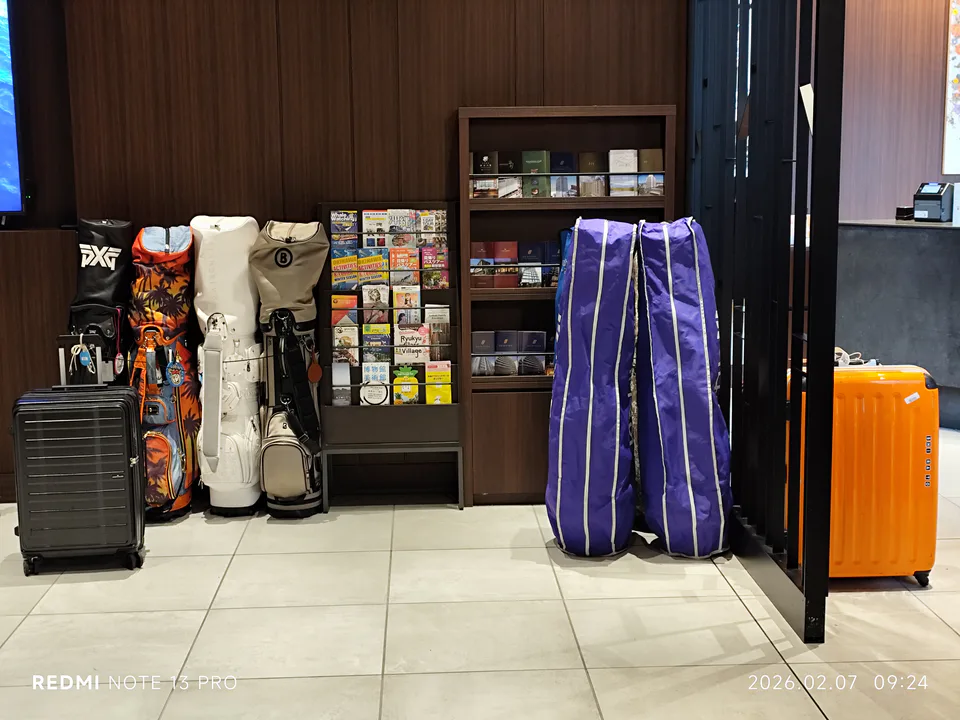
The best luggage strategy for Kawaguchiko and Hakone is usually not to forward the main suitcase to every overnight stop. If these are one-night or two-night mountain detours inside a longer Japan trip, send the big case past them to the next stable hotel—often Tokyo, Kyoto or Osaka—and travel through Fuji/Hakone with a small overnight bag.
That approach matters more for international visitors carrying a full-size suitcase through a multi-city itinerary. Kawaguchiko’s local same-day delivery service is station-to-participating-hotel, and Hakone’s local same-day service is Hakone-Yumoto-to-participating-hotel. They are separate local systems, not a same-day Kawaguchiko → Hakone luggage network. Trying to make the suitcase follow every hotel creates more handoff risk than simply letting it skip the awkward two-night segment.
ValueNavi luggage-routing table: where should the big suitcase actually go?
↔ Scroll table left or right
Itinerary | Best default for the large case | Carry with you | Main failure to avoid |
Tokyo → Kawaguchiko → Tokyo | Leave it at the Tokyo hotel or forward to the return Tokyo hotel | One-night bag | Dragging the case to Fuji only to bring it back |
Tokyo → Hakone → Tokyo | Leave/forward it in Tokyo, or use Hakone-Yumoto same-day service if the hotel participates | One-night bag | Taking a full-size case around the Hakone loop |
Tokyo → Kawaguchiko → Hakone → Tokyo | Forward to the return Tokyo hotel | Two-night bag | Assuming Kawaguchiko local delivery connects to Hakone same day |
Tokyo → Kawaguchiko → Hakone → Kyoto / Osaka | Forward from Tokyo directly to the Kansai hotel | Two-night bag plus delay essentials | Changing the delivery destination every night |
Mount Fuji climb / 5th Station detour | Leave it at a stable hotel or staffed storage | Climbing pack only | Building collection around a descent time you cannot guarantee |
ValueNavi rule: the suitcase should follow the stable accommodation chain, not the sightseeing chain. If you change mountain hotels every night, the overnight bag moves with you; the big case does not need to.
The “next stable hotel” rule is safer than forwarding every night
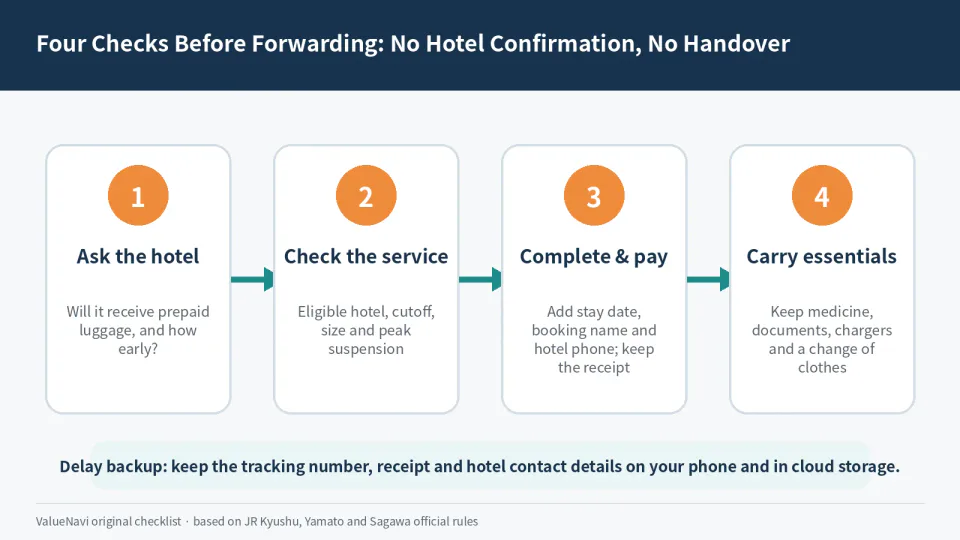
Yamato’s current hotel-to-hotel guidance says forwarding is possible when the sending location works with Yamato and the destination has a front desk that can receive luggage. It also tells travellers to arrange delivery so the bag reaches the destination accommodation at least one day before the stay. Both hotels should be confirmed in advance.
That creates a useful planning principle for a Tokyo–Fuji–Hakone–Kansai trip. Instead of Tokyo → Kawaguchiko hotel → Hakone hotel → Kyoto hotel, use Tokyo → Kyoto hotel for the large suitcase and carry a two-night bag through Kawaguchiko and Hakone. You remove two receiving handoffs and stop caring whether the mountain hotels use the same carrier or local service.
This is not “free convenience”: you must live without the main suitcase for a couple of nights. Pack medication, chargers, weather layers, underwear, one change of clothes and anything you cannot replace easily. But for a short mountain detour, that inconvenience is often smaller than moving a hard-shell case through buses, stairs, station queues and hotel cut-offs.
Hidden-cost table: carrying the suitcase is not actually free
↔ Scroll table left or right
Strategy | Cash cost | Hidden cost | Best fit |
Carry the main case everywhere | No delivery fee | Bus-hold uncertainty, stairs, storage search, slower transfers, less flexible sightseeing | Few transfers and one manageable case |
Forward to every hotel | Multiple delivery charges | Multiple labels, receiving confirmations and missed-handoff risk | Longer stays with generous delivery buffers |
Forward past Fuji/Hakone | One longer delivery | You need a correctly packed overnight bag | Short Kawaguchiko/Hakone detours in a multi-city Japan trip |
Local same-day service | Fixed per-bag fee where available | Hard cut-off and participating-hotel requirement | One-area sightseeing after arriving early enough |
Kawaguchiko local delivery: useful inside the area, not a bridge to Hakone
Fujiyama Luggage Delivery currently operates between Kawaguchiko Station and participating local accommodation. The published price is ¥2,000 per piece, one way. For station → hotel delivery, reception is 10:00–13:00 with hotel collection around 16:00. For hotel → station, handover is by 10:00 and collection at Kawaguchiko Station is 13:30–17:00.
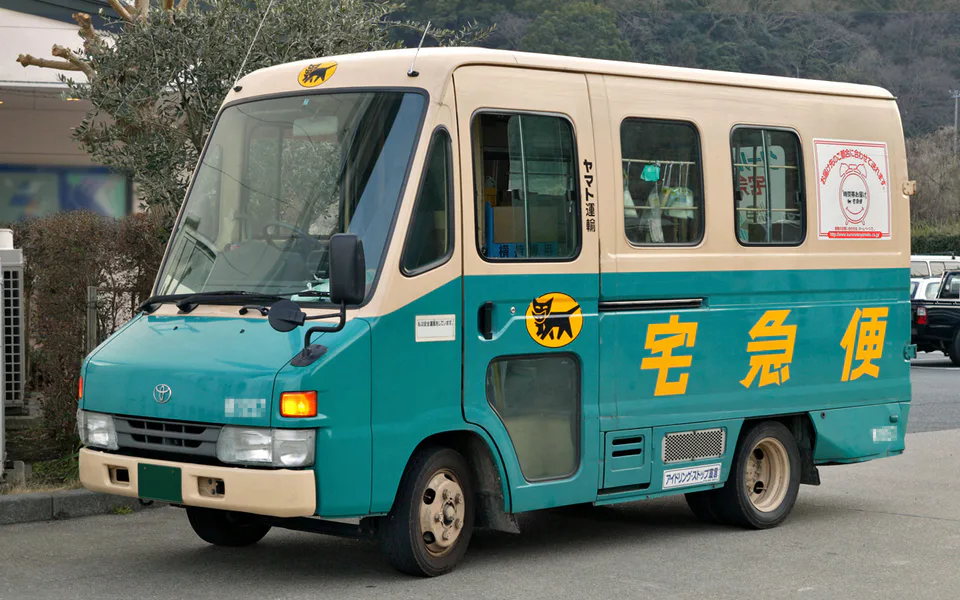
This is valuable when you arrive at Kawaguchiko Station and want to sightsee without the case before checking in. It does not mean the bag can be handed over in Kawaguchiko and appear in Hakone later that day. If Hakone is the next night, the safer route is usually to keep the big suitcase out of both stops entirely.
Hakone-Yumoto same-day delivery works only before the cut-off
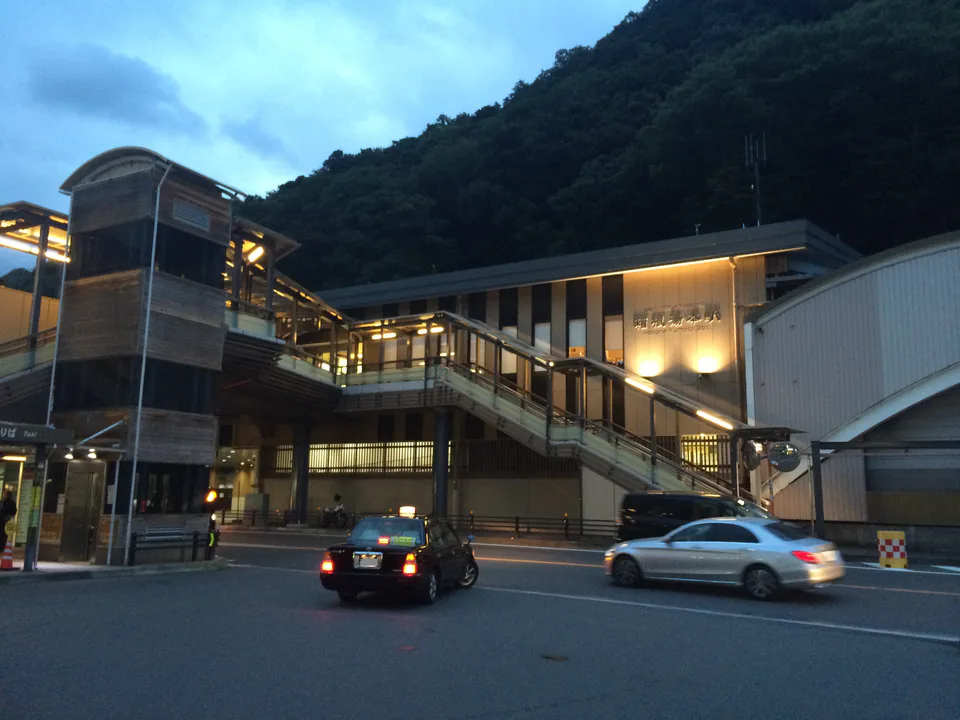
The official Hakone Luggage Transport Service accepts bags at Hakone-Yumoto Station from 08:30 to 12:00 for delivery to participating accommodation after 15:00. Same-day online reservations close at 11:30, but the bag still has to be handed over by noon.
Current one-way prices are ¥1,500 for a regular piece up to 140cm total dimensions and 15kg, and ¥2,500 for a large piece up to 200cm and 30kg. On the return, participating hotels accept bags by 10:00 for collection at Hakone-Yumoto Station from 13:30 to 18:30.
This service is excellent for the classic pattern: arrive early from Tokyo, hand over the case, do the Hakone loop before check-in, then collect the luggage at the ryokan. It is much less useful when you reach Yumoto after noon. A late arrival should trigger a different plan—storage, direct hotel transfer or sightseeing after checkout—not wishful thinking about the cut-off.
Large luggage on Fuji Excursion and highway buses: legal does not mean convenient
JR East’s general luggage rule allows up to two pieces free of charge, each no more than 250cm in total dimensions, no more than 2m long and no more than 30kg. The Fuji Excursion uses JR East’s general large-luggage guidance rather than the Tokaido Shinkansen reserved oversized-baggage-seat system.
That tells you what can be brought aboard; it does not promise that taking a large suitcase is pleasant on every departure. You still have to store and secure the bag without blocking aisles or seats.
Fujikyu’s current highway-bus guidance is more operationally restrictive: the underfloor trunk is generally limited to about one suitcase-size item per passenger, and the operator warns that baggage may be refused at the boarding point if the trunk is already full. That uncertainty is exactly why “the bus has a luggage hold” should not be the entire mountain-luggage strategy for a family carrying several large cases.
The 48-hour continuity bag: what must stay with you
When the big suitcase skips Kawaguchiko and Hakone, the smaller bag has to keep the trip functional even if delivery is delayed. I would keep passports, cash/cards, tickets, medication, glasses/contact-lens supplies, phones, chargers, power banks, camera essentials, weather layers, sleepwear, underwear, socks and at least one full change of clothing with me.
For families, add the child-specific items that cannot wait for the next hotel. For an onsen ryokan, add whatever clothing or personal items you need before the forwarded case returns. The test is simple: could you complete the next two nights if the main suitcase were one day late? If not, the overnight bag is under-packed.
Five failure modes that matter more than the delivery fee
1. The receiving hotel cannot accept the bag. Confirm the exact property, booking name, check-in date and receiving policy before handover. Similar hotel names are an avoidable source of error.
2. You plan for same-day Kawaguchiko → Hakone forwarding. The local Fuji and Hakone services do not form one same-day inter-area network.
3. You reach Hakone-Yumoto after noon expecting station-to-hotel delivery. The same-day reception window is already over.
4. Your bus plan assumes unlimited trunk space. Fujikyu explicitly says the trunk can fill and baggage may then be refused.
5. The essentials are inside the forwarded case. A technically successful delivery can still damage the trip if medication, chargers or weather gear arrive after you need them.
What I would do on the most common international itineraries
Tokyo → Kawaguchiko → Hakone → Kyoto: send the large suitcase from Tokyo to Kyoto, timed to arrive before the Kyoto stay, and carry a two-night bag through the mountain section. This is the strongest use case for bypass forwarding because both Fuji and Hakone contain transport where a large case reduces flexibility.
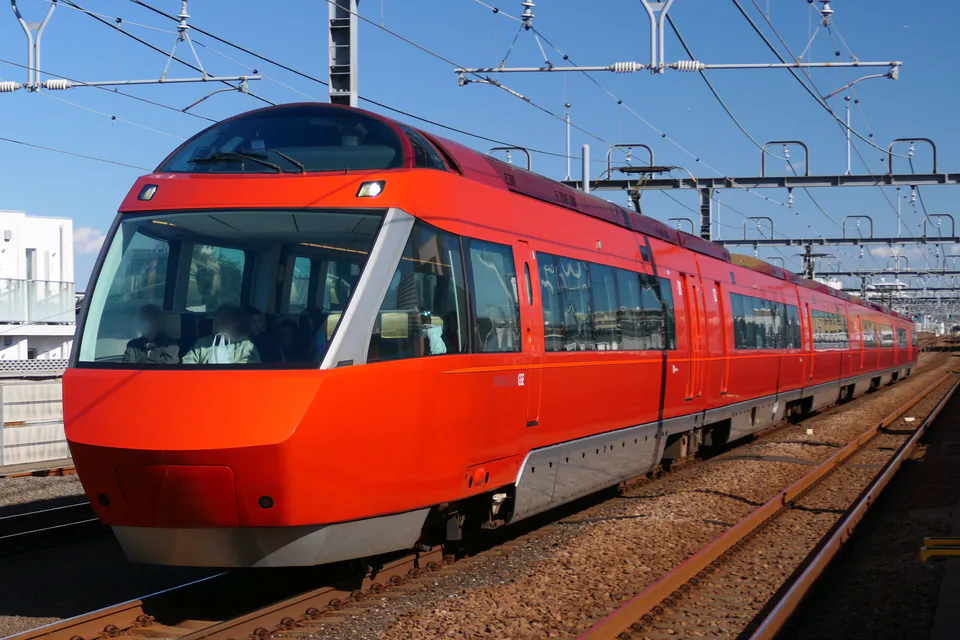
Tokyo → Hakone → Tokyo: if the same Tokyo hotel will store the case, leave it there. If not, send it to the return hotel after confirming receipt. Use Hakone-Yumoto’s local service only if you actually need the large bag at the ryokan that night.
Tokyo → Kawaguchiko → Tokyo: the case rarely needs to leave Tokyo for a one-night stay. Kawaguchiko’s local service is most useful when the suitcase is already travelling with you and you need hands-free sightseeing between station arrival and hotel check-in.
If the route itself is still undecided, settle Tokyo–Kawaguchiko–Hakone itinerary order and Tokyo to Hakone transport before choosing the luggage service. Luggage should follow the route design, not dictate it by accident.
Final verdict: skip the awkward segment, not just the awkward transfer
For one- or two-night Kawaguchiko/Hakone stops, my default is to forward the main suitcase to the next stable hotel and carry a 24–48-hour bag. It reduces the number of handoffs, protects buses and mountain transport from becoming luggage exercises, and gives you a clean fallback when local same-day cut-offs do not fit.
Use Kawaguchiko’s ¥2,000 local service when you need station-to-hotel convenience inside Kawaguchiko. Use Hakone-Yumoto’s ¥1,500/¥2,500 service when you arrive before noon and the ryokan participates. Those are excellent local tools, but they should not be mistaken for a cross-region forwarding chain.
The red-team condition is this: if you are staying three or four nights in one mountain area, need most of the contents of the large case, or cannot confirm the downstream hotel will receive luggage, bypass forwarding may stop being the best option. The strategy is strongest when the detour is short and the next stable hotel is already known.
Related planning
Japan luggage forwarding guide · Hakone loop timing · Kawaguchiko or Fujiyoshida
Sources
Yamato Transport hotel-to-hotel guidance
Fujiyama Luggage Delivery official service
Hakone Luggage Transport Service official page
JR East oversized-luggage guidance
Delivery times, participating hotels, cut-offs, prices and baggage rules can change. Confirm the exact receiving hotel and official service immediately before handing over luggage.