
If you have one day in Kawaguchiko, do not try to complete a list of attractions. Spend the first clear Mount Fuji window on one strong viewpoint, then add only one or two activities that still make sense if the mountain disappears. For most first-time visitors, that means Oishi Park or another north-shore viewpoint first, then the Mt. Fuji Panoramic Ropeway or a lake cruise, followed by one weather-proof stop. Fuji-Q Highland should normally be its own day rather than the final item on a lake itinerary.
The 2026 transport picture has also changed. Since July 17, a new boat route links Funatsu Pier near the ropeway directly with Oishi Park in about 15 minutes. That gives car-free travellers a real alternative to the Red-Line sightseeing bus during its operating hours. It does not turn Oishi Park into a late-evening boat destination: the final return sailing leaves Oishi in the afternoon, with the exact cutoff changing by season.
Checked August 25, 2026. Ropeway, boat and Fuji-Q operations can change because of wind, lightning, maintenance, water conditions or ride closures. Use the current operating page on the day rather than treating the schedule below as a guarantee.
↔ Scroll table left or right
Your usable time | What I would do | What I would cut first |
About 6 hours | One Fuji-view zone + ropeway or boat + one flexible indoor/food stop | Fuji-Q, museum-hopping and a second lake circuit |
One full day | North shore/Oishi + one Funatsu attraction block + one weather backup | Any attraction added only because it is nearby |
One night / two usable days | Use an early/late lake window, then give the second day a separate job | A second hotel unless it materially changes the route |
Fuji-Q is a trip priority | Give the park the full day | Do not bolt a full north-shore loop onto the same ticketed park day |
Fuji is hidden for most of the day | Museums, cafés, onsen and one low-effort lake activity if conditions allow | Paying repeatedly for new viewpoints in the hope that clouds disappear |
Start with the first clear Fuji window, not the attraction with the earliest booking
Mount Fuji visibility is the scarce resource in this itinerary. Ropeway tickets, cafés and museums can often be moved within the day; a clean view can disappear behind cloud for hours. That makes the first planning question very simple: if Fuji is clearly visible now, where can I use that visibility with the least friction?
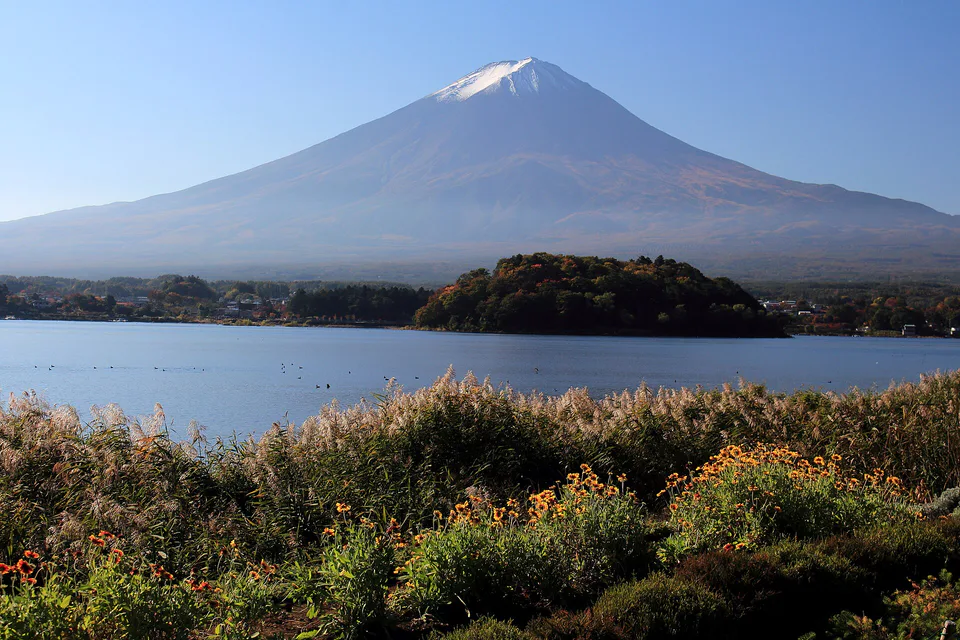
For an overnight guest with an easy north-shore route, Oishi Park is unusually useful because the park itself is open at all times and has no admission fee. The official local tourism site places it about 30 minutes from Kawaguchiko Station by the Red-Line sightseeing bus during normal service, but the park is not dependent on an attraction opening time. If your hotel, taxi or car makes an early visit realistic, you can use the view before the ropeway and cruise have opened.
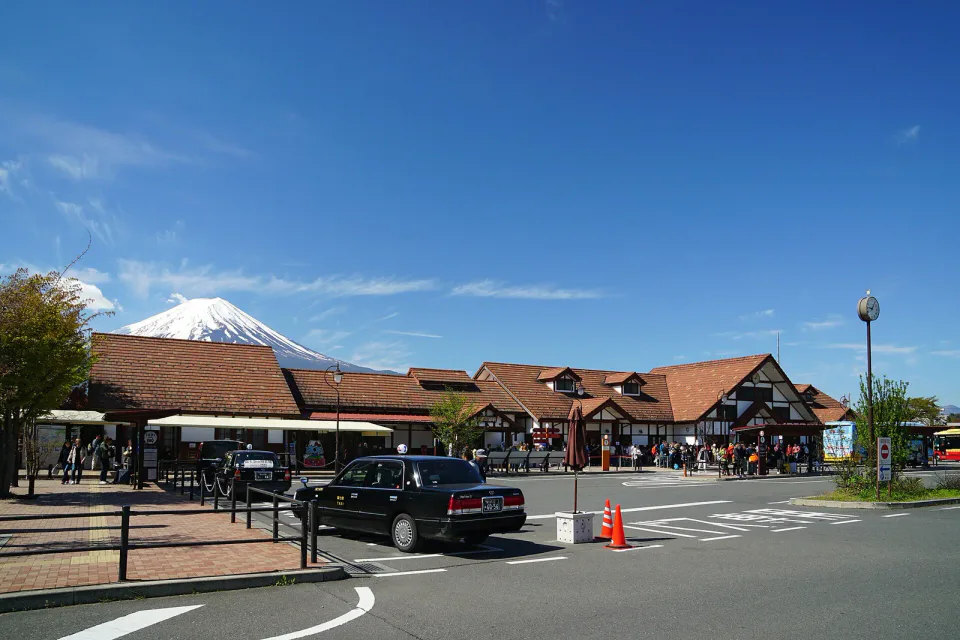
For a day-tripper arriving at Kawaguchiko Station around 09:00, the choice is more tactical. A clear mountain can justify going north first, but only if the transfer does not consume the same clear window. If the ropeway area is already close and visibility is excellent, taking the elevated view immediately can be more rational than spending the next half hour moving around the lake.
This is why a fixed “Oishi → ropeway → boat → museum” itinerary is weaker than a visibility-first decision tree. The correct order can reverse on the morning you travel.
Oishi Park is the best low-commitment Fuji-view stop — but the return journey matters
Oishi Park works because the basic experience is simple: lake, flowers, an open shoreline and Mount Fuji. There is no admission gate, and you do not need to justify the stop with a long attraction visit. On a clear day, 45–90 minutes can be enough unless seasonal flowers, photography or cafés are a major purpose of the trip.
The hidden cost is that the north shore is not the same transport zone as the ropeway/Funatsu side. Until 2026, a car-free visitor largely had to think in terms of the Red-Line bus, taxi or a much longer walk. The new Oishi Park Line changes that in the middle of the day.
Fuji Five Lakes Cruises began the new Oishi Park Line on July 17, 2026. The boat links Funatsu Pier and Oishi Park in about 15 minutes. The current one-way fare is JPY 1,000 for adults and JPY 500 for children. The operator explicitly says the route was introduced as another way to reach Oishi Park and to help disperse demand from crowded route buses.
That makes a useful 2026 sequence possible:
Kawaguchiko Station / ropeway area
→ Funatsu Pier
→ 15-minute Oishi Park Line
→ Oishi Park
→ return by boat, bus or taxi
But do not confuse “new boat access” with “flexible all-day access.” Current departures from Oishi end at 15:50 in the normal season, 16:45 in the summer/GW pattern and 14:50 in winter. The boat is excellent for a daytime loop; it is not your solution for a sunset that finishes after the last sailing.
If your real goal is autumn illumination or a late lakeside dinner, use the Kawaguchiko or Fujiyoshida accommodation guide to solve the overnight location first rather than depending on a daytime transport product.
Ropeway or sightseeing boat: they are different viewpoints, not mandatory twins
The Mt. Fuji Panoramic Ropeway and the sightseeing boat sit close enough together that travellers often treat them as one package. They are not the same experience.
↔ Scroll table left or right
Question | Ropeway | Sightseeing boat Appare |
What are you buying? | Elevation: a high panorama over the lake toward Fuji | Low-effort lake time and views from the water |
Current adult fare | JPY 1,000 round trip | JPY 1,000 |
Typical ride time | About 3 minutes each gondola leg, plus summit time and queue | About 20 minutes around the lake |
Main weather weakness | Wind, thunder and poor visibility | Wind/water conditions and poor visibility |
Mobility issue | Official site lists 64 stairs at the lakeside station and 112 at the upper station; wheelchair movement is difficult | Lower walking load, but check current boarding assistance for your specific mobility need |
Best for | Clear Fuji day, first visit, panoramic photography | Families, older travellers, a short lake experience, or a lower-effort midday block |
The ropeway currently operates 08:30–17:00, with the final descent at 17:20; from July 20 to August 31 it runs to 18:00 with the final descent at 18:20. The operator says gondolas generally run every five to ten minutes and explicitly recommends the morning as easier for avoiding crowds. The summit viewpoint is at about 1,075 metres.
The Appare sightseeing boat currently runs on a seasonal timetable, roughly every 30 minutes during its operating window. The operator lists the regular season as 09:00–16:30, the summer/GW period to 17:30 and winter 09:30–16:00, with weather and designated closure days still able to change operations.
My default first-trip answer is ropeway if the mountain is clear and mobility is not a problem; boat if the group wants a lower-effort lake experience. Do both when you genuinely want two different perspectives and the queues are reasonable. Cut one when the mountain is hidden, the day is short or the return transport already has a hard deadline.
The bundle price only saves money if you would have bought both anyway
The ropeway currently sells a Ropeway & Cruise set for JPY 1,700 for adults. The individual adult fares are JPY 1,000 for the ropeway round trip and JPY 1,000 for the Appare cruise, so the set saves JPY 300 against buying those two products separately.
That is a real discount, but it is not a reason to add the boat. If your six-hour itinerary already contains Oishi Park, the ropeway, lunch and a reserved return train, spending another 20 minutes on the lake plus boarding time may be worse value than saving JPY 300. A discount only matters after the activity survives the itinerary test.
There is also a current Ropeway & Oishi Park Shuttle set at JPY 2,500 for adults, combining the ropeway with a round trip on the new Oishi Park Line. Bought separately at current fares, that combination would total JPY 3,000. For a car-free visitor who already wants both the summit and Oishi Park, this is a more interesting 2026 transport-and-attraction package than adding the lake cruise by habit.
Fuji-Q Highland is not the fourth Kawaguchiko attraction — it is another day
Fuji-Q Highland is close enough to Kawaguchiko that it looks easy to add after the lake. That is a map illusion. The park currently sells a date-priced adult one-day pass from JPY 6,000 to JPY 7,900, and its 2026 operating calendar shows many autumn dates running from the morning into the evening. Ride closures and weather conditions can change by day.
Once you have paid for a day pass, queue time and ride availability become the scarce resources. Leaving in the middle of the day for Oishi Park or the ropeway converts the park ticket into an expensive partial-day product. The reverse is also true: arriving at Fuji-Q at 15:00 after a full lake circuit does not create a normal theme-park day.
I would separate them:
One Kawaguchiko day: lake / Fuji views. Skip Fuji-Q unless it is the reason for the trip.
Two usable days: one lake-and-Fuji day + one Fuji-Q day is a clean split.
Fuji-Q is the priority: stay where the park and station work best, then give the lake its own morning if time remains.
The Kawaguchiko vs Fujiyoshida guide becomes more useful than a generic “things to do” list once the park owns a full day.
Six hours in Kawaguchiko: choose one view zone and one paid attraction
Six usable hours is common for a Tokyo day trip after transport. It is enough for a strong visit, but only if the itinerary stops pretending that every famous pin is nearby.
A robust six-hour version is:
First clear window: Oishi Park / north shore or the ropeway.
Second block: one paid attraction — ropeway if you started north, or Appare if you want low-effort lake time.
Final flexible block: lunch, café, one museum or onsen depending weather and return time.
Do not add Fuji-Q. Do not visit three north-shore museums because the bus stops have similar names. Do not wait until the last hour to cross the lake if a reserved Fuji Excursion or highway bus controls the return.
This is where the Fuji Excursion booking guide becomes part of attraction planning: once the return train is fixed, every extra stop has to fit before the station buffer rather than before the attraction’s closing time.
A full day: the best itinerary has one point you are willing to delete
With a complete day, I would usually plan three blocks:
Morning: strongest Fuji-view opportunity — Oishi/north shore or ropeway depending visibility and transport.
Midday: Funatsu zone — ropeway/boat/lunch, or use the new boat to move between Funatsu and Oishi instead of repeating a bus leg.
Afternoon: one museum, café, onsen or Fujiyoshida stop that still works if Fuji disappears.
Before leaving the hotel or station, identify the expendable block. If the ropeway queue is long, delete the boat. If cloud arrives after Oishi Park, delete another paid viewpoint and keep the museum. If the Oishi boat stops because of weather, switch to bus/taxi rather than sacrificing the return connection.
A day with no deletable block is not a flexible itinerary; it is a timetable that needs everything to go right.
One night: the hotel should buy a second weather window, not just another bed
An overnight is strongest when it creates a view opportunity that a Tokyo day trip cannot reproduce easily: an early lakeside hour, sunset, a ryokan/onsen evening or a second morning before the return trip. It is not valuable simply because Mount Fuji is famous.
Use the first day for whichever weather window is available. If Fuji is hidden at 14:00, stop spending the afternoon chasing different viewpoints. Use the hotel, museum or onsen, then reset for the next morning. The extra night is buying optionality.
The second day needs a job beyond “try the same view again.” Good reasons include Fuji-Q, photography, a slower Oishi/north-shore day, a separate Fujiyoshida/Chureito block, or onward travel toward Hakone. If the only plan is another identical lake circuit, the how many nights at Lake Kawaguchi guide may push the second night elsewhere.
Cloudy day: stop treating every attraction as another chance to see Fuji
Cloud can move quickly, but there is a point where repeated viewpoint spending becomes poor planning. If the mountain is fully hidden and the forecast remains weak, ropeway + boat + two north-shore viewpoints do not create four independent chances. They create four versions of the same weather dependency.
Keep one low-cost view check, then move the day toward:
one north-shore museum rather than several;
a café or slower lunch;
hotel or day-use onsen if available;
Fujiyoshida streets or another town activity if the route is straightforward;
Fuji-Q only if it was already a real priority and rides are operating — not as a last-minute consolation purchase.
The trip should still have value when Fuji does not appear. If it does not, the better decision may be shortening Kawaguchiko rather than spending more to defend a bad-weather day.
Families and older travellers: remove transfers before removing attractions
For a family with a stroller or an older traveller, the best day is often geographically smaller. The boat can be attractive because it turns part of the journey into seated sightseeing. The ropeway can be a poor fit for some mobility needs because the operator explicitly lists substantial stairs at both stations and says wheelchair movement is difficult.
Do not use a generic “family-friendly” label. Ask what the group actually has to do between attractions. A theoretically easy museum reached after two bus changes can be worse than a more popular attraction beside the current stop. One zone per half day is a sensible ceiling for many groups.
If the accommodation includes a private bath and the family will genuinely use it, going back to the hotel at 16:00 can be better value than adding one more attraction before dinner. Hotel time is not wasted time when it was part of the reason you paid to stay by the lake.
Final verdict: Kawaguchiko gets better when you deliberately leave things out
For a first one-day visit, I would prioritise one strong Fuji-view zone + the ropeway or boat + one weather-independent block. Oishi Park remains the simplest north-shore viewpoint, and the new 2026 Oishi Park Line makes a daytime Funatsu–north-shore loop much easier without relying only on the Red-Line bus. The ropeway is my first paid choice on a clear day if stairs are not a problem; the sightseeing boat is the lower-effort alternative.
Do both only when the mountain is visible, queues are reasonable and the schedule genuinely has room. Give Fuji-Q a separate day. If you stay overnight, use the extra night to buy an early/late lake window and a second weather chance, not permission to collect more attractions.
The question that should end every add-on is: if I delete this stop, does the Kawaguchiko day actually become worse — or just less complete on paper?
teamLab Borderless Tokyo Review: Is It Worth 2–3 Hours of Your Tokyo Trip?
Hakone vs Kawaguchiko: Which Is Better for Your First Japan Trip?
Things to Do in Kyoto: 1-, 2- and 3-Day Itineraries for First-Time Visitors
References
Mt. Fuji Panoramic Ropeway — current fares, hours and accessibility · Mt. Fuji Panoramic Ropeway — official morning crowd guidance · Fuji Five Lakes Cruises — Appare and Oishi Park Line schedules · Fujikawaguchiko tourism — Oishi Park opening and access · Fuji-Q Highland — current operating calendar. Checked August 25, 2026.