
For a first Nara day trip, make Tōdai-ji the fixed point and treat everything else as optional. With about four usable hours, do Nara Park, the Great Buddha Hall and one compact finish. With six to eight hours, add either Kasuga Taisha for a longer eastern walk or Naramachi for cafés and old streets. Only try to do both when you arrive early, the weather is comfortable and the group still has walking capacity after lunch.
The route should also match the station you actually use. Kintetsu Nara is the cleaner default for the standard park-and-temple day because Nara Park begins only a short walk away and Tōdai-ji is about a 19-minute walk from the station. JR Nara can still be the right choice for a JR-based itinerary, but the official Nara guide puts the park roughly 15–20 minutes away on foot before the main sightseeing has even started.
Checked August 25, 2026. Tōdai-ji, Kasuga Taisha and seasonal events can change hours for ceremonies or special operations. Recheck the exact date if the day depends on a final admission time.
↔ Scroll table left or right
Usable time in Nara | Route I would choose | First thing to cut |
About 4 hours | Kintetsu Nara → Nara Park → Tōdai-ji → Kōfuku-ji/Sarusawa or compact Naramachi finish | Kasuga Taisha deep extension |
6–8 hours | Tōdai-ji + one full eastern or old-town branch | Do not force both Kasuga Taisha and a long Naramachi wander if walking is already slow |
Full early-start day | Tōdai-ji early → Kasuga Taisha → lunch → Naramachi / station-side finish | Extra temples that require backtracking |
Young children / older travellers / summer heat | Tōdai-ji + shorter park loop + Naramachi or bus-assisted return | Long forest approach simply for completeness |
Seasonal evening event | Keep the afternoon deliberately light | Do not spend all walking energy before the night event begins |
Tōdai-ji should be the anchor because it has the strongest time asymmetry
Tōdai-ji’s Great Buddha Hall is the easiest major Nara sight to use early. The temple currently opens the Great Buddha Hall at 07:30 from April through October and 08:00 from November through March. It closes at 17:30 in the warmer-season schedule and 17:00 in winter. Adult admission is currently JPY 800.
That matters because many first-time visitors waste the best early hour feeding deer near the station and only reach the main temple after the park has filled. The deer do not disappear at 10:00. Tōdai-ji’s quieter early window does.
For an early arrival, I would therefore reverse the usual tourist instinct:
Walk through the park without turning the first deer cluster into a 45-minute stop.
Use the early access at Tōdai-ji.
Spend more time with the deer after the main temple is already secured.
This is a ValueNavi priority decision rather than an official sightseeing route. The underlying fact is simply that Tōdai-ji opens early; the editorial conclusion is that the early opening is more time-sensitive than deer feeding.
Kintetsu Nara is the default for the park day; JR Nara is a route decision, not a mistake
Nara Park’s official travel guide puts the park about five minutes on foot from Kintetsu Nara and around 15–20 minutes from JR Nara, depending on the point used. Tōdai-ji is listed about 19 minutes on foot from Kintetsu Nara, while Kasuga Taisha is about 25 minutes away.
That makes Kintetsu the cleaner starting point for a visitor whose entire assignment is “Nara Park + Tōdai-ji + eastern sights.” You spend less of the first hour on city-side approach walking.
JR Nara can still win when the hotel, rail pass or onward route makes the JR platform substantially easier. The relevant comparison is not Kintetsu fare versus JR fare; it is:
hotel door → departure platform
+ train
+ arrival station → first real sight
If the wider choice is still unresolved, use Nara from Kyoto or Osaka. This page assumes Nara is already on the itinerary and decides what deserves the hours once you arrive.
Four hours: Tōdai-ji plus one compact finish is enough
A half-day Nara visit fails when it tries to imitate a full-day route at twice the speed. If you only have roughly four hours between station arrival and departure, keep the walking line short.
I would use:
Kintetsu Nara
→ Nara Park / Nandaimon
→ Tōdai-ji Great Buddha Hall
→ deer / park time
→ Kōfuku-ji / Sarusawa Pond OR a short Naramachi finish
→ station
The important deletion is Kasuga Taisha. That is not because the shrine is less important. Its forest-side position turns it into an additional outward leg at exactly the point when a short visit needs to begin folding back toward the station.
Choose Naramachi instead when the group wants lunch, cafés, shops and a more sheltered finish. The official Nara guide describes Naramachi as a compact area roughly one kilometre across and a short walk south of Kintetsu Nara, so it is easier to stop when the clock says the day is over.
Six to eight hours: choose Kasuga Taisha or Naramachi by energy, not prestige
With a normal full sightseeing day, Tōdai-ji and the deer no longer consume the whole itinerary. The key decision becomes how you want the second half of the day to feel.
Choose Kasuga Taisha when the forest approach, shrine architecture and lantern atmosphere are a major part of why you chose Nara. General worship hours currently run from 06:30–17:30 from March through October and 07:00–17:00 from November through February. Special admission inside the cloister is currently 09:00–16:00 and costs JPY 700, with closures or shortened access on ceremonial dates.
Choose Naramachi when the group is temple-saturated, hungry, hot, wet or simply wants the final two hours to become less structured. Shops and traditional streets give the day a different texture, and the compact grid lets you leave for Kintetsu or JR Nara without another deep excursion into the park.
Trying to do both can work for fit adults with an early start. It is not the default I would give a family, an older traveller or anyone already carrying several Kyoto walking days in their legs.
Kasuga Taisha has a 16:00 decision point that maps do not show
A route planner can tell you how far Kasuga Taisha is from Tōdai-ji. It cannot tell you that the optional paid inner-cloister experience currently stops accepting visitors at 16:00. That creates a practical boundary.
If seeing the inner side of the cloister and Fujinami-no-ya lantern hall matters, arrive with enough time before 16:00 and check ceremony closures for that date. If you only want the general shrine approach and worship area, the day has more flexibility.
This distinction matters because “Kasuga Taisha closes at 17:30” can be technically true for general worship in season while still being useless for the specific paid experience you intended to buy. Always plan to the component you care about, not the latest time printed anywhere on the attraction page.
Deer are a wild-animal interaction, not a photo prop
Nara’s deer are accustomed to people, but the Nara Deer Preservation Foundation explicitly warns that they remain wild animals and can behave aggressively. The foundation advises visitors not to touch them unnecessarily and to give deer crackers promptly rather than teasing an animal by repeatedly withholding food.
The official Nara tourism guide also says shika senbei are the only food tourists should give the deer. Keep paper, maps and your own food out of reach; deer can mistake them for something edible.
This changes the family route in a practical way. A small child is closer to a deer’s head height, and the preservation foundation specifically warns that children face a higher risk from charging or head-butting. I would therefore:
feed in a quieter open section rather than inside the first crowd near the station;
keep bags, maps and snacks closed before buying crackers;
give the cracker instead of making the deer chase it for a photograph;
move away once the crackers are gone rather than remaining in the centre of a feeding cluster.
The goal is not to make the deer “dangerous.” It is to stop planning as though a wild-animal interaction has zero operational cost.
Families and older travellers should decide the turnaround point before lunch
The eastern Nara route is deceptive because each individual extension looks small. Tōdai-ji to another hall; then farther through the park; then Kasuga Taisha; then perhaps the botanical garden or another path. The problem appears only when the group has to walk the whole distance back.
Before lunch, choose one turnaround rule:
If everyone still feels strong: continue to Kasuga Taisha.
If the heat, rain or steps are already accumulating: turn toward the central park / Naramachi side.
If one person is struggling: use a bus or taxi from the park edge rather than preserving an attraction count.
Nara’s official guide itself notes that the park is best explored on foot but that buses and taxis are useful for opposite sides of the area. Using one short ride is not “failing the walking itinerary.” It can preserve the only part of the day everyone still enjoys.
Rain and summer heat should change the route, not just the umbrella
In sustained rain, a long deer-and-forest route loses more value than Tōdai-ji or Naramachi. Keep the Great Buddha Hall, shorten open park time, then move toward covered interiors, cafés and the old-town grid. Tōdai-ji Museum can be paired with the Great Buddha Hall using a current joint ticket, while Naramachi’s shops and old townhouses provide more shelter than a long eastern park walk.
In summer, use Tōdai-ji’s early opening to move the longest outdoor walking block forward. Kasuga Taisha becomes an optional morning extension rather than a 15:00 obligation after hours in the sun.
The general rule is: bad weather should remove distance before it removes the strongest sight. Do not keep all the attractions and merely walk them faster.
A transfer day through Nara only works when the luggage has another plan
Nara sits neatly between parts of a Kyoto–Osaka itinerary, which makes it tempting to check out of Kyoto, sightsee in Nara with every suitcase, then continue to Osaka. That can work only when the baggage leg has been solved first.
A Nara day is largely a walking day. Dragging a full-size case through the park destroys the exact flexibility that makes the itinerary work. If Nara is a transfer-day stop, forward the main luggage, leave it at a verified storage point, or structure the railway so you do not have to backtrack across the city at the end.
The Japan luggage-forwarding guide is useful here. The success condition is not “a locker exists somewhere.” It is that the luggage plan does not force you to return to the wrong station after the sightseeing route has already finished elsewhere.
When should you stay overnight instead of returning to Kyoto or Osaka?
Do not book a Nara hotel simply because one day feels busy. Stay overnight when the night or early morning itself has a purpose:
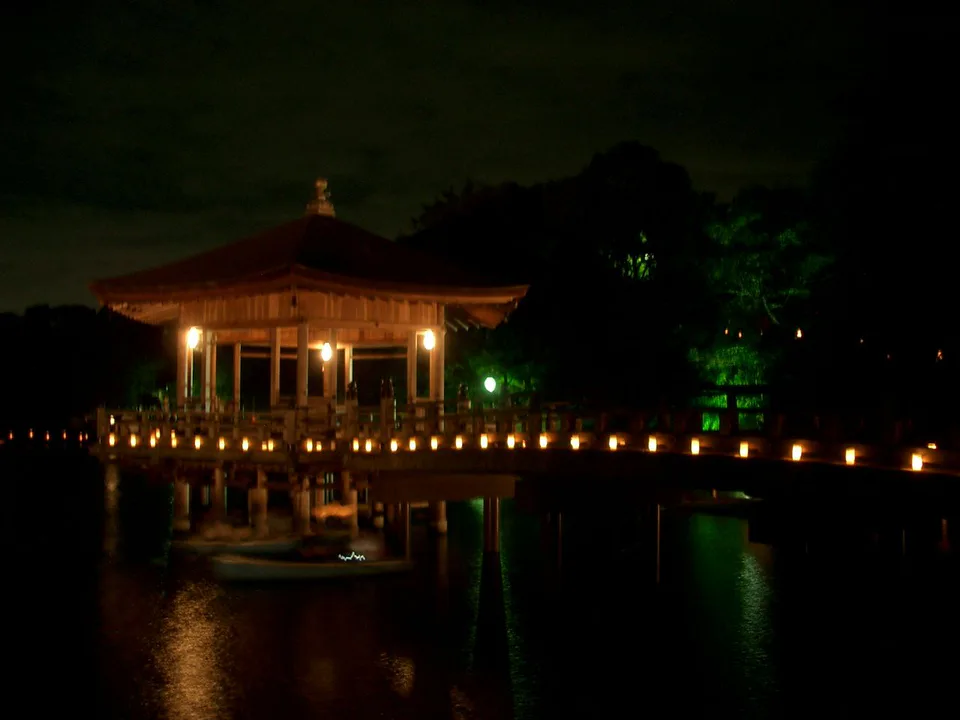
a seasonal evening event such as Tōkae or another confirmed illumination;
an early Nara Park / Tōdai-ji morning you genuinely value;
a slower second Nara-area day beyond the standard park circuit;
the overnight solves a sold-out Kyoto stay or advances the next route.
If none of those is true, the extra hotel change may solve less than the direct return to Kyoto or Osaka. Use the Nara day trip or overnight guide for that larger decision.
A realistic full-day route has a hard stop, not just a start time
For a first visit with good weather, I would use this sequence:
08:00–09:30: arrive early and go directly toward Tōdai-ji; use the park as the approach rather than the destination.
09:30–11:00: Great Buddha Hall / nearby Tōdai-ji precincts; add more only if you care about the temple itself.
11:00–12:00: deer and park time after the main temple is secured.
Lunch: eat before the group’s walking energy collapses.
Early afternoon: Kasuga Taisha or begin turning toward Naramachi.
Mid/late afternoon: Naramachi, Kōfuku-ji/Sarusawa or train home depending energy and the next commitment.
The exact clock can shift. The important part is that the route contains a hard stop: if Kasuga Taisha consumes more time than expected, Naramachi shrinks. If the group is tired after Tōdai-ji, Kasuga disappears. The schedule never requires both branches to be completed.
Final verdict: the best Nara day is one long line with one optional branch
For most first-time visitors, I would arrive through Kintetsu Nara when practical, protect Tōdai-ji early, treat deer feeding as a short activity rather than the first destination, then choose Kasuga Taisha for a deeper eastern walk or Naramachi for a softer finish. Four hours is enough for a strong Nara visit when you cut the eastern extension. Six to eight hours is enough for the classic full day.
The most common planning error is not missing a famous temple. It is spending the entire day walking farther east because every next stop seems close, then discovering that the return, heat, children or dinner reservation controls the final two hours.
Before adding any extra attraction, ask one question: does this stop improve the Nara day enough to justify walking both to it and away from it? If not, leave it for another visit.
Jozankei Autumn Leaves 2026: Day Trip or Overnight? The Foliage Buses Change the Answer
Okayama Korakuen and Kurashiki Day Trip: Foliage, Lights and Hotels
Nara Prison Museum: How to Plan Tickets, the Direct Bus and a Half-Day Visit
Fukuoka Guys’ Trip Hotels: Four Adults, Real Beds, Late Nights and Whether a Sauna Is Worth It
Nikko vs Okunikko in Autumn: Day Trip, Overnight and Where to Stay
References
Tōdai-ji — current opening hours and admission · Kasuga Taisha — current worship hours, special admission and fees · Official Nara Travel Guide — Nara Park access and getting around · Official Nara Travel Guide — Naramachi · Nara Deer Preservation Foundation — visitor safety around wild deer. Checked August 25, 2026.