
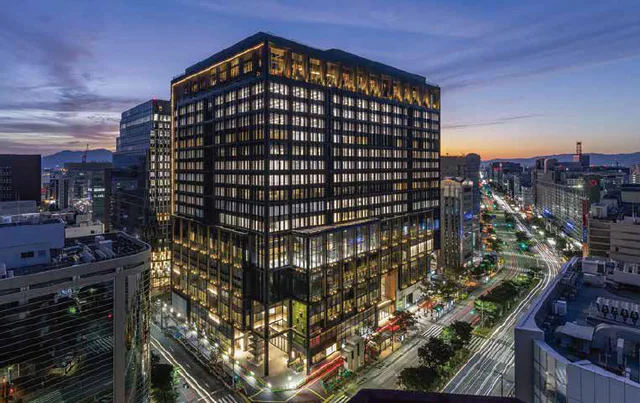
What is easiest to underestimate about ONE FUKUOKA HOTEL is not simply that it is new. The hotel occupies floors 18–19 of ONE FUKUOKA BLDG and connects directly to Fukuoka City Subway Tenjin Station, but its product only becomes distinctive when you also spend time inside it. If you leave early every morning and return only to sleep, the high-floor views, terraces, public bath, sauna and Library Lounge are benefits you have paid for but barely used.
This guide answers one question: what kind of Fukuoka itinerary makes it rational to protect actual hotel time at ONE FUKUOKA HOTEL? Rather than stopping at “new, luxurious and well located”, the decision needs to combine direct Tenjin access, airport and Hakata subway times, 35–40 m²-class rooms, guest-facility opening hours and your daily schedule. What the hotel really sells is the ability to return to a calm high-floor base without leaving Tenjin, not merely a short station distance.
ONE FUKUOKA HOTEL: the 30-second answer
I would book it if Tenjin is the main centre of the trip and I can leave at least one substantial block of time for the hotel each day: return with shopping bags before dinner, go out again, then come back for the bath and sauna; or use breakfast and the lounge the next morning. That kind of schedule reuses the station connection, room scale and guest facilities rather than photographing them once on arrival.
I would think twice if more than half the itinerary depends on JR, Shinkansen or inter-prefecture departures from Hakata Station. The subway ride from Hakata to Tenjin is only about six minutes, but repeated station entry, train travel and underground walking are still recurring costs. When hotel-facility time is repeatedly exchanged for early Hakata departures, Tenjin is no longer friction-free.
I would skip it if the hotel is genuinely only a bed for one night and I will not use the terrace, Library Lounge, public bath, sauna or breakfast. ONE FUKUOKA HOTEL deliberately puts weight on the stay itself. A 07:00 departure and 23:30 return schedule turns even a beautiful room into an expensive sleep-only product.
ONE FUKUOKA HOTEL snapshot: which facts actually change the decision?
↔ Scroll table left or right
Item | Verified detail | Trip consequence |
Location | Direct connection to Tenjin Station; about 3 minutes on foot from Nishitetsu Fukuoka (Tenjin) Station | Most valuable in rain, with large luggage and when returning before going out again |
Airport | About 11 minutes from Fukuoka Airport Station to Tenjin | Particularly useful on the first and last day by reducing final outdoor wayfinding |
Hakata Station | About 6 minutes from Hakata Station to Tenjin by subway | Count the repeated transfer cost on JR- or Shinkansen-heavy itineraries |
Rooms | Superior King 35 m²; Signature King 36 m² + 7 m² terrace; Terrace Twin 40 m² + 13 m² terrace | Not a compact-room hotel, but terrace and bed layout should match how you will use the room |
Public bath / sauna | 18F; 06:00–12:00 and 15:00–25:00 | Still usable after a normal dinner return |
Library Lounge | 18F; 06:00–22:00 | Late-return travellers may miss the evening window entirely |
Laundry / Garden Terrace | 18F; 24 hours; Garden Terrace availability depends on weather | Useful for longer stays and flexible return times, but outdoor value is weather-dependent |
Arrival reality: the real saving is the last stretch in rain and with luggage
The airport arrival is one of the hotel’s clearest strengths. Official access information gives about 11 minutes on the Airport Line from Fukuoka Airport Station to Tenjin, with the building connected from Tenjin Station’s east-side gate. That is not the same as a hotel that is simply “three minutes away” on a map. In rain, with a large suitcase or with an older relative, removing one outdoor navigation segment can matter far more than it does on a dry afternoon with a day bag.
The direct connection also has limits. If most days are spent in Daimyo, Tenjin, Imaizumi and Nakasu, the return journey stays short. If the next three days start with JR or Shinkansen from Hakata, Tenjin is only the first transport node. Before choosing a base, use the Fukuoka transport guide to count repeated station transfers, then compare that pattern with the three-day Fukuoka itinerary. If one of those days leaves Fukuoka entirely, the Fukuoka-to-Yufuin transport comparison is a better test than a hotel map pin.
Room decision: 35 m² and up does not mean every room buys the same kind of space
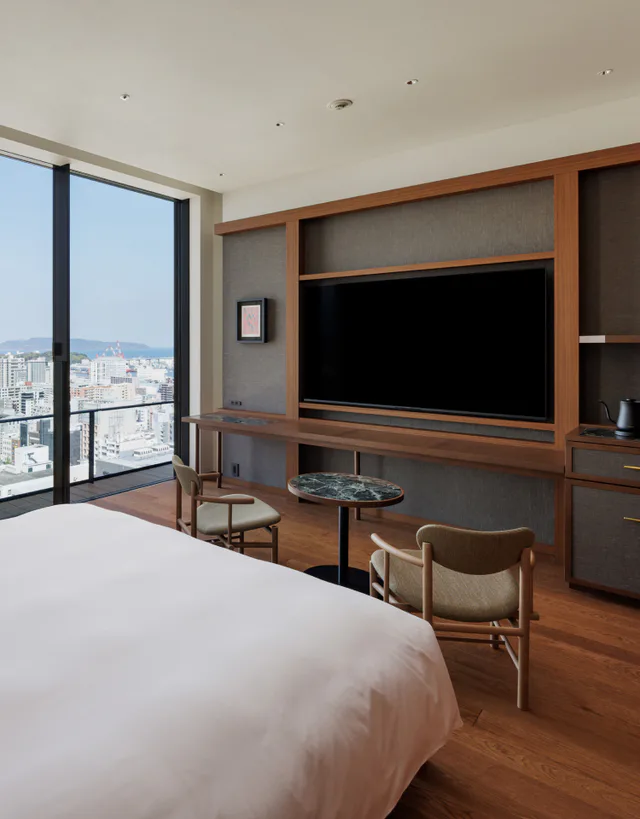
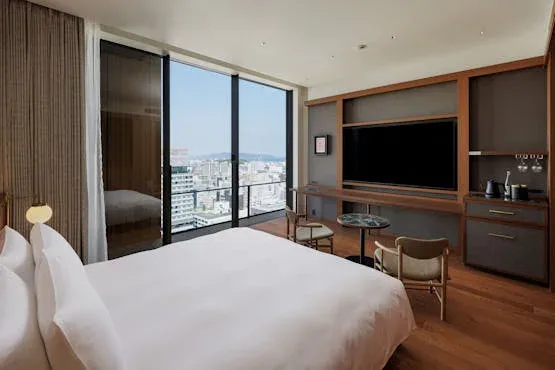
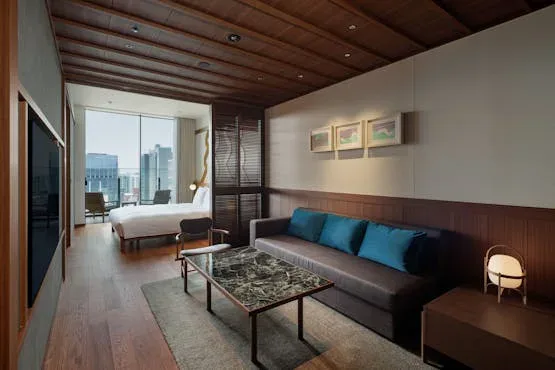
Room choice is the second place where the hotel can be misread. Superior King is 35 m² for one or two guests. Signature King provides 36 m² indoors plus a 7 m² terrace, also for one or two. Terrace Twin has 40 m² indoors plus a 13 m² terrace, sleeps up to three with two semi-double beds and a sofa bed for the third guest. These are not compact business-hotel rooms, but the rooms allocate space differently between terrace, desk, living area and bed configuration, so total square metres alone are not enough.
For two travellers who mainly spend the day outside and simply want one large bed with proper indoor space, I would start with Superior King. You get a full 35 m² indoors without paying for a terrace by default. Signature King becomes more convincing when one person needs to work or you deliberately want two visual zones—the desk looking inward and the terrace opening to the sky—rather than just a slightly different premium room name.
Terrace Twin is not merely a twin-bed version. Its 40 m² indoor space and 13 m² terrace make luggage and shared living easier for friends or a parent-and-child stay, and the beds can be arranged as a Hollywood Twin. But when a third guest uses the sofa bed, the sofa stops functioning as normal living-room furniture. Maximum occupancy therefore does not mean three guests retain the same comfort or shared space.
↔ Scroll table left or right
Room | Official space / capacity | Core difference | ValueNavi judgement |
Superior King | 35 m² / 1–2 guests | Full indoor area; terrace is not the focus | Start here if most of the day is outside and indoor room scale matters |
Signature King | 36 m² + 7 m² terrace / 1–2 guests | Sky-facing terrace; desk faces the atrium | Upgrade when work space and two different room experiences will actually be used |
Terrace King | 36 m² + 7 m² terrace / 1–2 guests | Bedroom and living area are separated | More meaningful when two travellers have different routines and want a two-zone feel |
Terrace Twin | 40 m² + 13 m² terrace / 1–3 guests | Twin beds; third guest can use the sofa bed | Best for friends, family and large luggage, but the third guest consumes sofa function |
If you actually stay here: use a one-night timeline to test whether the facilities fit
A useful model is: return from Tenjin shopping at 17:30 and drop your bags; go back out for dinner at 18:30; return to the 18th-floor Library Lounge around 21:15 for tea; use the public bath and sauna from 22:00; start a load of laundry around 23:15; then have breakfast at THE KITCHEN at 07:30 and leave again around 08:30. This is an itinerary model, not a claim that I personally stayed on that exact schedule. Its purpose is to test whether each facility sits inside the hours you can actually use.
If you return at 22:30 instead, the Library Lounge has already closed for the evening, but the bath and sauna are still within their current 25:00 closing time. That is an important ONE FUKUOKA HOTEL decision point: the lounge, sauna and other facilities do not share one single “hotel facilities” time window. Your return time determines which part of the premium is real.
Facilities with consequences: lounge, bath, laundry and breakfast all run on different clocks
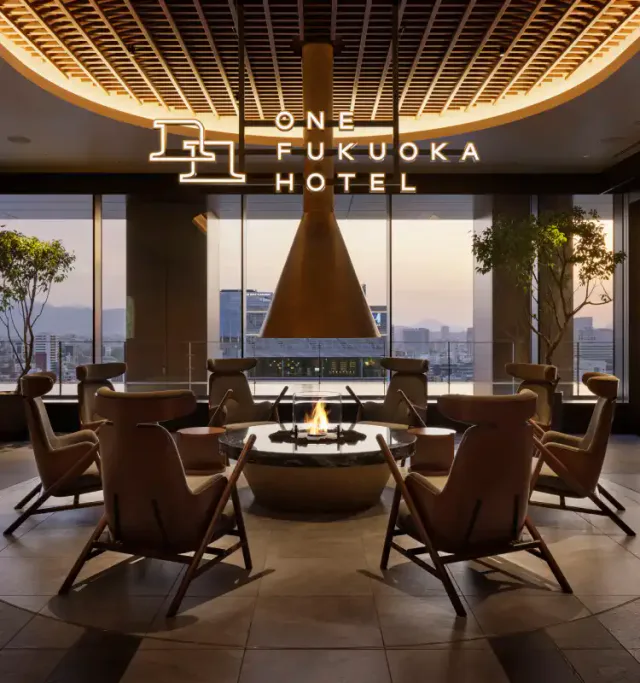
Library Lounge is on the 18th floor and is currently listed from 06:00 to 22:00, with books focused on Fukuoka, Kyushu and Asia plus self-service coffee, tea, ice cream and light food. It is meaningful if you return in the early evening, need an hour to work or deliberately want a quiet pause in the trip. If you consistently return after 22:00, its evening value is essentially gone.
The public bath and sauna are also on the 18th floor and currently run 06:00–12:00 and 15:00–25:00. The bath has a high-floor view and wooden terrace; the sauna is described with a high-temperature dry sauna, cold bath and outdoor-air rest area. Those are verifiable facilities, but they do not prove the space will always be quiet or uncrowded. The real decision is whether you still have 45–90 minutes after returning to the hotel.
The 18th-floor coin laundry is available 24 hours, detergent is automatically dispensed and some electronic payment methods are supported. That is useful for a three-to-five-night stay where you want to pack lighter, but having laundry does not guarantee zero waiting. The Garden Terrace is also available 24 hours in principle, while the hotel notes that bad weather can close it; outdoor space is therefore part of a weather-sensitive product.
Breakfast at THE KITCHEN on the 19th floor currently runs 07:00–10:30 and combines a buffet with a choice of main dish. The published selection includes options such as an avocado-salmon open sandwich, Mitsuse chicken pho, Chinese rice porridge, French toast, beef loin and eel rice. It works well when your Tenjin day starts after 09:00; if you need to be at Hakata for a very early train, I would compare a room-only rate instead.
For an early departure, compare the Fukuoka breakfast guide. If the next morning is a Yufuin departure, use the Fukuoka-to-Yufuin transport guide; for a longer route through Hita and Beppu, the Fukuoka–Hita–Yufuin–Beppu itinerary shows how quickly hotel time can disappear into cross-prefecture travel.
Location × itinerary: returning to the hotel twice can matter more than a three-minute walk
ONE FUKUOKA HOTEL fits best when your day naturally passes the hotel more than once. On a Tenjin shopping, underground-mall, Daimyo café and dinner day, you can return to drop bags and start again. The station connection is then used repeatedly. If you leave once in the morning and only return at bedtime, the location is still convenient, but the “reset at the hotel” advantage never happens.
Airport friction remains low because Tenjin is directly on the Airport Line, while Hakata is still one subway segment away. The real test is inter-prefecture travel. On days for Yufuin, Aso or Kumamoto, Hakata becomes a higher-frequency transport centre. Staying in Tenjin is still possible, but you are deliberately trading a repeated transfer for Tenjin nightlife and hotel time.
↔ Scroll table left or right
Itinerary pattern | Fit | Why | Main cost |
Tenjin / Daimyo shopping + dinner | High | You can return repeatedly; the connection and facilities are reused | The room premium still needs enough hotel use to justify it |
Nakasu yatai / city nightlife | Medium-high | The evening still stays centred on central Fukuoka | Returning after 22:00 means missing the lounge |
First / last day via Fukuoka Airport | High | Direct Airport Line plus direct building connection | A one-night stay may still underuse the facilities |
Yufuin / Aso / Kumamoto day trips | Medium-low | Hakata is reachable, but becomes a higher-frequency travel node | An extra subway and station movement repeats every day |
For a late central-Fukuoka evening, the Fukuoka yatai guide helps show how much of the lounge window you may lose. If you are adding a long day outside the city, the Fukuoka-to-Aso guide and the Route 210 road-trip guide are useful tests of whether Tenjin still deserves to be the base.
What do you actually give up by staying here?
The first sacrifice is pure transport-cost efficiency. The room types, terraces and guest facilities are designed to make you remain at the hotel longer. If you never remain there, you are paying for a product system you do not use. That does not make the hotel poor value in general; it means premium hotels are easy to waste when used on a business-hotel timetable.
The second trade-off is Tenjin versus Hakata as the base. Direct Tenjin access makes airport arrival and central evenings very easy, but JR and Shinkansen still belong to Hakata. If four of five nights are followed by JR departures, the subway becomes a fixed daily cost. If four of five days stay around Tenjin, Daimyo and Nakasu, that cost barely appears.
The third trade-off is how much value you really get from terrace and high-floor views. Signature King, Terrace King and Terrace Twin put part of their premium into outdoor space and scenery. Weather, season and your return time all change that value. If you return late on a cold winter night and know you will not sit outside, I would compare Superior King before automatically upgrading for a terrace.
Compare the same room and terms across all three booking platforms
Hold room type, guest count, breakfast, cancellation deadline, taxes and fees constant before comparing the total. ONE FUKUOKA HOTEL room differences are not just bed names: a 35 m² Superior King, a 36 m² + 7 m² Signature King and a 40 m² + 13 m² Terrace Twin buy different ways of using space. The platforms are inventory and terms checks, not a guarantee that one is always cheapest.
Booking.com — compare ONE FUKUOKA HOTEL rooms
Trip.com — compare ONE FUKUOKA HOTEL rooms
Agoda — compare ONE FUKUOKA HOTEL rooms
Final verdict: would I book ONE FUKUOKA HOTEL?
↔ Scroll table left or right
Decision | Core condition |
I would book | Tenjin is the activity centre; I expect to return at least twice a day; I will use the bath, sauna, lounge or breakfast; two travellers value 35 m²-plus living space. |
I would reconsider | Three or more days depend on Hakata JR/Shinkansen; I return after 22:00 every night; terrace-room premiums are high but I am unsure I will use the terrace. |
I would skip | The hotel is only a sleeping base; several days require leaving for Hakata before 07:00; I will not use the high-floor views, terrace or guest facilities. |
My final position is straightforward: ONE FUKUOKA HOTEL is not worth a premium merely because it connects directly to Tenjin Station. It is a complete hotel-time product that combines easy arrival, 35–40 m²-class living space, high-floor terraces, a public bath, sauna and lounge. The more often you return, use the facilities and centre the trip on Tenjin, the more coherent it becomes. The earlier you leave, the later you return and the more you rely on Hakata JR, the more carefully the premium needs to be recalculated.
ONE FUKUOKA HOTEL FAQ
Is ONE FUKUOKA HOTEL directly connected to Tenjin Station?
Yes. The official access page says ONE FUKUOKA BLDG connects directly to Fukuoka City Subway Tenjin Station and can be entered from the east-side ticket gate. The benefit matters more in rain, with large luggage or with older travellers than a simple straight-line map distance.
How long is it from Fukuoka Airport to the hotel?
The official access information lists about 11 minutes from Fukuoka Airport Station to Tenjin Station on the Airport Line. Door-to-door time still includes waiting, platform movement, gates and elevators, so 11 minutes should not be treated as the full airport-to-room journey.
How large are the rooms?
Among the principal published room types, Superior King is 35 m², Signature King and Terrace King are 36 m² plus a 7 m² terrace, and Terrace Twin is 40 m² plus a 13 m² terrace. Larger suites also exist. Choose by bed layout, terrace use and room routine rather than assuming the largest number is automatically best.
Does ONE FUKUOKA HOTEL have a public bath and sauna, and when are they open?
Yes. The public bath and sauna are on the 18th floor and are currently listed from 06:00–12:00 and 15:00–25:00. Children under 13 need adult supervision in the bath, and tattoos must be coverable according to the current hotel rules.
What time does the Library Lounge close?
The current published hours are 06:00–22:00. Travellers returning after 22:00 should treat evening lounge use as unavailable, although the bath and sauna retain a later window.
What time is breakfast, and is it sensible before an early train?
THE KITCHEN breakfast is currently listed from 07:00–10:30, with a buffet plus a chosen main dish. If you need to leave for Hakata before about 07:30, compare a room-only rate; if your Tenjin day starts after 09:00, breakfast is much easier to use fully.
Does the hotel have its own parking lot?
No dedicated hotel parking is listed. The official access page points to nearby paid options such as the Tenjin Underground Shopping Center South Parking S2. Drivers should not assume a hotel inside a large complex includes dedicated parking.
Fukuoka Itinerary: 3 Days for First-Time Visitors
Fukuoka Transport Guide: JR, Subway, Nishitetsu and Day Passes
Fukuoka Yatai Guide: Nakasu, Tenjin or Nagahama?
Fukuoka Breakfast Guide: Mentaiko, Udon or Onigiri?
Fukuoka Mentaiko Guide: Mentaiju, Yamaya or Fukuya?
Fukuoka to Yufuin: Train, Bus or Rental Car Compared
Fukuoka, Hita, Yufuin and Beppu: 3-Day Itinerary
Fukuoka to Aso: Day Trip or Overnight?
Fukuoka Coffee and Dessert Walk
Osaka and Kyoto in 7 Days: 3 Nights Each — When One Hotel Move Is Actually Worth It
seven x seven Itoshima: Is One Coastal Night Worth Leaving Fukuoka?
La Vista Furano Hills: Is a Small Room Worth It for a One-Night Furano Stay?
Where to Stay in Fukuoka: Hakata or Tenjin for Trains, Food and Day Trips
Hotel JAL City Fukuoka Tenjin: Is a 1-Minute Akasaka Walk Worth Choosing Over Tenjin Station?
Sources
ONE FUKUOKA HOTEL official website
Official Terrace Twin room information
Official Signature King room information
Official Superior King room information
Official breakfast information
Nishitetsu: ONE FUKUOKA BLDG and hotel-floor information
Booking.com: ONE FUKUOKA HOTEL
Trip.com: ONE FUKUOKA HOTEL