A Fukuoka-to-Aso day trip is reasonable by rental car only when Aso is the entire purpose of the day and you are willing to keep the mountain itinerary to two or three anchors. By public transport, I would usually stay overnight rather than sell the trip as a full Aso day. The current rail schedule can leave only 4 hours 29 minutes between arrival at Aso Station and the useful afternoon train back toward Kumamoto, before the mountain transfer is counted. As of August 25, 2026, the case for an overnight is even stronger because Mount Aso is at eruption alert level 3: access within roughly 2 km of Nakadake First Crater is restricted, the crater shuttle is suspended, and the regular mountain bus currently runs only as far as Kusasenri.
The decision therefore starts with a more precise question than “Can I get to Aso and back in one day?” Ask how many usable mountain hours will remain after Fukuoka, Kumamoto, Aso Station and the final climb are all counted. If Nakadake crater itself is non-negotiable, the current answer is not “leave earlier.” It is to wait for the restriction to change or redesign the day around the parts of Aso that remain accessible.
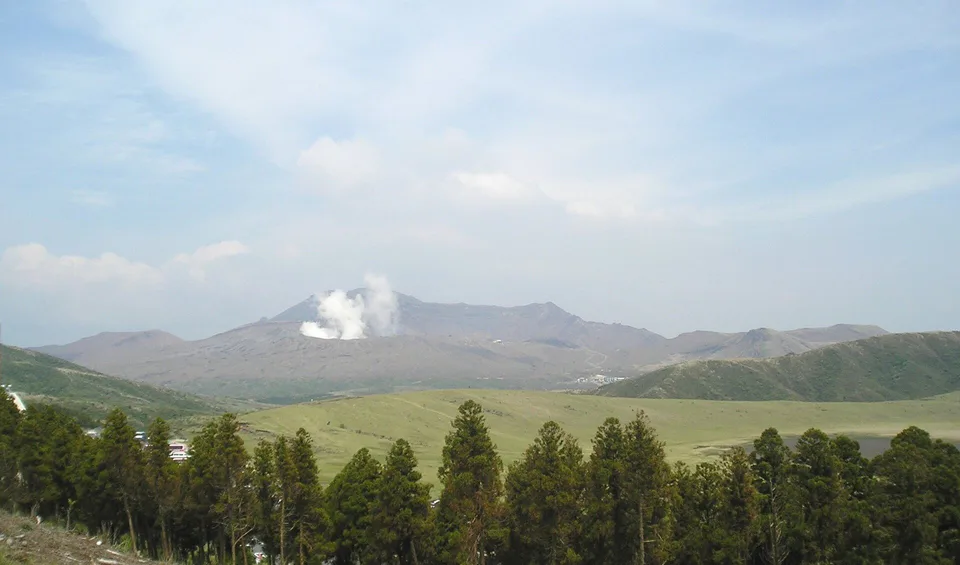
Kusasenri remains a useful Aso landscape anchor even when the crater itself is restricted. Photo: STA3816 / CC BY-SA 3.0, Wikimedia Commons.
The 30-second decision: day trip, Kumamoto night or Aso night?
↔ Scroll table left or right
Your actual trip | Best starting point | Why | Main trade-off |
Rental car, early departure, Aso is the only major destination | Fukuoka day trip can work | A car gives you control over Daikanbo, Kusasenri and Aso Shrine without waiting for sparse mountain connections | Expect a very long driving day; do not add Takachiho or Kurokawa |
No car, Kusasenri is the main objective | Overnight in Aso | Removes the same-day rail deadline and gives weather/connection recovery margin | One more hotel night and a rural last-mile plan |
No car, want city comfort and only a lighter Aso visit | Kumamoto overnight | Moves the Hakata–Kumamoto leg outside the sightseeing day and keeps a larger city transport base | You still have to reach Aso and then climb from Aso Station to the mountain zone |
Nakadake crater is the trip's main reason | Do not force the trip under the current Level 3 restriction | The current restriction reaches roughly 2 km from the crater and the crater shuttle is suspended | Kusasenri and other Aso areas can still justify a landscape-focused trip |
Aso + Kurokawa or Takachiho | Overnight / onward itinerary | The second destination needs its own transport and time budget | Trying to return to Fukuoka the same day turns the route into a connection exercise |
Current-status note: the Japan Meteorological Agency continues to list Mount Aso at eruption alert level 3 (mountain-entry restrictions) as of August 25, 2026. The alert was raised on August 14. Local bus operations around the mountain have been altered accordingly. Recheck the official status on the morning of travel because volcanic restrictions can change independently of the normal sightseeing timetable.
Public transport gives you 4 hours 29 minutes at Aso Station — not 4 hours 29 minutes on the mountain
JR Kyushu's current 2026 timetable makes the constraint visible. ASO BOY! No. 1 leaves Kumamoto at 09:57 and reaches Aso at 11:27. The later return, No. 4, leaves Aso at 15:56 and reaches Kumamoto at 17:08. If you build the Aso portion around those services, the theoretical station-to-station sightseeing window is:
15:56 - 11:27 = 4 hours 29 minutesThat number is easy to misuse because Aso Station is not Kusasenri and it is not Nakadake crater. The Aso tourism association currently estimates a taxi from Aso Station to Kusasenri at about 35 minutes and roughly JPY 3,500 one way. Using the taxi estimate only as a planning calculation:
4h29 at Aso Station
- 35 min outbound
- 35 min return
= about 3h19 before waiting, lunch, walking and return buffer
That is a ValueNavi derived planning number, not an official tour duration. It assumes a taxi is immediately available in both directions and does not include traffic, queues or time finding the vehicle. A bus is cheaper but less controllable. Sanko Bus currently operates the Aso mountain line only between Aso Station and Kusasenri because of the Level 3 restriction, and the operator explicitly warns that crowded services may prevent boarding the desired bus and that its timetable is not designed to guarantee JR connections.
This is the key reason I would not describe car-free Fukuoka→Aso→Fukuoka as a relaxed full-day Aso itinerary. Under the current timetable it is better understood as a Kusasenri-focused half-day nested inside a much longer Fukuoka–Kumamoto–Aso transport day.
The current Level 3 restriction changes what “Aso day trip” means
The Japan Meteorological Agency raised Mount Aso from eruption alert level 2 to level 3 at 15:45 on August 14, 2026. The current warning calls for restrictions within roughly 2 km of Nakadake First Crater. Sanko Bus has suspended the crater shuttle and temporarily closed Aso Sanjo Terminal; its Aso mountain route is operating only between Aso Station and Kusasenri.
That does not mean “Aso is closed.” It means the crater can no longer be treated as the automatic centrepiece of a normal sightseeing loop. Kusasenri remains reachable on the current mountain-bus operation, while places farther from the crater such as Daikanbo and Aso Shrine belong to a different part of the landscape and cultural itinerary. Their usefulness is still subject to weather, roads and local operating conditions, but they are not the same product as crater viewing.
For trip planning, separate two intentions:
“I want to see the active crater.” Under the current restriction, do not spend a scarce Japan day pretending an alternative viewpoint is the same experience. Check the JMA/local restriction first and postpone or substitute if the crater is essential.
“I want an Aso landscape day.” Kusasenri, caldera viewpoints and Aso's wider scenery can still justify the trip. In that case the restriction changes the route rather than automatically cancelling the destination.
This distinction is more useful than a generic “check before you go” warning because it tells you when the trip's value survives the closure and when it does not.
Self-drive from Fukuoka works only if you accept how much of the day is road time
Official Aso tourism access guidance gives about 1 hour 20 minutes from Fukuoka IC to Kumamoto IC, about 50 minutes from Kumamoto IC to Aso Station, and about 40 minutes from Aso Station to Kusasenri. Adding those published sectors produces roughly 2 hours 50 minutes from Fukuoka IC to Kusasenri before your hotel-to-interchange drive, rental-car collection, rest stops, traffic or parking are included.
Double the same reference chain and the round trip is already about 5 hours 40 minutes of driving before the city-side pieces are counted. This is not a live navigation prediction; it is a derived illustration of why a Fukuoka day trip must be selective.
A self-drive day can still be rational because the car buys something public transport does not: control over the last mile. I would cap the day at two or three geographic anchors, for example:
Daikanbo + Kusasenri + Aso Shrine when the crater is restricted and the goal is landscape plus one cultural stop.
Kusasenri + one nearby mountain stop + Aso Shrine when you want a slower mountain day.
Daikanbo + Aso town / Uchinomaki area when weather makes the high mountain less useful.
Do not build the day from a list of famous names. Every extra stop introduces another parking, road and timetable decision. On a same-day Fukuoka return, Takachiho and Kurokawa Onsen should normally be removed rather than squeezed in.
If you have not yet decided whether the road-trip shape is right for the wider Kyushu itinerary, compare the Kyushu 5–7 day route before locking the car. If you do rent, compare the same branch hours, protection and return buffer rather than only the lowest base rate.
Compare current Fukuoka / Kumamoto rental-car options
Where should you stay overnight: Kumamoto, Aso or Kurokawa?
“Stay overnight” is incomplete advice because the three obvious bases solve different problems.
Stay in Aso when the mountain itself is the reason for the trip
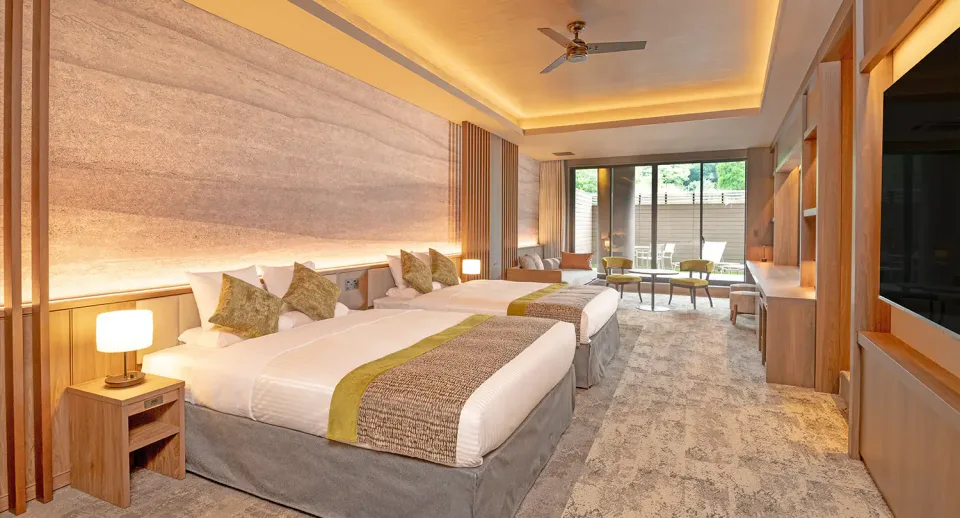
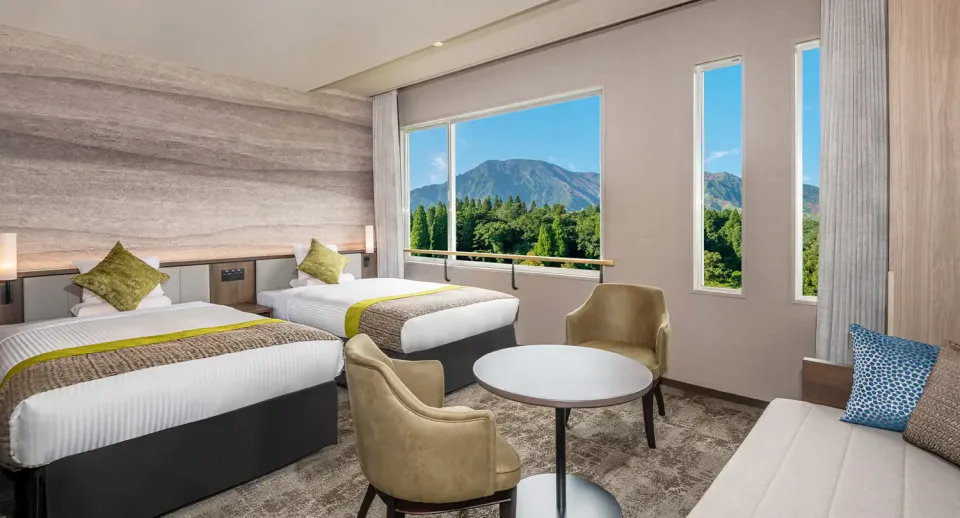
Aso is the strongest overnight choice when weather flexibility, Kusasenri, the caldera or an early mountain start matters more than city convenience. You remove one long same-day rail or road leg, can respond to the morning weather, and do not need to protect a 15:56-style return train before the landscape has done what you came for.
The trade-off is rural logistics. Aso Station, Uchinomaki and individual ryokan are not one walkable hotel zone, so confirm the last mile. The same Aso tourism association that quotes about 35 minutes by taxi to Kusasenri also shows how quickly local distances become material without a car.
For families, older travellers or anyone whose Japan trip contains only one Aso day, this is the overnight that most directly buys back sightseeing margin.
Stay in Kumamoto when rail simplicity matters more than mountain hours
Kumamoto is the cleaner compromise when you want a city hotel, easy Shinkansen access from Hakata and a less rural evening. Moving Hakata→Kumamoto to the previous day removes part of the transport load from the Aso morning.
But Kumamoto does not solve Aso's last-mile problem. JR Kyushu still places Kumamoto→Aso at 09:57→11:27 on ASO BOY! No. 1, and after arriving at Aso Station you still need the mountain bus, taxi or car. A Kumamoto night therefore improves the day; it does not turn Aso Station into the crater.
I would choose Kumamoto over Aso when Aso is only one piece of a broader Kumamoto-city itinerary or when the group strongly prefers urban hotel logistics. If Aso scenery is the whole reason for adding the night, sleep closer to Aso instead.
Stay in Kurokawa only when the ryokan and onward route are part of the plan
Kurokawa Onsen is not merely an “Aso overflow hotel.” It is a separate onsen destination with its own bus schedule and a time-sensitive ryokan evening. The current Kyushu Odan Bus links Kurokawa and Aso, but the service is sparse enough that it should shape the itinerary rather than be treated like a local shuttle.
Choose Kurokawa when the onsen stay itself is worth the hotel move and the next day continues naturally through central Kyushu. Do not add it to rescue an already overloaded Fukuoka day trip. If you are returning straight to Fukuoka after one mountain afternoon, Aso or Kumamoto is usually the cleaner overnight problem to solve.
Do not combine Aso and Takachiho as a Fukuoka day trip
Aso and Takachiho are close enough on a map to tempt overplanning and far enough operationally to punish it. The current Aso–Takachiho Asochiho bus normally takes about 2 hours 10 minutes end to end, and the Level 3 restriction has currently forced it to skip both Kusasenri Aso Volcano Museum and Aso Sanjo Terminal while detouring.
That makes the same-day Fukuoka idea even weaker. If Takachiho is genuinely important, give it a separate day or use an overnight sequence. The Takachiho Gorge guide is the better place to decide its own timing and boat/transport risk.
The same logic applies to Kurokawa. Aso + one second regional destination can make an excellent two-day route. Aso + Kurokawa/Takachiho + Fukuoka return in one day is usually a list of transfers masquerading as sightseeing.
Families and older travellers should value recovery margin more than one extra stop
The public-transport version becomes fragile fastest for groups that move more slowly. A 4-hour-29-minute Aso Station window is much less useful when the group needs toilet breaks, lunch at a fixed time, help boarding a crowded bus or a slower walk at Kusasenri. Missing a mountain bus can also threaten the rail connection back toward Kumamoto because Sanko Bus explicitly does not guarantee through connections with JR.
For a family with young children or older parents, I would use one of two patterns:
Car + one focused Aso day: start early, keep the stop count low and return before everyone is exhausted.
Aso overnight: move the long-distance travel to a separate block and let the mountain day breathe.
The expensive mistake is not staying one extra night. It is spending the same money on transport while everybody gets less time at the destination because the itinerary was built for ideal walking speed and perfect connections.
What if the crater is still closed on your date?
Use a simple value test before leaving Fukuoka:
Go anyway if your real priorities are Kusasenri, caldera scenery, Daikanbo, Aso Shrine or a rural/onsen stay. The day still has a clear identity.
Stay overnight rather than day-trip if uncertain mountain weather plus the crater restriction leaves too little value in a narrow afternoon window.
Choose another Kyushu day if Nakadake crater viewing is the main reason you were going. A restricted crater plus five-plus hours of same-day road time is a poor trade for a traveller with limited Japan days.
This is the red-team condition that changes the whole recommendation. Aso is not automatically worth a long Fukuoka out-and-back just because it is famous. The accessible part of Aso has to match the experience you actually want.
A two-day version that uses the overnight properly
For a first trip, the overnight should remove the same-day deadline rather than simply add a hotel.
Day 1: travel from Fukuoka toward Aso, use Daikanbo/Aso Shrine or a lower-elevation stop depending on route and weather, then sleep in Aso. Do not force the mountain if cloud, volcanic restrictions or late arrival make it poor value.
Day 2: use the morning for Kusasenri and the mountain zone that is legally accessible on that date, then return through Kumamoto or continue through Kyushu. If Kurokawa or Takachiho is next, treat that onward movement as the second day's major transfer rather than adding another Fukuoka return.
The important design change is that the mountain no longer has to fit between an 11:27 arrival and a 15:56 departure. You have bought back weather margin, lunch time and recovery from one missed connection.
Final verdict: count usable Aso hours, not map distance
If you are driving, Fukuoka→Aso→Fukuoka can work as one long day when you leave early, keep Aso as the sole destination and accept that several hours will be spent driving. If you are relying on public transport, I would normally stay overnight when Kusasenri or the mountain is the main purpose. The current JR pattern gives only 4 hours 29 minutes at Aso Station between the useful daytime trains, and even a best-case taxi calculation to Kusasenri cuts that to roughly 3 hours 19 minutes before normal sightseeing friction.
As of August 25, 2026, eruption alert level 3 is the bigger boundary: the crater shuttle is suspended and the mountain bus terminates at Kusasenri. If the active crater is non-negotiable, do not solve a safety restriction with a tighter itinerary. If the wider Aso landscape is the goal, go—but make the day about that landscape rather than trying to recreate a pre-restriction checklist.
Nikko vs Okunikko in Autumn: Day Trip, Overnight and Where to Stay
Itoshima Day Trip or Overnight? Is One Coastal Night Worth It?
Izu Oshima Day Trip or Overnight? Jetfoil vs Night Ferry From Tokyo
References
Japan Meteorological Agency — current Mount Aso volcanic activity and alert · Sanko Bus — Level 3 restrictions and current Aso mountain-bus changes · Sanko Bus — Aso crater shuttle status · JR Kyushu — ASO BOY! timetable · Aso tourism association — access, local travel and taxi estimates · Sanko Bus — Aso–Takachiho service. Checked August 25, 2026. Volcanic restrictions, buses, train operating dates, roads and weather can change; recheck all time-sensitive services for the actual travel date.