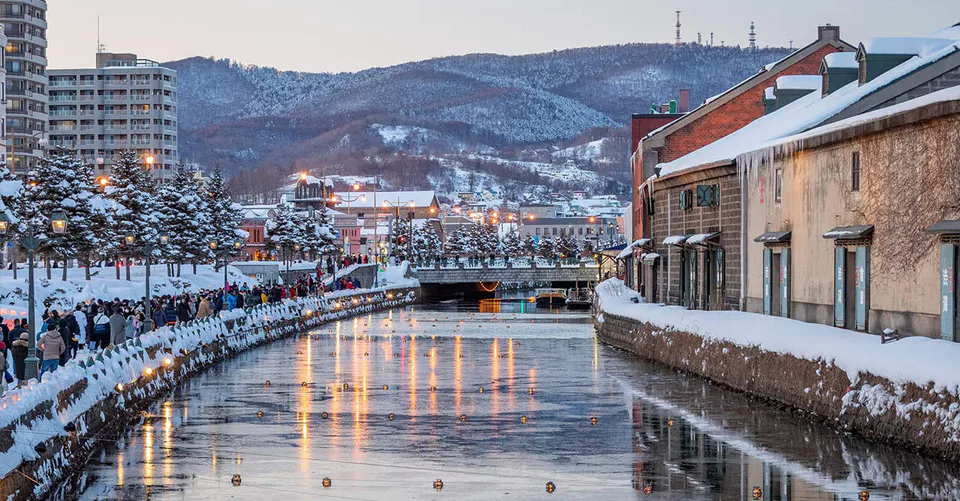
For most first-time visitors based in Sapporo, Otaru should stay a day trip. JR Hokkaido currently charges JPY 800 one way between Sapporo and Otaru in a non-reserved seat, and Otaru Tourism lists the fastest journey at about 32 minutes. One adult can therefore make the round trip for JPY 1,600 without changing hotels. An overnight becomes worth it only when you are deliberately buying hours that a normal day trip does not give you: the canal after dark, an unhurried dinner, a quiet early walk, a hotel you genuinely want to use, or a westbound onward route toward Yoichi, Kutchan or Niseko.
The useful question is not “Is Otaru beautiful at night?” It is what does the hotel night unlock that JPY 1,600 and about an hour of total rail time cannot? If you cannot name at least two meaningful overnight-only benefits, keep the Sapporo room and travel light for the day.
↔ Scroll table left or right
Your trip pattern | Better choice | Why | What can reverse it |
Canal + Sakaimachi + standard first-visit highlights | Day trip | Fast, inexpensive rail from Sapporo and no hotel move | You specifically want the canal after dark plus a quiet morning |
Canal lights + slow dinner + early-morning walk | One night | The hotel buys different hours, not extra attractions | You will leave Otaru before dark or depart immediately after breakfast |
Five- to seven-day Hokkaido trip with large luggage | Usually day trip | Keeping one Sapporo base protects time and avoids a winter luggage move | Otaru is also advancing the route west the next morning |
Next stop Yoichi / Kutchan / Niseko by rail | Overnight gets stronger | Otaru is already the transfer point for westbound JR travel | The actual next-day timetable is poor or you must return east anyway |
Heavy snow / highly flexible sightseeing priorities | Day trip often gets stronger | You can move Otaru to the best-weather day without moving luggage | A specific Otaru hotel or evening event is itself the priority |
ValueNavi Otaru Overnight Payback Score
This score measures whether sleeping in Otaru is doing enough work to justify a hotel move. It is not a score for Otaru itself. ValueNavi weights overnight-only time windows 25%, route progression 20%, hotel-specific utility 15%, low luggage/move friction 15%, weather resilience 15%, and opportunity-cost efficiency 10%. Each factor is 0–10; higher means the overnight is easier to justify.
Scenario | Overnight Payback Score | Decision |
|---|---|---|
Standard first visit; return to Sapporo after canal and Sakaimachi | Day trip. The hotel adds a move without unlocking enough scarce time. | |
Canal after dark + slow dinner + quiet morning | Strong one-night case because both sides of midnight are intentionally used. | |
Evening Otaru + next morning continues west toward Yoichi/Kutchan/Niseko | Best general overnight case: the night buys atmosphere and route progression. | |
Family with two large cases in winter, returning to Sapporo next day | Usually stay in Sapporo; packing and snow-luggage friction erase much of the gain. | |
Hotel itself is a major purpose: bath, room, dinner or special stay | Can justify one night even without westbound route progression. |
I treat 8.0+ as a strong overnight case, 6.5–7.9 as conditional, and below 6.5 as a signal that the Sapporo day trip probably does the job with less friction. These are ValueNavi editorial thresholds, not railway or tourism-board rules.
ValueNavi Hotel-Move Payback Equation
Use the overnight only when the gains clearly exceed the move:
Hotel-Move Payback = overnight-only usable hours + avoided backtracking + hotel-specific utility − packing/storage/winter-luggage friction − lost flexibility
The terms do not need fake yen values. Count them as real itinerary blocks. A canal evening plus a quiet morning gives two scarce windows. Continuing west the next day can remove a repeat Sapporo↔Otaru leg. Against that, checking out, storing bags, repacking and walking through snow are genuine costs. If the positive side contains only “it might feel nicer,” the payback is weak.
Why the day trip is the default: the rail penalty is unusually small
JR Hokkaido currently lists the Sapporo–Otaru non-reserved fare at JPY 800 each way. Otaru Tourism gives the fastest rail journey as about 32 minutes, with current visitor material generally placing rapid services in roughly the 33–40 minute range. That makes Otaru very different from destinations where an overnight is justified simply because the return journey is long.
For one adult, the basic day-trip transport cost is JPY 1,600 return. For two adults, it is JPY 3,200. That is the benchmark the overnight has to beat—not necessarily in cash, but in useful trip value.
An overnight can cost much more than the room rate suggests because it may also create:
a checkout from the Sapporo hotel;
a luggage move through Sapporo and Otaru stations;
bag storage before Otaru hotel check-in;
another packing and checkout cycle the next morning;
and, if you keep the Sapporo room anyway, a night when you are effectively paying for two hotel rooms.
That is why “the train is only half an hour” actually matters. The hotel is not saving a difficult commute. It has to create a different experience or improve the route.
If your Hokkaido night allocation is still unsettled, compare how many nights Sapporo needs and the 5-, 7- or 10-day Hokkaido itinerary before taking a night away from the main base.
The overnight is really a purchase of after-dark and before-opening hours
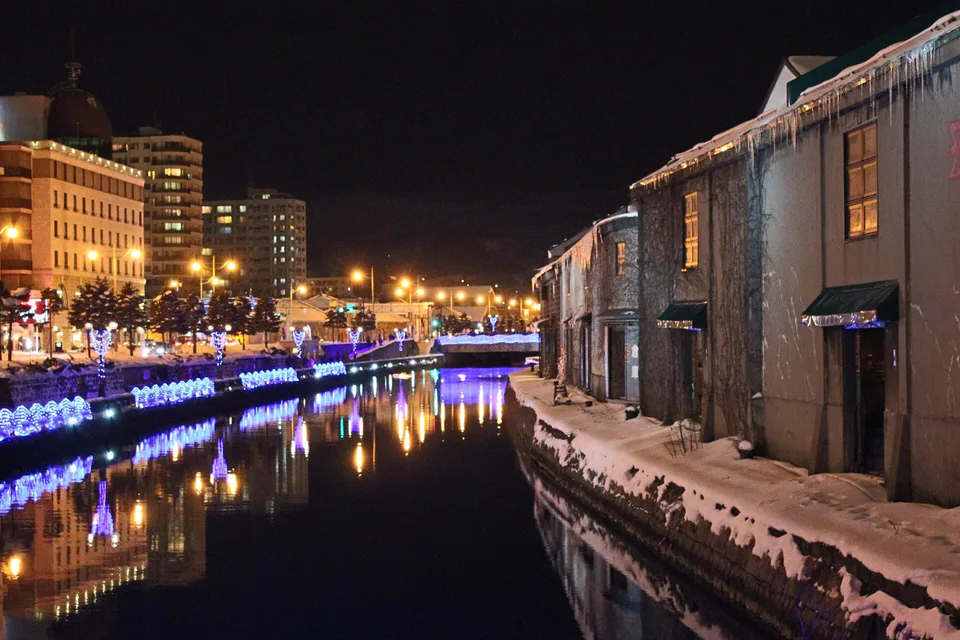
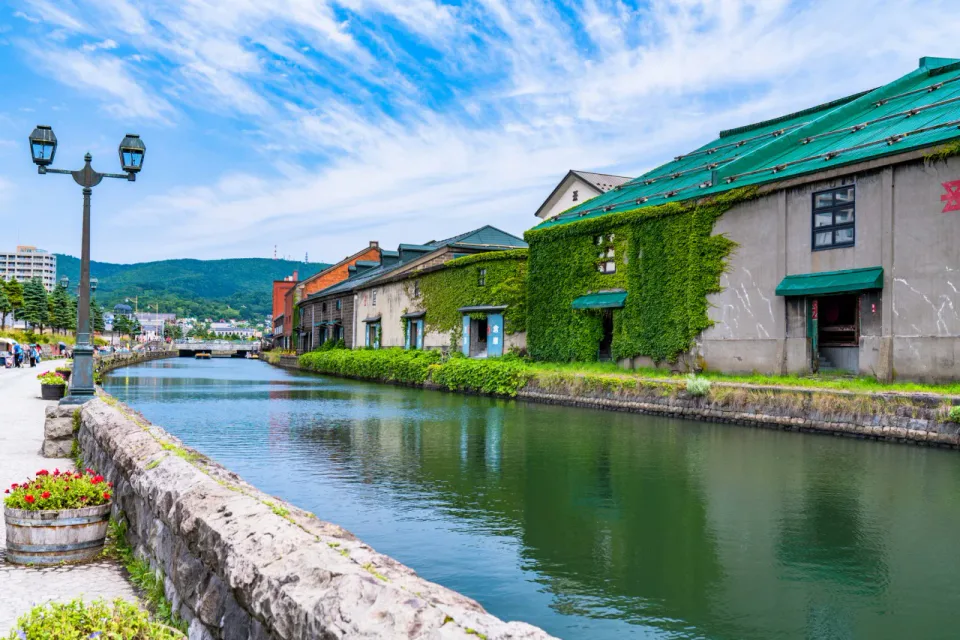
Otaru Canal is open to walk at any time, but its evening treatment is specific enough to make the overnight argument measurable. Otaru Tourism currently states that the gas lamps along the main canal promenade are lit from sunset until midnight, while the warehouse illumination runs from sunset until 22:30. The canal is about a 10-minute walk from JR Otaru Station.
That means a visitor does not need a hotel simply to see the canal after dark. A day-tripper can stay into the evening and take a later train back to Sapporo. The overnight starts to earn its cost when you want to stop watching the return clock: have dinner slowly, walk the canal after the daytime shopping period, then wake up and use the streets again before the next wave of day visitors.
The strongest one-night pattern therefore contains at least two deliberate overnight-only windows:
Evening window: canal gas lamps, warehouse lighting, dinner, bars or a hotel bath.
Morning window: an early canal/harbour walk, breakfast in Otaru, or quiet streets before the commercial day fully restarts.
If your plan is “arrive at 16:00, see the canal, sleep, leave at 08:30,” the hotel is doing very little. If the plan is “stay through the illuminated canal, eat without rushing, sleep locally and use a second quiet walking window in the morning,” the same room has a clear job.
Do not confuse a night in Otaru with more daytime sightseeing
The core Otaru first-visit sights are compact. The canal, Sakaimachi shopping street, music-box and glass-shopping areas, and central historic buildings can fit into a normal day trip. Staying overnight does not suddenly create another full day of must-see attractions.
This is the deletion test I would use: remove the words “romantic,” “atmospheric” and “beautiful at night” from the plan. What remains? If the answer is still “I want a slow dinner, two canal sessions, a hotel bath and a quiet morning,” the overnight has substance. If the answer becomes “I suppose it would be nice,” keep Sapporo.
Otaru Tourism’s current 2026–2027 night map is useful because it specifically identifies places operating after 21:00. That also highlights a practical limit: an overnight does not mean every shop and restaurant remains open late. Plan the evening venue you actually want instead of assuming daytime Sakaimachi activity continues into the night.
One night gets much stronger when Otaru moves the route west
JR Hokkaido’s current guidance says passengers continuing toward Yoichi, Kutchan or Niseko must transfer at Otaru Station. It also warns that IC cards such as Suica cannot be used beyond Otaru, so travellers continuing west need the correct ticket rather than assuming the Sapporo-area IC-card routine continues.
This creates the strongest non-atmosphere reason to stay. If the next day already moves west, an Otaru night can do two jobs:
give you the evening and morning Otaru experience; and
place you at the rail junction you must use for the next leg.
That is materially different from checking out of Sapporo, travelling to Otaru for sightseeing, returning to Sapporo to sleep, then travelling through Otaru again the next morning.
But do not overstate the route benefit. West-of-Otaru services are less frequent than Sapporo–Otaru trains, and the exact Yoichi/Kutchan/Niseko connection must be checked for the travel date. An Otaru hotel is a good route stage only when the next morning’s timetable actually works.
Winter makes the luggage move more expensive and the day trip more flexible
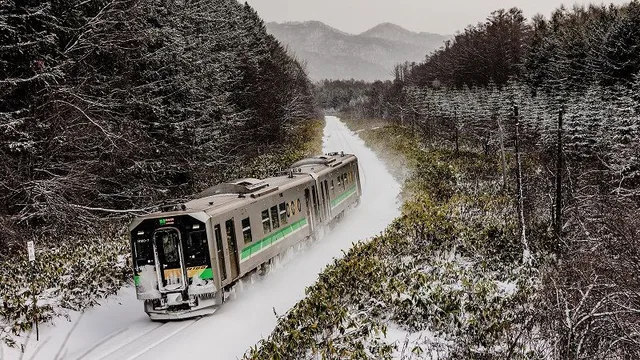
Winter is where an overnight can look more attractive and less attractive at the same time. Otaru after dark is visually stronger in snow, but changing hotels means dragging luggage over winter streets, dealing with wet wheels and slush, and making another transfer on a day when rail operations can be affected by snow.
A Sapporo day-trip base has one major resilience advantage: you can move Otaru to the best-weather day without changing accommodation. If heavy snow or poor visibility makes the original date unattractive, a day trip can be shifted more easily than a prepaid Otaru hotel.
An overnight can still be the better winter choice when the hotel itself matters or when you want to avoid a late-evening return during deteriorating weather. The important boundary is luggage. With a carry-on or overnight bag, the extra hotel is manageable. With two 29-inch cases, ski gear and children, the move needs a stronger payoff.
If the trip has several hotel changes already, use the Japan luggage-forwarding guide to decide whether the main suitcases can bypass Otaru while you carry only one overnight bag.
For families, the room has to beat the convenience of keeping the Sapporo room
A family of four pays the hotel-move cost more heavily than a solo traveller. Packing takes longer, winter footwear multiplies, children may be tired before dinner and a room that looks fine for two adults can become tight once four people and luggage arrive.
That does not make an Otaru night a bad family choice. It means the hotel itself needs to contribute something specific: a larger family room, a public bath everyone can use, an early breakfast that fits the route, or a location that makes the canal evening genuinely easy.
If the hotel is the reason you are considering the overnight, compare Dormy Inn vs OMO5 vs Hotel Sonia Otaru rather than deciding on the destination first and accepting any room afterward.
For couples, count “slow hours” rather than attractions
Couples often get more value from the overnight because the hotel is buying tempo rather than coverage. A long dinner, canal walk, drink, bath and late start the next morning can be a coherent one-night product even when no additional attraction is visited.
The trade-off is opportunity cost. If that night would otherwise be a ryokan in Noboribetsu, Jozankei or another destination where sleeping locally unlocks hot-spring time that cannot be reproduced from Sapporo, Otaru has to compete for the same scarce night. Compare Noboribetsu vs Jozankei before assuming every pleasant evening deserves another hotel.
An Otaru hotel before a flight only works when the flight schedule is generous
JR Hokkaido operates some direct Airport services between New Chitose Airport, Sapporo and Otaru, and Otaru Tourism currently lists the fastest Otaru–New Chitose Airport journey at about 75 minutes. That makes an Otaru final night possible before a later flight.
It is not a reason to stay in Otaru before an early flight. Not every train runs directly between Otaru and the airport, and a long airport journey is less resilient when the check-in deadline is tight. If the final morning has little margin, Sapporo or an airport-area hotel is the stronger departure base.
This is another example of the same rule: the overnight should solve a problem. “There is a direct train to the airport” is not enough if the departure time makes the connection fragile.
A practical overnight-value test
Before booking, score the night using four questions:
How many overnight-only Otaru sessions will I actually use? Canal after dark, late dinner, hotel bath, early walk and breakfast each count only if they are genuinely planned.
Does sleeping in Otaru move tomorrow’s route forward? Westbound travel toward Yoichi/Kutchan/Niseko is a stronger case than returning immediately to Sapporo.
What is the hotel-move cost? Count checkout, luggage, storage, winter walking and the possibility of paying for a Sapporo room you are not using.
Would I still want the night if the weather is poor? If the hotel, dinner and slow evening still have value, the booking is more resilient.
My threshold is simple: one overnight-only benefit is usually not enough; two or more meaningful benefits, or one major route-progression benefit, can justify the move. This is ValueNavi analysis, not a railway or tourism-board rule.
Three common trip scenarios
Five days in Hokkaido, first trip, Sapporo is the main base
Keep Otaru as a day trip. A short itinerary needs fewer hotel changes, and the JPY 1,600 adult return fare is a small price for preserving one base. Use the overnight night somewhere that changes the trip more dramatically.
Seven to ten days, one romantic night, next morning continues west
Stay one night. The room now buys the illuminated canal, an unhurried dinner and route progression through the Otaru rail junction. This is the strongest general overnight case.
Family with large luggage in winter, returning to Sapporo after Otaru
Take the day trip unless the hotel is a major attraction in its own right. The overnight adds packing and snow-luggage friction without solving a long transport problem.
Final verdict: stay only when the hotel changes the hours or the route
For a standard first visit from Sapporo, take the day trip. The current JPY 800 one-way fare and roughly 32-minute fastest journey make Otaru too easy to reach for a hotel move to justify itself on transport alone.
Stay one night when you can name what the night buys: the canal under gas lamps, a slow dinner, a second quiet morning session, a hotel you actively want to use, or a westbound route that already passes through Otaru. If you are merely sleeping in Otaru between two sightseeing blocks you could have done on a day trip, keep the Sapporo room.
USJ Halloween 2026 One-Day Itinerary: Opening to Horror Night
THE LUIGANS Spa & Resort Fukuoka: Is a 33m² Sea-View Room Worth Leaving Hakata for One Night?
Osaka and Kyoto in 7 Days: 3 Nights Each — When One Hotel Move Is Actually Worth It
Osaka Night Views: When Free Beats the Observation Deck — and When HARUKAS 300 Is Worth Paying For
References
JR Hokkaido — regular fares, including Sapporo–Otaru · JR Hokkaido — New Chitose Airport / Sapporo / Otaru services and westbound transfer notes · Otaru Tourism Association — current access times · Otaru Tourism Association — canal gas-lamp and warehouse illumination times · Otaru Tourism Association — 2026 visitor guide and night map. Checked August 26, 2026. Rail timetables, weather disruption and seasonal lighting/event schedules can change; recheck the exact travel date.