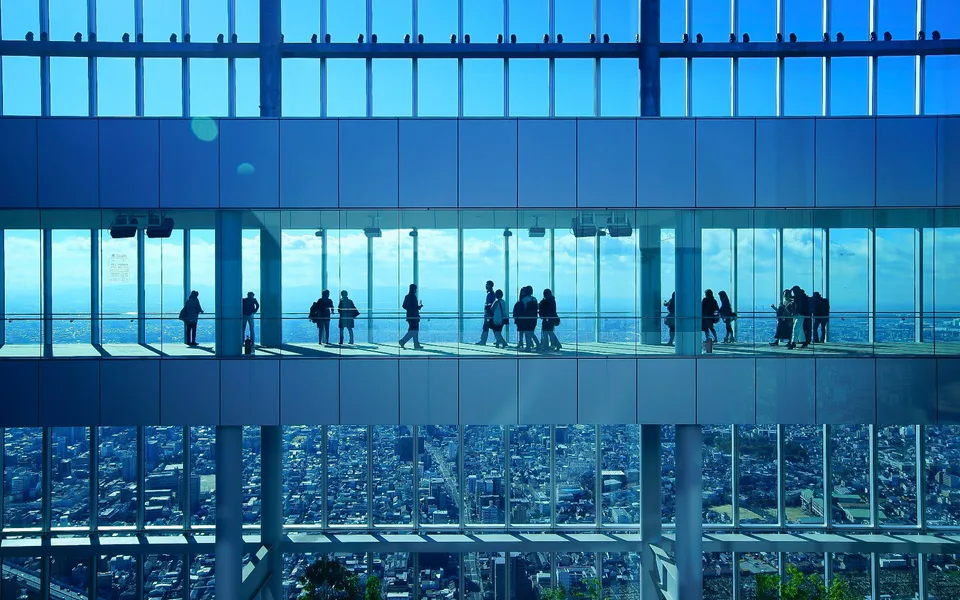
For most short Osaka trips, I would pay for one elevated night view at most. Use free views for the evenings that already end in Dotonbori, Nakanoshima or the bay area, then spend money only when height itself is the activity. The important 2026 change is that price no longer separates Osaka's two flagship decks very much: HARUKAS 300 is ¥2,200 (about US$13.85) same-day, but its official WEB advance ticket is 10% cheaper when bought by the previous day, bringing the adult price to about ¥1,980 (US$12.45). Umeda Sky Building is ¥2,000 (US$12.60). A ¥20 difference should not decide your evening.
The better question is where your day naturally finishes. Umeda Sky is the stronger choice when you want an open-air rooftop and are already around Osaka/Umeda. HARUKAS 300 is the stronger choice when you want one high, enclosed 360-degree panorama and Tennoji fits the route. If you are already at Kaiyukan, Tempozan Ferris Wheel is a much cheaper elevation upgrade. If you only want neon, water reflections or a pleasant post-dinner walk, paying for a tower may add less value than keeping the evening geographically simple.
Fact-checked August 26, 2026. JPY remains the primary currency; approximate USD figures use about ¥159 = US$1 as a working reference. Sunset times, special-event operations, weather restrictions and pass benefits can change.
The ValueNavi one-paid-view rule
Paid viewpoints are easiest to justify when they create a different kind of evening rather than repeating a view you already had the night before. On a three- or four-night Osaka stay, I would normally use this rule:
↔ Scroll table left or right
Night-view job | Best fit | Why |
Instant Osaka atmosphere after dinner | Dotonbori | Free, route-efficient and visually specific to Osaka; no need to create another appointment. |
Quiet river walk and architecture | Nakanoshima / Crystal Bridge | Also free; the value is the changing riverfront scene rather than height. |
Quick bay-area elevation after Kaiyukan | Tempozan Ferris Wheel | ¥900 (about US$5.65) and roughly 15 minutes; it avoids crossing Osaka for another deck. |
Umeda night view on an Osaka Amazing Pass after 15:00 | HEP FIVE Ferris Wheel | The pass includes HEP FIVE, while Umeda Sky changes to only a 10% discount after 15:00. |
Open-air rooftop, wind and sunset-to-dark transition | Umeda Sky Building | You are paying for the rooftop sensation, not just another skyline. |
One premium 360-degree panorama | HARUKAS 300 | At 300 metres, the panorama is the main event; advance pricing now removes most of the price objection. |
The weak strategy is to schedule a high viewpoint every night because Osaka has several. Umeda Sky and HARUKAS 300 are different enough to compare, but not different enough that most first-time visitors need both on a short trip. If you only have one paid-view budget, put it on the evening whose location and weather are strongest.
The biggest 2026 pricing correction: HARUKAS 300 is not meaningfully more expensive than Umeda Sky
Umeda Sky Building currently charges ¥2,000 (about US$12.60) for adults. HARUKAS 300's post-July 23, 2026 same-day adult ticket is ¥2,200 (about US$13.85), but the official April 2026 price-revision notice introduced a WEB advance ticket with a 10% discount when purchased by the previous day. That makes the advance adult price approximately ¥1,980 (US$12.45).
↔ Scroll table left or right
Option | Adult cost | Two-adult cost | What should decide it |
Umeda Sky Building | ¥2,000 ≈ US$12.60 | ¥4,000 ≈ US$25.15 | Open-air rooftop + Umeda route |
HARUKAS 300 same-day | ¥2,200 ≈ US$13.85 | ¥4,400 ≈ US$27.70 | Highest 360-degree panorama + Tennoji route |
HARUKAS 300 WEB advance | About ¥1,980 ≈ US$12.45 | About ¥3,960 ≈ US$24.90 | Same view, but you accept advance-purchase commitment |
For two adults, prebooked HARUKAS 300 is actually about ¥40 cheaper than two standard Umeda Sky tickets. That is too small to matter. Once prices converge this closely, choosing the wrong side of Osaka costs more in time and energy than choosing the “wrong” ticket.
There is also a current first-party information trap: at the time of this fact-check, HARUKAS 300's English ticket page reflects the new post-July 23 fare structure, while the English operating-information page still shows the older fee categories. Use the current ticket page and the April 1 price-revision notice for pricing rather than assuming every official subpage updated simultaneously.
Dotonbori is the best free night view when your evening already ends in Namba
Dotonbori works because the admission cost and the itinerary detour are both effectively zero when you were already coming to Namba for dinner, Shinsaibashi shopping or Hozenji. The canal, signs and crowds give you a night scene that reads as Osaka immediately. A high deck can show you more kilometres of city; it cannot replace that street-level atmosphere.
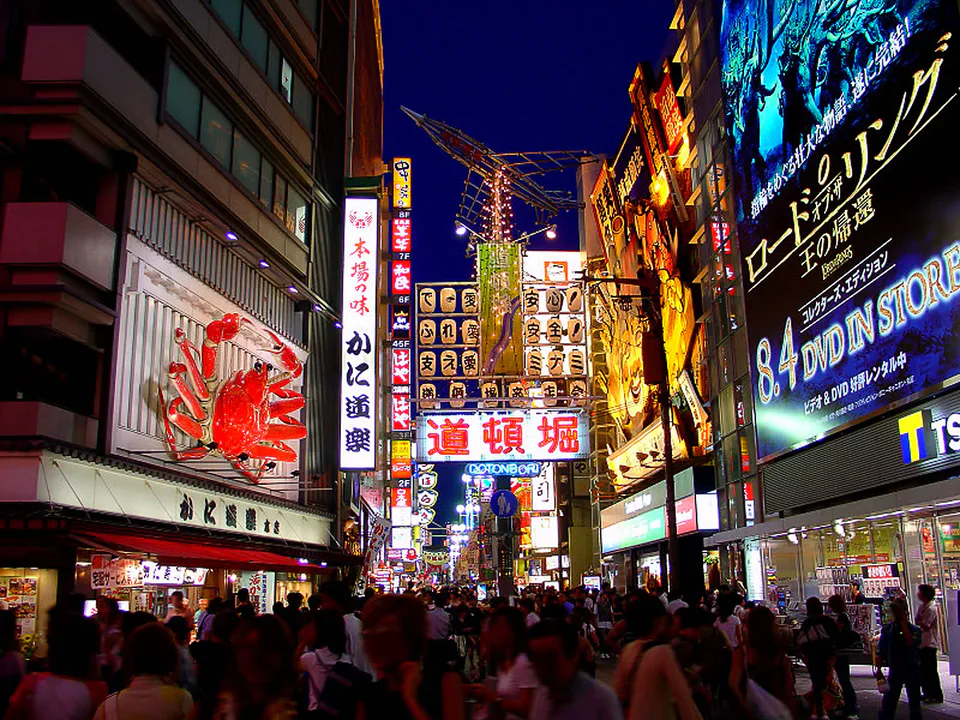
If you stay in Namba, I would normally put Dotonbori on a food or shopping evening rather than create a separate “night-view slot.” Compare Osaka hotels for shopping and nightlife or Cross Hotel Osaka's Dotonbori location if your evenings repeatedly finish here.
The boundary condition is simple: Dotonbori is not a skyline substitute. If your actual goal is to understand Osaka's scale from above, a free canal scene solves the wrong problem. Free wins here only when atmosphere is what you wanted in the first place.
Nakanoshima is the better free choice when the evening itself matters more than the viewpoint
Crystal Bridge in Nakanoshima is a pedestrian bridge with benches and night illumination, around five minutes on foot from Yodoyabashi Station according to Osaka tourism information. The surrounding river, Central Public Hall and other modern architecture make this a moving view rather than one fixed photo stop.
That makes Nakanoshima unusually good for couples or anyone who wants dinner plus a walk without turning the night into another queue. The trade-off is that you do not get a dramatic aerial panorama. I would choose it when the evening's quality depends more on pacing than height; the Osaka couples' stay guide uses the same logic of choosing the evening before choosing the hotel.
Maishima proves that “free” can still have the highest time cost
Maishima Seaside Promenade remains free and available for viewing all day. Osaka tourism specifically highlights sunset, passing ships and night views toward Nanko and Tempozan. But access requires a bus leg from Nishikujo or a transfer from the JR Yumesaki Line at Sakurajima to the Active Bus.
If Maishima is already on the day's route, that is excellent value. If you are in central Osaka and travel there only because admission is ¥0, the transport detour can make it the most expensive option in this article in terms of scarce evening time. This is the hidden-cost test: free admission is not the same as zero trip cost.
On a short trip where USJ already occupies the western side of Osaka, use the four-day Osaka/USJ/Kyoto trade-off before adding another west-side detour. A free sunset is poor value if it displaces the dinner or neighbourhood you actually came to Osaka for.
Tempozan Ferris Wheel: the cheapest sensible elevation upgrade
Tempozan Ferris Wheel currently costs ¥900 (about US$5.65) per person and takes about 15 minutes. Osaka tourism lists weekday hours of 10:00–21:00 and weekend/holiday hours of 10:00–22:00, with final boarding 15 minutes before closing. It is about a five-minute walk from Osakako Station and sits beside Kaiyukan.
For two adults, that is ¥1,800 (about US$11.30)—less than half the same-day cost of either flagship deck. The decision is not “Is the view as good as HARUKAS 300?” It is “Do I need to leave the bay area for a second activity?” If Kaiyukan already used the afternoon, a 15-minute Ferris-wheel loop can be the right amount of night view.
The Osaka Amazing Pass currently lists Tempozan Ferris Wheel among participating attractions, so pass users should check whether it is already covered on the exact day of use before paying separately.
Osaka Amazing Pass users have a different Umeda answer after 15:00
This is one of the easiest Osaka night-view mistakes to make. The current Osaka Amazing Pass rules state that Umeda Sky Building's observatory is included only until 15:00. From 15:00 onward, showing the pass gives a 10% discount instead. With the regular ¥2,000 adult fare, that means an evening pass-holder price of about ¥1,800 (US$11.30), not free admission.
Meanwhile, the same current pass page lists HEP FIVE Ferris Wheel as a participating attraction with normal hours of 11:00–23:00 and final boarding at 22:45. Its regular fare is ¥1,000, and it reopened in April 2026 after renovation.
↔ Scroll table left or right
If you hold the Osaka Amazing Pass in Umeda | Best value move |
You can reach Umeda Sky before 15:00 | Use the included observatory admission if the daytime view fits the itinerary. |
You specifically want sunset / night at Umeda Sky | Budget the discounted evening admission; do not count it as free in the pass break-even. |
You mainly want an included elevated night view after dinner | HEP FIVE is the cleaner pass play because the inclusion remains useful into the evening. |
This does not make HEP FIVE “better” than Umeda Sky. It makes it better for a specific budget problem. Umeda Sky still wins when the open-air rooftop is the experience you actually want.
Umeda Sky Building: pay for the rooftop, not the altitude number
Umeda Sky Building's Kuchu Teien Observatory currently operates 09:30–22:30 with last admission at 22:00. Adult admission is ¥2,000 (about US$12.60); the current child fare for ages 4 through elementary school is ¥500.
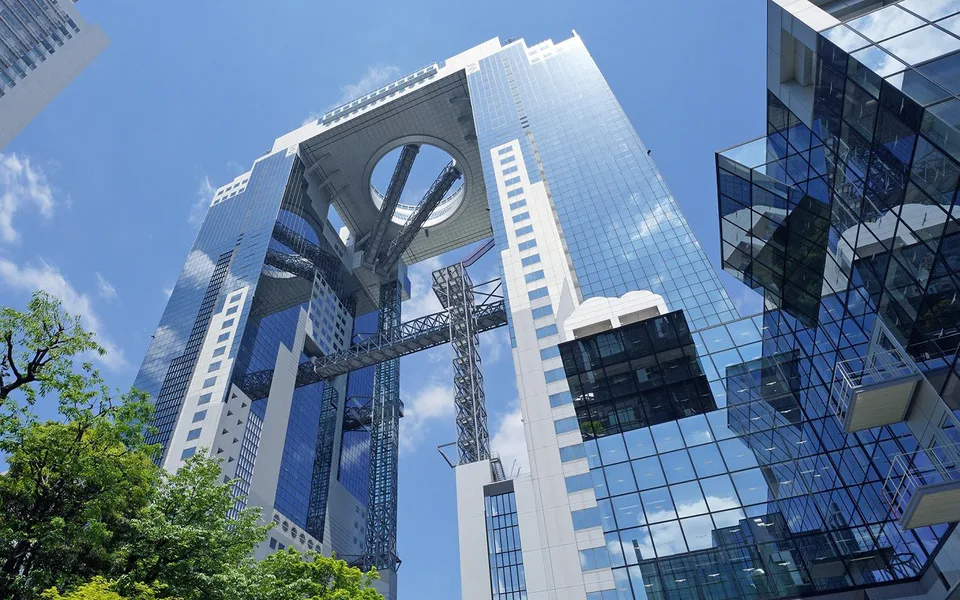
The paid value is the open-air roof at roughly 173 metres and the physical sensation of being outside above the city. That is why I would choose Umeda Sky over HARUKAS 300 for someone who cares about rooftop atmosphere more than maximum height. It is also why poor weather changes the recommendation more aggressively: strong wind, rain or low visibility can damage the exact part of the product you paid for.
If you go, give it enough time for the transition from daylight to full night. Paying ¥2,000 and arriving after darkness for a rushed 20-minute photo stop strips out much of the experience that differentiates it from cheaper or free options.
HARUKAS 300: choose it when the panorama itself is the evening
HARUKAS 300 now charges ¥2,200 (about US$13.85) for a same-day adult ticket for ages 15 and over, ¥900 (about US$5.65) for ages 6–14, and free admission for preschool children aged 5 and under. Standard hours remain 09:00–22:00, with last admission 30 minutes before closing.
The standard same-day ticket does not allow re-entry. The official ticket information also warns that same-day sales can involve queues or numbered tickets during busy periods. If sunset is important, buying the WEB advance ticket by the previous day has two benefits: it is 10% cheaper and it reduces dependence on the same-day ticket counter.
I would choose HARUKAS 300 for a first-time visitor who wants one premium skyline and already has Tennoji/Abeno in the day. I would not choose it merely because it is taller. If the party does not care much about skylines, visibility is weak or you are already exhausted after a full day elsewhere, 300 metres of height does not rescue the opportunity cost.
Do not schedule Umeda Sky and HARUKAS 300 on consecutive nights by default
Two adult visits to both flagship decks at ordinary same-day pricing cost ¥8,400 (about US$52.85) before transport, food or any special ticket. Even using HARUKAS advance pricing, the pair is still about ¥7,960 (US$50) for two adults. More important than the money, both consume the same scarce part of the day: the hour around sunset and early night.
That creates a route-conflict cost. If you dedicate one evening to Umeda Sky and the next to HARUKAS 300, you have used two prime dinner/evening windows to answer a similar “Osaka from above” question. For most short trips, I would instead pair one paid deck with one free street-level night: Umeda Sky + Dotonbori, or HARUKAS 300 + Nakanoshima, for example.
I would keep both only when the views themselves are a major trip theme, photography is a priority, or one visit is tied naturally to Umeda and the other to Tennoji without extra cross-city movement.
Your hotel base should decide which night view survives the cut
↔ Scroll table left or right
Where your evening ends | Lowest-friction night-view choice | What I would avoid |
Namba / Shinsaibashi | Dotonbori; add one paid deck on a different evening only if height matters. | Crossing to Maishima solely because it is free. |
Umeda / Osaka Station | Umeda Sky; HEP FIVE for an Amazing Pass evening-value option. | Going all the way to Tennoji just to save ¥20 on an advance ticket. |
Tennoji / Abeno | HARUKAS 300, especially with advance purchase. | Traveling to Umeda only because a list ranked its rooftop slightly higher. |
Bay area / Kaiyukan | Tempozan Ferris Wheel. | Leaving the bay during sunset, then paying for another elevated view elsewhere. |
Maishima event / nearby hotel | Maishima Seaside Promenade. | Ignoring a free sunset already on your route. |
If your base is still open, compare Namba vs Umeda or the Osaka accommodation decision hub. Night-view planning is one of the rare cases where a “worse” attraction can produce the better evening simply because it is already on the way home.
Bad visibility changes the type of night view you should buy
Low cloud, haze and heavy rain mainly attack long-distance visibility—the exact thing high-rise tickets monetize. Umeda Sky also depends more on outdoor conditions because the rooftop is part of its appeal. On a poor-visibility evening, changing to Dotonbori or Nakanoshima is often smarter than buying a different tower ticket and hoping height solves the weather.
This is the weather-exchange rule: move the paid deck to the clearest evening; move the free street-level night into the weak-weather slot. That gives you flexibility without paying twice for compromised views.
Final verdict: pay for one distinct experience, not for every high building
If I were planning a first Osaka trip, I would usually choose one paid elevated view and let the rest of the nights stay free. Choose Umeda Sky when open-air rooftop atmosphere and Umeda routing matter most. Choose HARUKAS 300 when you want the strongest 360-degree panorama and Tennoji fits the day; with the current advance discount, price is essentially a tie. Choose Tempozan when you are already in the bay area and only need a short, inexpensive elevation upgrade.
For free nights, Dotonbori is the best default when you want unmistakable Osaka energy, Nakanoshima when you want a slower walk, and Maishima only when you are already on the western route. Osaka Amazing Pass users should remember the special evening rule: Umeda Sky is not free after 15:00, while HEP FIVE remains a much cleaner included night-view option.
The recommendation flips if skyline photography is a major purpose of the trip or if your route naturally gives you separate Umeda and Tennoji evenings. Otherwise, the extra observation deck is usually not buying a new Osaka experience; it is buying another version of the same scarce sunset hour.
Next decision: choose Namba or Umeda before deciding which Osaka night deserves a detour
Official sources and current-price notes
Osaka Tourism: Ebisu Bridge / Dotonbori
Osaka Tourism: Crystal Bridge / Nakanoshima
Osaka Tourism: Maishima Seaside Promenade
Osaka Tourism: Tempozan Ferris Wheel
Umeda Sky Building official: current hours
Umeda Sky Building official: current ¥2,000 adult admission reference
Osaka Amazing Pass: Umeda Sky before-15:00 rule, HEP FIVE and Tempozan participation
HARUKAS 300 official current ticket page
HARUKAS 300 official April 1, 2026 fare-revision notice and WEB advance discount
HARUKAS 300 official operating-hours page
Admission prices, operating hours, special-opening rules, weather restrictions and pass benefits can change. Recheck the official page for your exact date, especially around fireworks, holidays and strong-weather days. If visibility is poor, do not buy a high-rise ticket simply because it was on the original itinerary.
Edogawa Fireworks 2026: The Best Free Side to Watch, When to Arrive and How to Get Out
Centara Grand Hotel Osaka: Is the 40m² Family Room Worth It for Four?
THE LUIGANS Spa & Resort Fukuoka: Is a 33m² Sea-View Room Worth Leaving Hakata for One Night?
Osaka Kuromon Market Food Tour 2026: You’re Paying for a Guide, Not the Food