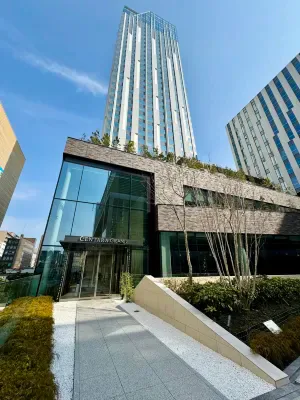
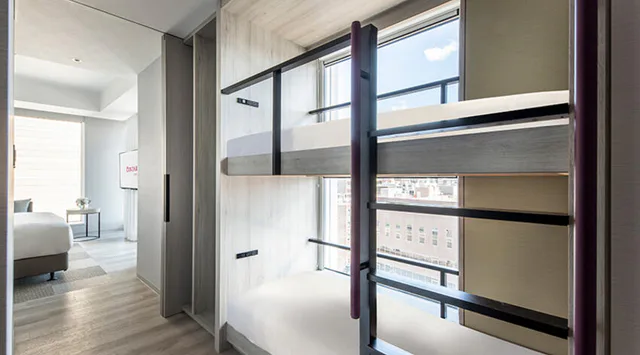
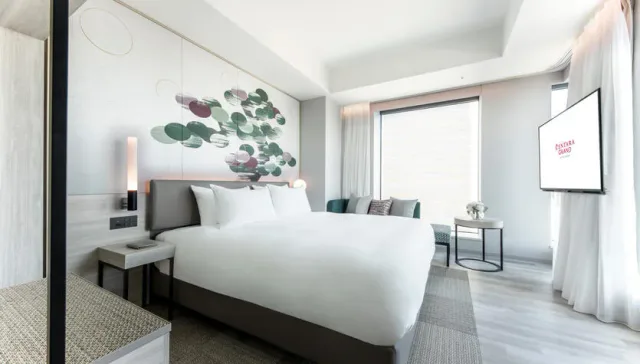
Centara Grand Hotel Osaka’s 40m² Family Room is a strong one-room solution for two adults with two younger children, but it is not a generic four-person room. The hotel lists the Family - Yu, Family - Rei and Family - Miyabi rooms at 40m² with a king bed, separate children’s bunk area, a maximum of two adults and two children, and no extra beds. If your group is four adults, includes three adults, or has children who no longer fit the bunk-bed rule, the correct comparison is usually a two-room plan rather than trying to make the Family Room work.
The more useful question is not “Is 40m² big?” It is “Is one 40m² room with one bathroom and family sleep zoning better for us than two 27–30m² rooms with more total space, a second bathroom and more privacy?” That answer changes with the children’s ages, bedtime routine, room-rate gap and how often you use Nankai Namba versus Osaka Metro Namba.
Fact-checked August 26, 2026. JPY remains the primary currency; approximate USD figures use about ¥159 = US$1 as a working reference. Room availability, rate-plan rules and connecting-room availability remain date-specific.
The 30-second decision: who should actually book the Family Room?
↔ Scroll table left or right
Your group | My default | Why |
2 adults + 2 children clearly within the bunk-bed rule | Family - Yu or Rei first | One booking gives a king bed plus a separate children’s sleep zone without adding a second room. |
2 adults + children who sleep early | Family Room is especially useful | The bunk area creates better bedtime separation than one open room with everybody around the same beds. |
2 adults + an exactly 11-year-old child | Confirm the sleeping arrangement before paying | The room page allows bed-sharing for ages 11 and under, while the FAQ says bunk beds are for children under 11. |
3 adults + 1 child | Do not force the Family Room | The Family Room is capped at two adults; the hotel also says extra beds are unavailable. |
4 adults | Plan on two rooms | The Family Room is not a four-adult room. |
Older children / teens who need adult-style beds and privacy | Compare two rooms | You gain more total floor area, a second bathroom and better separation. |
Family away all day at USJ, Kyoto or Kobe | Yu/Rei usually before Miyabi | All three Family tiers remain 40m²; the Club premium only works if you use the lounge windows. |
Eligibility comes before price: the Family Room is a specific exception, not a four-person loophole
Centara’s current Family Room pages list 40m², maximum two adults and two children, one king-size Simmons bed and separate bunk beds for children. The hotel FAQ separately states that no extra beds are available and that the maximum number of adults per room is two. That means the Family Room should be read as a purpose-built family configuration, not as permission to put any four travellers into one room.
This matters because booking sites often compress occupancy into a simple “sleeps four” label. Enter the real ages and guest mix before comparing prices. A room that works perfectly for two parents plus two primary-school children can be the wrong product for four friends or for a family travelling with an adult grandparent.
The real comparison is one 40m² Family Room versus 54–60m² across two Deluxe rooms
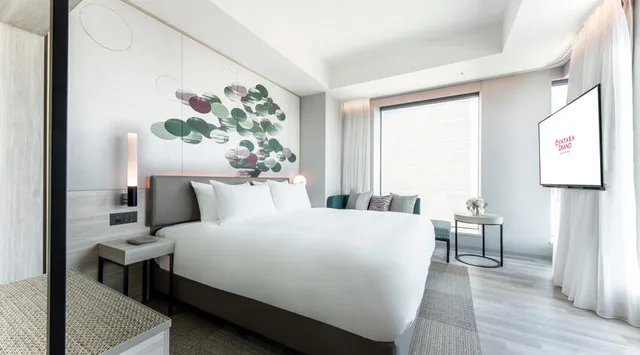
Centara’s current room inventory lists standard Deluxe rooms at 27–30m². Two such rooms therefore provide roughly 54–60m² of combined floor area. Compared with a 40m² Family Room, that is about 35–50% more total floor area, before you even count the second bathroom and the ability to close a door between sleepers.
↔ Scroll table left or right
Decision dimension | One 40m² Family Room | Two 27–30m² rooms |
Total published floor area | 40m² | 54–60m² combined |
Bathrooms | One room’s bathroom setup | Two separate room bathrooms |
Sleep separation | King area + separate children’s bunk zone | Two fully separate rooms |
Best fit | Parents + younger children who benefit from staying together | Older children, teens, adults, or groups where morning bathroom congestion matters |
Main trade-off | One bathroom and child-specific occupancy rules | Usually higher total rate and connecting rooms are request-based rather than something to assume |
The hotel lists interconnecting rooms as available on request and specifically recommends contacting the property to arrange connecting rooms or suites for families. Treat that as a planning option, not a guarantee until the hotel confirms it.
The useful price test is therefore:
Two-room privacy premium per night = two-room total rate − Family Room rate.
Then ask what that premium buys your group: roughly 14–20m² more combined published floor area, a second bathroom, more adult-style sleeping flexibility and better privacy. For a purely hypothetical example, if two rooms cost ¥10,000 more per night, that is about US$63 per night. Over four nights, the extra cost becomes ¥40,000 (about US$252). For a family with two small children, that may be unnecessary. For four adults sharing morning routines, it can be money spent on a real bottleneck rather than on luxury branding.
The age-11 edge case is easy to miss
Two current official rules use slightly different age wording. The Family Room page says children aged 11 and under may share an adult bed, one child per bed. The hotel FAQ says the Family Room bunk beds are available for children under 11.
That creates a real boundary case for a child who is exactly 11. Do not convert “11 and under may bed-share” into “an 11-year-old is definitely eligible for the bunk bed.” If the bunk is essential to making the room work, confirm the sleeping arrangement directly with the hotel before locking a non-refundable rate.
The same logic applies to height and sleeping comfort. The hotel notes that bed-sharing suitability can depend on a child’s height. Published occupancy tells you what the hotel permits; it does not tell you whether your particular family will sleep well.
40m² solves sleep zoning better than it solves morning congestion
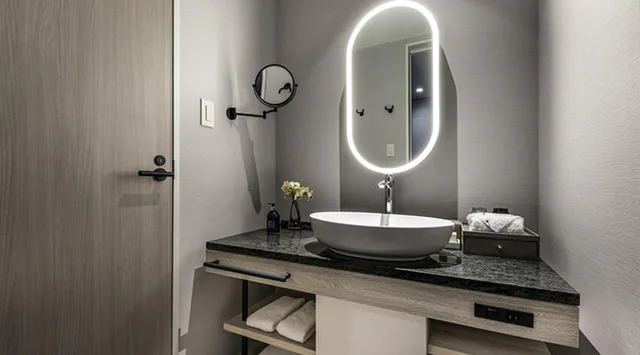
The strongest feature of the Family Room is the separate children’s bunk zone. It lets parents stay awake, pack or prepare the next day without placing every sleeper around the same bed. That is a genuine layout advantage even though the room is not apartment-sized.
The weakness appears in the morning. Four people still operate from one room and one bathroom setup. If everybody needs showers, hair drying and a fixed departure for USJ or a day trip, the bottleneck can matter more than the headline floor area. This is where two smaller rooms can outperform one larger room despite looking less efficient on the booking screen.
I would therefore value 40m² differently by family type. For two adults with two young children, the separate sleep zone is often the scarce resource. For parents with older children or teens, the scarce resource may shift to bathroom access and privacy.
Yu, Rei and Miyabi are all 40m² — do not pay a floor premium expecting a larger family room
Family - Yu on the Standard Floor, Family - Rei on the Premium Floor and Family - Miyabi on the Club Floor all use the same 40m² family-room headline and the same two-adult/two-child capacity. The tier decision should therefore be based on floor positioning and services, not on an assumption that Miyabi gives the family more room to spread out.
For most sightseeing-heavy families, I would start by pricing Yu and Rei. Move to Miyabi only after proving that the Club Lounge fits the daily schedule. A more expensive label is not useful if its main benefits happen while you are still at USJ or on a Kyoto day trip.
Miyabi’s value depends on how many lounge windows you actually capture
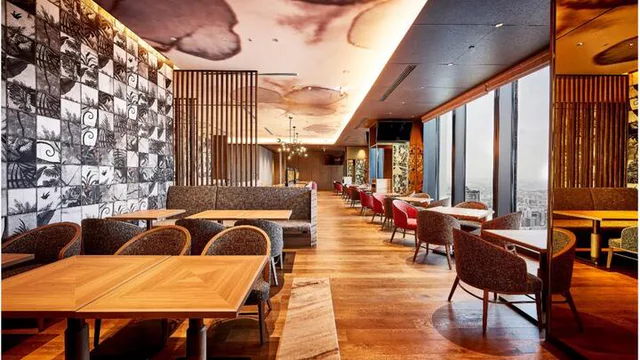
The Club Lounge currently operates 07:00–22:00, with breakfast 07:00–10:30, afternoon tea 14:30–16:30 and Evening Cocktails 17:30–19:30. The hotel’s regular Suan Bua breakfast starts earlier at 06:30 and runs to 10:30, with last entry at 10:00.
That creates a useful correction: buying Miyabi for Club Lounge access does not buy an earlier lounge breakfast. If your family wants to leave around 07:00 for a full day, the lounge breakfast window itself starts at 07:00. The Club tier makes more sense when hotel time is part of the day, not when every morning and evening is optimized for being elsewhere.
↔ Scroll table left or right
How the family uses the hotel | Miyabi value |
Only returns to sleep | Weak — the room is still 40m² and the key lounge windows are missed. |
Uses Club breakfast only | Needs a price check — compare the Club premium with a non-Club breakfast-inclusive rate. |
Returns for afternoon rest on one or two days | Stronger — afternoon tea becomes a real benefit rather than unused entitlement. |
Uses afternoon tea plus Evening Cocktails on several days | Strongest case — multiple lounge windows are replacing real food/drink spending and hotel downtime is intentional. |
This is the window-capture test: before paying for Miyabi, mark the days when your family will physically be back between 14:30 and 19:30. If the answer is zero, the Club premium has to justify itself through other benefits.
Nankai Namba is genuinely close; Osaka Metro Namba is a repeated-cost decision
The hotel’s current access page lists about four minutes on foot from Nankai Namba South Exit and about eight minutes from Osaka Metro Midosuji Line Namba Exit 4. It also lists the Nankai Rapi:t journey from Kansai International Airport to Namba at roughly 40 minutes.
That is why Centara is particularly coherent for a family arriving from Kansai Airport and spending evenings around southern Namba. The transfer-free airport leg, short South Exit walk and family sleep layout all solve friction on the same trip.
But the Metro side deserves frequency weighting. The official walking estimates differ by roughly four minutes. If your itinerary creates six Metro-station walks over several days, that published-distance difference adds about 24 minutes of walking benchmark; eight walks make it about 32 minutes. Those are derived planning figures, not a promise of actual walking time, and a stroller or large luggage can make the practical difference feel larger.
This is why “four minutes from Namba” is incomplete. Ask which Namba you will use most often. If the trip is mostly Namba, KIX and Nankai-linked travel, Centara’s location is excellent. If every day points north through the Midosuji Line toward Umeda or Shin-Osaka, another hotel can be better even if its airport arrival is less elegant.
If the base itself is still open, compare the main Namba hotel trade-offs or OMO7 Osaka vs Centara Grand Hotel Osaka before paying a family-room premium.
Driving? The pool of hidden cost is the parking space, not the room
Centara currently lists only 15 hotel parking spaces, including two barrier-free spaces. The overnight guest fee is ¥3,500 (about US$22) on weekdays and ¥4,000 (about US$25) on weekends and holidays per stay for up to 24 hours.
For a family using a rental car, that changes the hotel comparison. A room that looks only ¥3,000 cheaper than another property can lose the price advantage once parking is added. More importantly, a 15-space on-site capacity is a reminder not to treat parking as an unlimited background amenity. Recheck the hotel’s current procedure and longer-stay terms if the car is essential.
If most Osaka days are rail-based, I would not rent a car merely because the Family Room makes the hotel feel family-oriented. The Nankai and Namba location is one of the hotel’s strengths; paying for a car can duplicate transport rather than improve it.
Family Room versus apartment hotel: decide whether you need sleep zoning or living functionality
Centara’s Family Room solves a hotel problem: parents and children get separate sleeping zones inside a full-service property. It should not automatically beat an apartment-style hotel when the real requirement is a kitchen, in-room laundry, multiple beds for older travellers or longer-stay living space.
If those functions matter more than Club Lounge access or luxury-hotel service, compare MIMARU Osaka Shinsaibashi Central rather than asking the Centara Family Room to solve a different trip. The right question is not which hotel has more features; it is which room removes the bottleneck your group will face every day.
Before booking, compare the same product — not three different “family” rates
Enter the real number of adults, children and their ages on every booking platform. Then verify whether the returned room is Family - Yu, Family - Rei or Family - Miyabi. Keep taxes, breakfast, cancellation deadline and payment timing aligned before deciding that one site is cheaper.
For a two-room alternative, do the same exercise with the exact two room types you would book and ask the hotel about interconnecting availability. Do not compare one refundable Family Room against two non-refundable rooms and call the price difference a pure space premium.
Booking.com — compare Centara family rooms
Trip.com — compare Centara family rooms
Agoda — compare Centara family rooms
Five failure modes that can make the 40m² room the wrong booking
1. Treating “four people” as “four adults.” The room’s official adult cap is two.
2. Missing the age-11 wording split. Bed-sharing and bunk-bed rules do not use identical age language; confirm an exactly 11-year-old’s setup.
3. Paying for Miyabi while spending every day outside the hotel. The room does not become larger on the Club floor.
4. Ignoring the second-bathroom value of two rooms. Four people getting ready at the same time can make bathroom count more important than one-room floor area.
5. Calling the hotel “four minutes from Namba” without checking your line. Four minutes is the Nankai South Exit benchmark; the hotel lists eight minutes from Osaka Metro Midosuji Line Exit 4.
Final verdict: the Family Room is worth it when it prevents a second room without creating a new bottleneck
I would shortlist Centara Grand Hotel Osaka’s 40m² Family Room for two adults with two younger children when Nankai Airport access, Namba evenings and one-room family logistics all matter. In that situation, Family - Yu or Rei usually solves the key problem cleanly: parents get a king bed, children get a separate bunk zone, and everyone stays in one room.
I would compare two rooms instead when the group includes more than two adults, the children are too old for the intended bunk setup, morning bathroom congestion matters, or privacy is worth paying for. Two 27–30m² rooms give roughly 35–50% more total published floor area plus a second bathroom, so the extra rate is buying something concrete.
Miyabi is a separate decision. Pay for it when you will actually capture the Club Lounge windows; do not pay simply because the floor name sounds more premium. And if the trip repeatedly uses Osaka Metro rather than Nankai, re-run the hotel choice by daily route frequency before allowing a convenient airport arrival to dominate the whole stay.
Next decision: compare Centara with the other Namba hotel layouts
THE LIVELY FUKUOKA HAKATA: Is Nakasu-Kawabata Worth a 12 m² Room?
THE BLOSSOM HIBIYA: Are the High-Floor Views Worth Paying More For?
Sapporo Grand Hotel: Is the 10-Minute Underground Walk Worth It in Winter?
Osaka Hotels for Kyoto and Kobe Day Trips: When 3–5 Minutes to the Station Matter Twice a Day
Sources
Centara Grand Hotel Osaka — Family - Yu Standard Floor
Centara Grand Hotel Osaka — Family - Rei Premium Floor
Centara Grand Hotel Osaka — Family - Miyabi Club Floor
Centara Grand Hotel Osaka — access and parking
Centara Grand Hotel Osaka — Club Lounge service hours
Centara Grand Hotel Osaka — Suan Bua breakfast hours
Room types, occupancy interpretation, connecting-room availability, rates, parking rules and lounge operations can change by stay date. Confirm the exact sellable room and guest ages before paying. This article may contain affiliate links; ValueNavi may earn a commission from qualifying bookings at no additional cost to you.