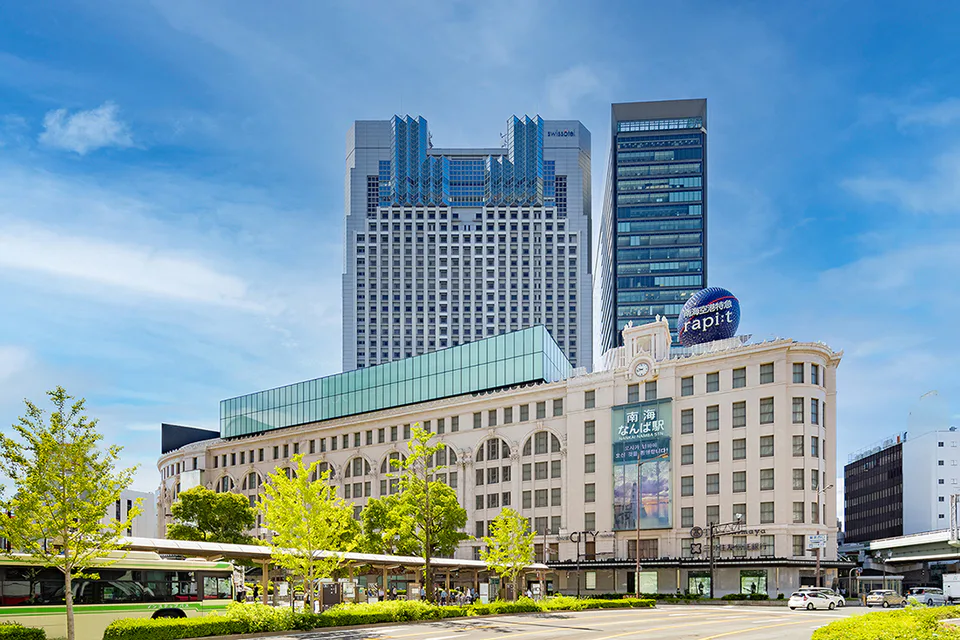
Choose Swissôtel Nankai Osaka when the Nankai airport train is the piece of the trip you most want to simplify. Choose Hotel Royal Classic Osaka when Osaka Metro Namba is the station you will use repeatedly. Choose Centara Grand Hotel Osaka when a specific room configuration—especially the 40 m² family room for two adults and two children—is more valuable than the shortest station connection. These are three different products even though all three are sold as Namba hotels.
The most useful comparison is not nightly rate or star category. It is which friction repeats. A Kansai Airport arrival and departure normally use the Nankai connection once each; a five-night city stay can use Osaka Metro far more often. A family-room layout may matter every night. The hotel premium should follow the problem that repeats, not the most impressive feature on arrival day.
↔ Scroll table left or right
Decision | Swissôtel Nankai Osaka | Hotel Royal Classic Osaka | Centara Grand Hotel Osaka |
Nankai Airport arrival | Strongest: hotel says less than 1 minute from Nankai Namba exit | About 4 minutes from Nankai Namba | About 4 minutes from Nankai Namba South Exit |
Osaka Metro Namba | Midosuji Namba is under 2 minutes | Strongest: directly connected to Exit 12 | About 8 minutes from Midosuji Namba Exit 4 |
Reference room advantage | Swiss Advantage rooms span several bed/size variants; Twin can take up to 3 adults | Standard Twin is 30–31 m²; the 31 m² type can take 3 guests | Family room is 40 m² with king + children’s bunks |
2 adults + 2 children | Needs a different eligible room strategy | Standard Twin is not a 2+2 family solution | Strongest fit when the children meet the exact room conditions |
4 adults | Do not assume a Swiss Advantage Twin works: max 3 adults | Do not assume the Standard Twin works: max 3 in the 31 m² type | Family room does not work: max 2 adults + 2 children |
First eliminate the hotels that do not fit the party
Room legality comes before station convenience. Centara’s current 40 m² Family room is explicitly designed for up to two adults and two children, with a king bed plus separate bunk beds for the children. That makes it unusually clean for a 2+2 family, but it also creates a hard boundary: four adults cannot treat “40 m² family room” as a four-adult room.
The same check applies to the other two. Swissôtel’s current FAQ lists the Swiss Advantage Twin for up to three adults, while the Queen and King versions are for two. Hotel Royal Classic’s Standard Twin is 30–31 m²; the 31 m² version can accommodate three guests, not four.
This is the fastest way to avoid a false comparison. A family of two adults and two children may find Centara’s room geometry solves the trip before station distance matters. Four adults should reopen the search for a qualifying larger room, two-room setup or apartment-style hotel rather than forcing one of these reference categories to work.
Swissôtel Nankai Osaka: pay for the Nankai hand-off, not the hotel name
Swissôtel’s official access guide says Nankai Namba Station is connected to the hotel and the walk from the station exit is less than one minute. After the gates, guests follow hotel signs to the dedicated lift. For someone arriving from Kansai Airport with two large suitcases, that is a concrete product: the airport-train journey ends without another outdoor or underground navigation problem.
The same official guide shows why the word “Namba” can mislead. Osaka Metro Midosuji Namba is also close—under two minutes—but Osaka-Namba on the Hanshin/Kintetsu lines is around five to six minutes and JR Namba around nine minutes. Swissôtel is therefore not equally “direct” from every Namba-labelled station.
Best fit: late or tiring KIX arrival, large luggage, Nankai both ways, and a stay whose evenings are already centred around Namba.
Main trade-off: airport-train directness may be used only twice. If five sightseeing days repeatedly use Metro or northbound routes, do not let the clean arrival chain dominate the whole hotel decision.
Red-team condition: if you arrive in daylight with one carry-on and leave from somewhere other than KIX, much of the Swissôtel location premium can disappear. The hotel may still win on room or service, but “above Nankai” is no longer enough.
For a room-level decision, use the Swissôtel Nankai Osaka airport-access and room guide.
Hotel Royal Classic Osaka: the strongest answer when Metro use repeats
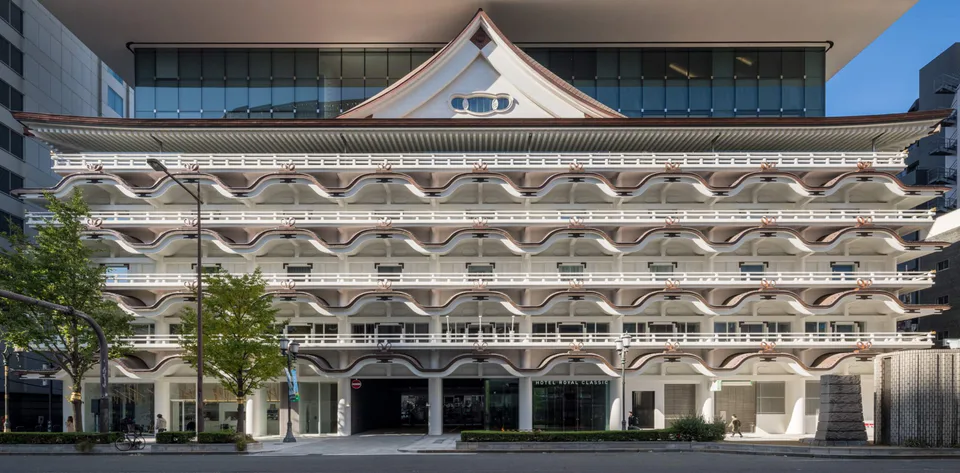
Hotel Royal Classic is directly connected to Osaka Metro Namba Station at Exit 12. Its own access page puts Nankai Namba at about a four-minute walk and JR Namba at about ten minutes via Namba Walk. That reverses the Swissôtel logic: the Nankai airport arrival has a small final walk, but the Metro relationship can pay back every day.
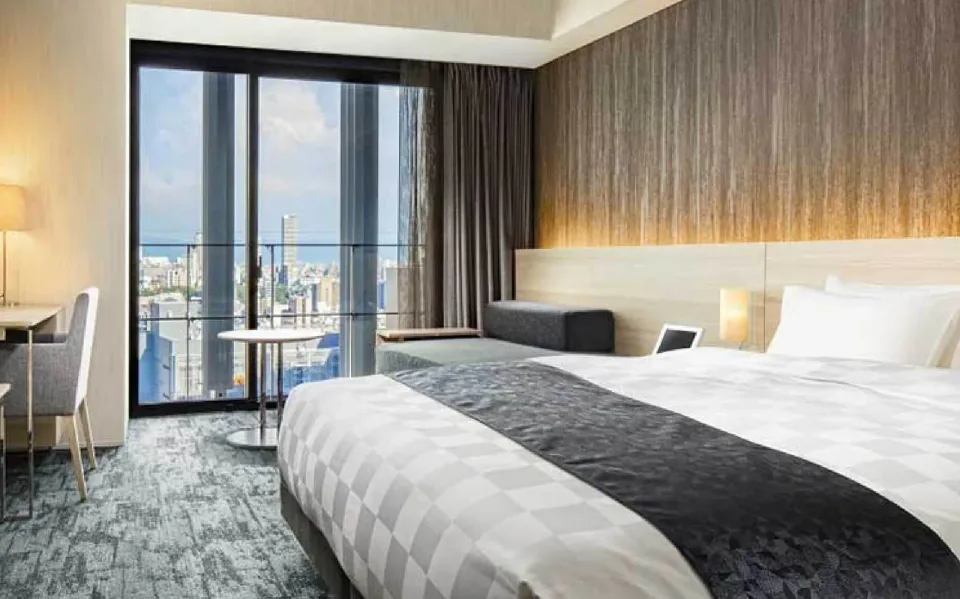
The standard Twin also gives a useful room-space baseline. The hotel currently lists it at 30–31 m² with two 120 cm beds; the 31 m² type can accommodate three guests. All standard rooms are described with bathrooms that have a washing area, which can matter to families or travellers who dislike compact unit-bath layouts.
Best fit: two adults, repeated Midosuji/Sennichimae use, Shinsaibashi/Umeda/Tennoji city movement, and a preference for a roughly 30 m² conventional twin.
Main trade-off: you give up Swissôtel’s near-zero Nankai final walk. For a 23:00 arrival with two 29-inch cases, four minutes can matter more than it does on an ordinary sightseeing morning.
Red-team condition: if the only reason you are considering Royal Classic is “it is connected to Namba,” write down which Namba railway you actually use. Direct Metro connection does not make the Nankai or JR hand-off disappear.
Centara Grand Hotel Osaka: the room has to justify the extra station distance
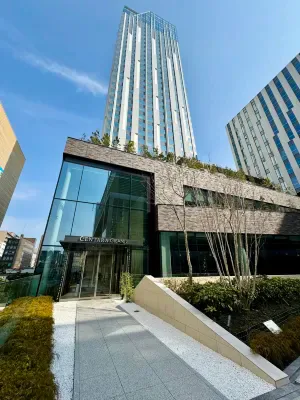
Centara’s current access page places the hotel about four minutes from Nankai Namba South Exit and about eight minutes from Osaka Metro Midosuji Namba Exit 4, with a second-floor entrance accessible via the Namba Parks deck. That is still a central Namba location, but unlike the other two hotels, neither Nankai nor Metro directness is its defining advantage.
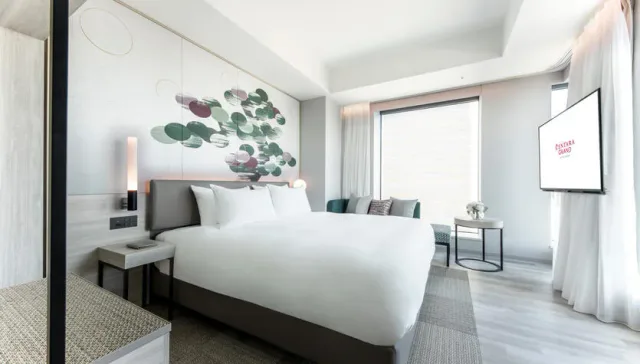
The strongest reason to choose Centara is therefore a room or hotel-use requirement. The current Family room is 40 m² and designed for two adults plus two children, with a king bed and separate bunk beds. For the right family, that can be more useful every night than shaving several minutes off an airport or Metro walk.
Best fit: 2 adults + 2 children who fit the current family-room rules, travellers who will spend meaningful time in the hotel, or guests who prefer the Namba Parks/south-Namba side enough to accept the longer Metro walk.
Main trade-off: you are paying for room and hotel proposition rather than the cleanest transport hand-off.
Red-team condition: a 40 m² room is not automatically better value for a couple who is outside the hotel from breakfast until midnight. If the extra space is unused and transport repeats every day, Royal Classic or Swissôtel can be the more rational purchase.
For the detailed family-room question, use Centara Grand Hotel Osaka: Is the 40 m² Family Room Worth It?
Use a repeat-use count: airport access usually happens twice, city access can happen ten times
A station premium should be multiplied by how often you use it.
Imagine a five-night Osaka stay. Nankai may matter on arrival from KIX and departure back to KIX: two high-value uses. Osaka Metro can appear on five mornings and five evenings: potentially ten uses. This does not mean Royal Classic automatically wins. It means the repeated Metro relationship can outweigh a cleaner airport hand-off if the itinerary is city-led.
The reverse is also true. A one-night stop before an early KIX flight has almost no time for repeated city access. In that case the Nankai hand-off can dominate the entire stay, pushing Swissôtel upward even if another hotel has a larger room.
This is ValueNavi analysis rather than an official hotel metric. The useful calculation is:
location value = friction saved per use × number of real uses.
A four-minute saving used twice and a two-minute saving used ten times are different products. The correct hotel depends on which repetitions are actually in your itinerary.
Large luggage changes the value of the last 4–8 minutes
A hotel map treats a four-minute walk as four minutes. A traveller carrying two large suitcases experiences elevator choice, crowds, door thresholds, rain exposure and whether the route remains step-free. That is why Swissôtel’s Nankai connection becomes disproportionately valuable on an airport day even if the raw distance difference looks small.
But luggage also changes the room decision. Hotel Royal Classic’s 30–31 m² Standard Twin provides materially more published area than many compact Japanese city rooms. Centara’s 40 m² Family room provides still more space for the specific 2+2 configuration. Swissôtel’s room portfolio has several size and bedding variants, so the exact room must be compared rather than assuming the brand gives one standard floor area.
Do not convert published square metres into a promise that two open suitcases will fit. Furniture, bed position and circulation still matter. Use area as a screening tool, then verify the exact room layout.
Late KIX arrival: Swissôtel wins only if the train still gets you to Namba cleanly
Swissôtel’s station relationship is especially valuable after a late flight, but hotel location cannot rescue a missed airport train. Build the evening from the time you expect to be landside with luggage, not the scheduled landing time. If the arrival is close to the final workable Nankai service, the correct comparison may become airport hotel versus Osaka rather than Swissôtel versus Royal Classic.
If you do reach Nankai Namba late, Swissôtel removes the most final-mile decision-making. Royal Classic and Centara each add a short walk; that may be trivial for a solo traveller and material for a sleeping child, stroller or heavy luggage.
Should you move to Swissôtel for the final night just for KIX?
Usually not. A final-night hotel change has its own cost: packing, checkout, moving luggage, storage or early check-in and another check-in. The move becomes rational only when it solves more than the airport train.
Strong case for moving: your final evening is already in Namba, you have large luggage, and the KIX departure is early enough that a simpler morning materially reduces risk.
Weak case: you are comfortably based in Kyoto or Umeda, the flight leaves in the afternoon and the only benefit is turning one easy transfer into a shorter walk. In that case the hotel move may cost more time than it saves.
This is the same principle used in the Kyoto vs Osaka base decision: a second hotel should have a job you can name.
Three booking scenarios
Two adults, late KIX arrival, four nights, two large cases
Start with Swissôtel. The first night is one of the highest-friction moments of the trip, and the direct Nankai relationship has real value. Then check the exact room rate and size. If Royal Classic offers a materially better 30–31 m² twin rate and the next four days are Metro-heavy, the answer can reverse.
Two adults, five city-heavy nights, light luggage
Start with Royal Classic when Osaka Metro is the repeated transport spine. The Nankai arrival happens once; Metro convenience can recur every day. Swissôtel still belongs in the price check, but airport directness should not receive five nights of credit.
Two adults + two children who need four defined sleeping places
Start with Centara’s 40 m² Family room if the children meet the current room conditions. The king-plus-bunk configuration can solve a problem the reference rooms at the other two hotels do not. If the party is four adults, stop: this family room is not the answer, and the comparison needs different room categories or a different hotel.
What would make each recommendation wrong?
Swissôtel becomes weaker when KIX/Nankai is not used, luggage is light, or Metro trips dominate the stay.
Royal Classic becomes weaker when the trip is essentially an airport transition, the party prizes a near-zero Nankai hand-off, or its room layout does not fit the occupancy.
Centara becomes weaker when the family room does not legally fit the party, the extra hotel space is barely used, or repeated Metro walking matters more than room time.
If none of the three wins clearly, the unresolved question is probably not hotel quality. It is whether Namba is the right Osaka base at all. Use Namba vs Umeda before comparing more room rates.
Final verdict
Swissôtel is the airport-friction specialist. Royal Classic is the repeated-Metro specialist. Centara’s strongest edge is a room configuration that must match the family exactly.
For a first Osaka trip with two adults and large bags arriving and leaving via KIX, I would start the rate check with Swissôtel and Royal Classic side by side. Swissôtel wins when the luggage-heavy Nankai hand-off is worth paying for; Royal Classic wins when the stay is long enough that Metro use and the 30–31 m² Twin matter more. For a genuine 2+2 family, Centara enters for a different reason entirely: its 40 m² family room can solve the sleeping plan. Four adults should not borrow that conclusion.
Do not award a five-night premium to a benefit used only on arrival day. Count how many times each advantage will actually be used, then pay for the one that repeats.
Compare Namba hotel availability for your dates
RIHGA Royal Gran Okinawa: Is Asahibashi Worth It for Your First or Last Night?
Mercure Tokyu Stay Osaka Namba: Which Room Actually Has a Washer-Dryer?
Sawara Grand Festival Autumn 2026: Day Trip or Stay After Dark?
Where to Stay for Kishiwada Danjiri: Kishiwada, Rinku or Namba
ARK Hills Spicy Grand Prix 2026: Which Dish Is Worth a Detour?
References
Swissôtel Nankai Osaka — official station access · Swissôtel — Swiss Advantage room information · Swissôtel — current occupancy FAQ · Hotel Royal Classic Osaka — official access · Hotel Royal Classic Osaka — Standard room sizes and occupancy · Centara Grand Hotel Osaka — official access · Centara Grand Hotel Osaka — 40 m² Family room. Checked August 25, 2026. Room inventory, occupancy rules and access conditions can change; verify the exact room and party composition before payment.