Sawara Grand Festival Autumn 2026 is now confirmed for October 9–11, and I would plan it as a late-afternoon-to-night festival rather than an ordinary Tokyo day trip that happens to contain floats. Katori City’s August 18 transport notice explicitly gives the 2026 dates, while the dedicated autumn-festival page says the detailed 2026 programme will be updated around September. That means you can lock the weekend now, but you should not copy 2025 float times into the final itinerary.
For most Tokyo-based travellers, the best version is still a long day trip: arrive by early afternoon, see the 14 autumn floats and historic merchant streets in daylight, then stay until the lantern-lit atmosphere has genuinely begun. A Sawara or Narita overnight becomes worth paying for when it removes a stressful late return, protects night photography, or fits a Narita Airport day before or after the festival.
↔ Scroll table left or right
Your trip | Best structure | Why |
Tokyo base, first visit | Long day trip, stay after dark | You get both float craftsmanship and the night atmosphere without another hotel |
Night photography is the purpose | Consider Sawara overnight | You remove the pressure to abandon the scene for one specific Tokyo train |
Narita flight next day | Compare Narita overnight | The festival can become part of a Chiba-side sequence instead of a Tokyo out-and-back |
Only daytime available | Still worthwhile for floats and old town | You miss the strongest lantern-and-music transformation |
Driving from Tokyo | Prefer rail unless the wider route truly needs the car | 2026 local transport detours already confirm meaningful traffic-control impact |
October 9–11 is now confirmed; the minute-by-minute programme is not
Katori City’s standing rule says the autumn Suwa Shrine festival is held on the Friday, Saturday and Sunday centred on the second Saturday of October. Earlier planning could therefore derive October 9–11 for 2026 from the calendar.
That is no longer merely a derived date. On August 18, 2026, Katori City published a public-transport detour notice explicitly stating that the Sawara Grand Festival Autumn Festival will be held from Friday, October 9 through Sunday, October 11, 2026.
The dedicated autumn-festival page, updated August 13, says detailed information for the 2026 festival is scheduled to be updated around September. So separate the facts:
Confirmed now: October 9–11; autumn festival; 14 floats in the Shinjuku district; transport detours will operate.
Still pending: exact 2026 float movements, lineup times, nonoji-mawashi demonstrations, traffic-control map and any day-specific ceremonies.
Book the date now. Build the exact street sequence after the September update.
The 14-float autumn festival is not the same Sawara event you see in July videos
Sawara no Taisai combines two festivals. The summer Yasaka Shrine festival uses 10 floats in the Honjuku district; the autumn Suwa Shrine festival uses 14 floats in the Shinjuku district. Search results and social videos often mix them.
This matters because a saved summer map is not an autumn route. The visual vocabulary is related—large carved floats, giant dolls, Sawara-bayashi music and controlled turning—but the operating area and participating floats differ. For October, use only the autumn-festival digital map and programme once the 2026 versions are live.
Why I would stay after dark
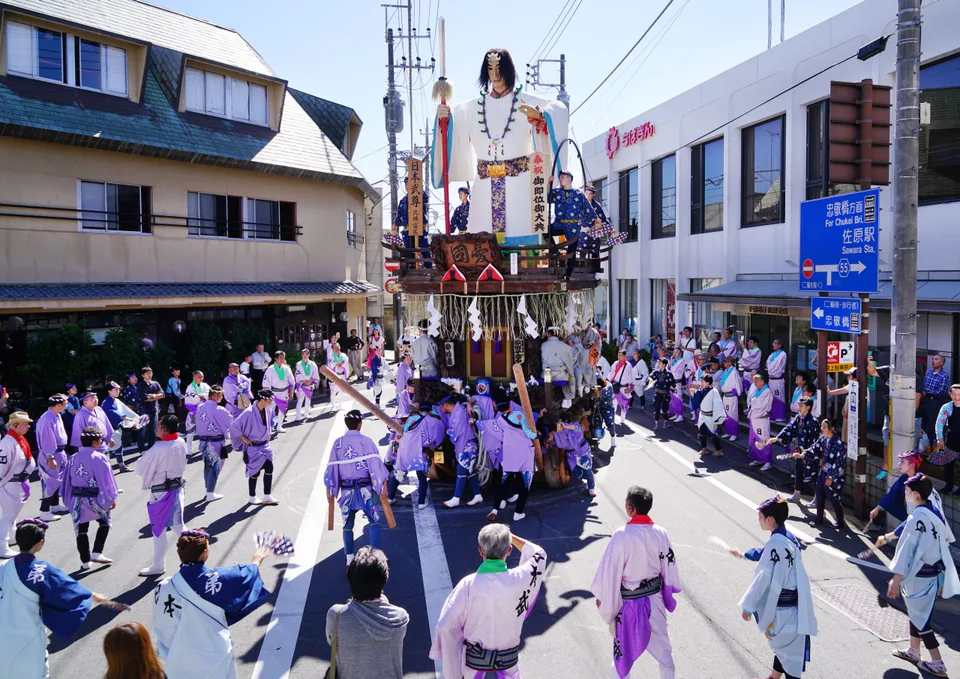
Daylight is the best time to understand the physical objects. The floats use heavy wood construction, detailed carving and very large upper figures; Katori City notes that some dolls reach around four metres. The historic merchant streets give those details a context that is much easier to read before dark.
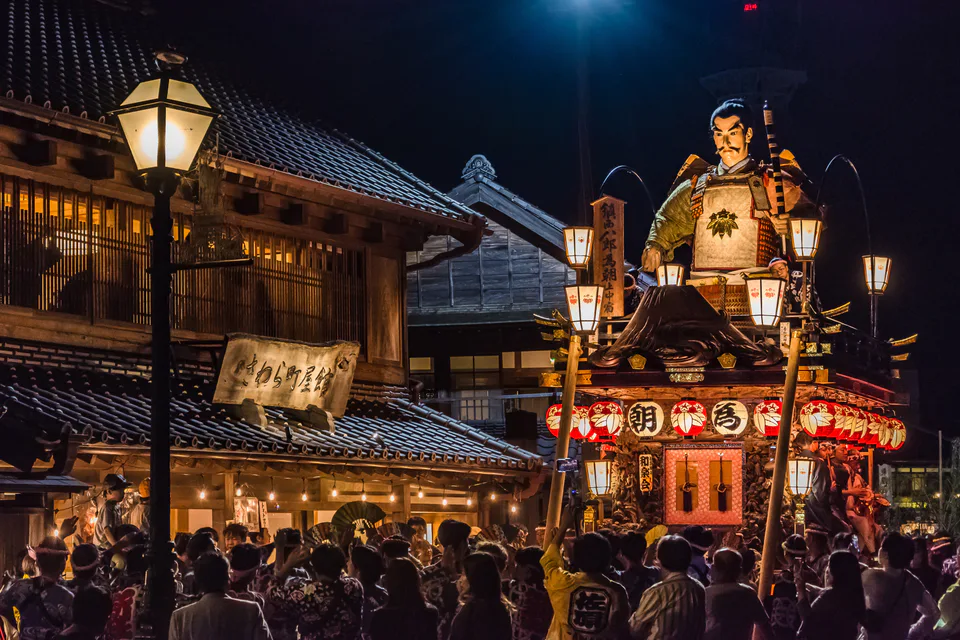
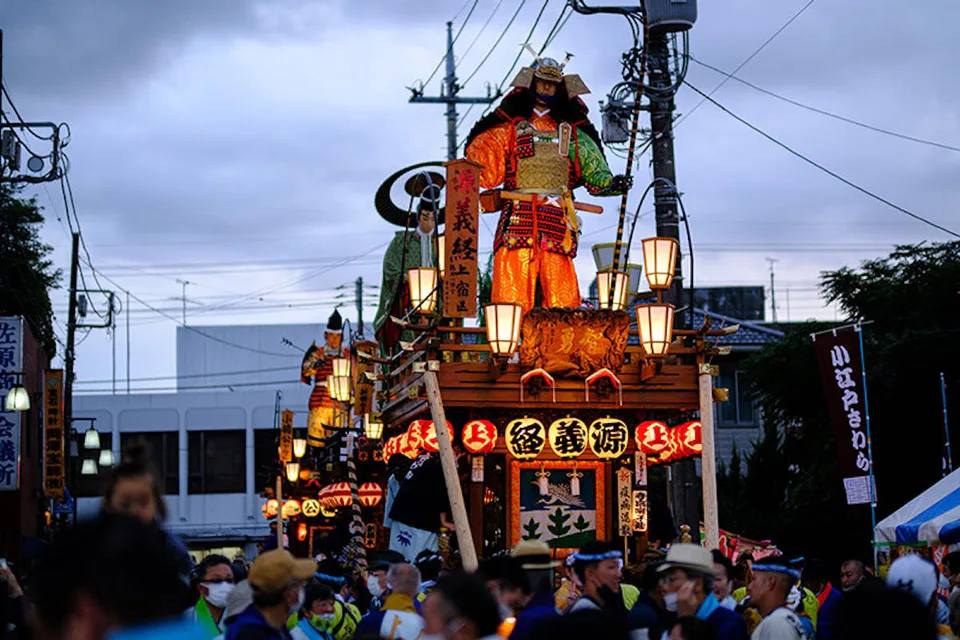
Evening changes the product. Lanterns come on, Sawara-bayashi carries through the streets and the floats become moving points of light between old façades. If you leave at 16:00 to make Sawara behave like a normal easy Tokyo day trip, you save transport stress by deleting the part of the festival with the strongest atmosphere.
The useful compromise is not “stay until the last possible train.” It is “stay long enough that night has actually added something.” Once you have seen a meaningful evening float sequence, the value of another hour becomes personal rather than mandatory.
Nonoji-mawashi is the movement to recognise, but do not chase an old location
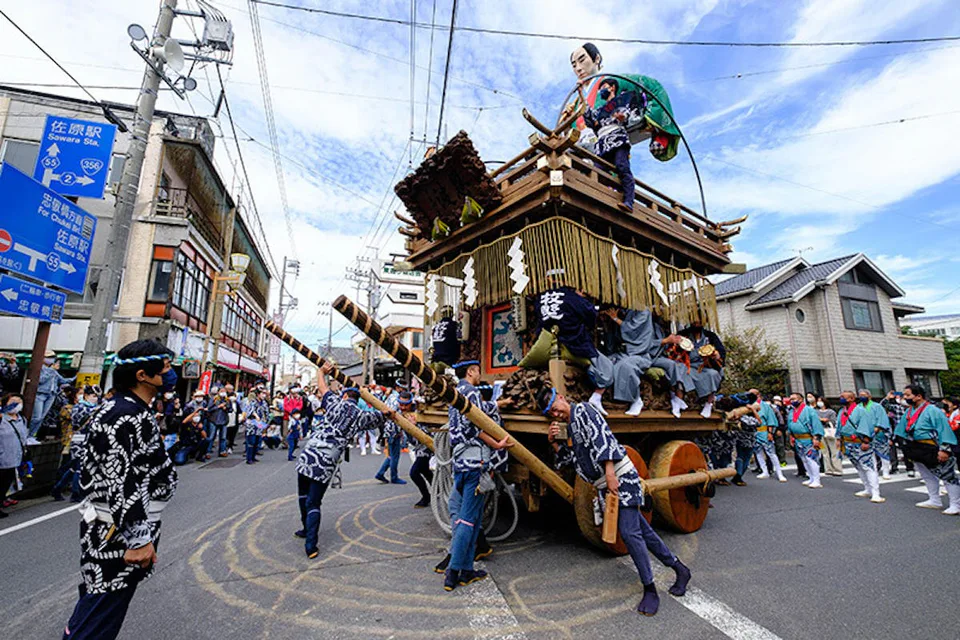
One of Sawara’s signature techniques is nonoji-mawashi, a controlled circular turn of a massive float. The appeal is precision: the team has to rotate a tall, heavy structure while preserving control and presentation. It is almost the opposite of a speed-focused float festival.
Do not lock one 2025 intersection into a 2026 itinerary. The city’s detailed programme and digital map are exactly the tools that should determine where multiple floats and demonstrations are expected this year. Until those appear, the correct plan is to understand the movement, not pretend you know the final camera position.
The new 2026 bus-detour notice does not mean JR Sawara Station is closed
Katori City’s August 18 notice says multiple local bus routes will detour during October 9–11 because of traffic restrictions. Several bus stops named “Sawara Station” or nearby central stops will be suspended, with temporary stops such as Sawara Station North Exit used on affected routes.
This is easy to misread in translation. It refers to bus stops and bus routing, not a closure of JR Sawara Station itself. A Tokyo traveller arriving by rail should not infer from the municipal bus notice that trains no longer reach Sawara.
The practical impact is on local movement after you arrive. If you had planned to use a city bus for a short hop inside Sawara, that route may no longer behave normally. On festival day, assume more walking and use the final 2026 map rather than an ordinary-day transit app screenshot.
Tokyo day trip versus Narita overnight: solve the next morning, not just the festival night
Ordinary access makes Sawara possible from Tokyo, but it is not a 30-minute suburban festival. The city’s general tourism information gives the journey from Tokyo as a substantial intercity trip, and the useful festival version extends into the evening.
That creates three viable structures:
1. Tokyo → Sawara → Tokyo
Best when your Tokyo hotel remains the right base for the next several days. Keep the return flexible and do not schedule a hard late dinner or show after Sawara.
2. Tokyo → Sawara → Narita
Strong when a Narita flight or Narita-area night already belongs at this point in the itinerary. You are not booking Narita accommodation “for the festival”; you are making one hotel solve both the evening return and the next transport direction.
3. Stay in Sawara
Best when night photography, a second festival morning or a slow historic-town stay is itself the product. It is overkill if you only want one lantern-lit sequence and would otherwise prefer to wake up in Tokyo.
If Narita is involved, use Narita Late Arrival and Narita Capsule vs Shuttle Hotel to keep the airport logic separate from the festival emotion.
Do not choose Saturday just because “the middle day must be best”
Previous editions have used the middle Saturday for major lineup or handover sequences, but those details can be year-specific. The current 2026 autumn page has not yet published this year’s detailed programme.
If all three dates work, wait for the September schedule and choose from the event you actually value:
large float lineup;
specific shrine or mikoshi ritual;
nonoji-mawashi opportunity;
evening float movement.
If you must book one date before the programme appears, optimise for your ability to stay after dark and your next morning rather than guessing that Saturday automatically has the best content.
Driving: 1,000 parking spaces would not solve the festival-day problem
Katori City has historically provided temporary festival parking, but the 2026 transport notice already confirms that road restrictions will cause bus detours and possible major delays. The exact 2026 parking and traffic map still belongs to the later update.
For an overseas visitor coming from Tokyo, I would use rail unless the car has another essential job before or after Sawara. Driving creates three new variables—parking availability, restricted roads and the evening traffic exit—on a day when JR already delivers you to the town.
A car can make sense inside a wider Chiba road trip. It does not become the default simply because Sawara is outside central Tokyo.
Rain changes the value more than the yes/no status
Katori City’s standing festival information says the event proceeds in rain, while protective coverings can be placed over the large float figures. That does not mean weather is irrelevant. Rain changes photography, walking comfort, crowd movement and how clearly you can see the craftsmanship that is one of the reasons to visit in daylight.
Separate “festival still operating” from “the experience I wanted still exists.” A traveller focused on Sawara-bayashi and atmosphere may accept rain. A photographer whose priority is uncovered float detail may value a different day much more.
Recheck the official city notice immediately before travel; severe weather can still produce operational changes beyond the standing rain policy.
My first-timer plan
Early afternoon: arrive and eat before crowd and restaurant uncertainty grows.
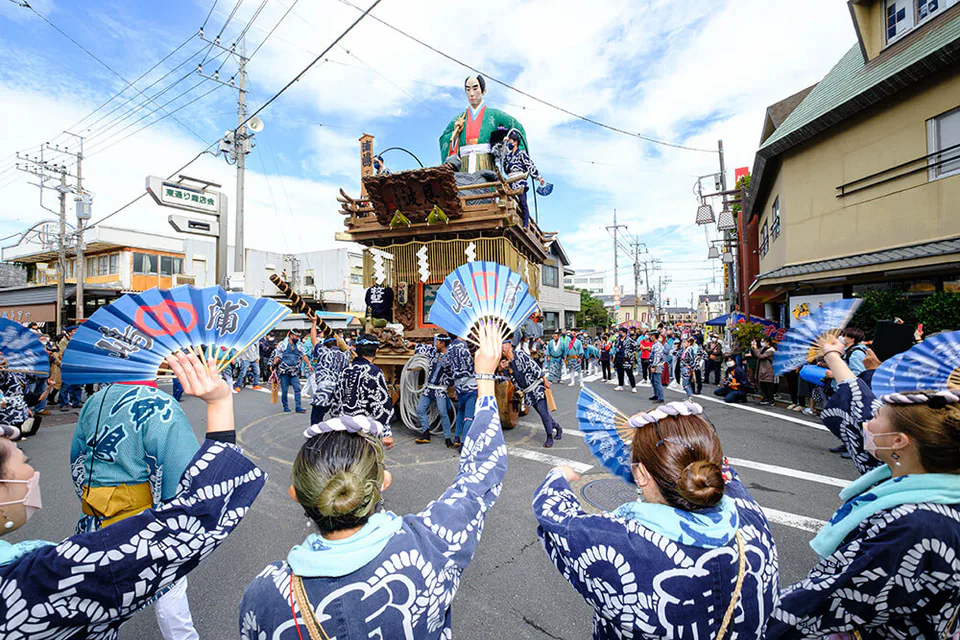
Daylight: use the historic streets to inspect float carving and giant dolls; do not overfill the day with normal Sawara attractions.
Late afternoon: stop making long detours and use the 2026 digital map once published to position around useful float movement.
Dusk/night: stay until lantern light and Sawara-bayashi have genuinely changed the atmosphere.
Return: go to Tokyo if it remains your base; go to Narita only when Narita also solves the next morning; stay in Sawara only when the slow festival night itself is worth the hotel.
Final verdict
October 9–11, 2026 is now confirmed by Katori City. For most first-time visitors, make Sawara a long day trip rather than a daytime half-day: arrive while the floats are easy to study, stay long enough for the lantern-lit night atmosphere, then return to Tokyo without a hard appointment waiting at the other end. Upgrade to Narita or Sawara overnight only when the hotel removes a second problem—airport positioning, night photography pressure or a second festival morning.
Do not freeze Saturday, one intersection or one float timetable from 2025. Katori City says the detailed 2026 autumn information is expected around September; that update should determine the final viewing route.
Korankei Autumn Leaves Day Trip: Buses from Nagoya, Illumination and Traffic
Tokyo Autumn Leaves Day Trip by Train: Gardens, Ginkgo and Evening Foliage
Kochi Yosakoi Festival 2026: Which Day, Which Venue and Do You Need Paid Seats?
Takayama Autumn Festival 2026: Save October 9 Night for the Lantern Floats
Arashiyama Autumn Leaves Day Trip: Morning, Train and Temples
References
Katori City — Sawara Grand Festival Autumn page · Katori City — confirmed Oct 9–11, 2026 transport detours · Katori City — festival structure and 14 autumn floats. Checked August 25, 2026.