
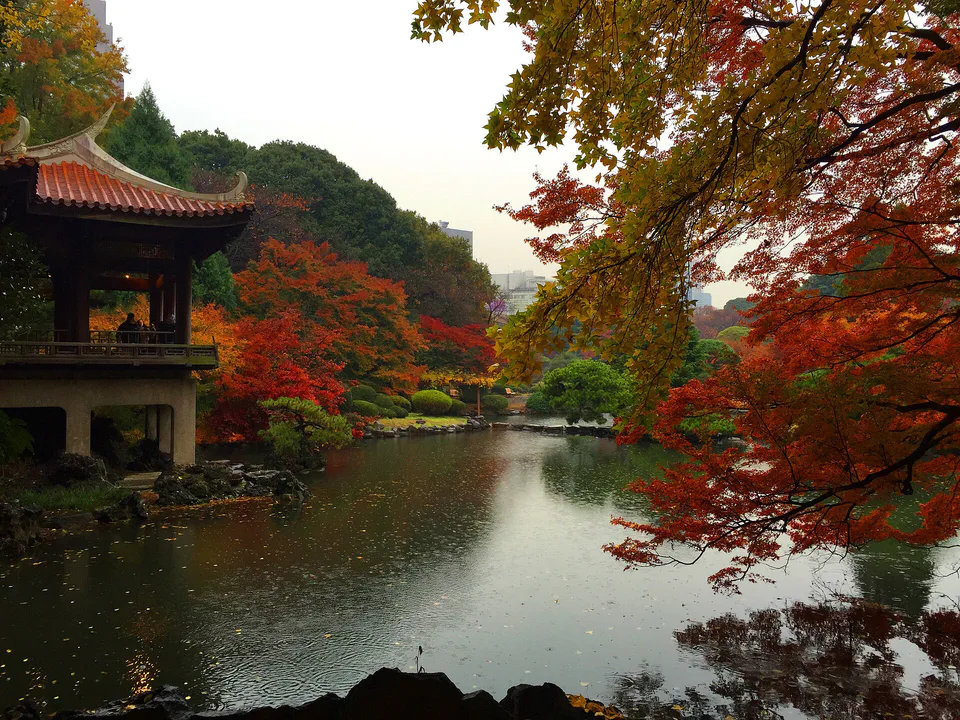
The best Tokyo autumn-leaves day trip is usually the one with the fewest direction changes, not the most famous stops. Mt. Takao, Okutama and Showa Kinen Park should normally be treated as separate western-Tokyo days. In central Tokyo, two major gardens can fit comfortably; an evening foliage event should be added only if its 2026 dates and entry rules are confirmed and the daytime route still leaves a real delay buffer.
The biggest planning error is believing that a 30-minute train journey means you have 30 minutes of schedule risk. In autumn you also pay for station walking, entrance queues, photography stops, lunch, earlier sunset, crowded paths and the possibility that one garden looks better than expected and deserves another hour. A route that works only when every stop takes the minimum advertised time is already overbooked.
Facts rechecked August 26, 2026. Shinjuku Gyoen currently opens 9:00–16:30 from October 1 to March 14, with last admission at 16:00; adult admission is ¥500 (about US$3.15 at late-August 2026 exchange rates). Showa Kinen Park opens 9:30–16:30 from November through February; adult admission is ¥450 (about US$2.85). The Emperor Showa Memorial Museum is closed for major renovation through November 27, 2026. As of this check, the official Rikugien 2026 news page still does not show a 2026 autumn nighttime-viewing announcement, so do not reuse 2025 dates or ticket rules.
ValueNavi Foliage Day-Trip Score
This score measures how easy each route is to execute well on a limited Tokyo day. It does not rank which place has the most beautiful leaves. ValueNavi weights route fit 25%, schedule resilience 20%, weather resilience 15%, foliage variety 15%, hard-slot freedom 10%, physical accessibility 10%, and money value 5%. Each dimension is scored 0–10.
Route | Score | Best reason to choose it | What reverses the result |
|---|---|---|---|
Shinjuku Gyoen + Gaien | Low direction-change cost, strong transport recovery and two different foliage types. | Your only goal is mountain scenery. | |
Koishikawa Korakuen + Rikugien | Dense central rail network and a coherent traditional-garden day. | The second garden feels repetitive or the hoped-for night event is unconfirmed. | |
Showa Kinen Park | One large site reduces inter-attraction transfers and works well for families. | You only have a half-day or need an early fixed reservation in eastern Tokyo. | |
Mt. Takao | High scenic payoff for travellers who want hiking as well as foliage. | Peak queues, slow group pace or a hard evening slot make the day fragile. | |
Okutama / Mitake | Most nature-focused option and a strong repeat-visitor choice. | Arrival/departure day, unstable weather or a group needing indoor recovery. |
The lower mountain scores do not mean “skip the mountains.” They mean that more of the day depends on walking pace, weather and the final transport chain. If hiking is the purpose, those dimensions should receive more personal weight than this general first-trip model.
ValueNavi True Foliage Block: calculate gate-to-gate, not train time
True Foliage Block = hotel-to-station access + rail time + station/gate walking + queue/admission + actual foliage time + exit walk + return buffer. The last two terms are what ordinary route searches usually hide.
↔ Scroll table left or right
Route type | Hidden block | Planning consequence |
Central garden | Gate queue + photography + second-garden decision | A half-day can stretch, but recovery transport is dense. |
Showa Kinen | Long internal walking + walk back to the chosen exit | Start the exit before the official closing time becomes relevant. |
Mt. Takao | Cable-car/chairlift queue + trail pace + descent | Do not protect a city dinner by rushing the safe mountain margin. |
Okutama/Mitake | Local bus/cable-car/final connection | The return chain is part of the attraction plan, not an afterthought. |
ValueNavi Hard-Slot Budget: how many things can one foliage day safely contain?
A hard slot is anything you cannot casually arrive 45–60 minutes late for: a timed evening ticket, last cable car, final rural bus, reserved restaurant, airport train, theatre performance or another fixed booking. This is a ValueNavi planning model, not an operator rule.
↔ Scroll table left or right
Day type | Hard-slot budget | Why | What usually breaks first |
Central-garden day | 1 fixed evening slot is reasonable | Dense transport gives you several recovery paths | Lunch or the second garden runs long |
Showa Kinen Park day | 0–1, preferably late and flexible | The park is large and November closing is early | Walking back to the gate takes longer than expected |
Mt. Takao in peak foliage | 0 hard evening slots by default | Cable-car/chairlift queues, trail pace and descent timing are variable | You rush the mountain to protect a city reservation |
Okutama / Mitake | The final transport is already your hard slot | Rail and local-bus recovery options are thinner | A scenic stop pushes you onto a much later connection |
My rule: if the transport chain itself already contains a hard slot, do not add another one unless missing it has almost no consequence. That is why a mountain day plus a non-refundable Rikugien evening ticket is structurally worse than two gardens plus the same evening ticket.
Choose the route by date, then by tree type, then by transport direction
↔ Scroll table left or right
Period | First direction to check | Best same-direction fallback | Do not assume |
Nov 1–10 | Mt. Mitake / Okutama / Mt. Takao | Western Tokyo or Tachikawa | Central gardens must already be peak |
Nov 11–20 | Mt. Takao / Showa Kinen Park | Shinjuku Gyoen if city colour has advanced | Ginkgo and red maple are at the same stage |
Nov 21–30 | Central gardens / ginkgo | Late Showa Kinen colour | Mountains are still the best use of a full day |
Dec 1–10 | Low-elevation late-maple gardens | Hamarikyu or indoor city day | “Tokyo still has colour” means every Tokyo location does |
These are planning windows, not a 2026 peak forecast. In the final week, current foliage photos and the weather forecast should override the generic calendar. Ginkgo also needs its own check: a windy day can rapidly move an avenue from yellow canopy to leaf carpet to bare branches while protected maples remain useful elsewhere.
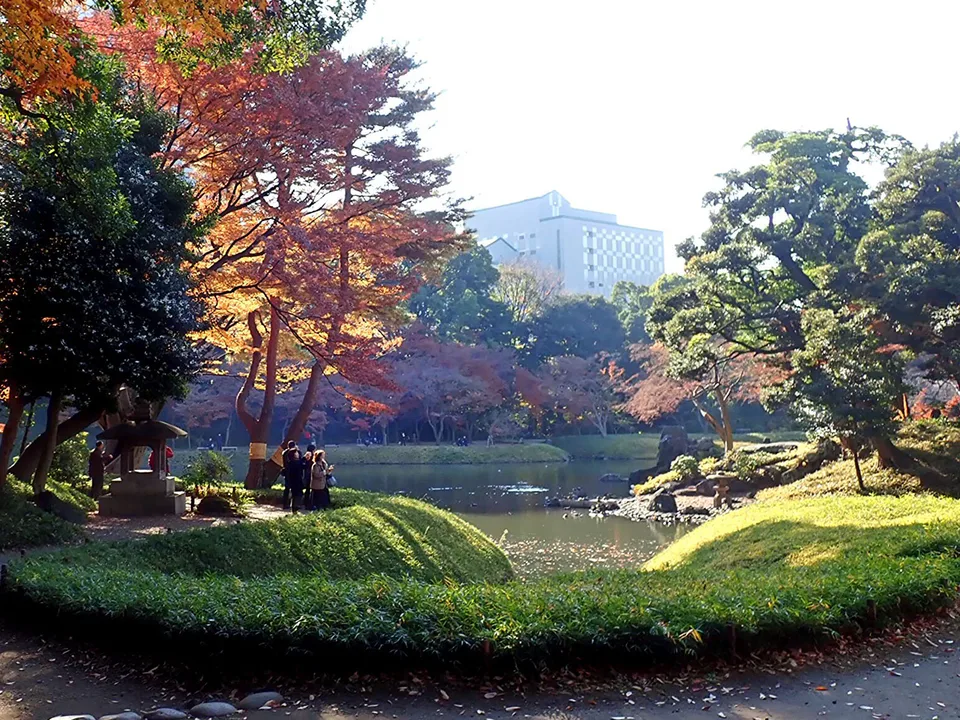
Route 1: Shinjuku Gyoen + Meiji Jingu Gaien — the safest first-time foliage day
I would start Shinjuku Gyoen close to opening and reserve roughly 2–2.5 hours. Its value is not that every tree peaks simultaneously; it is that a large mixed landscape gives you several things to work with even when colour is uneven. The October-to-mid-March closing time is early enough that morning use is much safer than treating 16:00 last admission as a target.
Adult admission is currently ¥500 (about US$3.15). From November 1–15, 2026, the confirmed Chrysanthemum Flower Beds Exhibition adds another reason to visit even if maple colour is still developing; Shinjuku Gyoen also remains open on Mondays during that exhibition period.
After lunch, move toward Meiji Jingu Gaien only if current ginkgo reports support it. I would cap the avenue at about 60–90 minutes unless photography is the main mission. If the ginkgo has already dropped, do not spend the afternoon searching for another distant avenue. Stay west and switch to another Shinjuku/Aoyama activity.
Best for: first-time Tokyo visitors, older travellers, families and anyone who wants a day that still works when foliage is imperfect. Avoid if: your only priority is a mountain landscape.
Route 2: Koishikawa Korakuen + Rikugien — good only if you genuinely want two garden compositions
These gardens are often paired because both are famous, not because every traveller needs both. I would use Koishikawa Korakuen in the morning, have lunch around Iidabashi/Korakuen, then move to Rikugien in the early afternoon. That gives the day enough structure even if no night event exists.
The decision gap is whether the second garden adds value or repetition. If the first garden already gives you the red-maple / pond / traditional-garden experience you wanted, skipping the second and spending the afternoon around Ueno, Yanaka or Tokyo Station can be more rewarding. The pair makes most sense for photographers, garden enthusiasts or travellers whose Tokyo priorities are specifically autumn landscapes.
2026 caution: the official Rikugien 2026 news page had not published an autumn nighttime-viewing announcement at the August 26 check. The 2025 event used its own evening ticket and separate entry period, but those dates and rules are not a 2026 promise. Build a complete daytime itinerary first; add the evening only after the 2026 page exists.
Route 3: Showa Kinen Park — treat the gate-to-gate time as part of the attraction
Showa Kinen Park should not be squeezed into a two-hour slot just because the train to Tachikawa is straightforward. Ginkgo avenues, the Japanese garden, lake, family areas and seasonal displays are spread across a large site. In November the paid park area normally opens 9:30–16:30, so useful daylight and gate-closing time are finite.
I would enter by around 10:00 and start making my way toward the exit by roughly 15:30 unless I already know my exact gate and route. The hidden cost is the return walk: your final photograph may be 20–30 minutes from the station-facing exit you imagined when planning the day.
Adult admission is ¥450 (about US$2.85). For 2026, one rain backup is weaker than usual: the Emperor Showa Memorial Museum is closed for major renovation from June 1 through November 27, 2026. If rain is persistent before that date, I would shorten the park rather than assume the museum can absorb two wet hours.
Best for: families, older travellers, ginkgo + maple variety and visitors who prefer one big park to multiple admissions. Avoid if: you only have a half-day or your evening contains an early hard reservation back in eastern Tokyo.
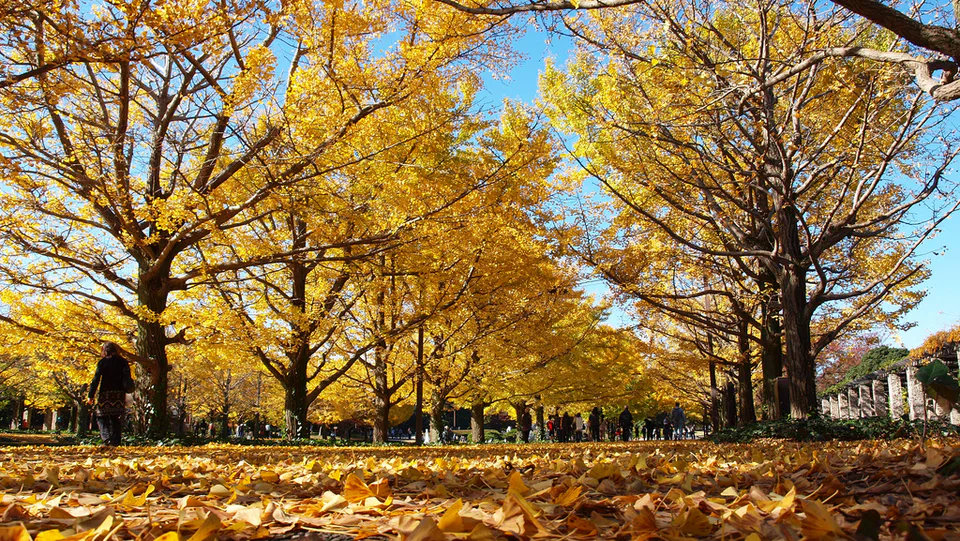
Route 4: Mt. Takao — protect the descent, not a city dinner reservation
GO TOKYO currently describes Mt. Takao as about 50 minutes from Shinjuku and its autumn colour as running from early to late November. That makes it convenient by mountain-day standards, but not predictable by city-attraction standards.
The cable car or chairlift removes only part of the physical effort. You still have slopes, temple approaches, crowd flow, food waits and the decision of whether to continue to the summit. During peak foliage, a “quick” queue can erase the buffer you thought you had for the evening.
I would plan the day around a latest comfortable descent decision, not around a fixed list of stops. For example: if the mountain is crowded or the group is moving slowly, cut the summit before cutting the safe descent margin. If the day goes well, add the onsen or museum after you are back at the base — not before.
Best for: travellers who want hiking or mountain scenery even if the leaves are not perfect. Avoid if: you are using a wheelchair/stroller without a carefully checked accessible plan, travelling with large luggage, or need to be across Tokyo for a strict evening booking.
Route 5: Okutama or Mitake — the last connection is part of the sightseeing plan
Okutama and Mitake have a different failure mode from Mt. Takao. The issue is less “can I get there?” and more “what happens after I get off the JR line?” Valley walks, lakes and mountain areas can depend on local buses, cable cars and longer walking segments.
Choose one primary geography before leaving Tokyo: a Mitake Gorge walk, a Mt. Mitake day, Hatonosu Gorge or a Lake Okutama-oriented route. Trying to stitch several of them together because they all appear under “Okutama” creates the exact kind of hidden transport day this guide is meant to prevent.
GO TOKYO describes Mitake Gorge’s riverside path as roughly four kilometres around Mitake Station. That makes it much easier to reason about than a vague “explore Okutama” instruction: you can judge whether the group wants a river walk, then build lunch and the return train around it.
Best for: repeat Tokyo visitors, hikers and travellers willing to trade urban flexibility for nature. Avoid if: this is arrival day, departure day, the weather is unstable, or the group needs frequent indoor rests.
ValueNavi route-conflict matrix: combinations that look possible but are poor
↔ Scroll table left or right
Combination | Verdict | What goes wrong |
Mt. Takao + timed Rikugien night event | High conflict | Mountain delays compete directly with a non-flexible evening entry |
Okutama + Shibuya Sky sunset | High conflict | A rural return chain is a poor lead-in to a premium sunset slot |
Showa Kinen + Shinjuku dinner | Low conflict | Same broad direction and the park can be shortened deliberately |
Shinjuku Gyoen + Gaien | Low conflict | Short transfer and different foliage types |
Koishikawa + Rikugien + another major paid attraction | Medium-high conflict | The third stop converts two relaxed gardens into clock-watching |
Mt. Takao + Okutama | Do not combine | “Western Tokyo” is a region, not one attraction cluster |
The 90-minute recovery test before you book a night event
For any paid evening foliage event or sunset reservation, I use a simple test: can the daytime itinerary still reach the event if it loses roughly 90 minutes? The 90 minutes are not an official standard; they represent one meaningful delay — long lunch, train disruption, queue, wrong station exit or a garden that simply deserves more time.
If losing 90 minutes means skipping lunch, cutting the best garden or sprinting across Tokyo, the daytime plan is too tight. If it merely removes a secondary café or short walk, the plan is resilient enough.
This is especially important for international visitors who have only a few Tokyo days. Missing a prepaid sunset or illumination slot can be more expensive than skipping one extra daytime garden.
What to cut first when the day runs late
↔ Scroll table left or right
Your day | Protect | Cut first |
Central gardens + confirmed night event | The best daytime garden + evening slot | Second garden or long lunch |
Showa Kinen Park | Your chosen ginkgo/maple zone + exit margin | Lake, cycle loop or distant family area |
Mt. Takao | Safe descent + one core mountain experience | Summit, extra trail or post-hike city stop |
Okutama / Mitake | Return transport | Second gorge/lake/museum |
Knowing what to delete is more useful than having a perfect-looking 08:00–21:00 itinerary that cannot survive a single delay.
Hotel base: one foliage day does not justify moving hotels
Shinjuku is the most useful city base when Mt. Takao, Okutama, Mitake or Showa Kinen occupy multiple days. For a single western excursion, I would not move from an otherwise well-located Tokyo Station or Ueno hotel just to save one morning transfer.
Tachikawa becomes rational only when the saving repeats — for example Showa Kinen on one day and another western-Tokyo trip the next. Otherwise the hotel move itself can consume more time than it saves.
Large luggage should remain at the city hotel, in station storage or in a forwarding plan. A mountain foliage day already has enough friction; a 29-inch suitcase adds no sightseeing value.
Transport passes: count the networks you actually use
Suica or PASMO remains the simplest default for mixed transport. A subway pass does not help much if the day is dominated by JR or Keio. Mt. Takao is primarily a Keio journey from Shinjuku; cable car/chairlift fares are separate. Showa Kinen and Okutama use JR for much of the access, but one foliage day does not make a nationwide JR Pass worthwhile.
The correct pass test is not “how many trains am I taking?” It is “how much of the exact fare I would otherwise pay is covered by this product?” Do that calculation after the route is fixed.
Rain, wind and poor colour: replace the route, not the entire day
Heavy rain or river warnings: cancel gorge and mountain routes. Strong wind: sharply reduce confidence in ginkgo avenues. Low cloud: decide whether hiking itself still has value before committing to Mt. Takao or Mitake.
The best backup stays in the same transport direction. If a western day fails before departure, use Shinjuku, Tachikawa or Kichijoji. If a northern/eastern garden is disappointing, switch around Ueno, Tokyo Station or another nearby indoor district. Do not turn Plan B into a new 90-minute cross-city transfer.
Final verdict
For a first Tokyo foliage day, I would choose Shinjuku Gyoen + Gaien or a two-garden central route because they preserve the most flexibility. I would choose Showa Kinen when a large park is the point, Mt. Takao when the mountain is the point, and Okutama/Mitake only when nature is worth sacrificing most of a city day.
The recommendation changes when current colour reports show a large advantage farther west. But even then, the same rule holds: the route must have one main direction and one clear priority.
Do not measure a successful autumn day by how many famous leaves you photographed. Measure it by whether you spent the best daylight at the place you cared about most — without making every later reservation fragile.
Official sources checked for this rebuild
Okayama Korakuen and Kurashiki Day Trip: Foliage, Lights and Hotels
5- or 7-Day Kyushu Autumn Leaves Itinerary: Fukuoka, Yufuin, Beppu and Mountain Routes
Tokyo Autumn Day Trips Compared: Spider Lilies, Kochia, Oze, Susuki and Onsen
Hakodate and Onuma Autumn Leaves: Late Foliage Timing, Transport and Where to Stay
14-Day Japan Autumn Leaves Itinerary: Six Routes, Flights and Hotels