
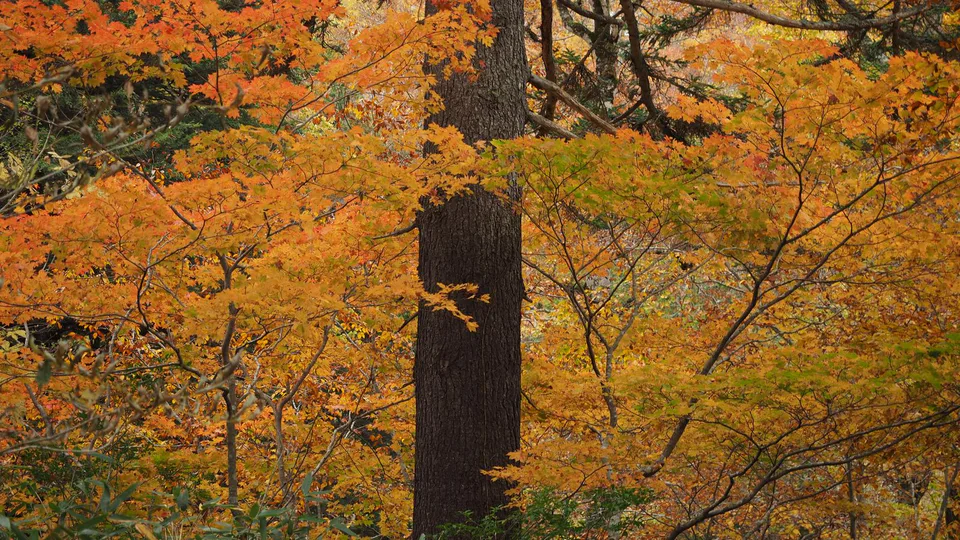
Choose the autumn trip by date first, then by travel burden. Kinchakuda is the easiest narrow-window choice when the spider lilies are actually in bloom. Hitachi Seaside Park is the most straightforward large-scale October colour trip for most first-time visitors. Hakone is the better late-October-to-November choice when you want scenery plus museums or onsen rather than one flower field. Oze is a hiking mission, not a casual Tokyo excursion: the public-transport journey to its trailhead area is long enough that most travellers should either start exceptionally early or stay closer the night before. And if the real goal is a Gunma onsen town such as Kusatsu, I would normally spend one night instead of paying six or more hours of return transport to use only the middle of the day.
The mistake is treating all five as interchangeable “autumn day trips from Tokyo.” They peak in different weeks, consume very different amounts of the day and fail differently in rain. Use this guide as a deletion tool: eliminate anything that does not match your dates, then choose the trip whose transport and walking cost still leaves enough useful hours at the destination.
↔ Scroll table left or right
Option | Best planning window | Tokyo-side transport burden | Walking / weather burden | ValueNavi verdict |
Kinchakuda spider lilies | Usually mid-September to early October; use the live bloom report | Low for a regional trip; Koma Station is about a 15-minute walk from the park | Low to moderate; exposed outdoor colour is weather-sensitive | Best short-window, low-friction choice |
Oze kusamomiji / autumn leaves | Golden marsh grass in September; surrounding autumn leaves around early October | Very high from Tokyo; the Gunma access guide lists about 4 hr 40 min by direct bus from Shinjuku to Tokura/Oshimizu gateways before the final local access | High; boardwalk walking, mountain weather and seasonal facility closures matter | Treat as a hiking project, not the default day trip |
Hitachi Seaside Park kochia | Green/red gradient in early October; red foliage around mid-October; brown/gold later | Moderate-high but simple; official access is about 85 min Tokyo→Katsuta + 15 min bus | Low to moderate; large park but comparatively easy terrain | Best October colour field for most first-time visitors |
Sengokuhara susuki, Hakone | September to November | Moderate; after reaching Hakone-Yumoto, official tourism guidance gives about 30 min by bus to Sengoku Kogen | Moderate; mountain buses and congestion add variability | Best mixed scenery + onsen/museum option |
Kusatsu / Gunma onsen | Autumn into winter; foliage should be treated as a bonus | High; under 3 hr from Ueno by limited express + bus, or about 4 hr by direct highway bus | Low once in town, but the return journey is expensive in hours | Usually convert the “day trip” into one overnight |
ValueNavi Seasonal Day-Trip Fit Score
This is a date-and-scenario score, not a permanent ranking of destinations. ValueNavi weights season/date match 25%, useful destination hours 20%, transport simplicity 15%, weather salvage value 15%, walking-fit 10%, uniqueness 10%, and Tokyo-return resilience 5%. Each factor is 0–10.
Scenario | Score | Interpretation |
|---|---|---|
Kinchakuda on a confirmed strong live-bloom day | High visual payoff with comparatively low regional transport friction. | |
Hitachi around the mid-October red-kochia window | Long but simple access, strong first-trip spectacle and manageable walking. | |
Hakone in late October/November with scenery + museum/onsen backup | Lower single-subject uniqueness than peak kochia, but much stronger weather salvage. | |
Oze from a Tokyo hotel as a same-day public-transport trip | Excellent hiking destination, weak default day-trip geometry from Tokyo. | |
Kusatsu as a Tokyo day trip when onsen is the main purpose | Too much of the day is spent returning instead of using the onsen-town hours. | |
Kusatsu converted to one overnight | Dinner, evening Yubatake, repeated bathing and morning become usable instead of transit time. |
I treat 8.5+ as a strong fit, 7.0–8.4 as conditional, and below 7.0 as a sign that the route is consuming too much of the intended experience. The score never overrides a safety veto: poor Oze weather, inadequate footwear or closed mountain facilities can make the correct decision “do not go” regardless of the numeric result.
ValueNavi Useful Colour Hour Ratio
Autumn trips often look efficient because articles quote only one-way train time. Use a broader ratio:
Useful Colour Hour Ratio = purposeful destination hours ÷ total hotel-to-hotel trip hours
A high ratio means most of the day is spent where the autumn experience actually happens. A low ratio means access, transfers and the return are dominating. This is why Kinchakuda can beat a more dramatic destination on a four-day Tokyo trip, and why Oze can be a superb hiking choice yet a poor casual day-trip choice from a Tokyo hotel.
Timing note checked August 26, 2026. Flower and foliage dates move with weather. Hitachi and Oze publish seasonal guidance; Kinchakuda publishes live bloom information. Hidaka City’s detailed festival page currently available still describes the 2025 event, so do not copy last year’s festival dates into a 2026 itinerary without checking the current bloom/event notice.
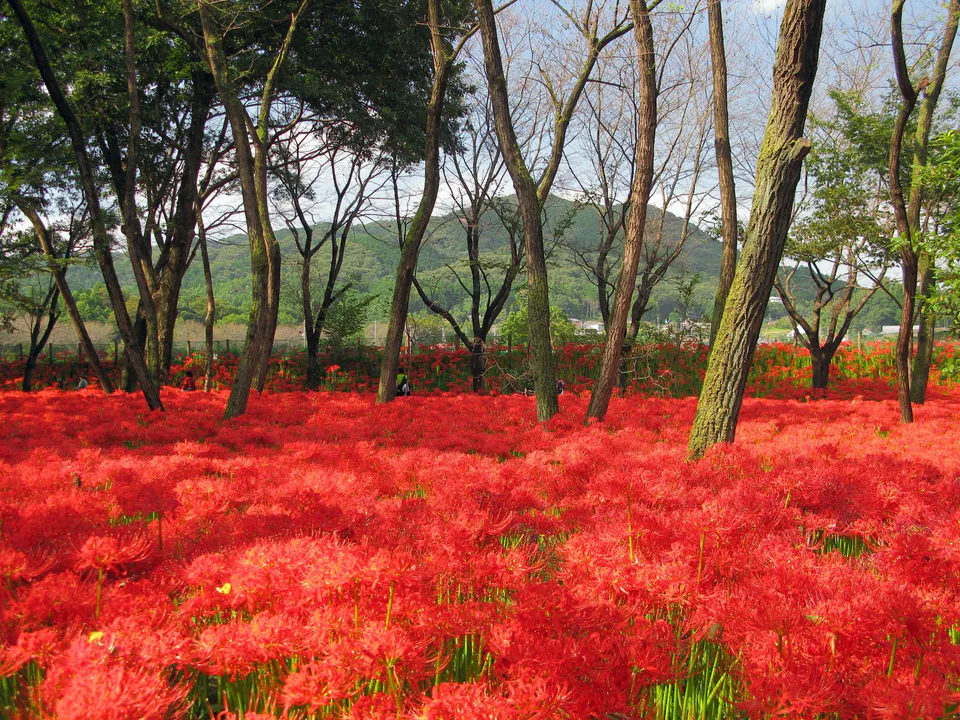
Kinchakuda is the lowest-friction option here, but only when the live bloom report supports your date.
Step 1: let the calendar delete the wrong trips
An autumn comparison should not begin with “Which place is best?” It should begin with “Which place is actually in its useful season on my date?” A beautiful destination outside its colour window is not a weaker version of the same product; it is a different trip.
Mid-September: Kinchakuda or Oze, but for completely different travellers
Kinchakuda’s appeal is the concentrated red spider-lily bloom. Hidaka City describes the site as one of Japan’s largest clusters, with roughly five million flowers, and advises visitors to use public transport during the bloom because roads become heavily congested. Koma Station on the Seibu line is about a 15-minute walk away. This makes Kinchakuda the cleanest choice when your dates line up and you want a visually distinctive half- or full-day without committing the whole day to mountain logistics.
Oze’s September product is different. The Oze Preservation Foundation says the marsh grass begins turning orange/gold in September, with surrounding mountain foliage following around late September to early October. That is not a flower-field visit. It is a long-access, long-walking nature day where the boardwalk and mountain environment are the main event.
Decision: choose Kinchakuda when you want autumn colour with low transport risk. Choose Oze only when the walking day itself is what you want.
Early to mid-October: Hitachi is the easiest large visual payoff
Hitachi Seaside Park currently describes the kochia cycle as green/red gradient in early October, red foliage around mid-October, red/brown gradient in late October and golden colour from late October into early November. The park also warns that the timing moves with weather.
For Tokyo visitors, the important advantage is not merely the colour. The official access chain is legible: limited express from Tokyo Station to Katsuta in about 85 minutes, then about 15 minutes by bus to the park. That is roughly 100 minutes of published in-vehicle time before waiting and park walking. It is a long day trip, but it is a simple one.
In October 2026 the park’s regular hours are currently listed as 09:30–17:00, and the park operates daily throughout October. During the main autumn kochia season it also applies a seasonal surcharge; the exact autumn surcharge period is set around the peak rather than being a reason to choose the date blindly.
Decision: if your dates are around the red-kochia window and you want the lowest planning complexity among the “big autumn spectacle” options, Hitachi is the default.
Late October to November: Hakone becomes more rational than chasing one colour field
Hakone’s official tourism association gives September through November as the attractive season for the Sengokuhara susuki grassland. From Hakone-Yumoto, the published bus journey to Sengoku Kogen is about 30 minutes.
The important advantage is portfolio value. If clouds, wind or imperfect colour reduce the grassland payoff, Hakone still has museums, onsen, Lake Ashi and other mountain stops. That makes it more resilient than a trip whose entire value rests on one flower or foliage field.
The trade-off is transport variability. Hakone’s mountain buses can be slowed by congestion, and trying to combine Sengokuhara, Lake Ashi, Owakudani and multiple museums in one day turns the resilience advantage into itinerary overload. Pick the grassland plus one major secondary theme.
Step 2: compare the amount of Tokyo time each destination consumes
Headline travel time should be converted into useful destination hours. A place can be technically reachable in a day while leaving too little time to justify the effort.
Kinchakuda: the easiest to fit around the rest of a Tokyo stay
The main last-mile burden is a roughly 15-minute walk from Koma Station. That makes Kinchakuda much easier to position as a flexible day than the other options in this guide. If the flowers are behind schedule or rain makes photography unappealing, the sunk transport cost is relatively modest.
This is also the best option here for travellers who do not want to sacrifice one of only four or five Tokyo days to a very long regional transfer.
Hitachi: long, but the transport chain is predictable
About 85 minutes to Katsuta plus about 15 minutes by bus is already a significant commitment each way, but there are only two main transport stages. For families and first-time visitors, two simple stages can be easier than a nominally similar trip with several mountain connections.
The park itself is large, so “arrival at the gate” is not the end of the time calculation. If Miharashi Hill is the priority, build the day around it rather than trying to use every amusement and garden zone.
Oze: the transport burden can consume the day before the hike begins
Gunma’s official access guide currently lists direct buses from Shinjuku to Tokura or Oshimizu, gateways to Oze, at about 4 hours 40 minutes. From the gateway, local access is still required depending on the trailhead. Hatomachi Pass also has year-round traffic restrictions, so private cars cannot simply drive to the trailhead; visitors transfer to shared buses or taxis.
This is the article’s biggest correction. Oze is possible from the Tokyo region, but it should not sit in the same planning bucket as Kinchakuda or Hitachi. A Tokyo hotel → Oze → Tokyo hotel day is a mission with a large transport-to-sightseeing ratio.
ValueNavi rule: if you are unwilling to organise the day around the earliest realistic access and a fixed return, delete Oze. If Oze is the reason for the trip, move the night closer to the access point or treat it as an overnight hiking segment.
Kusatsu: day-trip mathematics fight the reason people go
Gunma’s official guide places Kusatsu at under three hours from Ueno by limited express plus the 25-minute bus from Naganohara-Kusatsuguchi, while direct highway buses from Tokyo/Shinjuku are around four hours. A day trip is technically possible.
But a six-hour-plus return transport budget removes the hours that make an onsen town distinctive: ryokan dinner, an evening Yubatake walk, repeated bathing and a slower morning. If your main goal is onsen rather than “tick Kusatsu off the map,” this is a classic case where sleeping there changes the product.
For the detailed onsen choice, use the Kusatsu vs Ikaho vs Shima comparison.
Step 3: decide how much walking and weather risk you are buying
Autumn scenery is weather-sensitive, but the consequence of bad weather differs dramatically by destination.
↔ Scroll table left or right
Traveller / condition | Best fit | Why |
Young children / older travellers | Hitachi or Kinchakuda | They avoid Oze’s long access and full hiking commitment; both still require walking but are easier to scale down |
Rain forecast | Hakone | Museums and onsen can replace an outdoor block without throwing away the entire regional trip |
Clear, cool day + strong walker | Oze | The long boardwalk day becomes the purpose rather than an inconvenience |
One perfect photography window | Kinchakuda or Hitachi | Both have a specific visual subject and live seasonal updates can guide the date |
Couple wanting autumn + onsen | Hakone overnight or Gunma overnight | Sleeping there protects the evening/morning experience rather than spending it on the return to Tokyo |
Oze has a safety veto that the flower parks do not
The Oze Preservation Foundation says kusamomiji arrives in September, autumn leaves are typically best around early October, and by late October first snow can arrive. Some toilets and mountain facilities begin closing from October. The boardwalk must also be treated as an outdoor hiking surface, not an urban promenade.
That means a wet or cold forecast is not merely a photography disappointment. It changes clothing, footing, daylight margin and the consequences of a missed connection. The Foundation advises checking current transport, lodge and facility status for the actual day.
Hakone has the strongest bad-weather salvage value
If Sengokuhara is poor in heavy rain, a museum-and-onsen day can still justify leaving Tokyo. This is the main reason Hakone can beat a more spectacular single-subject destination when the forecast is uncertain.
Do not overuse that flexibility, though. “We can always add something else” is how a manageable Hakone day turns into four mountain transfers. In poor weather, choose one indoor anchor plus onsen rather than trying to preserve the original full circuit.
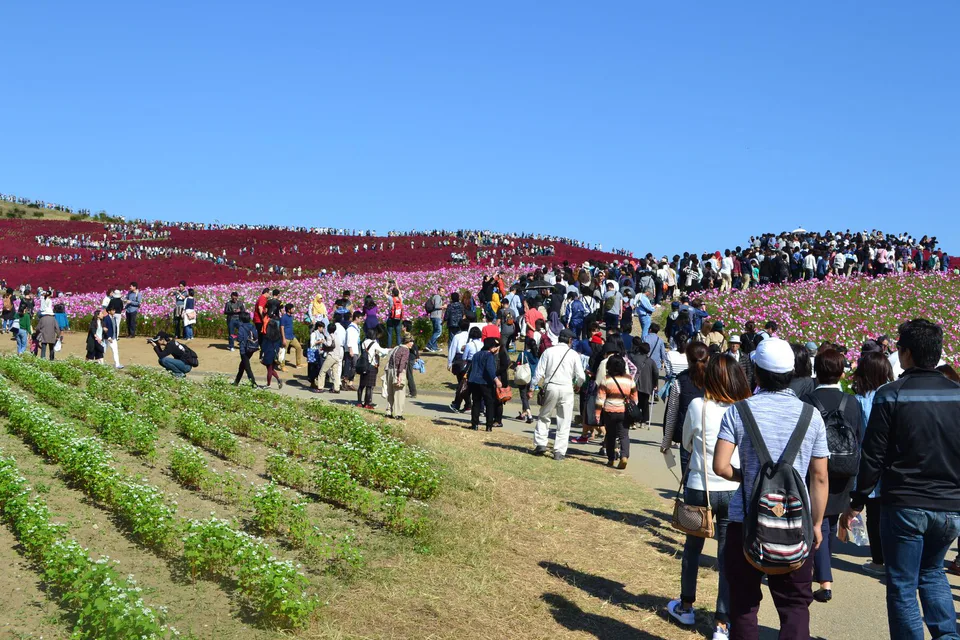
Hitachi’s October kochia is a long day from Tokyo, but the official rail-plus-bus access chain is simple enough for most first-time visitors.
Which trip should you choose by month?
September
First choice: Kinchakuda when the live spider-lily report is good. Alternative: Oze only if you actively want a long walking day and have solved the access. Do not choose Oze merely because “autumn starts earlier in the mountains.”
Early October
Oze can offer tree colour around early October, while Hitachi kochia is often moving through green/red gradient toward full red. Choose Oze for hiking; choose Hitachi for the colour field and easier logistics. The exact visual peak should be checked again immediately before travel.
Mid-October
Hitachi is the strongest default. Its official flower calendar places red kochia around mid-October. Oze remains possible but is entering a colder, later-season phase, and mountain facilities begin winding down in October.
Late October to November
Hakone becomes the strongest mixed-experience choice. Sengokuhara’s susuki season extends through November, and the area still makes sense when scenery is imperfect because onsen and museums can carry the day. If you want the onsen town itself to be the destination, move one night to Kusatsu, Ikaho or Shima rather than forcing a return to Tokyo.
When is an overnight actually worth it?
Use one test: does sleeping there unlock hours or experiences that cannot be reproduced on the day trip?
Kinchakuda: usually no. Return to Tokyo.
Hitachi: usually no for the park alone. Stay only if the trip is expanding into Ibaraki.
Hakone: yes when ryokan dinner, repeated onsen, an early mountain start or a second Hakone block matters.
Oze: yes when the overnight fixes access or unlocks dawn/longer hiking rather than merely adding a bed.
Kusatsu / Gunma onsen: usually yes if onsen is the main purpose.
This is more useful than asking whether a destination is “worth one night” in the abstract. The night must buy a scarce time window.
Do not combine two directions just because both are called autumn trips
Kinchakuda is in Saitama, Hitachi Seaside Park in Ibaraki, Hakone in Kanagawa, and Oze/Gunma onsen use northern mountain corridors. Trying to pair two of them in one day creates a transfer itinerary rather than an autumn itinerary.
If you have two free days, choose two separate day trips only when both conditions are strong. If one day has poor weather, keep it in Tokyo and move the outdoor trip. The Japan rainy-day backup guide is more useful than trying to make a prepaid regional day work at all costs.
Final verdict
For most first-time Tokyo visitors, Hitachi Seaside Park is the best October autumn day trip when the kochia colour is good; Kinchakuda is the better September choice when the spider lilies are actually blooming; Hakone is the best late-October/November option when you want a broader day than one colour field.
I would not put Oze in the same default category. Its current Tokyo-side access burden is large enough that it should be chosen because you want Oze’s hiking experience, not because you want “some autumn colours.” And I would not use Kusatsu as a normal foliage day trip: once the onsen town is the reason to go, one overnight usually protects more value than the return-to-Tokyo schedule.
The date can reverse every recommendation. Check live bloom/foliage conditions and current transport again before locking a weather-sensitive day.
Related planning
Official sources and verification date
Checked August 26, 2026 against Hidaka City tourism/event information and its Kinchakuda access material; Hitachi Seaside Park’s official flower calendar, access guide and 2026 operating calendar; the Oze Preservation Foundation season guide and 2026 access notices; the Hakone Tourism Association Sengokuhara susuki guide; and Gunma’s official Kusatsu access guide. Seasonal colour, traffic, bus operations and mountain facilities can change quickly; recheck the exact travel date.
Image sources and licences
Kinchakuda spider lilies; 京浜にけ; CC BY-SA 3.0 · Kochia Hill; Dandy1022; CC BY-SA 4.0.

