
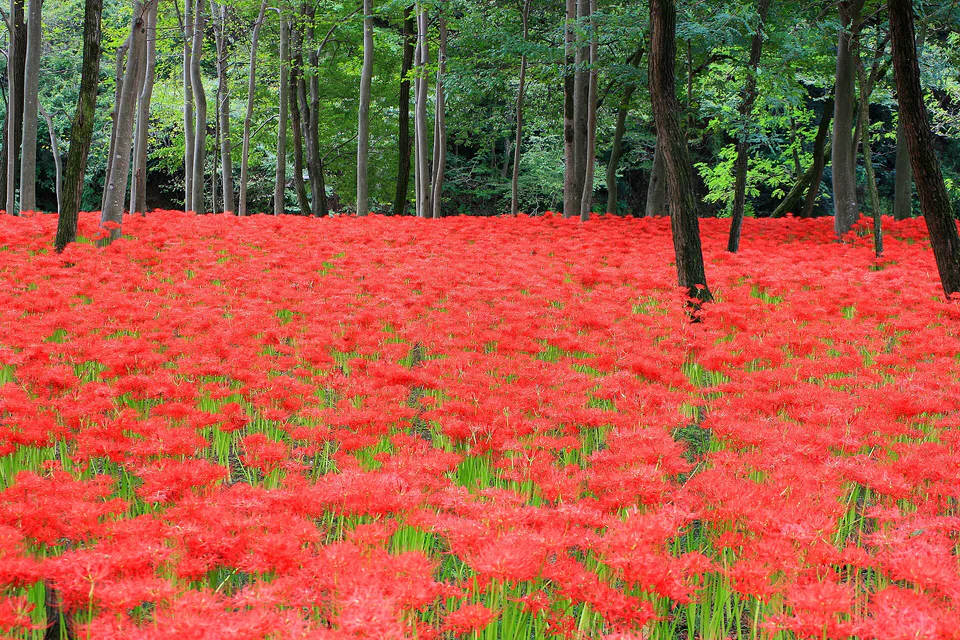
Kinchakuda’s 2026 Manjushage Festival runs from September 21 to October 6, but those dates are not a bloom forecast. The organiser explicitly warns that the flowers may not be blooming when the festival opens on September 21, and the paid-entry period will be set separately according to the flowers. For a Tokyo day trip, the most important decision is therefore when to commit, not which September weekend looks convenient on a calendar.
My default rule is: keep the day flexible until the official bloom updates show that the colony is worth the journey. From September 1, Kinchakuda publishes flower information through its website, Instagram and telephone service. Check again three to five days before travel, then once more on the morning of departure if the trip is photography-led.
↔ Scroll table left or right
What you know | What to do | Why |
Only the festival dates: Sep 21–Oct 6 | Do not lock a non-refundable flower day yet | The official notice says festival opening does not mean the lilies are already blooming |
Official bloom updates have started from Sep 1 | Build a shortlist of 2–3 possible days | Weather can move the useful viewing window quickly |
Live photos show a strong flowering section | Commit to the day and use rail | Koma Station is about a 15-minute walk and avoids severe road congestion |
Festival stalls are open but flower reports are weak | Skip or postpone unless the festival itself is the goal | Food stalls cannot replace the red-lily landscape that justifies the Tokyo detour |
Paid-entry dates are announced | Use the current entry hours and photography rules, not an old-year blog | The paid period is explicitly different from the festival period |

2026 has three different calendars: festival, paid entry and bloom
The official 2026 festival notice currently confirms September 21 (Monday/holiday) through October 6 (Tuesday), 09:00–16:30 for the Manjushage Festival. Those are the dates for local food and product stalls. They are not a promise that the flower colony is at its best throughout that window.
The same notice makes two unusually useful warnings:
admission becomes paid only during the flowering period, and the exact 2026 paid period will be announced separately;
the fact that the festival starts on September 21 does not mean the red spider lilies will already be blooming that day.
Kinchakuda’s current park rules list JPY 500 admission when the paid bloom period is in force and prohibit tripods, monopods and light stands inside the colony during that paid period. The useful distinction is that the rule is published, but the 2026 dates when it applies are still flower-dependent.
This is why copying a previous year’s opening date creates a bad itinerary. A festival has a fixed operating calendar. A flower colony does not.
Use a three-stage booking gate instead of guessing the peak
Stage 1: before September 1 — keep the day movable
Do not choose Kinchakuda as the one fixed outdoor day of a short Tokyo trip merely because September 21 appears on the event poster. Book flexible rail plans and keep another Tokyo or Saitama option available.
Stage 2: from September 1 — follow the official bloom feed
Kinchakuda says flower conditions will be reported through the official website, its Instagram account and an automated telephone service running from September 1 to October 10. Use those sources instead of generic “mid-September” summaries.
The most useful signal is a dated photograph or section-specific update close to your visit. Red spider lilies have a short visual peak; recent heat or heavy rain can matter more than the average timing from past years.
Stage 3: three to five days before — decide whether the flowers justify the detour
Ask a simple question: if the food stalls disappeared, would today’s official flower report still make me travel from Tokyo? If yes, go. If no, do not let a festival calendar rescue a weak bloom day.
This deletion test is particularly important for photographers and first-time visitors with only three or four Tokyo days. Kinchakuda is worth the travel when the woodland colony is performing; it is not a compulsory September attraction on every itinerary.
From Tokyo, Koma Station is the low-risk default
Kinchakuda’s official access guidance lists Koma Station on the Seibu Ikebukuro Line at about a 15-minute walk. JR Komagawa Station is about a 40-minute walk, although buses can reduce that final distance. For most visitors coming from central Tokyo, Koma is the easier mental model because the final leg is walkable and does not depend on a local bus.
The site strongly asks visitors to use public transport during the flowering season. Its current traffic guidance warns that surrounding roads such as Route 299 and the Kawagoe-Hidaka and Route 407 corridors can develop traffic jams of 5–10 km or more, while parking capacity is limited.
That means driving does not merely exchange a train ride for comfort. At peak bloom it exchanges a predictable station walk for a congestion and parking problem. A rental car only becomes attractive when Kinchakuda is one stop in a broader Saitama route and you have a robust parking plan.
Do not copy the old “arrive at 07:00” rule until 2026 paid-entry hours are confirmed
Earlier seasons have used earlier paid-area operating windows, which is why many older guides recommend dawn-style arrival. But the confirmed 2026 festival itself runs from 09:00 to 16:30, while the separate paid-entry dates and operating details are still being tied to the flowers.
So I would not publish “07:00 is best” as a 2026 fact yet. Once the organiser announces the paid-entry period and hours, use the earliest official public-access window that fits your train. Until then, the durable advice is simpler: arrive early within the confirmed operating conditions if photography and lower crowd density matter.
This avoids a subtle planning failure: leaving Tokyo before dawn because a 2025 article said the gates were open, then discovering that the 2026 arrangement is different.
The JPY 500 question matters less than the flower-status question
The current park rules state JPY 500 admission during the paid flowering period. For an international trip, that is not the expensive part of Kinchakuda. The expensive part is the half-day of scarce Tokyo time and the round trip to Hidaka.
Do not over-optimise the admission fee while under-checking bloom. A perfect JPY 500 flower day is better value than a free or early-season day when the colony is mostly green.
The same logic applies to the festival stalls. Their confirmed 09:00–16:30 schedule is useful for lunch or local products, but the stalls are an add-on to the flower decision, not the reason to ignore current bloom reports.
Photography: the current rules make handheld technique the safe default
Kinchakuda’s rules prohibit tripods, monopods and light stands inside the red-spider-lily colony during the paid-entry period. The paths can become narrow and crowded, and stepping into the flower beds is not an acceptable workaround.
For 2026, plan on handheld photography unless the current official notice explicitly says otherwise. Use image stabilisation, a faster shutter speed and the woodland trunks as part of the composition rather than searching for a perfectly empty path.
Morning light can be easier to manage beneath the trees than harsh midday patches, but the best photographic time still depends on actual weather, leaf cover and the flower stage. A cloudy morning can produce more even colour than a technically “golden” but high-contrast day.
How long should a first visit take?
For most Tokyo visitors, treat Kinchakuda as a focused half-day rather than an automatic all-day Saitama excursion. A practical block is roughly two to three hours on site, plus the rail journey and the 15-minute station walk each way.
Use the first hour for the strongest flower area while energy and crowd tolerance are highest. After that, take a slower river or woodland loop, use the festival stalls if they are operating, and leave before the return journey starts competing with your Tokyo evening.
Do not add Kawagoe, Chichibu and multiple other Saitama stops just because the train has already carried you outside Tokyo. Kinchakuda is strongest when the flower window is protected rather than diluted by another long transfer.
Rain changes the ground more than it changes the decision to see flowers
The park’s official guidance warns that rainy conditions can make the walking paths muddy and can reduce available parking. Rain is therefore another argument for rail and waterproof footwear rather than a reason to force a rental car.
Light rain can still work photographically if the flower status is strong. Heavy rain, wind or a weak bloom report should push the trip into the flexible column. This is an outdoor seasonal attraction; the correct backup is another day, not blind loyalty to a prepaid timetable.
Who should go — and who should skip?
Go: the official bloom update is strong, you enjoy seasonal landscapes or photography, and you can give the trip a half-day without deleting a higher-priority Tokyo experience.
Go even if the festival date is not ideal: the live flower report is excellent and public access is operating normally. The flowers outrank the festival stall calendar.
Skip or postpone: the festival has started but the organiser is warning that flowering is still weak, or your only available day requires a long car journey into forecast congestion.
Skip on a short first Tokyo trip: when Kinchakuda is only a “September checklist” item and you are sacrificing a core Tokyo neighbourhood you genuinely want more.
Final verdict: follow the flowers, not the poster
The 2026 festival calendar gives you September 21–October 6, 09:00–16:30. It does not give you the best flower date. Treat the paid-entry period as a second calendar and the live bloom report as the final gate. From September 1, use the official updates; three to five days before travel, decide whether the red colony itself is strong enough to justify the Tokyo detour.
If it is, use Koma Station and public transport. If it is not, keep the day for something else. That flexibility is the single biggest upgrade you can make to a Kinchakuda itinerary.
Nada Fighting Festival 2026: October 14 or 15 — How Much of the Festival Should You Actually See?
Sapporo Shopping Hotels: Stay Where You Can Drop Your Bags, Not Just Where the Shops Are
Kyushu Odan Bus 2026: Full Service Returns Sep 1 — But Aso Crater Access Does Not
100% Doraemon & FRIENDS Tokyo 2026: The Shop Needs a Ticket, the Themed Cafe Does Not
Sakura Castle: The Stamp Is Open 24/7 — The Castle Is in the Moats, Not a Keep
References
Kinchakuda — 2026 Manjushage Festival dates and bloom-update channels · Kinchakuda — official access and traffic guidance · Kinchakuda — current paid-period and photography rules. Checked August 25, 2026. Paid-entry dates remain flower-dependent and should be rechecked before travel.