
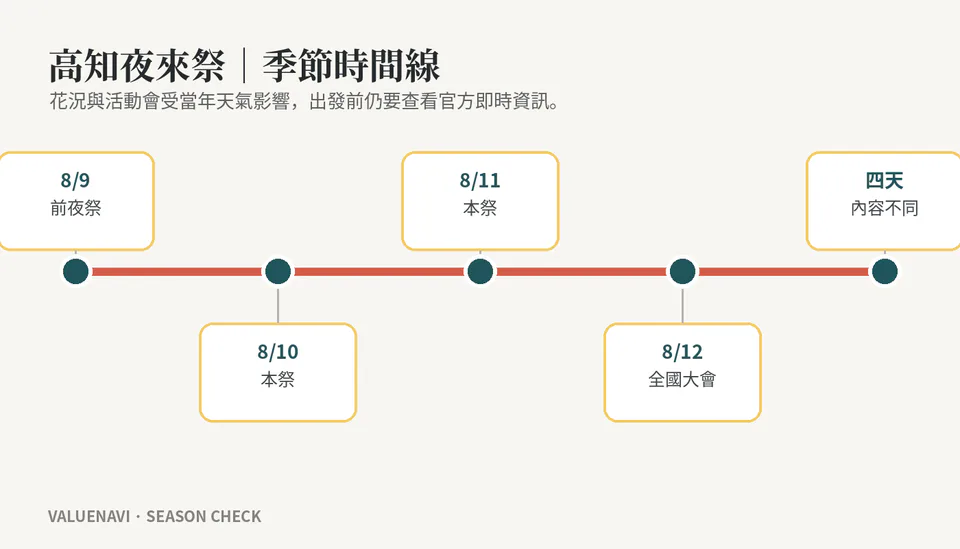
The 73rd Kochi Yosakoi Festival ran from August 9 to 12, 2026. Those four dates did not deliver four interchangeable festival days. August 9 was the eve programme, August 10 and 11 were the two full citywide main days, and August 12 combined the national competition with the closing programme. If you are using the 2026 edition to understand how to plan a future Yosakoi trip, the best default is simple: give one full main day to August 10 or 11, choose one anchor venue, and stop trying to follow every team around Kochi.
The festival itself already moves. In 2026 the official schedule spread the main programme across Otesuji and 16 other competition/performance areas from roughly 11:00 to 22:00 on August 10 and 11. That makes Yosakoi fundamentally different from a single-route parade: the spectator can lose a surprising amount of useful viewing time by repeatedly changing venue.
Which Yosakoi day should you choose?
↔ Scroll table left or right
| Date | 2026 role | Best for | Main trade-off |
|---|---|---|---|
| Aug 9 | Eve festival, Central Park, 17:00–21:40/21:50 range | Arrival night, compact introduction | Not a substitute for the full citywide main festival |
| Aug 10 | Main day, 11:00–22:00 across Otesuji + other venues | First-timers with one full day | Heat and venue-chasing temptation |
| Aug 11 | Main day, same broad citywide format | First-timers; useful second chance if Aug 10 does not fit | Same stamina cost as Aug 10 |
| Aug 12 | National competition + closing programme | Visitors who care about competition/awards and a more concentrated finale | Less representative of the two main citywide days |
If you have only one night in Kochi, I would choose August 10 or 11 rather than building the entire trip around the eve or closing day. If you have two nights, the better upgrade is not “see twice as many venues.” It is to use one evening for structured, full-formation viewing and the second for close-range street atmosphere.
ValueNavi Day Allocation Score
These are editorial scores for an international visitor deciding which 2026 festival day deserved scarce trip time. They are not official festival ratings. Higher is more favorable for that decision.
↔ Scroll table left or right
| Day | Money Cost | Time Cost | Booking Risk | Weather Risk | Crowd Risk | Route Fit | Uniqueness | Composite |
|---|---|---|---|---|---|---|---|---|
| Aug 9 eve | 9.0 | 8.5 | 8.0 | 6.0 | 6.0 | 8.5 | 7.5 | 7.6 |
| Aug 10 main day | 8.5 | 5.0 | 7.0 | 5.0 | 4.0 | 9.5 | 10.0 | 7.0 |
| Aug 11 main day | 8.5 | 5.0 | 7.0 | 5.0 | 4.0 | 9.5 | 10.0 | 7.0 |
| Aug 12 competition/finale | 8.0 | 6.0 | 7.0 | 5.5 | 5.0 | 7.5 | 9.0 | 6.9 |
The main days do not win on comfort. They win because they are the most complete expression of Yosakoi. If you are already travelling to Kochi for the festival, that uniqueness should normally outweigh the extra heat, crowd and time cost.
The spectator chase tax: every venue change must earn its travel time
Yosakoi creates an unusual planning trap because the official programme makes it possible to track teams by time and venue. That does not mean a first-time visitor should do it. The more precisely you chase a favourite team across the city, the more your evening starts behaving like a logistics exercise.
↔ Scroll table left or right
| Venue changes in one main day | What usually happens | ValueNavi call |
|---|---|---|
| 0–1 change | You watch long enough to understand formations, music and differences between teams | Best default |
| 2 changes | Still workable if the venues are central and the second move has a clear purpose | Acceptable |
| 3+ changes | Walking, route checking, heat and crowd crossings start replacing viewing time | High chase tax |
This is an editorial model, not an official rule. The point is to make the hidden cost visible. If you are leaving Otesuji because you specifically want the close-range arcade atmosphere in Obiyamachi, the move has a job. If you are moving merely because another map pin exists, stay put.
Otesuji paid seats: buy certainty, not “the real festival”
The official Yosakoi FAQ makes an important distinction. Watching teams at the festival’s ordinary competition and performance venues does not require a ticket. The major exception is the Otesuji main competition area, where grandstand seating is paid; the FAQ says those tickets are typically sold in advance and can be competitive.
That means a paid seat is not an admission fee for Yosakoi. It is a product that buys a more predictable viewing position at one structured venue. That can be excellent value when sitting time, a clean sightline or a published team order matters. It is unnecessary when your priority is roaming freedom, close street atmosphere or simply seeing plenty of dancers.
If your decision is really about sightlines rather than dates, use the Otesuji vs Obiyamachi vs Chuo Park comparison. It separates structured formations from close-up energy and recovery-friendly viewing so this main guide can stay focused on the overall festival plan.
Otesuji works best when you have a target block, not a target whole day
For 2026, the official team lists published separate Otesuji daytime and night blocks. On August 10, for example, the published daytime Otesuji block began at 13:15 and the night block at 17:45; August 11 used the same broad structure. That level of scheduling is useful when you have a few teams you care about.
It is less useful if it persuades you to sit through every block because you already paid for part of the day. One strong Otesuji block plus a contrasting free venue is usually a better first experience than turning the whole festival into one grandstand.
Heat should delete the second venue before it deletes the festival
The main festival days run through the hottest part of an August afternoon and deep into the evening. If heat or rain changes the day, the first cut should be the optional second or third venue—not the water break, meal or hotel recovery period.
A workable main-day rhythm is: start with a daylight block, retreat for food and cooling, then return for the evening block. That is particularly valuable when the hotel is central enough to make a mid-afternoon reset cheap. If the hotel is outside the core, the break may become too expensive in travel time and you should use an indoor café or shopping-area stop instead.
Where to stay: optimize the return, not the arrival
Kochi Station is useful for rail arrival, luggage and onward travel. Obiyamachi/Harimayabashi is stronger when the festival evening and late food are the main priorities. The correct base is usually revealed at 21:30, not at 12:00: after hours of heat and standing, how many more transport stages do you want between the final venue and bed?
Use Where to Stay for Kochi Yosakoi before booking. If you are continuing to Tokushima for Awa Odori, the hotel decision becomes part of a larger Shikoku transfer problem rather than a standalone Kochi choice.
One night: one anchor + one optional contrast
With only one night, arrive early enough to leave luggage, eat before the strongest crowd period and choose one anchor. Otesuji is the cleanest choice if you value full formations and a predictable sequence. Obiyamachi is the stronger choice if proximity and atmosphere matter more. Chuo Park is useful when the group needs a stable meeting point and easier breaks.
Add one nearby contrasting venue only if everyone still has energy. The second venue is a bonus, not proof that you “used the festival properly.”
Two nights: change viewing style, not hotel
Two nights are much more valuable when you keep the same room. Use one day for structure—Otesuji, perhaps with paid seating if that solves a real need—and the second for free roaming or an arcade/park experience. That creates two different Yosakoi memories without adding luggage friction.
If Kochi and Tokushima are both fixed in the same trip, use the Shikoku four-day no-car Yosakoi/Awa Odori plan before booking anything non-refundable. The daylight transfer between festival cities can matter more than squeezing one extra performance block into Kochi.
August 12 is not “bonus day three”
The 2026 schedule gave August 12 a different job: the national competition and closing programme ran across Otesuji, Obiyamachi, Central Park and Kochi Castle. This is the better date if you care about the competitive/finale structure, but it should not automatically be stacked after two full main days.
If you already experienced August 10 or 11 properly, ask whether the closing day adds a new experience or merely repeats the same physical cost. Festival completists may love it. A first-time Japan itinerary may benefit more from using that day to continue the trip.
Final verdict
For a first Kochi Yosakoi trip, protect August 10 or 11 as one complete main day. Treat August 9 as a compact introduction and August 12 as a competition/finale choice, not automatic extras. Paid Otesuji seating is useful when certainty and reduced standing justify it; free viewing is still the normal way to experience most venues.
The biggest upgrade is not buying more tickets. It is reducing the spectator chase tax: one anchor, one optional contrast, one hotel return that still feels easy at the end of the night.
Next decision|Choose Otesuji, Obiyamachi or Chuo Park as your anchor
Kishiwada Danjiri Festival 2026: Free Viewing or Paid Kankan-ba Seats?
Katakai Festival 2026: September 11 or 12? Daytime Fireworks, Seats and the Nagaoka Exit
Sawara Grand Festival Autumn 2026: Day Trip or Stay After Dark?
Kishiwada Danjiri October 2026: Districts, Transport and How to Plan the Day
USJ Halloween with Kids 2026: Day Plan, Safe Routes and Age Limits


Sources
YOSAKOI.COM official 73rd festival material: August 9–12, 2026 dates; August 9 eve programme; August 10–11 main festival schedule; August 12 national competition/closing programme; official Otesuji daytime and night team orders; official FAQ on generally free viewing and the paid Otesuji grandstand exception. Information rechecked August 27, 2026. ValueNavi scores and the spectator-chase model are editorial analysis, not official festival ratings.