
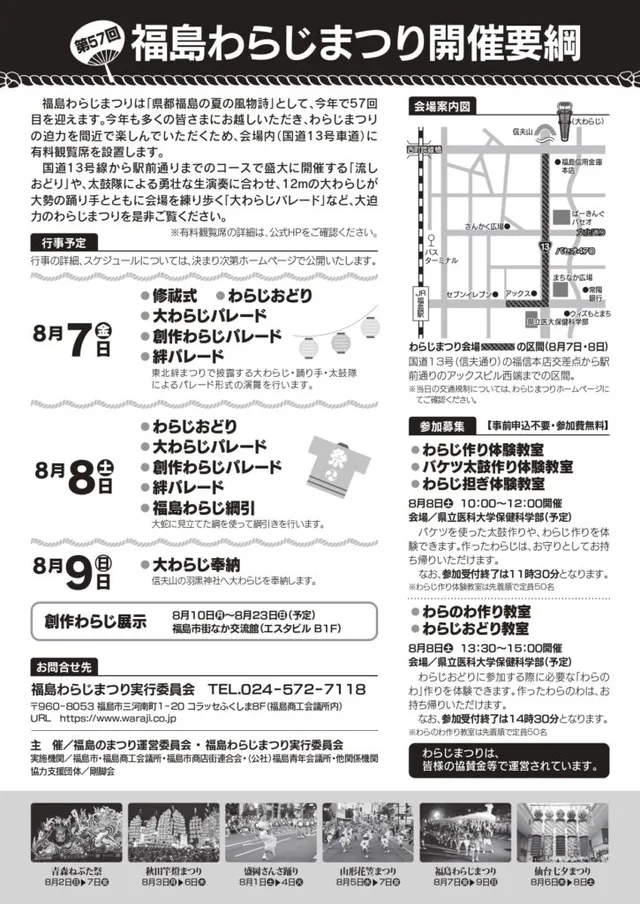
Looking back at Fukushima Waraji Festival 2026, August 7 was the winning one-day choice: it delivered the full city-centre street festival, while the entire August 8 programme was cancelled after a sudden thunderstorm. August 9 still completed the festival with the giant waraji dedication at Haguro Shrine, but that was a ritual morning rather than another street-parade day.
That outcome adds a planning lesson the pre-festival schedule could not show: when a festival gives you two broadly similar outdoor street nights and both fit your itinerary, attending the first one creates weather redundancy. The second night can become a fallback or bonus rather than the only chance to see the main spectacle. This is ValueNavi analysis based on what happened in 2026, not a guarantee that future editions will use the same programme or weather pattern.
Historical 2026 facts: the festival ran August 7–9. August 7 was held; August 8 was cancelled in full for safety because of severe weather; August 9’s dedication at Haguro Shrine concluded the festival. Recheck the next edition rather than copying these dates forward.
↔ Scroll table left or right
Your priority | 2026 date | What it offered | What 2026 taught us |
First visit, giant waraji + street spectacle | August 7 | Kizuna Parade, giant-waraji parade, Waraji Odori and creative-waraji groups | It was the only city-centre main-festival day that actually ran |
Family / participation-heavy programme | August 8 planned | Workshops, tug-of-war, children’s dance, parade and finale | The whole programme was cancelled by sudden thunderstorm |
Ritual origin matters more than street entertainment | August 9 | 09:30 giant-waraji dedication at Haguro Shrine | No Route 13 dance programme or official food stalls |
Two nights available in a future similar edition | Attend the first street night | Use the second as bonus/weather fallback | Reduces the risk of making the later outdoor night your only chance |
August 7 was the cleanest first-visit programme even before the weather decided the weekend
The official 2026 programme put the giant waraji on display from 13:00 to 16:30, followed by the purification ceremony at 17:30. The Kizuna Parade began at 18:15, and the main giant-waraji parade and Waraji Odori began at 18:50. A second giant-waraji parade was scheduled around 20:50, with the closing announcement around 21:10.
Thirty-one Waraji Odori groups with 2,243 participants were listed for the August 7 main dance programme, alongside creative-waraji groups. That made Friday a self-contained first-visit night: ritual opening, live parade performance, the 12-metre waraji and a second chance to see the main object later in the evening.
In hindsight it also became the only successful street-festival night of 2026. But I would not recommend a future Friday merely because Friday “has better weather.” The reusable reason is that the first main night gives you another scheduled festival day behind it if conditions or travel disruption go wrong.
August 8 was designed as the richer participation/family day—and then disappeared
The planned Saturday programme began much earlier. The official schedule listed morning waraji-making, bucket-drum and carrying workshops, followed by waranowa-making and Waraji Odori lessons in the afternoon. The street programme then included the Waraji tug-of-war at 17:00, a children-and-parents dance at 18:10, Kizuna Parade at 18:25, the main parade/dance at 18:50 and a final giant-waraji lift around 20:55.
That programme made August 8 the more attractive date for families or visitors who wanted to participate in workshops rather than simply watch a compact evening.
But on August 8, the organiser cancelled the entire day because of severe weather and a sudden thunderstorm. The tug-of-war was cancelled too. The official post-event note later confirmed that the first day ran in good weather while the second day was called off for safety.
This is the most useful decision gap in the original article: the “richer programme” can also create a larger single-day exposure to weather. If workshops are the reason you choose the day, accept that the whole plan may vanish with the outdoor festival. Build the Tohoku route so the cancellation does not destroy the trip.
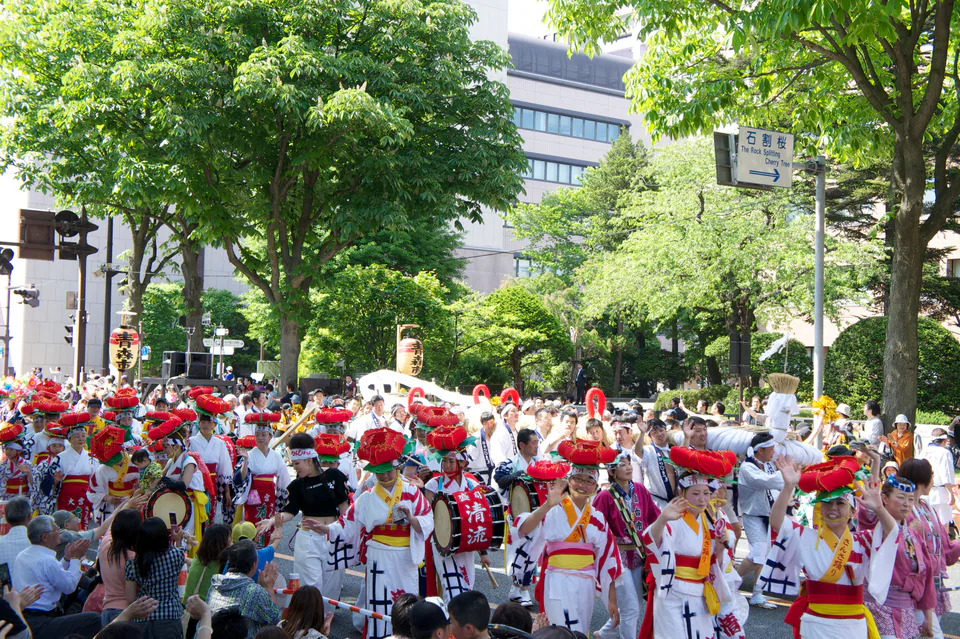
Fukushima Waraji parade. Photo: yisris / Wikimedia Commons, CC BY 2.0.
August 9 was not a quieter third street day
The final day had one central job: the giant-waraji dedication at Haguro Shrine on Mount Shinobu at about 09:30. The official programme explicitly said there were no Route 13 dance events and no official food stalls that day.
This matters because “festival August 7–9” sounds like three interchangeable days. It was really two city-centre festival days plus one ritual conclusion. The English-language festival history explains the logic: the August waraji completes the pair with the other giant straw sandal dedicated during the winter Shinobu Dawn Procession, linking the summer event back to the older Haguro Shrine tradition.
Choose August 9 only when that ritual continuity is what you want to understand. It is a poor substitute for a first visitor whose mental image is live drums, dancing and the 12-metre waraji moving through Fukushima City.
The best future two-night strategy is “first night essential, second night optional”
2026 provides a clean red-team lesson for festival planning. Imagine you booked Fukushima for August 7 and 8 but treated Saturday as the “main” night because it had more daytime activities. The thunderstorm would have removed the exact programme you protected.
A more resilient structure is:
Arrive in time for the first main street night and treat it as the essential festival block.
Use the second street day for workshops, participation, repeat photography or a different viewing position only if it runs.
If weather cancels the second day, redirect the day without feeling that the entire festival trip failed.
This rule only applies when future schedules again offer two substantially similar main-festival days. Always read the new programme first.
Do not use the festival phone line as a substitute for a flexible itinerary
For 2026, the organiser published a same-day automated phone line from 10:00 on August 7 and 8 to announce whether the festival would be held. That is useful operational information, but it does not solve the hotel or rail plan after a cancellation.
If the weather forecast is unstable, your backup should already exist: an indoor Fukushima stop, a flexible train to the next Tohoku city, or a hotel night that is useful without the festival. Waiting for the go/no-go announcement before inventing the whole day creates unnecessary stress.
The Japan rainy-day itinerary guide is more useful here than trying to “recover” every planned street-festival hour.
Paid seats buy a view, but weather can still erase the event
Paid viewing seats were sold for the 2026 main festival. After August 8 was cancelled, the organiser published a ticket-refund process for the cancelled day.
That outcome matters for decision-making: a ticket reduces viewing uncertainty but cannot reduce cancellation risk. Do not build a non-refundable hotel/rail chain around a paid seat as if the ticket guarantees the outdoor event will happen.
For a first night in a future edition, I would buy a paid seat when sitting or sightline certainty matters; I would still preserve a weather alternative outside the ticket.
Individual Waraji Odori participation is an advance decision, not a spontaneous crowd activity
In 2026, the organiser opened an individual participation allocation for Waraji Odori and accepted applications until the 100-person capacity was reached. This is different from simply walking into the parade from the roadside.
If participation is the reason for the trip, the application window becomes part of the date choice. The official 2026 participant list placed the individual-participation group on August 8—exactly the day that was cancelled. That is another reminder that participation plans carry more event-specific risk than ordinary free viewing.
Do not let that discourage participation. It means the wider itinerary needs slack: the more unique and non-transferable the booked festival role, the less aggressively you should schedule the surrounding days.
Families should choose between Friday simplicity and Saturday activity density
Before the cancellation, August 7 and 8 solved different family needs. Friday was a simpler late-afternoon/evening event. Saturday offered workshops from the morning, tug-of-war, children’s dance and the later finale.
For a family with a child who tires after a long day, “more activities” is not automatically better. A compact first night plus an early hotel return can outperform a ten-hour festival day. For an older school-age child who actively wants the craft/dance workshops, the richer daytime programme can justify the extra load.
The correct family question is not “which day has more?” It is “which parts will the child still be able to enjoy by 18:50 when the giant-waraji parade begins?”
One day, two days or the dedication?
One day, first visit: choose the first main street night when future programmes are broadly similar. In 2026, that was August 7 and it became the only street day that ran.
Two days: treat day one as essential, day two as participation/repeat/weather-contingent value.
Ritual-focused visitor: use the Haguro Shrine dedication day because the meaning of the paired waraji is the point.
Family: prefer the compact street evening unless the daytime workshops are specifically worth the extra heat and fatigue.
Final verdict
The 2026 hindsight answer is August 7: it was the full street-festival experience and the only main city-centre day that actually took place. August 8 was planned as the richer workshop/family/participation day but was cancelled by a sudden thunderstorm. August 9 completed the ritual at Haguro Shrine and should be chosen for meaning, not as a substitute parade.
The durable ValueNavi rule for future editions is more important than the historical winner: when two outdoor main nights are similar enough, protect the first one. Let the second become optional upside. Festival weather can erase a programme; it should not be allowed to erase the entire trip.
Nada Fighting Festival 2026: October 14 or 15 — How Much of the Festival Should You Actually See?
Yamaga Lantern Festival 2026 Seats: Refund Deadline, Ticket Types and What You Get Back
Best MiraCosta Room: Which View, Balcony or Terrace Should You Book?
Sendai Tanabata Festival 2026: Fireworks, Three-Day Plan and Where to Stay
Sapporo Snow Festival: Odori vs Susukino — Where Should You Stay?
References
Fukushima Waraji Festival — official 2026 programme · official August 8 cancellation notice · official post-festival report · official festival history. Historical 2026 facts checked August 25, 2026; future programmes must be reverified.