
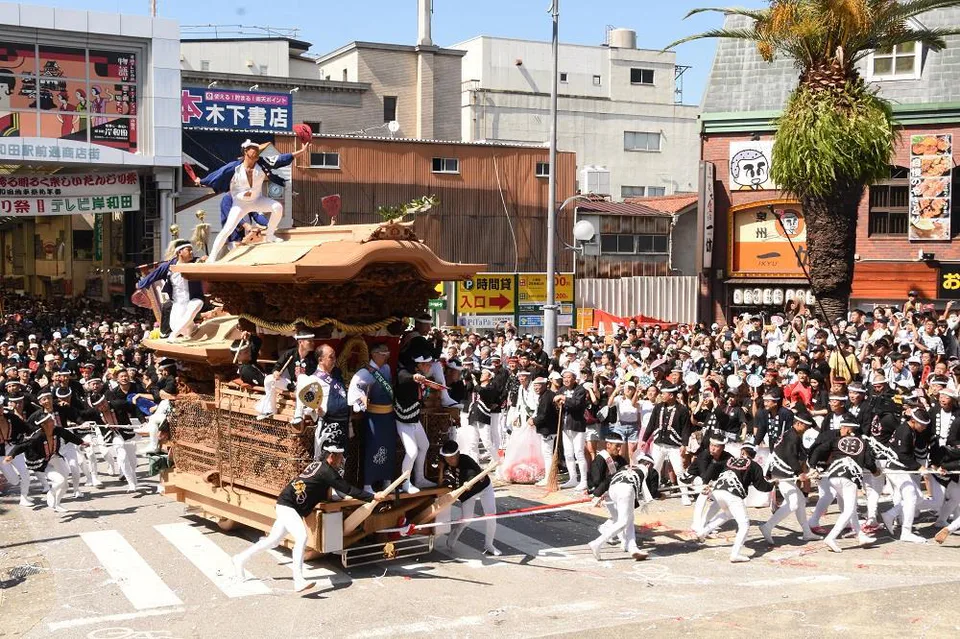
For Kishiwada Danjiri 2026, pay for a Kankan-ba viewing seat when your priority is one reliable, close view of yarimawashi and your group values a defined viewing position more than the freedom to roam. Stay with free street viewing when you want to move between different corridors, photograph wider scenes or keep the lantern-lit evening flexible. A paid seat does not make the whole festival easier: you still need to reach Kishiwada through crowd controls and leave through the pedestrian system after the session.
The 2026 decision is now concrete. Viewing seats are on sale for the September 18 trial pull, September 19 sessions at 06:00, 09:30, 13:00 and 15:30, and September 20 sessions at 13:00 and 15:30. The city has also published traffic restrictions for September 6 and 18–20. Choose the viewing product first, then the arrival time and hotel base. Do not arrive with a generic “I will find a famous corner” plan after the streets are already compressed.
↔ Scroll table left or right
Your priority | Start with | What you gain | What you give up |
See yarimawashi clearly without holding a roadside spot | Paid Kankan-ba viewing seat | A defined viewing position for a specific session | Less freedom to change area when crowds, light or weather shift |
Photography, street atmosphere and multiple corridors | Free viewing | Mobility and the ability to abandon a poor sightline | No guaranteed front-row view; standing and crowd management become your job |
Short preview without giving the festival a full day | Sep 18 trial pull | Two-hour afternoon programme; 2026 viewing seats are also sold for it | No full Yoimiya/Honmiya atmosphere and no equivalent lantern night |
Early kinetic atmosphere | Sep 19 06:00 session / Yoimiya morning | You experience the festival while the day is still beginning | Requires a very early Osaka departure or nearby stay |
Main daytime spectacle without dawn | Sep 19 09:30, 13:00 or 15:30 / Sep 20 13:00 or 15:30 | More practical transport timing | Greater crowd load and less flexibility near the major viewing zone |
Lantern-lit evening is the reason for going | Free evening route after a daytime session or separate free-view plan | You can follow the atmosphere rather than remaining tied to one daytime seat | Need your own safe viewing and station-exit strategy |
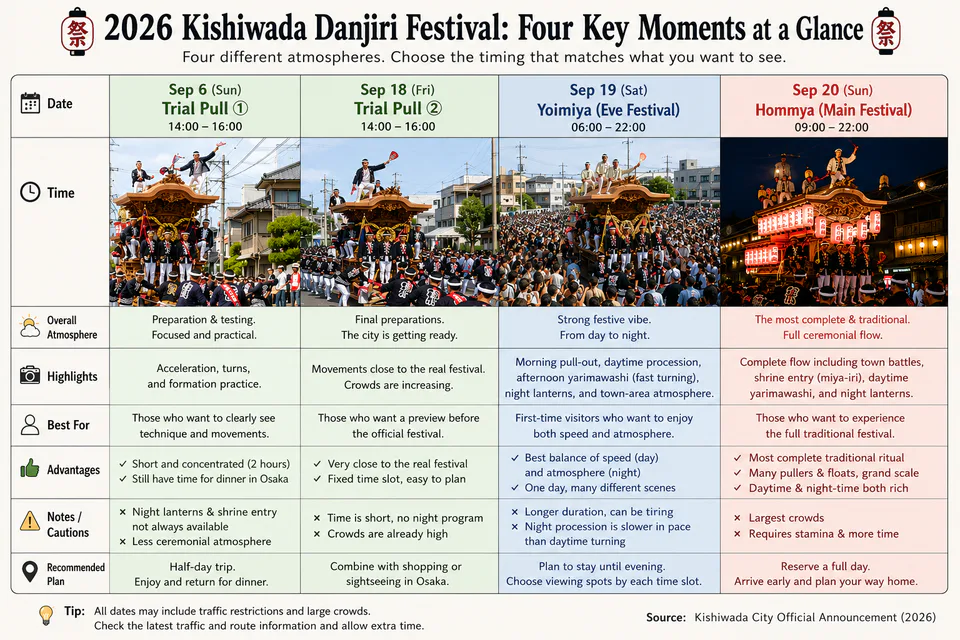
2026 dates: trial pull, Yoimiya and Honmiya are different products
Kishiwada City currently lists the September festival as:
September 6: trial pull, 14:00–16:00.
September 18: trial pull, 14:00–16:00.
September 19: Yoimiya, 06:00–22:00.
September 20: Honmiya, 09:00–22:00.
The October festival is a separate set of districts and dates; do not treat it as a backup copy of September. If your decision is specifically Yoimiya versus Honmiya, use the Yoimiya vs Honmiya comparison. This guide solves a different problem: how much viewing certainty should you buy once the date is chosen?
The 2026 viewing seats turn Kankan-ba from a crowd gamble into a timed product
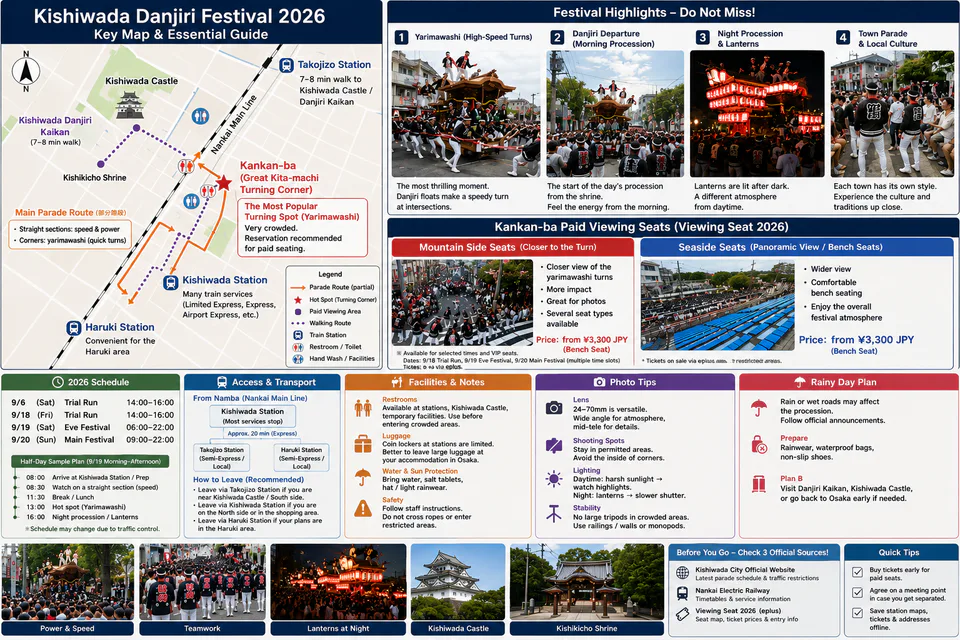
The authorised 2026 ticket listing currently shows viewing-seat sessions at Kankan-ba for September 18–20. Sales opened July 3, with booking deadlines varying by festival date. September 19 currently has sessions beginning at 06:00, 09:30, 13:00 and 15:30; September 20 has 13:00 and 15:30 sessions. There is also a viewing-seat product for the September 18 trial pull.
That makes the paid-seat decision more useful than the vague phrase “reserved seats may be available.” You are buying a specific viewing block, not an all-day festival upgrade.
I would pay when one of these is true:
a first-time visitor wants to see yarimawashi clearly without spending a long time holding a roadside position;
older travellers or a family cannot comfortably stand for a long open-ended wait;
the trip has only one short Kishiwada window and a failed free sightline would make the whole detour feel wasted;
photographing the Kankan-ba turning action is the main purpose and a known angle is worth more than roaming.
I would keep free viewing when the group mainly wants atmosphere, lanterns, wide street scenes or the freedom to leave one area as soon as it becomes uncomfortable.
Do not buy a paid seat if the lantern-lit evening is your real priority
The paid seats solve the predictable sightline problem around Kankan-ba. They do not automatically solve the best night atmosphere. Kishiwada City describes the daytime festival through dynamic pulling and the evening through floats decorated with lanterns. Those are different visual products.
If the whole reason for visiting is the lantern-lit streets, do not let a daytime seat dictate the entire day. A more efficient plan can be a moderate daytime session — paid or free — followed by food and rest, then a separate evening walk using the live crowd-control pattern.
This is especially important for families. A 13:00 viewing session plus hours of standing until 22:00 can turn “we paid for the best view” into an overlong day. Use the Kishiwada arrival-time guide to choose a window rather than trying to consume the whole published festival schedule.
Trial pull: buy it as a two-hour preview, not as discounted Honmiya
The September 18 trial pull runs 14:00–16:00 and now has an actual viewing-seat product. That makes it unusually easy to turn into a compact Ibaraki-style “event block” within a wider Osaka stay.
But the value is different from September 19–20. You can see teams, turning technique and movement without giving the event an entire day, but you do not get the same full festival programme or lantern evening.
Choose the trial pull when it fits an existing Osaka day. Do not add a hotel night just because the viewing slot is easier to obtain unless the trial itself is one of your trip priorities.
2026 traffic restrictions make driving the wrong default for most visitors
Kishiwada City published the 2026 festival traffic-control notice on August 3 and confirms restrictions on September 6, 18, 19 and 20. The restrictions cover festival streets where the danjiri move and pedestrian flows are managed.
For an overseas visitor staying in Osaka, this strengthens the normal recommendation to use Nankai Railway rather than a rental car. Parking somewhere “near the festival” does not mean the same road will remain usable for the return. A car can also trap the group on the wrong side of a restriction just when the evening crowd is peaking.
If the wider Kansai trip already uses a rental car, consider leaving it at the hotel or a station outside the controlled centre and using rail for the festival segment.
Namba is the natural Osaka base — but one festival should not control a whole Kansai stay
Kishiwada is on the Nankai Main Line, so Namba has the cleanest hotel-base logic for a festival-focused trip. A group can finish the event, return toward Nankai Namba and avoid crossing Osaka again after a long outdoor day.
That advantage should still pass a repetition test. If Kishiwada is one evening inside a five-night Kansai trip and the other mornings are all JR departures toward Kyoto, Kobe or Himeji, Umeda can remain the better overall base. Use Namba vs Umeda before moving hotels for one festival.
Free viewing still wins when mobility is part of the experience
A famous corner can become a bad place to spend an hour if barriers compress the sightline, the crowd behind you grows or the exit route becomes inconvenient. Free viewing lets you treat a poor position as disposable.
The best free position is not necessarily the closest. I would prioritise:
a legal position behind barriers or marshal lines;
a wide enough angle to see the float approach as well as the turn;
space behind the group so you can retreat without crossing the float route;
a known route toward the station or a quieter parallel street.
That wider view often produces better photographs too because the runners and turning geometry remain in the frame.
Build the return before the final float
Festival closing time is not station arrival time. Barriers, one-way pedestrian flows and closed crossings can make the route back different from the morning route.
Before watching the final planned segment, set:
a target time to start moving toward the station;
a second station approach if the first is blocked;
a meeting point away from the danjiri route if the group becomes separated;
the hotel name and route saved offline.
Do not stack a same-evening Kansai Airport flight, non-refundable dinner or another hard appointment after Kishiwada. The festival is valuable precisely because the street is not operating like a normal transit corridor.
Three practical 2026 plans
Comfort-first first visit
Choose one paid viewing session, arrive with enough margin to clear crowd controls, use the seat as the day's visual anchor, then leave or switch to a short free-view walk. Best for older travellers, families and anyone with only one festival window.
Photography and atmosphere
Use free viewing from a wider legal angle, move once rather than chasing every famous corner, take a food/toilet break before the evening crowd, then return for lanterns. Best for travellers who value changing light and street context more than one guaranteed Kankan-ba angle.
Short Osaka add-on
Use the September 18 trial pull, with or without a viewing seat, as a two-hour festival sample. Return to Osaka afterwards. Best when the main festival weekend does not fit and you do not want Kishiwada to consume a full Kansai day.
Final verdict
For 2026, a Kishiwada paid viewing seat is worth buying when one dependable yarimawashi sightline is the scarce resource. It is not automatically “better viewing” for the entire festival. Free viewing remains the stronger product when mobility, lantern night, wider photography and the ability to leave a bad crowd pocket matter more.
Whatever you choose, use Nankai access from Osaka rather than treating the published road network as normal on September 6 and 18–20. The city has already published 2026 traffic restrictions, so transport is not an afterthought. The correct order is date → paid/free viewing → arrival window → return path → hotel base.
References
Kishiwada City — official 2026 September and October festival schedule · Kishiwada City — 2026 festival traffic restrictions · eplus — authorised 2026 Kishiwada Danjiri viewing-seat sessions and sales windows. Checked August 25, 2026. Ticket inventory, seat types, crowd controls and festival operation can change; confirm live information before travel.