
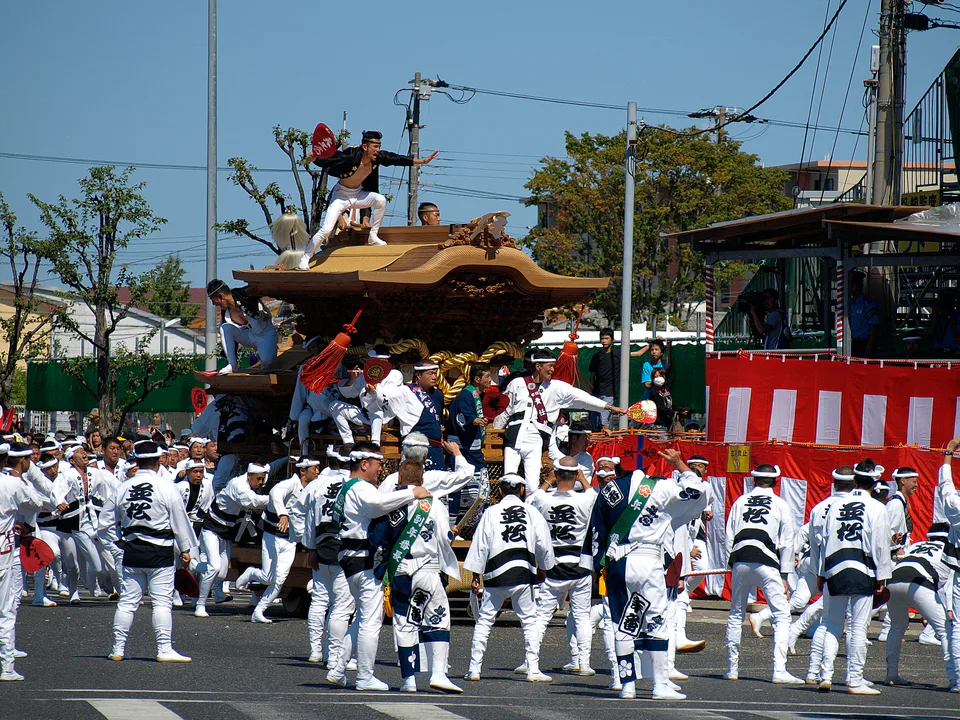
For most first-time international visitors, the best Kishiwada Danjiri arrival is not 6:00 a.m. I would use the 2026 Yoimiya opening at 06:00 only when seeing the festival from its very first hours is itself the priority. For a lower-friction first visit, arrive late morning or around midday for a concentrated daytime session. If lantern-lit danjiri, cooler temperatures and a shorter commitment matter more than maximum daytime speed, make the evening your only session.
The 2026 September festival is officially scheduled for Saturday, September 19 from 06:00 to 22:00 for Yoimiya and Sunday, September 20 from 09:00 to 22:00 for Honmiya. Those are the confirmed outer operating windows. As of August 25, 2026, Kishiwada City has published this year's Kishiwada and Haruki festival maps, but its parade/miyairi-order page still lists the detailed 2025 order rather than a 2026 minute-by-minute sequence. Do not build a 2026 trip around last year's 13:00 parade or shrine-entry times unless the city publishes this year's detailed order.
If the date itself is still undecided, use Yoimiya vs Honmiya first. This page solves the next question: once the date is fixed, which part of a very long festival day deserves your limited time?
↔ Scroll table left or right
Your priority | ValueNavi arrival window | What you are buying | Main cost |
The opening of Yoimiya is non-negotiable | Before the official 06:00 start | The earliest part of the day and the strongest sense of the festival waking up | Very early Osaka departure, long stamina bill if you stay too long |
First visit, daytime pulling matters most | Late morning to around midday | A full daylight session without sacrificing half the night before | Hotter conditions and already-established crowds |
Daytime plus lantern atmosphere | Mid-afternoon, then take a deliberate break | Two distinct festival moods in one visit | Requires several hours of standing/rest management; do not remain curbside continuously |
Families, older travellers or lanterns are the priority | Early evening | A shorter session, illuminated floats and less daytime heat exposure | You give up much of the fastest daylight action |
Specific parade or Honmiya shrine-entry sequence | Wait for the 2026 detailed official order | You can target the event you actually care about | Using a 2025 timetable as if it were 2026 can put you in the wrong place at the wrong time |
The 06:00 start is a specialised choice, not the default best arrival
Yoimiya's official 2026 window begins at 06:00. That makes dawn tempting because it sounds like the most authentic or complete way to see the festival. The hidden cost is that a visitor sleeping in central Osaka may need to wake long before sunrise, travel south on the Nankai Line, orient themselves around road controls and then manage a festival that officially continues until 22:00.
Do not turn “I want to see the start” into “I should stay for sixteen hours.” Treat the opening as one complete session. If the early atmosphere is the reason you came, see it properly, then leave or take a long indoor break. The 06:00 start earns the sleep sacrifice only when that particular scene matters more than the afternoon or lantern-lit festival.
This is especially important on a wider Japan trip. Losing the next morning in Kyoto, USJ or another intercity transfer can cost more trip value than gaining four extra festival hours you were too tired to enjoy.
For most first visits, late morning or midday has the best stamina-to-experience ratio
A late-morning or midday arrival is not the “less serious” version of Kishiwada. It is often the best way to give the festival three or four strong hours instead of eight tired ones. You arrive after a normal breakfast, still see the daytime character that Kishiwada City describes as dynamic and powerful, and retain enough energy to choose whether to leave before evening or bridge into the lantern period.
The cost is heat. September can still be hot, and the crowd has already formed. Solve food, water and toilets before trying to hold a viewing position. Do not spend the first hour chasing the most famous corner from an old video; use the current 2026 festival map and select a legal public area that also gives you a workable route back to the railway.
For a normal Osaka day trip, I would rather have a planned three-hour daytime chapter plus a calm return than a dawn-to-night endurance test. If two parts of the festival are genuinely non-negotiable, add a real break rather than pretending standing time is free.
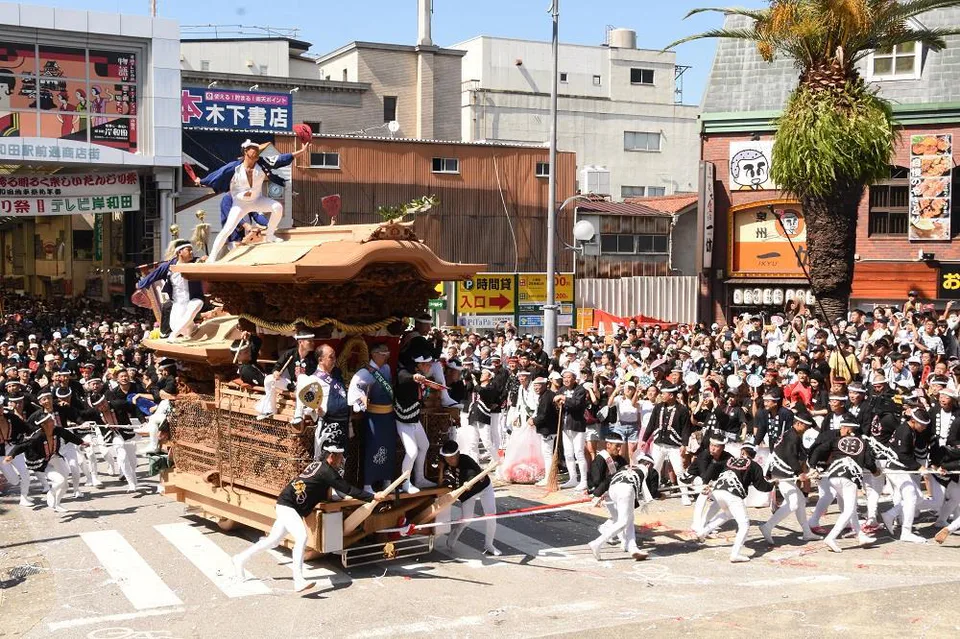
Lantern night is a different product, not the leftovers after daytime pulling
Kishiwada City's current festival page explicitly distinguishes the powerful daytime pulling from the beautiful lantern-lit danjiri at night. That means an evening-only visit is a valid first-choice itinerary, not merely what remains if you missed the morning.
Choose evening when your group values atmosphere, illuminated carvings and a shorter physical commitment more than maximum daytime speed. It is particularly rational for families, older companions and travellers already spending the morning elsewhere in Osaka.
The trade-off is straightforward: you cannot claim the strongest daytime action and the easiest evening in the same short window. If speed and turning action are the priority, arrive in daylight. If the lanterns are the priority, preserve your energy for them.
Do not use a 2025 parade timetable as a 2026 promise
This is the most important current-data warning in the article. Kishiwada City has already confirmed the 2026 September dates and overall hours, and it published the 2026 Kishiwada/Haruki maps in August. However, as of August 25, the city's detailed “parade and miyairi order” section still exposes the 2025 Kishiwada and Haruki listings.
Previous official schedules show that the festival is broken into more specific parade, shrine-entry and pulling periods. That history is useful for understanding why the day has different moods, but it is not a license to copy last year's minute-by-minute sequence into a 2026 itinerary.
If your entire reason for attending is a named Kishiwada Station parade, a particular shrine entry or a specific town's place in the order, recheck the official site close to the festival. If this year's detailed sequence is still unavailable, plan by the confirmed outer window and current map rather than by an old screenshot.
Choose Kishiwada district or Haruki before you choose the train
The September festival covers both the Kishiwada and Haruki districts, and the city publishes separate current maps for them. They are not one continuous spectator zone. Nankai also treats Kishiwada and Haruki as separate stations: Kishiwada is NK24 and Haruki is NK22.
For a first visit focused on the classic central Kishiwada experience, Kishiwada Station is the obvious transport anchor. If your target is in the Haruki district, using Kishiwada Station simply because it is the better-known name can create an unnecessary walk or backtrack.
Station choice should follow the district and viewing plan. Nankai's current Kishiwada Station information also confirms elevators and other barrier-free facilities, but festival crowd controls can change the most comfortable street route. Save the current map rather than relying only on the station diagram.
Three or four strong hours usually beat a full festival day
Use a session budget rather than an arrival-time badge:
Opening session: attend the beginning of Yoimiya, then stop once the early scene you came for is complete.
Daylight session: arrive late morning or around midday, watch one coherent section and leave before fatigue dictates the decision.
Day-to-night session: arrive in the afternoon, then leave the curbside crowd for a proper meal/cooling break before returning for the illuminated atmosphere.
Lantern-only session: arrive early enough to orient yourself before dark, watch the night festival, then leave on a preselected rail route.
The point is not that four hours is a universal maximum. It is that every extra hour should buy another distinct experience. If the fifth hour only buys more standing, heat and a worse train home, it has stopped adding value.
Families and older travellers should choose the retreat point before the viewpoint
For a child, older parent or heat-sensitive traveller, decide what ends the session before you enter the densest crowd. Examples: the next toilet break becomes difficult, a child stops drinking, the group can no longer change position safely, or everyone has already seen the scene they came for.
This reverses the usual festival-planning order. The “best” viewing point is only useful if the group can leave it. A slightly less famous section with a clear route toward the station can be a better family choice than the most photogenic corner surrounded by a dense crowd.
Large luggage should not enter this equation at all. Store or forward it before the festival. Nankai's station map shows coin lockers at Kishiwada Station, but festival-day availability is not guaranteed; a hotel or planned baggage service is the safer strategy for full-size cases.
Do not treat 22:00 as your train-departure time
Both September festival days officially continue until 22:00. That is an event boundary, not a promise that you can remain at the busiest point until 22:00 and then walk straight onto an empty train.
Choose one of two strategies. If the next morning matters, leave before the final crowd movement becomes the dominant part of the evening. If the lantern finish matters more, accept the post-event dispersal as part of the experience and remove any hard dinner, airport or early-morning commitment afterward.
Kishiwada Station is on the Nankai network and is served by multiple service types including Rapi:t β, Southern, Express and Airport Express services. The precise train you use should be checked on the day; the important planning choice is to know which station and direction you need before the crowd starts moving.
Which arrival should you choose?
Choose the 06:00 opening only when the start of Yoimiya is itself your non-negotiable scene. Do not do it merely because the festival officially starts then.
Choose late morning or midday for the strongest first-time default. It protects sleep, gives you a full daylight experience and leaves the option to leave or deliberately continue into evening.
Choose an evening-only visit when lanterns, atmosphere and stamina matter more than high-speed daytime action. This is a particularly strong choice for mixed-age groups.
For Honmiya shrine-entry or a specific parade sequence, do not lock a minute-level 2026 arrival from old schedules. The city has confirmed September 20 from 09:00 to 22:00, but wait for the current detailed order if that named sequence is the reason for the trip.
Maidreamin Fukuoka Tenjin: ¥880 Entry vs ¥3,800 HYPER — Check the Night System Before You Go
Tokyo Helicopter Night Tour: 23, 30 or 55 Minutes? Check Where You Actually Depart
Mt Fuji Day Trip or Overnight: When an Extra Night Is Worth It
Aomori Nebuta vs Hirosaki Neputa After 2026: Which Festival Should You Choose Next Time?
Sapporo Hotel Comparison: Tokyu Stay vs Solaria vs GRANBELL for a Four-Night Winter Stay
References
Kishiwada City — 2026 Danjiri Festival dates and official festival information · Kishiwada City — 2026 September Kishiwada/Haruki festival maps · Kishiwada City — parade and miyairi order page · Nankai Electric Railway — Kishiwada Station. Checked August 25, 2026. Recheck the official city pages before travel because detailed parade orders, traffic controls and rail operations can change.