
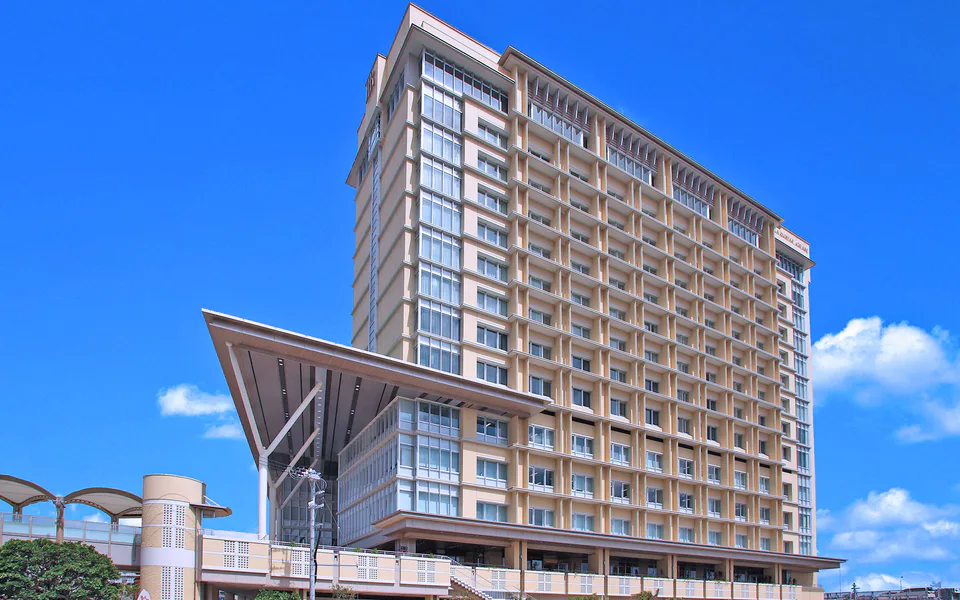
RIHGA Royal Gran Okinawa is at its best when the hotel is doing transport work for you, not merely giving you a larger room in Naha. The current Yui Rail fare between Naha Airport and Asahibashi is ¥290 per adult (about US$1.80), and the operator lists about 11 minutes. The hotel is connected from Asahibashi by the pedestrian route toward Naha Bus Terminal. That combination makes the property unusually coherent for a first night before you rent a car, a last night after you return one, or a no-car Naha segment.
The recommendation weakens quickly if you keep a rental car every day. The hotel still gives you 35m²-or-larger rooms, but the rail-and-bus hub becomes underused while valet parking costs ¥1,500 per car per night (about US$9.40). The practical question is therefore not “Is Asahibashi convenient?” but “How many times will this stay actually use Asahibashi as a transport node?”
Fact-checked August 26, 2026. JPY remains the primary currency; approximate USD figures use about ¥159 = US$1 as a working reference. Hotel rates, room inventory, transport schedules and package rules can change.
If you have not chosen your Okinawa base structure yet, start with Where to Stay in Okinawa and Do You Need a Car in Okinawa?. This hotel makes most sense after those two decisions are clear.
ValueNavi transport-node test: count useful hub events, not hotel nights
This is the core ValueNavi framework for RIHGA Royal Gran Okinawa. Give the hotel one “hub event” each time its location removes a meaningful transfer or street-level luggage movement from your plan:
↔ Scroll table left or right
Hub event | Why it matters |
Airport → Asahibashi on arrival | Direct Yui Rail ride plus a connected pedestrian approach instead of another taxi or city transfer. |
Asahibashi → airport on departure | Simple final-morning rail access without keeping a car solely for the airport run. |
Naha Bus Terminal departure | The terminal is about two minutes from the hotel, so a no-car day can start from the same transport node. |
Car-free Naha day using Yui Rail | The station remains useful during the stay instead of only on arrival. |
Rental-car pickup delayed until the northbound segment | The hotel helps separate city days from driving days, avoiding an unnecessary hotel-parking night. |
Rental car returned before the final Naha night | The final night becomes rail-based rather than another valet-parking night. |
My rule: if you can identify at least two real hub events in a one- or two-night stay, Asahibashi is doing enough work to deserve serious consideration. If you have zero or one hub event across a four-night self-drive stay, the location premium is much harder to justify; you are mostly buying the room itself.
This is not an official hotel metric. It is a ValueNavi decision tool for separating “station-connected sounds convenient” from “the itinerary repeatedly uses the connection.”
The 30-second answer: when I would book, compare or skip
↔ Scroll table left or right
Trip pattern | My call | Why |
First Naha night, no rental car yet | Book / strong fit | Airport rail, predictable luggage route and a large room all solve arrival-night friction. |
Last Naha night after returning the car | Book / strong fit | The final morning becomes a simple rail departure rather than another driving-and-return sequence. |
Two Naha nights, entirely no-car | Strong fit | Yui Rail and Naha Bus Terminal can both be used more than once. |
Four nights, rental car every day | Compare again | You keep paying ¥1,500 nightly parking while barely using the station/bus advantage. |
Repeated late Kokusai-dori evenings | Compare another Naha base | Asahibashi is transport-efficient, but it is not the most direct doorstep for the busiest Kokusai-dori blocks. |
Beach-resort stay | Skip for this purpose | The hotel solves Naha logistics, not resort time. |
The hidden cost of collecting a rental car too early
Parking is the easiest visible cost to quantify. RIHGA currently charges ¥1,500 per car per night. By comparison, Yui Rail currently charges ¥290 per adult between Naha Airport and Asahibashi. For two adults, that airport rail trip is ¥580 (about US$3.65) one way.
These are not interchangeable products: a car gives you mobility that Yui Rail does not. But if the car will sit in valet parking while you spend the first evening and following morning in central Naha, the extra night creates at least ¥1,500 of hotel parking before rental-day cost, fuel or other car expenses are even considered. That is the hidden-cost reason I prefer a partial-rental pattern here when the itinerary allows it.
One clean sequence is airport → Asahibashi → hotel → Naha evening, then collect the rental car only when the route actually turns north. The reverse works on the final night: finish the road-trip segment, return the car, then use Asahibashi for the last sleep and airport departure.
Use the Okinawa Car Rental Guide and 5-Day Self-Drive Route to decide where the car days should begin and end.
Connected to Asahibashi does not mean platform-to-room
The official route matters because “connected” can be over-read. From Asahibashi you leave the gate toward the bus-terminal side, follow the pedestrian bridge, enter the hotel on level 2, then take the lift to reception on level 14. The benefit is a predictable sheltered-style approach that removes part of the street-level wayfinding; it is not zero walking.
That distinction matters most with large luggage, rain or heat. A traveller with two rolling suitcases benefits more from a route that is easy to follow than a traveller carrying one backpack. The value is therefore wayfinding reliability, not a fantasy five-step platform-to-bed transfer.
For a late first night or early last morning, compare the Late Arrival or Early Flight guide and Naha 2-Day No-Car itinerary.
35m² changes the room baseline—but Premier does not automatically make it larger
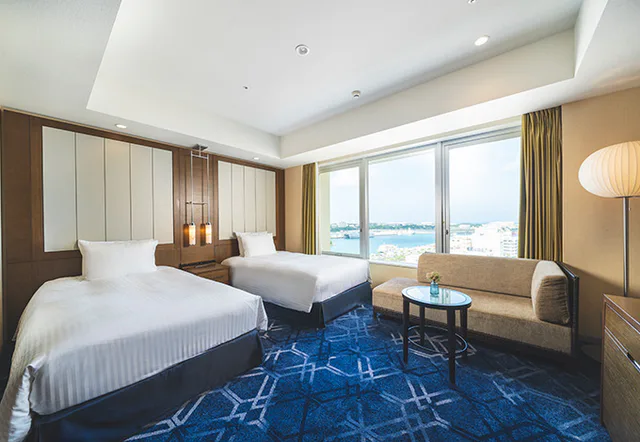
The useful room fact is simple: common standard Twins and common Premier Twins are both 35m². City View Twin is 35m² and can accommodate a third person. Bayside Twin is 35m² for two. Premier City View Twin is also 35m², just on higher floors with Premier services.
That means the upgrade ladder is not a space ladder. For two travellers, I would start with Bayside Twin or City View Twin and only move up when a specific benefit has value: higher floor, breakfast, earlier check-in, later checkout or View Bath.
↔ Scroll table left or right
Room choice | Published size | What you are really buying |
Bayside Twin | 35m² / 2 guests | Two-person baseline with the full room-size benefit. |
City View Twin | 35m² / 2–3 guests | Third-person capability, not more floor area. |
Bayside View Bath Twin | 35m² | Bath/view experience, not extra room area. |
Premier City View Twin | 35m² / higher floor | Premier benefits and higher-floor placement. |
The hotel does not publish a universal claim that two particular 28- or 29-inch suitcases can remain fully open in every layout. Treat 35m² as a strong city-hotel baseline, not a suitcase guarantee.
For another 35m² Naha product with a very different station trade-off, compare The Naha Terrace.
ValueNavi Premier break-even: breakfast gives you a hard reference ceiling
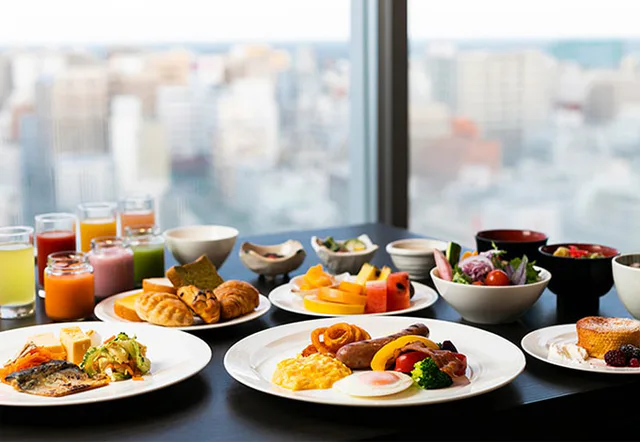
Breakfast currently costs ¥3,300 (about US$20.75) per adult and ¥1,870 (US$11.75) for ages 6–11. Premier includes breakfast and also changes the standard 15:00/11:00 check-in/out to 14:00/12:00, alongside higher-floor placement and other Premier benefits.
That gives you a useful ValueNavi reference point:
↔ Scroll table left or right
Party | Current breakfast value for one morning | How to use it |
1 adult | ¥3,300 ≈ US$20.75 | If Premier is only slightly more than this and you will eat breakfast, the other benefits are effectively inexpensive. |
2 adults | ¥6,600 ≈ US$41.50 | This is the cleanest two-person breakfast-only reference ceiling. |
2 adults + 1 child age 6–11 | ¥8,470 ≈ US$53.25 | Family breakfast value can make Premier more competitive if the morning schedule actually uses it. |
Decision rule: compare the same room type, date, guest count and cancellation terms. If Premier is ¥6,000 more for two adults and both will eat breakfast, the current breakfast price already explains most or all of the difference before you value the extra hour at either end of the stay. If Premier is ¥12,000 more, breakfast alone does not justify it; you need to genuinely value the higher floor, 14:00 check-in and 12:00 checkout as well.
The boundary condition is morning timing. Breakfast runs 07:00–10:00. If you have a very early flight, marine pickup or other fixed departure, the breakfast benefit can collapse. Do not count a benefit you cannot consume.
First night versus last night: the hotel solves different problems
↔ Scroll table left or right
Stay position | Main job | Hidden risk |
First night | Absorb flight arrival, luggage and a simple Naha evening before the road trip begins. | Picking up a car immediately can erase the station advantage and add parking. |
Middle Naha nights | Use rail and bus access repeatedly for a no-car city segment. | If evenings are almost entirely Kokusai-dori, another location may fit the actual night pattern better. |
Last night | Return the car, repack in a 35m² room and simplify the airport morning. | A late resort checkout plus late drive back can still make the final transfer tiring; the hotel does not erase road-trip timing. |
This is why I like the property more as a trip-edge hotel than as an automatic four-night Naha base. One night can use the location intensely; four nights can dilute it if the itinerary becomes mostly self-drive.
What you give up: nightlife doorstep and self-drive simplicity
The first trade-off is obvious: you do not get the busiest Kokusai-dori blocks directly outside the door. If every evening is designed around repeated late dinners, bars or shopping in that zone, a more central Kokusai-dori property can reduce nightly return friction.
The second trade-off is that full-time self-driving underuses the station and bus terminal while introducing a valet handover each driving day. The hotel does not publish a fixed valet retrieval time, so I would not invent one. The objective cost is enough: parking remains ¥1,500 per night, and every car day includes a vehicle handover step.
The third trade-off is upgrade ambiguity. Several room names sound more premium without adding floor area. If you want more room, verify the actual square metres rather than assuming Premier or View Bath is larger.
Five failure modes that make the stay worse than it looks on paper
1. You collect a rental car at the airport and then leave it parked for the first Naha night. You pay for mobility you are not using and immediately add hotel parking.
2. You read “directly connected” as “no walking.” There is still station navigation, the pedestrian route and a lift to the 14th-floor reception.
3. You pay for Premier because it sounds larger. Common Premier Twin categories remain 35m²; the premium is mainly service, floor and timing.
4. You count breakfast value on a morning you cannot use it. A 07:00 opening is irrelevant if the trip requires an earlier departure.
5. You choose Asahibashi for a stay whose real centre of gravity is nightly Kokusai-dori activity. Transport convenience and evening convenience are not the same thing.
ValueNavi decision table: when the recommendation flips
↔ Scroll table left or right
Situation | Default | What would reverse it |
Two adults, first night, no car yet | RIHGA is a strong fit | A much cheaper hotel on an equally simple airport route, or a very late arrival when you only need the nearest practical bed. |
Final night after returning the car | Strong fit | An airport-area hotel is materially better for an exceptionally early departure. |
Two Naha nights, no car | Strong fit | Your entire itinerary is concentrated around Makishi/Miebashi and you value doorstep nightlife more than the bus terminal. |
Four-night self-drive | Compare again | You specifically value the 35m² rooms enough to accept parking and underused rail access. |
Premier upgrade for two adults | Use ¥6,600 breakfast value as the first reference | If breakfast is unusable, the upgrade must stand on the higher floor and check-in/out timing instead. |
For repeated Kokusai-dori evenings, compare HOTEL COLLECTIVE Naha. For the closest station-versus-shopping-area decision, use RIHGA Royal Gran Okinawa vs JR Kyushu Hotel Blossom Naha.
Compare the same room before booking
Match the same dates, exact room category, guest count, breakfast, taxes and cancellation terms. Standard versus Premier, City View versus Bayside and regular bath versus View Bath can remain around 35m² while included benefits differ. A cheaper rate is not automatically the better deal if it loses breakfast or flexibility, and a higher rate is not justified simply because the room name sounds more premium.
Booking.com — RIHGA Royal Gran Okinawa
Trip.com — RIHGA Royal Gran Okinawa
Agoda — RIHGA Royal Gran Okinawa
Final verdict: I would use RIHGA as a trip-edge hotel, not an automatic Naha default
I would book RIHGA Royal Gran Okinawa most confidently for the first or last Naha night, or for a short no-car city segment, because those patterns use the airport rail, Asahibashi connection and nearby bus terminal repeatedly while also benefiting from the 35m² room baseline.
I would reconsider it for a multi-night full self-drive stay. The room is still generous, but parking becomes a recurring cost and the transport hub becomes less relevant. I would also compare a more central Kokusai-dori base when nightlife doorstep matters more than airport and bus-terminal efficiency.
The ValueNavi red-team question is: if the pedestrian connection to Asahibashi disappeared, would you still choose this hotel at the same price? If the answer is yes because you mainly want the room, treat it as a room-value decision. If the answer is no, make sure your itinerary contains at least two real hub events so you actually consume the location premium.
FAQ
How much is Yui Rail from Naha Airport to Asahibashi?
The current Yui Rail fare is ¥290 per adult, and the operator lists about 11 minutes between Naha Airport and Asahibashi. Check the live timetable for your travel date.
Does connected to Asahibashi Station mean no walking?
No. You still leave the gate, follow the pedestrian route toward Naha Bus Terminal, enter the hotel on level 2 and take a lift to reception on level 14.
How large are the common rooms?
Common Bayside Twin, City View Twin and several Premier Twin categories are 35m². The important lesson is that Premier does not automatically mean a larger room.
How much is parking?
The hotel currently charges ¥1,500 per car per night for valet parking, with repeated entry and exit allowed.
What time is breakfast?
Breakfast currently runs 07:00–10:00 and costs ¥3,300 per adult and ¥1,870 for children aged 6–11. Use those prices as a reference when comparing a Premier rate that includes breakfast.
La Vista Furano Hills: Is a Small Room Worth It for a One-Night Furano Stay?
Sapporo vs Chitose for the Last Night: Where to Stay in Hokkaido
Okinawa Shopping Hotels: Chatan or Naha for Your Final Two Nights?
Fukuoka Tower: Is the ¥1,000 Ticket Worth the Detour? Timing Changes the Answer
Sources
RIHGA Royal Gran Okinawa — official access and parking
RIHGA Royal Gran Okinawa — official room information
RIHGA Royal Gran Okinawa — official breakfast hours and prices
Yui Rail — Asahibashi fare and travel-time table
Room types, rates, availability, transport schedules and cancellation terms can change by date. This article may contain affiliate links; ValueNavi may earn a commission from qualifying bookings at no additional cost to you.