
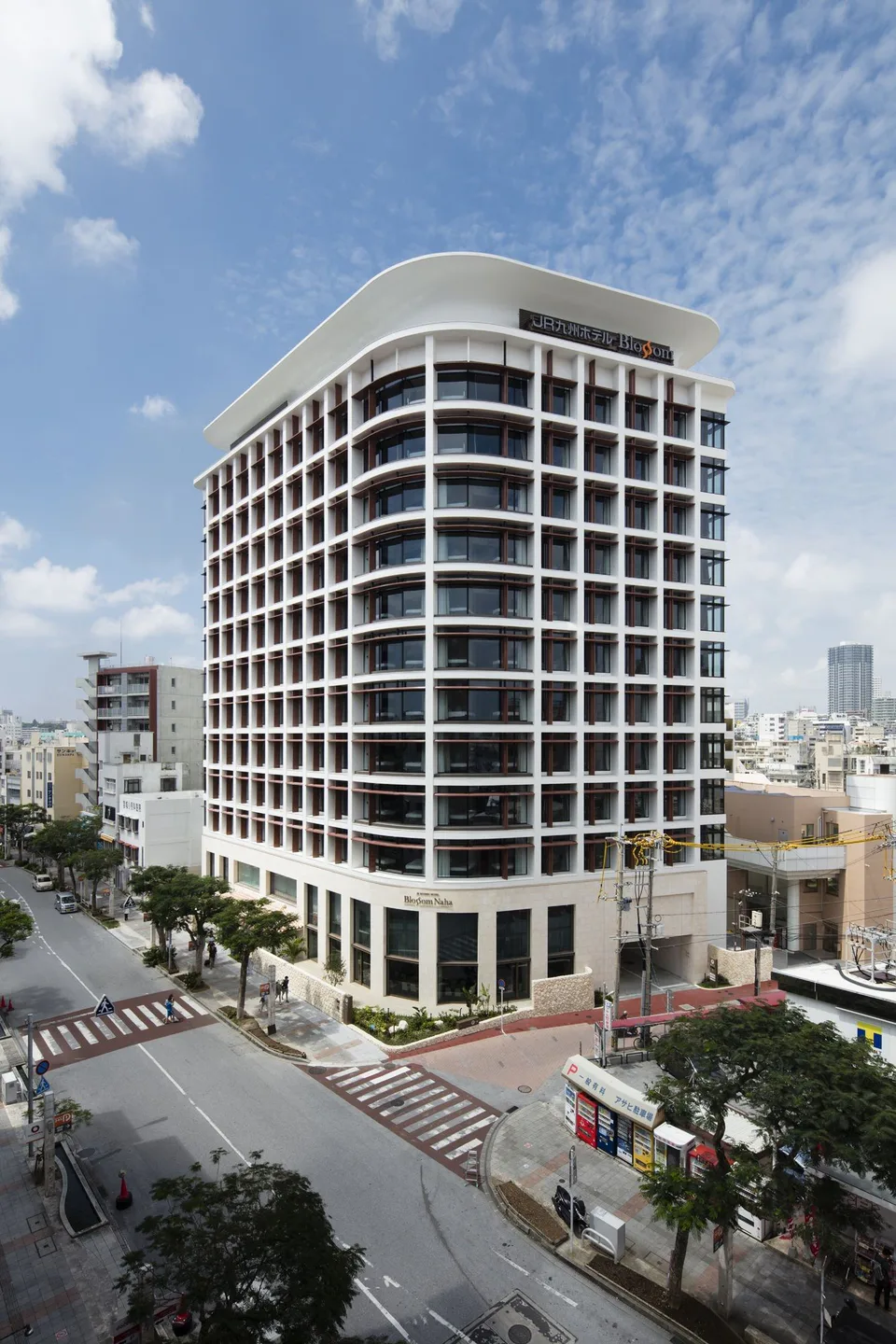
The easiest thing to notice about JR Kyushu Hotel Blossom Naha is “about one minute from Kokusai-dori.” I think the better reason to stay for two or three nights is the way that location combines with 24-hour self-service laundry, separate guestroom bath/wash areas and the 13th-floor guest lounge. This is not a station-front hotel: current official guidance still puts Miebashi Station at roughly a five-minute walk. For one night, that distinction may barely matter. For a multi-night Naha stay, the walk from the hotel back to food, shopping and evening activity on Kokusai-dori is the distance you may reuse every day. On October 11, Naha Great Tug-of-War 2026 turns Kokusai-dori access from a shopping convenience into a genuine post-event walking advantage.
My decision is therefore not “is this the closest hotel to Yui Rail?” It is whether you are willing to accept a small final walk from the monorail in exchange for a better two- to three-night city-base rhythm. I lean yes when you do not rent a car for the whole stay, return to central Naha in the evening, and will genuinely use the laundry or lounge. I lean no when your hard requirement is a one- or two-minute station walk, or when the trip is really a beach-resort holiday and Naha is only a transfer night.
If you have not decided how many nights belong in Naha, start with the Okinawa first-time visitors guide and the 2-day Naha itinerary without a car. This hotel makes more sense after Naha has already been chosen as a real base, not when the itinerary actually belongs in Onna or Motobu.
JR Kyushu Hotel Blossom Naha: the 30-second decision
I would book: two people staying in Naha for two or three nights, no car or only partial car rental, daytime movement by Yui Rail/bus/tours, and evenings that return to Kokusai-dori for food and shopping. In that pattern, the one-minute Kokusai-dori access, 24-hour laundry and guest lounge all repeat through the stay.
I would compare again: you drive every day. The hotel has 102 mechanical parking spaces, but that does not erase central-Naha road friction. Kokusai-dori has weekday bus-lane restrictions and a Sunday Transit Mall period. Parking availability, vehicle height and your actual arrival direction matter more than the existence of an on-site car park.
I would skip: “station exit to lobby in one or two minutes” is a non-negotiable requirement, or you want a resort where the hotel itself fills half the day. JR Blossom’s strengths are city-base efficiency and repeated evening use, not a pool, beach or all-day resort schedule.
↔ Scroll table left or right
Factor | Verified detail | Trip impact |
Location | Kokusai-dori ~1 min; Miebashi Station ~5 min | Night activity is extremely close, but airport arrival still includes a final street walk |
Base rooms | Superior Double 23m² / Superior Twin 26m² | Choose by bed setup and luggage before chasing premium categories |
Family Room | 33m² / 3–4 guests / standard beds + bunk + sofa bed | Four guests should confirm bedding acceptance, not only maximum occupancy |
Coin laundry | 11F, 24 hours; machine status visible on in-room VOD | High value for multi-night, family and humid/summer trips |
Guest lounge | 13F, guest-only, 07:00–24:00, free coffee | Adds a second space outside a 23–26m² base room |
Parking | 102 mechanical spaces; current guest rate JPY1,500/night | On-site parking does not remove Kokusai-dori road-time restrictions |
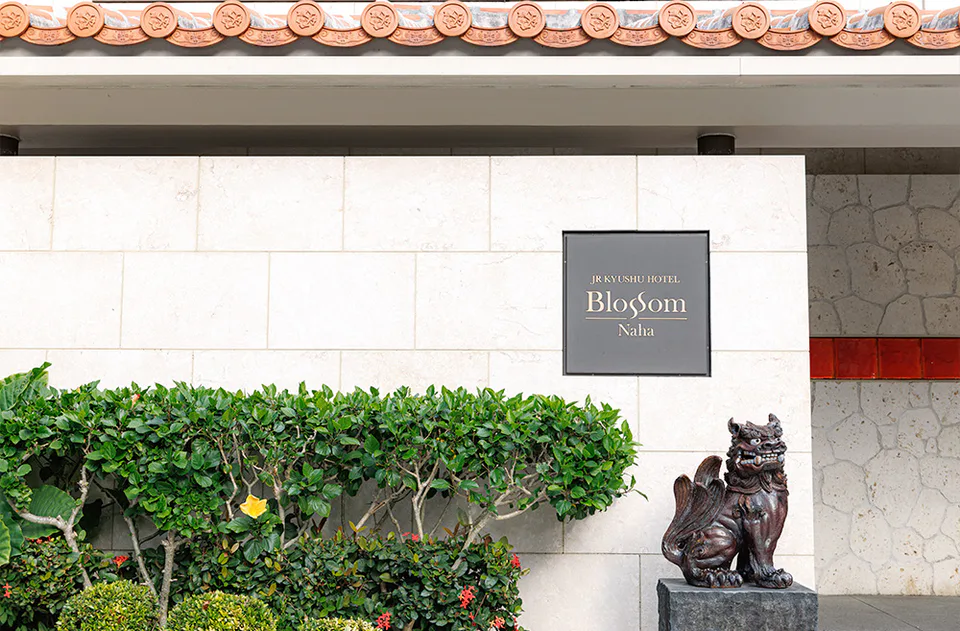
Kokusai-dori in one minute does not mean zero station friction
There are two different location questions. From Naha Airport, current hotel guidance gives roughly 14 minutes on Yui Rail to Miebashi Station, then about five minutes on foot to the hotel. Makishi Station is another option at roughly 16 minutes from the airport plus about eight minutes on foot. For a first arrival, I would generally treat Miebashi as the main monorail route because both the train and final walk are shorter.
The same five-minute walk does not cost every traveller the same. Two 28-inch suitcases, a sudden Okinawa downpour, a stroller or an older family member can magnify it. After check-in, however, the roughly one-minute walk to Kokusai-dori may be used more than once each evening. My reading is that JR Blossom does not minimise arrival friction; it minimises repeated after-check-in city-centre friction.
That distinction is useful against another Naha location model. In the RIHGA Royal Gran Okinawa vs JR Blossom comparison, RIHGA buys stronger Asahibashi/airport-arrival convenience while JR Blossom buys stronger Kokusai-dori evenings and 24-hour laundry. If you want a larger Naha hotel with a pool/club proposition, the Hyatt Regency Naha Okinawa review is a different trade again.
Arrival reality: airport, monorail, taxi or rental car
↔ Scroll table left or right
Transport | Current official baseline | My use case |
Yui Rail via Miebashi | Airport → Miebashi ~14 min + walk ~5 min | Most predictable for two travellers with manageable luggage |
Yui Rail via Makishi | Airport → Makishi ~16 min + walk ~8 min | Usually not my first choice for rain or large luggage |
Taxi | Hotel estimates airport journey around 15 min; traffic varies | Useful for late arrival, several travellers or heavy luggage because it buys away the final station walk |
Self-drive | 102 mechanical spaces + Kokusai-dori traffic restrictions | Best as a partial-car-rental base, not automatically the easiest daily drive-in/out hotel |
A taxi is not guaranteed to be faster than rail at every hour. Its value is more physical: it removes the final five-minute suitcase walk and reduces transfers when a late flight has already taken most of your energy. For a no-car trip, keep the route simple with the Naha no-car itinerary. If you are undecided about renting, separate the Naha nights from the driving days with the Okinawa car-rental comparison and the 5-day Okinawa self-drive itinerary. JR Blossom is especially logical before pickup or after returning the car.
Room decision: decide how you sleep before paying for extra square metres
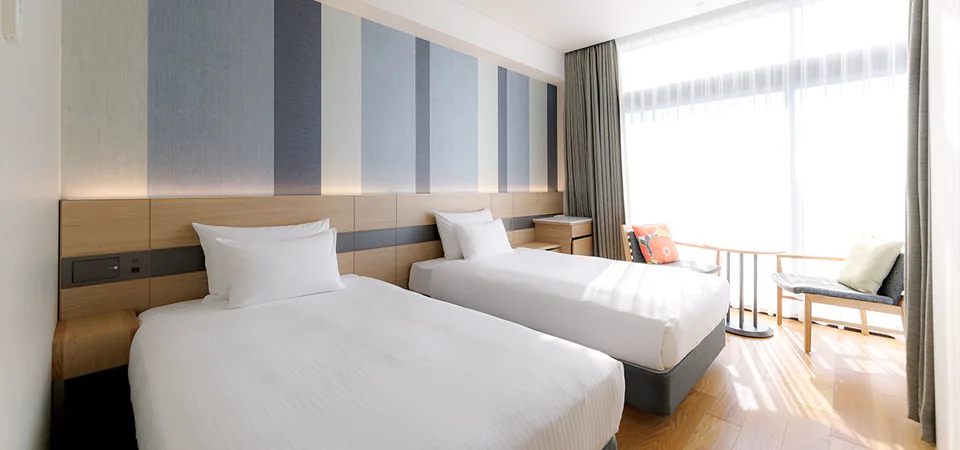
The base Superior Double is 23m² for one or two guests with a 160cm-wide bed. Superior Twin is 26m² with two 120cm-wide beds. The hotel also states that all guestrooms use a bathroom with a separate wash area, which has more practical value for a multi-night couple stay than simply seeing a bathtub in a photo.
For two people, I would compare Superior Double and Superior Twin before jumping to premium categories. Double works when one bed suits both people and luggage is modest. Twin adds some floor area and separates sleep space. Official data does not prove that two 28-inch suitcases can remain fully open without affecting circulation, so I will not label 26m² “large-luggage stress-free.” But if both travellers bring big cases, Twin is my first price check.
Deluxe King is a 28m² corner room with a 180cm bed and is highlighted by the hotel for families who may bed-share with a young child. Deluxe Twin is 33m² for two to three guests and can add a bed, with an L-shaped sofa and more storage. They are different upgrades: King is about one wide bed and corner light; Deluxe Twin is the clearer multi-person and storage upgrade.
↔ Scroll table left or right
Room | Official detail | My take |
Superior Double | 23m² / 1–2 / 160cm bed | One-bed setup, lighter luggage |
Superior Twin | 26m² / 1–2 / 120cm ×2 | My first comparison for two travellers with more luggage |
Deluxe King | 28m² / corner / 180cm bed | Consider for bed-sharing with a young child; not a multi-bed room |
Deluxe Twin | 33m² / 2–3 / extra bed possible | The more meaningful space/storage upgrade for three guests |
Family Room | 33m² / 3–4 / only 12 rooms | Four guests should check the exact bedding setup first |
Premium Twin | 34m² / only 4 rooms / 11–12F view bath | Upgrade for the bathroom/view experience, not for one extra square metre |
For four guests, the bigger risk is bedding—not 33m²
The Family Room is the category you should never buy from “33m², sleeps four” alone. Current hotel data lists two 120×200cm standard beds plus a 97×200cm bunk bed and a 95×200cm sofa bed, for three to four guests. Only 12 Family Rooms exist. Four-person occupancy therefore does not mean four identical standard single beds.
For two adults and two children, the configuration may solve the desire to stay in one room. For four adults, check whether everyone accepts a bunk/sofa-bed arrangement, then verify the exact OTA occupancy and bedding for your date. Booking platforms can separate room name, bed type and maximum guest count in ways that make “sleeps four” look simpler than it is. Enter every traveller and child age before judging the product.
If the family trip also includes driving or weather uncertainty, pair this room decision with the Okinawa family road-trip guide and the Okinawa rainy-day and typhoon guide. A family room is only one part of the logistics problem.
Premium Twin: the upgrade is the view bath, not one square metre
Premium Twin is a different product. There are only four rooms, on floors 11–12, at 34m², with a full-glass view bathtub as the defining feature. The area is only marginally larger than the 33m² Family/Deluxe categories, so the upgrade argument should not be “the room is bigger.” It is “I want the higher-floor bathroom experience.” If you simply need a smooth two-person multi-night base, the 26m² Superior Twin remains much closer to the core job.
24-hour laundry is the real three-night multiplier
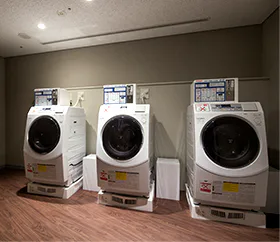
The 11th-floor 24-hour coin laundry is one of the hotel’s strongest long-stay features. The hotel does more than say it exists: machine operation and estimated finishing status can be checked through the guestroom VOD. In Okinawa heat, beach weather or a family trip, this saves the repeated “walk downstairs just to see whether a machine is free” friction.
It can also change packing. If you know you can wash on night two or three, there is less reason to pack extra clothing only because you are afraid of running out. Twenty-four-hour operation does not mean a machine is always instantly available—other guests still exist—but it gives you a much wider window to fit laundry around dinner instead of arranging the day around the laundrette.
That is why JR Blossom can beat a larger room in some comparisons. The JR Blossom vs HOTEL COLLECTIVE comparison makes the trade explicit: HOTEL COLLECTIVE has a 30m² room baseline, while JR Blossom’s 24-hour laundry can become more valuable on a three-night humid-weather stay.
13th-floor lounge: a second space outside the 23–26m² base room
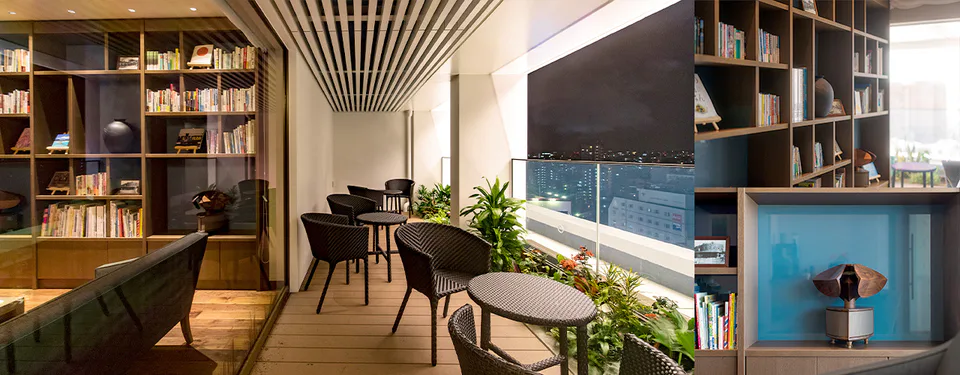
The 13th-floor Library Lounge & Terrace is another facility whose value rises with stay length. Current hotel information lists guest access from 07:00 to 24:00, books around Okinawa/Kyushu/travel/design and complimentary coffee. I treat it as a second hotel space for people staying in a 23–26m² base room, not as a sightseeing attraction that deserves its own schedule.
If you leave at 08:00 and return close to midnight every day, the lounge does not become valuable just because it exists. If you come back in the afternoon to drop shopping, wait for laundry or want somewhere to sit after dinner without immediately going back to the room, it is usable. That is different from Premium Twin’s view bath: the lounge is a shared benefit potentially available to every guest, while the view bath belongs to a scarce high-category room.
A realistic three-night rhythm: when do these facilities actually work?
Imagine returning to Naha around 18:30. Drop shopping in the room, walk back toward Kokusai-dori for dinner at 19:00, return around 21:00 and check laundry status from the TV. If you need a wash, start it; while waiting, sit in the 13F lounge, then shower and organise the next day. This is not a claim of personal stay experience—it is an itinerary model using the verified location and facility hours to test whether the hotel’s multi-night features fit together.
In that model, the one-minute Kokusai-dori access pays back when you go out again at night, 24-hour laundry pays back after you return, and the separate wash/bath layout reduces room-use friction. If all three fit your behaviour, a three-night stay exposes more of the hotel’s value than a one-night sleep. If every day is a long northern-Okinawa drive and the room is only for sleeping, those features become unused cost.
Self-driving: there is parking, but Kokusai-dori is not an ordinary road
Current hotel information lists 102 mechanical spaces: 72 standard and 30 high-roof. The current guest rate is JPY1,500 from 15:00 to 12:00 the next day, then JPY300 per additional 60 minutes. High-roof spaces are limited and the car park can fill. There are no parking staff on duty from 23:00 to 06:00, so the front desk needs to assist during that period.
More important, Kokusai-dori has weekday bus-lane restrictions around 07:30–09:00 and 17:30–19:00 on specified directions, while the Sunday Transit Mall generally closes Kokusai-dori to ordinary vehicles from 12:00–18:00. This does not make the hotel incompatible with driving. It means “has parking” and “can drive in exactly the same way at any hour” are different statements. My preference is to use this hotel on no-car days, before car pickup or after car return.
If driving dominates the trip, use the Okinawa 5-day self-drive itinerary to place the rental days, then consider whether the final night is better served by Tokyu Stay Okinawa Naha if in-room laundry/repacking and airport departure matter more than Kokusai-dori evenings.
Breakfast: decide from tomorrow’s departure time first
Breakfast is currently served at BARBARESCO 37 from 06:30, with last entry at 09:30 and closing at 10:00; food/drink service is listed through 09:45. Current guest pricing in the source is JPY2,640 for adults, JPY1,760 for children and free for children under seven, with roughly 60 dishes built around Okinawa and Kyushu ingredients. Prices and supply can change, so treat those as a current planning baseline.
For a normal Naha city morning, 06:30 is easy to use. For a very early flight, early marine-activity pickup or an early rental-car departure north, do not buy breakfast just because the buffet is large. Match the same room, guest count, breakfast and cancellation terms before comparing platform prices.
What are you giving up by staying here?
First, station-front feel. Five minutes from Miebashi is short, but it is not exit-to-lobby. Second, driving freedom. The mechanical car park is substantial, but road-time restrictions around Kokusai-dori still exist. Third, resort time. The lounge, laundry and central location are city-base facilities; they do not replace a beach, large pool complex or an afternoon spent inside an Onna resort.
What you get back is a different kind of efficiency: Kokusai-dori almost immediately outside, 24-hour laundry after you return, separate bath/wash areas and a lounge open until midnight. A four-person family also gets a clear one-room product, provided the bedding works. These features align with the hours multi-night city travellers actually use the hotel.
If you discover that the trip really needs resort time instead, compare the contrast with Ala Mahaina Condo Hotel in Motobu or Hotel Monterey Okinawa Spa & Resort in Onna. Those properties ask you to preserve hotel/resort time; JR Blossom asks you to preserve access to Naha city.
Compare the same room and cancellation terms on three platforms
Fix the same dates, exact room category, guest count, bedding, breakfast, taxes and cancellation deadline before comparing Booking.com, Trip.com and Agoda. Family Room requires every guest and child age to be entered; Premium Twin only makes sense when the view bath is genuinely part of the purchase. Do not compare the first headline rate for different products and call the cheapest platform the winner.
Verify JR Kyushu Hotel Blossom Naha rooms for your dates
Final verdict: would I book JR Kyushu Hotel Blossom Naha?
↔ Scroll table left or right
Decision | Core condition |
Book | Two people, 2–3 Naha nights, no car or partial rental, evenings on Kokusai-dori, real use of 24-hour laundry/lounge |
Compare again | Daily city-centre driving, or four adults sharing Family Room; calculate road friction and verify bedding first |
Skip | Hard requirement is a 1–2 minute station walk, or the trip is built around beach-resort time rather than a Naha city base |
My final positioning is simple: JR Kyushu Hotel Blossom Naha does not win by being the closest hotel to Yui Rail. It wins by making Kokusai-dori evenings and a multi-night city routine unusually easy. For two people staying two or three nights without a car every day, I would start with Superior Twin. For three to four people, I would inspect Family Room bedding before anything else. For daily self-drive, station-exit purists or travellers who want a beach resort, I would rank it lower.
JR Kyushu Hotel Blossom Naha FAQ
How do I get from Naha Airport to JR Kyushu Hotel Blossom Naha?
Take Yui Rail to Miebashi Station, which the hotel lists at roughly 14 minutes from the airport, then walk about five minutes. Makishi Station is another option at roughly 16 minutes by rail plus an eight-minute walk. The hotel estimates a taxi at around 15 minutes, but road traffic can change the real journey.
Does JR Kyushu Hotel Blossom Naha have coin laundry?
Yes. The 11th-floor coin laundry is listed as open 24 hours, and machine operating/estimated finish status can be checked through the in-room VOD. That is particularly useful for multi-night, family or summer trips.
How do four people sleep in the Family Room?
The Family Room is 33m² for three to four guests and uses two 120cm standard beds, a bunk bed and a sofa bed. Enter the full guest list and child ages and confirm the actual bedding sold on your date rather than relying only on “sleeps four.”
How does parking work for self-drive travellers?
The hotel has 102 mechanical spaces and currently charges staying guests JPY1,500 per night. High-roof spaces are limited. Also account for weekday Kokusai-dori bus-lane restrictions and the Sunday Transit Mall period when planning access.
Is Premium Twin worth upgrading to?
Not automatically. Premium Twin is 34m², only four rooms, on floors 11–12, and its defining feature is the full-glass view bath. Superior Twin at 26m² already handles the main two-person multi-night job; Premium makes more sense when the bathroom/view experience is specifically worth paying for.
What time does breakfast start?
Breakfast currently starts at 06:30, with last entry at 09:30 and closing at 10:00. It works for many city mornings, but early flights or activity pickups should be timed first before choosing a breakfast-included rate.
Tokyu Stay Fukuoka Tenjin: Is an In-Room Washer-Dryer Worth Leaving Hakata Station?
HOTEL FORZA Hakata Station Chikushi-Guchi I Review: 1-Minute Access and 18m² Rooms
Hotel Sosei Sapporo Review: Is a 39 m² Twin-Queen Room Worth a 15-Minute Walk from Sapporo Station?
Hotel Metropolitan Tokyo Marunouchi: Is Tokyo Station Access Worth It Before an Early Shinkansen?
Lotte Hotel Busan vs Arban Hotel: Is the Five-Star Premium Worth It in Seomyeon?
Sources
JR Kyushu Hotel Blossom Naha official website
Official facilities information
Official access and parking information
Booking.com | JR Kyushu Hotel Blossom Naha
Trip.com | JR Kyushu Hotel Blossom Naha
Agoda | JR Kyushu Hotel Blossom Naha
Room types, rates, availability and cancellation terms can change by date. This article may contain affiliate links; ValueNavi may earn a commission from qualifying bookings at no additional cost to you.