Miyako Hotel Hakata is worth the premium when you will repeatedly use at least two or three of its expensive advantages: the direct subway connection, 30–31 m² baseline rooms, Spa Lucida and a 12:00 checkout. If the stay is mostly “sleep beside Hakata Station and leave again,” JR KYUSHU HOTEL Blossom Hakata Chuo is usually the more rational product. Blossom is only about two minutes on foot from Hakata Exit, its 25 m² Superior Twin already handles two-person luggage well, check-in starts an hour earlier, breakfast starts 30 minutes earlier, and coin laundry is available 24 hours.
The useful question is therefore not whether Miyako is “better.” It is whether enough of its premium features stack on the same trip. Paying more for direct access while never using the spa, spending all day outside the room and leaving before noon is very different from arriving in heavy rain, making several Shinkansen trips, using the spa twice and enjoying the larger room for four nights.
↔ Scroll table left or right
Your actual stay | Start with | Why | What can reverse it |
Late arrival, rain, large luggage, repeated Hakata Station use | Miyako | East Exit 7 connects directly to the hotel B1 entrance, removing the final outdoor segment | You only use Hakata Station once or twice and Blossom is materially cheaper |
One transit night before an early train | Blossom | Two-minute station walk, 14:00 check-in and 06:30 breakfast do the practical jobs without buying a resort-style stay | Heavy rain, mobility constraints or an unusually small rate gap make Miyako's indoor continuity valuable |
Three or four nights with room time and spa use | Miyako | The 30–31 m² room, spa and 12:00 checkout can all repeat or be used more than once | Most days run from early morning to late night and the hotel is only a bed |
Long Kyushu trip with laundry and early starts | Blossom | 24-hour coin laundry and 06:30 breakfast solve functional travel problems | Luggage volume or recovery time makes the larger Miyako room more important |
Family returning after 19:00 | Recalculate Miyako's spa value | The outdoor Spa Lucida becomes 18+ from 19:00 | Adults use the spa separately, the family returns earlier, or the indoor bath still provides the value you want |
Use a premium-stacking test before paying for Miyako
Miyako's premium is easiest to defend when several advantages overlap. I would count five:
Indoor arrival value: direct connection from Hakata subway East Exit 7 matters in rain, with large luggage or after a long travel day.
Room-space value: the Superior Twin is 30–31 m² rather than Blossom's 25 m² Superior Twin.
Spa value: you will genuinely use Spa Lucida rather than treating it as an attractive facility photo.
Late-checkout value: Miyako checks out at 12:00 rather than Blossom's 11:00.
Repeated-station value: several days begin or end through Hakata Station, making the final station-to-room route repeat.
If Miyako wins only one of those five, I would usually take the cheaper acceptable Blossom room. If it wins three or four, the rate gap is buying a different stay rather than a slightly nicer version of the same bed.
This framework is deliberately rate-independent. Hotel prices change by date; the number of premium features you will actually use is much more stable.
The station difference is weather protection, not “one minute vs two minutes”
Miyako's official access route is unusually specific. From the subway side, East Exit 7 connects directly to the hotel's B1 entrance. From the JR/Shinkansen Chikushi Exit, the hotel describes the walk as about one minute. Blossom Hakata Chuo is on the opposite, Hakata Exit side and officially describes itself as about two minutes on foot from Hakata Station.
Those numbers are too small to justify a large premium on their own. A traveller arriving at 14:00 with one cabin bag will barely care. The difference becomes more valuable when the final segment is repeated in rain, when two large cases are being rolled across the station frontage, or when a late arrival has already consumed most of the group's energy.
Neither hotel removes all station walking. A Shinkansen platform, a JR gate and a subway concourse are not the hotel lobby. Miyako removes the outdoor final link more completely; it does not teleport you from every platform to the room.
If Hakata itself is not yet the correct base, stop here and decide Hakata vs Tenjin first. Paying for perfect Hakata Station access is a weak decision if most nights actually end in Tenjin.
The room premium is roughly 20–24% more published floor area, not just “a bigger room”
For two adults, the clean comparison is Miyako Superior Twin at 30–31 m² against Blossom Hakata Chuo Superior Twin at 25 m². On published area, Miyako gives about 5–6 m² more, or roughly 20–24% more floor area.
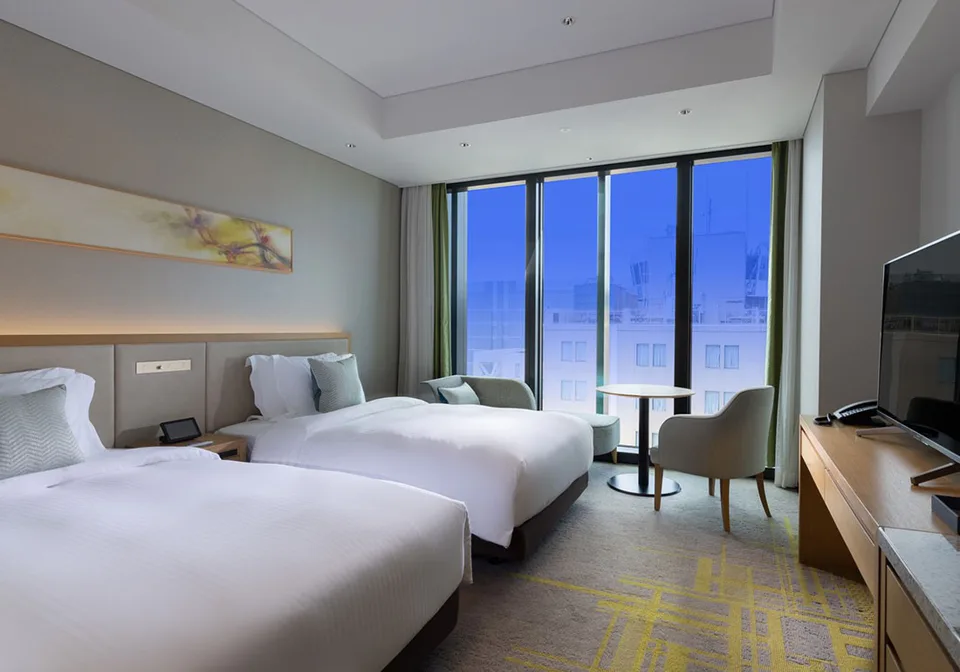
That is meaningful when the room has to absorb two large suitcases, shopping bags and several nights of clothing. It is less meaningful when you check in late, sleep once and leave before breakfast.
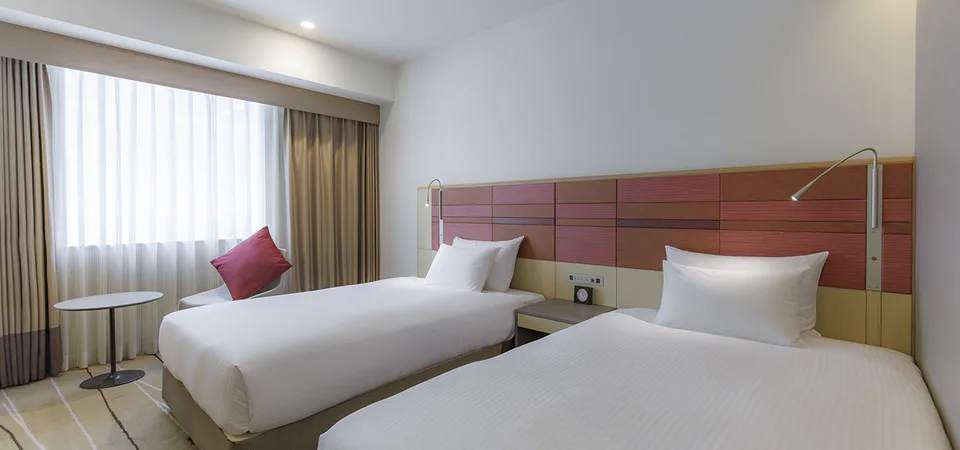
Blossom's 25 m² Superior Twin is not a cramped fallback. The hotel explicitly describes it as having enough space to spread luggage, with two 120 cm beds. It also offers a 29 m² Deluxe Twin for up to three guests. This creates an important escape route: if Miyako's cheapest acceptable room is much more expensive, compare Blossom's larger room before assuming you must change hotel brands to gain floor space.
Spa Lucida only counts if your schedule and group can use it
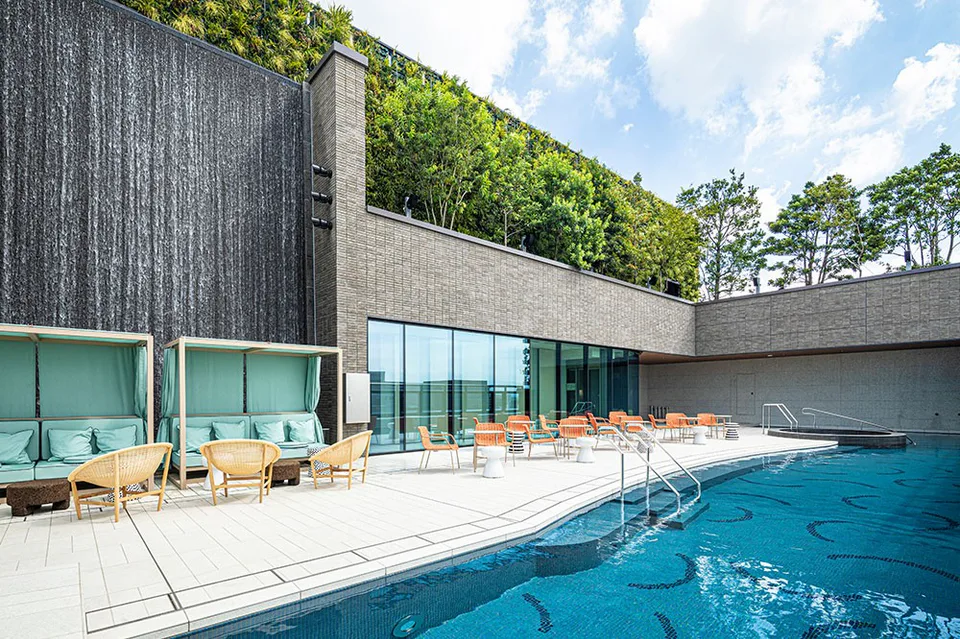
Miyako's strongest non-location feature is Spa Lucida. The official current hours are 06:30–12:00 and 14:00–23:00 for the outdoor spa, and 06:30–12:00 and 14:00–24:00 for the indoor bath. The outdoor spa changes to an adults-only 18+ period from 19:00.
That last rule matters more than a generic “family-friendly spa” label. If a family returns from sightseeing at 20:30 with teenagers or younger children, the outdoor spa cannot function as the whole-family evening activity you may have imagined. Adults can still value it, and the indoor bath has a later window, but the premium needs to be recalculated around who will actually use which facility.
For two adults returning to the hotel by 21:00, Miyako can create two useful spa sessions: evening and next morning. For a couple who stays out until midnight every night, Spa Lucida is mostly a facility they paid to walk past.
ValueNavi rule: count planned spa sessions, not spa existence. If the answer is zero, remove Spa Lucida from the price justification.
Blossom's operational advantages are easier to use on a moving Kyushu trip
Blossom Hakata Chuo is less resort-like, but several of its advantages survive even when you barely spend leisure time in the hotel. Check-in starts at 14:00, one hour before Miyako's 15:00. Coin laundries operate 24 hours on the 5th, 11th and 12th floors. Those are small features, but they solve real problems on a multi-city route.
The earlier check-in can matter on an arrival day when you want to unload two cases before a Fukuoka evening. The laundry matters after several nights in Tokyo, Kyoto or Kyushu when you need clean clothes more than another hotel amenity.
Miyako reverses the timing advantage at the other end of the stay: checkout is 12:00 versus Blossom's 11:00. If your train leaves after lunch or you had a late previous night, that extra hour can have more value than Blossom's earlier arrival access.
This is why “which hotel has better hours?” is the wrong question. Blossom owns the arrival edge; Miyako owns the departure edge.
Breakfast is one of the clearest places where Blossom wins on function
Blossom Hakata Chuo currently serves breakfast from 06:30 to 10:00, last entry 09:30, at JPY 2,200 for hotel guests. Miyako's current breakfast buffet runs 07:00 to 10:30, last entry 10:00, at JPY 3,500 per adult.
For a relaxed city morning, Miyako's later breakfast and longer checkout can be a pleasant combination. For an early Shinkansen, Yufuin transfer or other rail-heavy morning, Blossom's 30-minute earlier start is more operationally useful and costs less.
Do not overvalue either buffet if the train is genuinely early. If breakfast forces you to eat quickly, return to the room, collect luggage and rush to the platform, choose a room-only rate and solve breakfast at or near the station. The Fukuoka breakfast guide gives alternative options.
One night, two nights and four nights should not produce the same winner
One transit night: Blossom usually has the stronger burden of proof. A two-minute walk, earlier check-in and early breakfast already solve the basic Hakata-station job. Miyako needs rain, heavy luggage, a small rate gap or actual spa use to justify paying more.
Two nights: compare the number of Hakata Station movements and whether you will spend an evening or morning at the hotel. Miyako becomes more persuasive if the station connection and spa are each used more than once.
Three to four nights: room space starts to compound. Five or six extra square metres can matter when two suitcases remain open, shopping accumulates and the hotel is no longer only a sleep stop. But Blossom's 24-hour laundry also becomes more valuable on exactly this longer stay.
The longer the stay, the correct question becomes less “which hotel is nicer?” and more “which feature repeats?” Repeated room-space value favours Miyako; repeated laundry/early-departure value favours Blossom.
Count Hakata Station crossings before paying for direct access
A direct station connection becomes more valuable when Hakata Station repeatedly appears in the itinerary. Examples include Shinkansen days, JR day trips, airport movements and an onward route to Yufuin or Beppu.
If the stay is three nights but the only Hakata Station use is arrival and departure, Miyako's location premium is being used twice. If the itinerary passes through Hakata Station six or eight times, the same physical advantage repeats much more often.
This does not mean every station-heavy itinerary should book Miyako. Blossom is also extremely close. The point is that direct access should be priced against frequency, not against a hotel-map screenshot.
Use the Fukuoka transport guide and Fukuoka to Yufuin transport guide to see whether Hakata really is the repeated node in the trip.
When the Miyako premium is probably not worth it
You are staying only one night and will not use Spa Lucida.
You have one small bag and good weather, so Blossom's two-minute outdoor walk is trivial.
You leave before 07:30 and breakfast/spa/late checkout all become irrelevant.
Every evening is in Tenjin or Nakasu and the hotel is only where you sleep.
The rate gap is large enough that Blossom's 29 m² Deluxe Twin still costs less than Miyako's 30–31 m² Superior Twin.
In those cases, Miyako may still be the more luxurious hotel, but luxury and trip value are not the same decision.
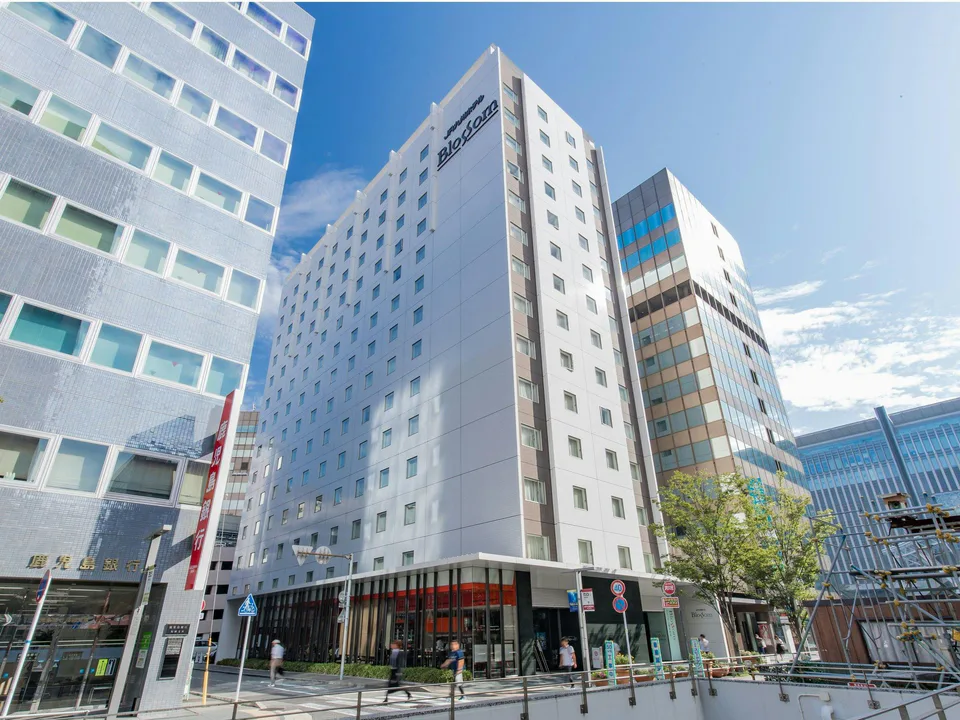
When Blossom becomes a false economy
Blossom can lose when its cheaper rate makes you ignore several small frictions that all occur on the same trip. Heavy rain, two large suitcases, repeated station crossings and a four-night stay can make the Miyako room and indoor continuity worth more than the headline price difference.
The answer can also reverse when late checkout has a specific job. If a midday train means you can use Miyako's room until 12:00 instead of checking out at 11:00 and storing luggage immediately, the extra hour is real usable hotel time rather than a decorative policy difference.
The comparison should therefore be made on the same room standard and same useful hours, not the cheapest displayed rate on each booking page.
Compare the exact room, then apply the premium-stacking test
For two adults with luggage, start with Miyako Superior Twin (30–31 m²) and Blossom Superior Twin (25 m²). If Blossom's Deluxe Twin at 29 m² is available at a modest upgrade, add it to the comparison. Hold breakfast, taxes, occupancy and cancellation flexibility constant.
Then ask:
Will direct indoor access materially help more than once?
Will the extra 5–6 m² be used for multiple nights or large luggage?
Will anyone use Spa Lucida at least once or twice?
Does 12:00 checkout solve a real departure-day problem?
Would Blossom's 14:00 check-in, 06:30 breakfast or 24-hour laundry solve more practical problems instead?
If Miyako wins at least two or three of the first four, the premium has a strong case. If most answers are no and Blossom wins the fifth, book Blossom and spend the difference somewhere the trip will actually use.
Compare Hakata Station hotel rates for your dates
Final verdict
Miyako Hotel Hakata is the better hotel when its premium features stack: repeated Hakata Station use, heavy luggage or rain, several nights in a 30–31 m² room, actual Spa Lucida sessions and useful 12:00 checkout time. JR KYUSHU HOTEL Blossom Hakata Chuo is the better-value default when a two-minute walk is already easy enough and the stay is driven by early trains, 24-hour laundry, earlier check-in or simply a lower rate.
The most important red-team condition is price. There is no universal percentage at which Miyako becomes “worth it.” If the rate gap is small and you will use three premium features, Miyako can be easy to justify. If the gap is large and the room is only a place to sleep, Blossom can win even on a rainy trip.