
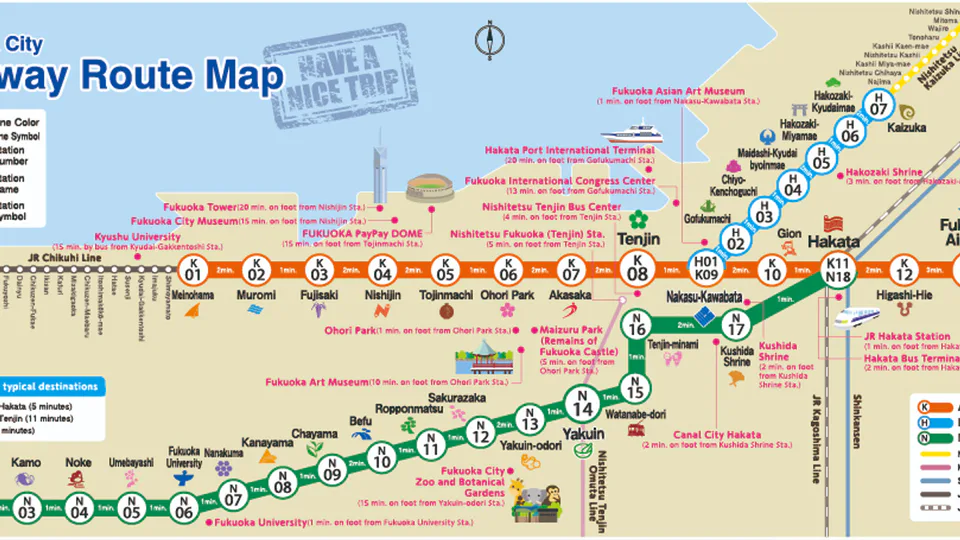
Most visitors do not need to buy a Fukuoka transport pass in advance. If an adult’s day stays inside the Fukuoka City Subway network, the easiest default is usually to tap the same eligible contactless bank card or device for every ride: the subway currently caps that day’s contactless subway charges at JPY 640, the same price as the adult 1-Day Pass. Buy a pass deliberately only when it solves a different problem — a family fare, attraction discounts, heavy Nishitetsu use, or a genuinely multi-operator sightseeing day.
The useful order is operator first → number of rides second → pass last. Fukuoka City Subway, JR Kyushu, Nishitetsu trains and Nishitetsu buses are separate systems. A through train, a convenient IC card and a city name can make them feel like one network, but the fare products do not merge just because the journey looks continuous on Google Maps.
Fukuoka transport pass: the 30-second decision
↔ Scroll table left or right
Your actual day | Start with | Why | Main catch |
Adult, subway-only city sightseeing | Contactless pay-as-you-go | Current daily subway cap is JPY 640, the same as the adult 1-Day Pass | Use the same card number and same physical/device medium all day |
Adult wants subway-pass attraction discounts | Subway 1-Day Pass | Same JPY 640 ceiling, but the physical/digital pass can unlock listed facility benefits | It still covers only Fukuoka City Subway |
Two adults travelling with children on a subway-heavy day | Check Fami Chika Ticket first | Current family price is JPY 1,000 for up to two adults plus unlimited eligible children/infants in the same family group | Eligibility and purchase method are specific; it is not a generic group ticket |
Dazaifu only | Nishitetsu normal fare or Dazaifu sightseeing ticket | A large multi-operator pass usually buys coverage you will not use | Do not confuse Nishitetsu Fukuoka (Tenjin) Station with JR Hakata Station |
Dazaifu + Yanagawa + several Nishitetsu bus/train rides | Recalculate FUKUOKA 1DAY PASS | The current pass covers a wide Nishitetsu train-and-local-bus area | Current Nishitetsu price is JPY 2,980; it does not cover JR or Fukuoka City Subway |
Itoshima / Chikuzen-Maebaru | Transport IC card or through ticket | The train can run through from the subway onto JR Chikuhi Line | Subway contactless payment cannot be used through onto JR Chikuhi Line |
Heavy same-day JR + subway + buses + ferry use | Check FUKUOKA TOURIST CITY PASS | It is a genuine multi-operator product | High price, tourist eligibility rules and route exclusions mean it is not a default city pass |
For most adults, the subway contactless cap removes the need to predict your day
Fukuoka City Subway’s current adult 1-Day Pass costs JPY 640. The subway’s contactless-payment system also caps eligible subway rides at JPY 640 per service day, defined as 03:00 to 03:00 the following day. That changes the usual “should I buy a metro pass?” calculation.
If your eligible contactless card works, you do not need to know at breakfast whether you will take three rides or six. Tap the same card or the same phone/watch on every subway entry and exit. If your total stays below JPY 640, you pay the lower amount. If it goes above JPY 640, the subway applies the cap.
This creates a simple ValueNavi default:
Two short JPY 210 rides: pay JPY 420. A pass would lose money.
Three JPY 210 rides: JPY 630. You still have not reached the pass price.
Four JPY 210 rides: the raw total would be JPY 840, so the JPY 640 cap becomes useful automatically.
Three JPY 260 rides: raw total JPY 780; the same automatic cap protects you.
The exact fares vary by distance, but the principle survives: an adult does not need to forecast the break-even point if contactless capping is available and the whole day remains inside the subway network.
The main operational rule is consistency. The subway says the cap is calculated only when the same card number and the same medium are used. A physical credit card and that same card loaded into a phone can be treated separately. Changing device midway through the day can therefore destroy the cap calculation you expected.
When the JPY 640 Subway 1-Day Pass is still better than simply tapping
The 1-Day Pass is not obsolete. It can be the better product when one of three things is true.
First, your card is not eligible for contactless transit. A transport IC card such as Hayakaken, Suica or another compatible Japanese IC card is convenient, but the ordinary IC-card fare is not the same product as the bank-card contactless daily cap.
Second, you want the pass benefits at participating facilities. Fukuoka City Subway currently lists discounts at selected museums and attractions for 1-Day Pass and family-ticket users. If one of those discounts is already in your itinerary, the pass can beat an otherwise identical JPY 640 contactless day.
Third, you prefer a fixed child/family product. Family pricing is where buying a ticket in advance can save far more than the adult cap.
Families should not copy the adult calculation: the JPY 1,000 Fami Chika Ticket can dominate
The original “one adult = one JPY 640 pass” logic breaks quickly for families. Fukuoka City Subway currently sells the Fami Chika Ticket for JPY 1,000 per eligible family group. It is for families travelling with at least one child or infant; up to two adults may travel, and the number of eligible children/infants is not capped. The family members must travel on the same itinerary, and the official rule defines family within the stated relationship rules.
Consider two adults plus two elementary-school children on a subway-heavy day. Four individual day tickets would be:
JPY 640 × 2 adults + JPY 320 × 2 children = JPY 1,920.
The Fami Chika Ticket is JPY 1,000. That is a JPY 920 difference before any attraction benefits. This is exactly the kind of decision ordinary “best Fukuoka pass” lists miss because they compare products per person rather than per travelling party.
There are two other family products worth checking. The Family Pair Ticket is currently JPY 800 for one adult plus one elementary-school child. During eligible weekends, holidays and school-holiday periods, the subway also sells a JPY 100 elementary-school pass; on those dates the official site itself notes that one adult JPY 640 pass + one JPY 100 child pass can be cheaper than the JPY 800 pair ticket.
The practical hierarchy is therefore:
One adult + one school-age child: compare Family Pair versus adult day ticket + any JPY 100 child promotion.
Two adults + one or more children: check Fami Chika before buying separate tickets.
Mixed route using JR/Nishitetsu too: remember that these family subway tickets stop at the subway boundary.
Fami Chika’s current official purchase information uses the my route digital-ticket system, so do not discover the product at the gate and assume every purchase channel is identical.
Fukuoka Airport arrival: the terminal can matter more than the pass
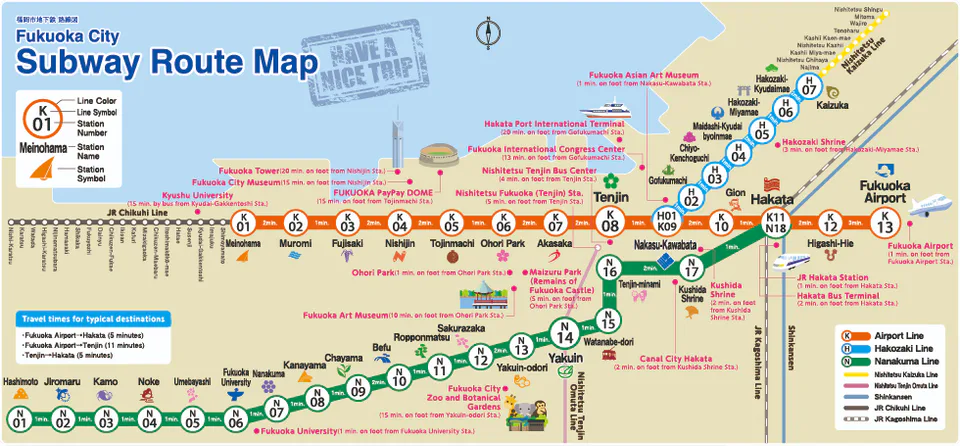
Fukuoka Airport Domestic Terminal is directly connected to Fukuoka Airport Subway Station. The International Terminal is not. The airport currently tells international-terminal passengers to use the free inter-terminal shuttle; the published journey is about ten minutes, before waiting and walking.
That means an international arrival should not compare “Airport → Hakata subway fare” as though the station were underneath the arrival hall. With large luggage, the real chain is immigration → baggage → shuttle stop → wait → roughly ten-minute terminal bus → subway → hotel.
This does not make a subway pass more valuable. In fact, a late arrival usually makes it less valuable because there are fewer rides left in the day. If the only journeys are Airport → Hakata and perhaps Hakata → Tenjin, pay as you go. Buying a day pass to “start saving immediately” is a false objective when the travel day is nearly over.
The International Terminal also has direct bus services to Hakata, Tenjin, Dazaifu and several Kyushu destinations. If the next journey is Yufuin or Beppu, use the Fukuoka–Yufuin transport comparison rather than forcing the subway into a regional trip it does not simplify.
Dazaifu: do not buy a whole-city pass to solve one Nishitetsu day trip
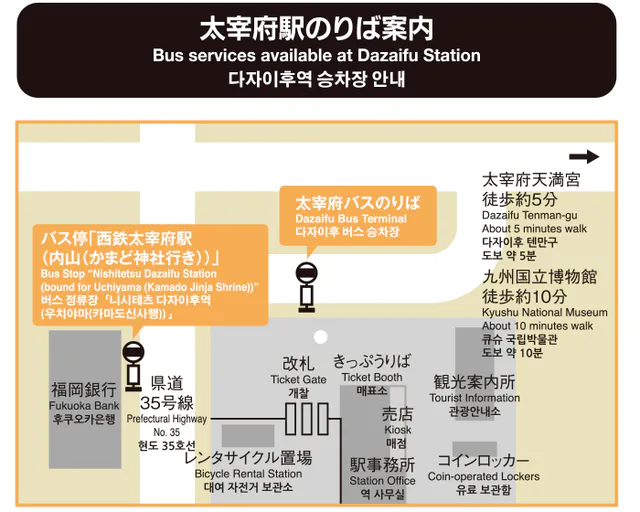
Dazaifu belongs mainly to the Nishitetsu decision, not the Fukuoka City Subway decision. From central Fukuoka, the natural rail departure is Nishitetsu Fukuoka (Tenjin) Station or Yakuin, with a connection onto the Dazaifu Line. If Dazaifu is the only major out-of-city destination that day, start by pricing a normal Nishitetsu return or the current Dazaifu Sightseeing Ticket.
Nishitetsu currently lists the Dazaifu Sightseeing Ticket at JPY 1,000 and bundles the return train journey from Nishitetsu Fukuoka (Tenjin) or Yakuin with a voucher for three Umegae Mochi plus selected benefits. The point is not that every visitor must buy it; it is that a destination-specific ticket can match the actual trip much better than an all-network pass.
The FUKUOKA TOURIST CITY PASS has a Dazaifu version at JPY 2,800, but that price only becomes defensible when the rest of the same day also uses enough of its city-wide bus, rail, subway and ferry coverage. It explicitly does not cover the Dazaifu Liner Bus “Tabito.” A traveller doing hotel → Dazaifu → Tenjin dinner should not pay for an entire multi-operator city merely because “Dazaifu” appears in the product name.
The Nishitetsu FUKUOKA 1DAY PASS only makes sense when Nishitetsu keeps repeating
Nishitetsu’s current FUKUOKA 1DAY PASS costs JPY 2,980 for adults and JPY 1,490 for children. It covers Nishitetsu trains from Fukuoka (Tenjin) to Yanagawa plus the Dazaifu and Amagi lines, together with a wide area of Nishitetsu local buses.
This is not a “Fukuoka everything pass.” It excludes the Fukuoka City Subway and JR. Its value therefore depends on whether Nishitetsu itself repeats throughout the day.
I would not buy it for Dazaifu alone. I would recalculate it for a day such as Dazaifu + Yanagawa + additional Nishitetsu local buses, where multiple long Nishitetsu segments finally make the network coverage useful.
There is also a 2026 freshness trap. Nishitetsu changed railway fares on April 1, 2026. Its current first-party FUKUOKA 1DAY PASS page lists JPY 2,980, while some older tourism brochures and cached pages still show JPY 2,800. For travel after the fare revision, use the operator’s live product page rather than an old screenshot.
Itoshima is where the “one train, one fare system” assumption fails
Trains on the Fukuoka Airport Subway Line can run through Meinohama onto JR Kyushu’s Chikuhi Line toward Itoshima. Operationally, staying on the same train can feel like one system. Fare products do not work that way.
Fukuoka City Subway’s contactless bank-card system currently cannot be used through onto the JR Chikuhi Line. The subway explicitly tells passengers travelling to JR Chikuhi Line stations to use a ticket or transport IC card instead. The JPY 640 subway contactless cap also does not magically cap the JR section.
This makes an IC card unusually valuable for an Itoshima day. It preserves the through-ride convenience without forcing you to split the trip around the subway contactless boundary. A subway day ticket can still make sense if you have several additional subway rides before or after Itoshima, but do not buy it because the train happens to originate in the subway.
If the real decision is whether Itoshima deserves the day at all, compare Dazaifu vs Itoshima before optimising the fare.
The FUKUOKA TOURIST CITY PASS is a specialist multi-operator tool, not the default tourist answer
The current official Fukuoka tourism site lists the FUKUOKA TOURIST CITY PASS at JPY 2,500 for the Fukuoka City version and JPY 2,800 for the Fukuoka City + Dazaifu version. It is for eligible short-stay overseas visitors and can cover a combination of buses, trains, subways and ferries within its defined area.
That breadth sounds attractive, but broad coverage is only valuable when the itinerary actually uses it. A normal day built around Hakata, Tenjin, Ohori Park and one dinner is far more cheaply handled by the subway cap or ordinary fares. The Tourist City Pass starts to make sense when the day deliberately mixes several operators — for example, subway + JR or Showa Bus + Nishitetsu bus + ferry — and the raw fares approach the pass price.
There is also purchase friction that matters to international English-speaking travellers. The current official guide says paper purchase requires passport verification at listed counters, while its digital app is only available to visitors from South Korea, Taiwan and Thailand because of the app’s stated privacy restrictions. A traveller from the US, UK, Canada or Australia should therefore not build the morning around “I’ll just buy it in the app” without checking the current purchase channel.
In other words, the wider the pass, the stronger the burden of proof. If you cannot name the JR, bus, ferry and/or Dazaifu journeys that make up most of the JPY 2,500–2,800 value, do not buy it merely because it says “Tourist City Pass.”
Hakata versus Tenjin changes which operator you naturally use
The hotel base can change the transport product without changing the sightseeing list.
Stay near Hakata: the subway and JR become natural. Airport arrivals are simple from the Domestic Terminal; regional trains leave from Hakata; an Itoshima through ride can also begin here with the correct ticket/IC setup.
Stay near Tenjin: Nishitetsu becomes much more natural for Dazaifu and Yanagawa, while subway access still handles the airport, Hakata and central city. A Dazaifu-heavy trip based in Tenjin therefore has less reason to buy a broad multi-operator pass than the same sightseeing list might suggest from a different hotel.
If the base itself is undecided, fix it first with Hakata vs Tenjin. Do not choose a hotel because you already bought a pass; choose the pass after the hotel and itinerary reveal which operator repeats.
Six real trip patterns and what I would buy
1. Airport → Hakata → Tenjin dinner
No pass. Pay as you go. A nearly finished arrival day rarely contains enough subway movement to justify pre-buying anything.
2. Hakata → Ohori Park → Tenjin → Kushida Shrine → Hakata
Adult: use the same eligible contactless card all day. If the raw subway fares exceed JPY 640, the cap solves it automatically. Buy the 1-Day Pass instead only if its attraction benefits matter or contactless is not practical.
3. Two adults + two children doing a subway-heavy family day
Check Fami Chika first. At current prices, JPY 1,000 can beat JPY 1,920 for four separate adult/child 1-Day Passes by JPY 920.
4. Dazaifu and back, then dinner in Tenjin
Use a Nishitetsu destination-specific or ordinary ticket. Do not buy a JPY 2,800–2,980 network pass simply to solve one out-and-back.
5. Dazaifu + Yanagawa + Nishitetsu buses in one long day
Recalculate the JPY 2,980 FUKUOKA 1DAY PASS. This is the type of itinerary where Nishitetsu itself repeats enough for unlimited coverage to have a job.
6. Itoshima from Hakata or the airport side
Use a transport IC card or correct through ticket. Do not start a through JR Chikuhi Line journey with Fukuoka Subway contactless payment, because the subway’s contactless system does not extend into the JR section.
Where the recommendation breaks
The “do not buy a pass in advance” default stops being valid when a special product clearly changes the party total or your day deliberately uses multiple expensive segments. Families are the obvious example: the JPY 1,000 Fami Chika Ticket can make advance planning worthwhile. A Dazaifu + Yanagawa Nishitetsu day can justify the FUKUOKA 1DAY PASS. A complex foreign-visitor city day can justify the Tourist City Pass.
The opposite red-team test matters too. If a pass changes your sightseeing order because you feel compelled to “get your money’s worth,” the fare optimisation has started controlling the holiday. Fukuoka’s central fares are low enough that paying a few hundred yen more can be rational if it removes a detour, an unnecessary bus connection or a rushed attraction.
Final verdict: buy the smallest fare product that matches the operator you actually repeat
For an adult subway day, my default is contactless pay-as-you-go with the JPY 640 automatic cap. For a family, check Fami Chika and the family/child products before buying individual passes. For Dazaifu or Yanagawa, move into the Nishitetsu fare world and choose a destination-specific ticket or the JPY 2,980 FUKUOKA 1DAY PASS only when the itinerary genuinely uses enough Nishitetsu. For Itoshima, use a ticket or transport IC card that survives the subway-to-JR boundary.
The FUKUOKA TOURIST CITY PASS is the exception for a genuinely multi-operator day, not the starting point for every visitor. The best Fukuoka pass is often no pass at all — because the city now lets the correct payment method absorb the uncertainty for you.
References and verification date
Fukuoka City Subway — 1-Day Pass · Fukuoka City Subway — contactless payment and daily cap · Fukuoka City Subway — Fami Chika Ticket · Nishitetsu — FUKUOKA 1DAY PASS · Nishitetsu — Dazaifu and other discount tickets · Fukuoka City Official Tourist Guide — FUKUOKA TOURIST CITY PASS · Fukuoka Airport — International/Domestic terminal shuttle. Checked August 25, 2026. Fares, pass prices, eligibility, app availability and operator rules can change; recheck the exact travel date.
Sanrio Puroland Tickets 2026: Save on the 2 PM Pass Only If You Know What You’ll Skip
Kochi Yosakoi Festival 2026: Which Day, Which Venue and Do You Need Paid Seats?
Fukuoka Self-Drive Hotels: Choose Your Car Days Before You Choose Hakata, Tenjin or Uminonakamichi
Solaria Nishitetsu Hotel Fukuoka vs CROOM Hakata Gion: Better for 4 Adults?
Mitsui Garden Hotel Fukuoka Gion vs Solaria Nishitetsu Hotel Fukuoka: Best for 3 Adults?