
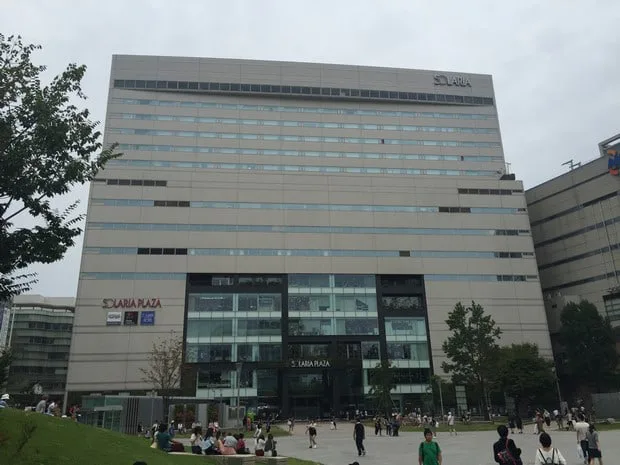
For three adults, I would choose Mitsui Garden Hotel Fukuoka Gion for a short Hakata-led stay and Solaria Nishitetsu Hotel Fukuoka for a longer Tenjin-led stay with large luggage. Both give the group three proper beds, so the decision is not “which hotel can sleep three?” It is whether you want a 26.6 m² room that keeps Hakata/Gion and a guest public bath in the same package, or a 41.8 m² triple that gives each traveller much more room to live with luggage in Tenjin.
The important number is not simply 15.2 m² more. Divided across three people, Solaria provides about 5.1 m² more gross room area per person than Mitsui. That is not the same as 5.1 m² of empty floor, because walls, furniture and bathroom layout consume part of the figure, but it explains why the gap becomes more valuable after several nights.
If you have not decided between Hakata and Tenjin, read Hakata vs Tenjin first. If the group is still debating one triple versus two rooms, start with Fukuoka Hotels for 3 or 4 Adults.
The 30-second decision
↔ Scroll table left or right
Your trip | Choose | Why | What you give up |
1–2 nights, early JR/Shinkansen departure | Mitsui Garden Fukuoka Gion | 7-minute official walk from Hakata Station; 5 minutes from Gion | 26.6 m² is less forgiving with three large cases |
3–5 nights, three large cases | Solaria Nishitetsu | 41.8 m² triple with three 120 cm beds | Tenjin is less direct for repeated Hakata departures |
Group will genuinely use a public bath | Mitsui Garden | Guest-only large bath gives the room a second washing workflow | Benefit disappears if nobody wants to use it |
Tenjin shopping / Nishitetsu-led days | Solaria | Direct access to Nishitetsu Fukuoka (Tenjin) Station area | You pay the route cost when mornings start at Hakata |
ValueNavi space calculation: 15.2 m² becomes 5.1 m² per person
Mitsui Garden's current Standard 3 Beds is 26.6 m² with three 1,110 mm beds. Solaria's Deluxe Triple is 41.8 m² with three 120 × 205 cm beds. Both are true three-bed rooms rather than two-bed rooms that merely allow a third guest.
↔ Scroll table left or right
Room | Published area | Gross area ÷ 3 | Editorial reading |
Mitsui Standard 3 Beds | 26.6 m² | ~8.9 m²/person | Efficient triple; works best when the room is a base, not a living room |
Solaria Deluxe Triple | 41.8 m² | ~13.9 m²/person | More tolerance for three open cases, shopping and different sleep/get-ready rhythms |
Difference | 15.2 m² | ~5.1 m²/person | Becomes more valuable as nights and luggage accumulate |
Do not interpret those per-person figures as usable floor. Hotel room area includes space occupied by beds, walls and wet areas. The useful conclusion is narrower: a three-adult group is buying substantially more spatial tolerance at Solaria, not a guaranteed rectangle where three 28-inch suitcases can stay open.
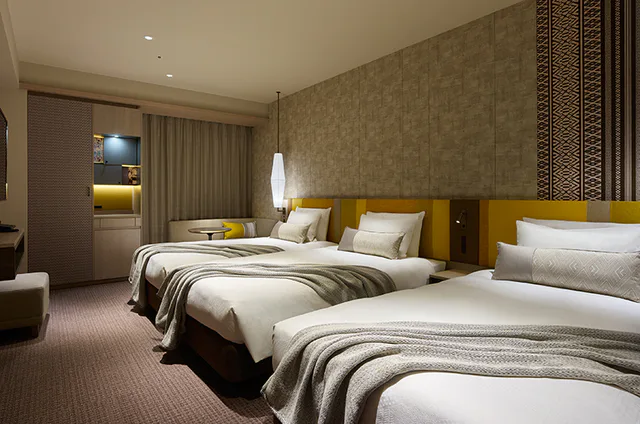
Mitsui's 26.6 m² triple solves bed equality first; luggage tolerance is the trade-off.
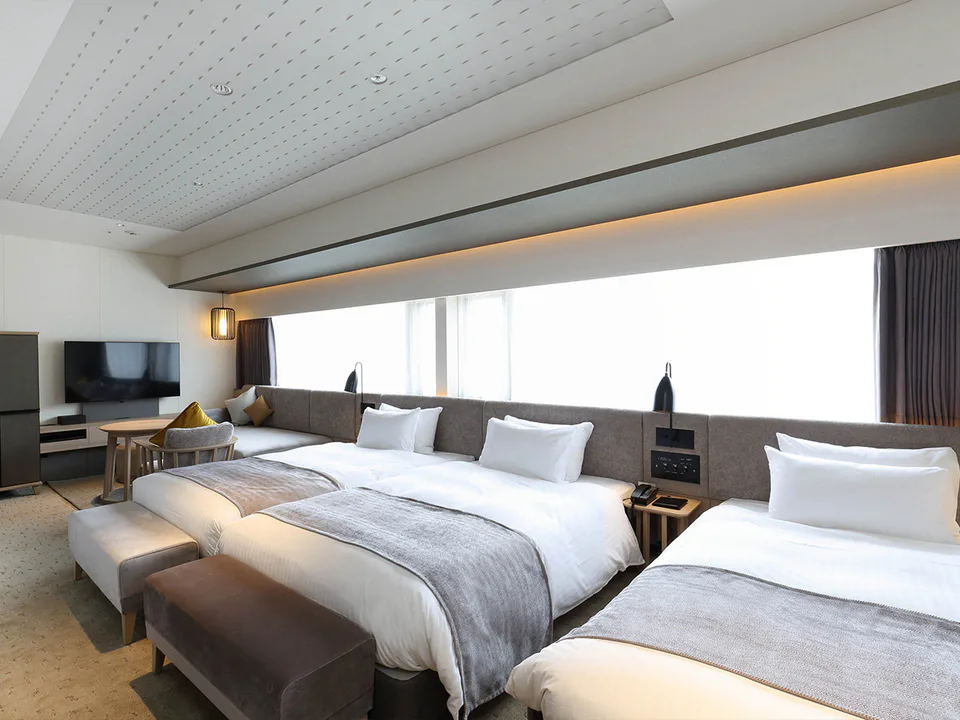
Solaria's 41.8 m² triple buys more shared living space, not merely a larger specification.
ValueNavi Hotel Fit Score: the winner changes when the itinerary changes
This score is not a star rating. It uses the same five decision dimensions—route fit, sleeping/room fit, luggage tolerance, daily workflow and stay-length value—and scores each hotel out of 10 for a defined trip. Change the trip and the score changes.
Scenario A: two nights, one early Hakata departure, medium luggage
↔ Scroll table left or right
Dimension | Mitsui Garden | Solaria |
Route fit | 10 | 6 |
Sleeping/room fit | 8 | 10 |
Luggage tolerance | 6 | 9 |
Daily workflow | 9 | 8 |
Stay-length value | 9 | 7 |
Total / 50 | 42 | 40 |
Scenario B: four nights, Tenjin shopping, three large cases
↔ Scroll table left or right
Dimension | Mitsui Garden | Solaria |
Route fit | 7 | 10 |
Sleeping/room fit | 8 | 10 |
Luggage tolerance | 5 | 10 |
Daily workflow | 8 | 9 |
Stay-length value | 6 | 10 |
Total / 50 | 34 | 49 |
The useful insight is not that Solaria “scores higher.” It is that the same hotels nearly tie in a short Hakata-led stay and separate sharply in a longer Tenjin-led stay. That boundary condition matters more than a generic hotel ranking.
Mitsui's public bath is only valuable if it changes the bathroom queue
Mitsui Garden's guest-only large public bath on the 13th floor is currently open 15:00–25:00 and 05:00–09:00. For three adults, that can turn one in-room bathroom into two washing workflows: one person uses the room while another uses the public bath. The hotel also lists a self-service laundromat, which adds long-stay utility that the room-size comparison alone misses.
But I would not assign automatic value to the bath. If one traveller dislikes communal bathing, everyone returns after 01:00, or the group simply prefers to shower privately, the feature does not compensate for the smaller triple. This is a good example of why an amenity list is not a decision. An amenity only matters when it removes a repeated constraint.
Hakata vs Tenjin: count repeated route friction, not one airport transfer
Mitsui Garden is officially about seven minutes on foot from JR Hakata and five minutes from Gion Station. Solaria has direct access to the Nishitetsu Fukuoka (Tenjin) Station and Tenjin Bus Center area; its official access information gives about three minutes from the subway and about seven minutes by subway from JR Hakata.
That creates a simple route test. List where the first meaningful movement of each morning starts. If three of four mornings begin with JR or Shinkansen at Hakata, the Hakata-side base earns value repeatedly. If mornings begin in Tenjin and one or more days use Nishitetsu, Solaria's location earns value repeatedly. Do not let a one-time airport arrival outweigh four days of route direction.
The same logic applies to Dazaifu. A Tenjin-led trip naturally favours Solaria because Nishitetsu is part of the trip's transport structure. A trip that uses Hakata as the launch point for regional rail does the opposite. For the network itself, use the Fukuoka JR vs Subway vs Nishitetsu guide.
Three large suitcases: occupancy is not luggage capacity
Neither hotel's published occupancy chart proves that three specific large hard-shell cases can remain open without blocking circulation. That uncertainty is more consequential at 26.6 m². For one or two nights, suitcase choreography is tolerable: open one, repack it, move it aside. Across four or five nights, repeating that process becomes part of the hotel experience.
This is where Solaria's extra 15.2 m² has the clearest value. If the group shops heavily, returns to the room during the day or has three travellers getting ready on different schedules, room area gets reused. If everyone travels with cabin bags and the room is only for sleeping, the same premium can be wasted.
Price test: compare the exact triple, then divide the premium by three
Do not compare the cheapest Mitsui card with the cheapest Solaria card. Use three adults, Standard 3 Beds at Mitsui, Deluxe Triple at Solaria, and match breakfast, taxes and cancellation deadline. Then calculate:
Solaria space premium per person per night = (Solaria triple total − Mitsui triple total) ÷ 3 ÷ number of nights.
Keep the booking total in Japanese yen because that is the underlying hotel-market price. For English-language budgeting, add the current USD equivalent at the point of purchase rather than hard-coding a permanent conversion; on 27 August 2026, ¥1,000 was about US$6.27, but exchange rates move.
If the resulting premium buys five square metres more gross area per person, a Tenjin base and less luggage friction every day, it can be rational. If the trip is two nights with one early Shinkansen morning, the same premium may buy very little that the group actually uses.
When neither hotel is the right answer
If you need both 40 m²-class space and several early Hakata departures, these two hotels force an unnecessary compromise. Compare larger Hakata rooms or two rooms instead. The THE BLOSSOM HAKATA Premier guide is one useful next step.
If the group has a light sleeper, different return times or strong privacy preferences, two rooms can also beat either triple. One-room savings are not automatically savings if the bathroom, luggage and sleep schedule create four days of negotiation.
Check the exact room, not the hotel name
If Mitsui Garden Hotel Fukuoka Gion fits your group
Booking.com — check Standard 3 Beds for three adults
Trip.com — compare the same Mitsui triple for your dates
Agoda — compare the same occupancy and cancellation terms
If Solaria Nishitetsu Hotel Fukuoka fits your group
Booking.com — compare Solaria Deluxe Triple for three adults
Trip.com — check the 41.8 m² triple on the same dates
Agoda — compare Solaria triple-room terms
Final verdict
For a two-night three-adult stay with an early JR or Shinkansen morning, Mitsui Garden Hotel Fukuoka Gion is the more disciplined choice: three equal beds, a Hakata/Gion location and a public bath that can reduce bathroom pressure. For four nights with large suitcases and a Tenjin-led itinerary, I would pay more attention to Solaria Nishitetsu's 41.8 m² Deluxe Triple because the extra space and location are reused every day. If you need Solaria-sized space and Mitsui-style Hakata routing at the same time, widen the shortlist instead of forcing either hotel to solve the wrong problem.
References
Mitsui Garden Hotel Fukuoka Gion official Guest Rooms, Access and Large Public Bath pages; Solaria Nishitetsu Hotel Fukuoka official Deluxe Triple and access information. Facts re-checked 27 August 2026. Room inventory, rates and cancellation terms vary by date.
For three adults, the district choice should be driven by repeated daily routes, not by the hotel brand alone.
Room types, rates, availability and cancellation terms can change by date. This article may contain affiliate links; ValueNavi may earn a commission from qualifying bookings at no additional cost to you.