
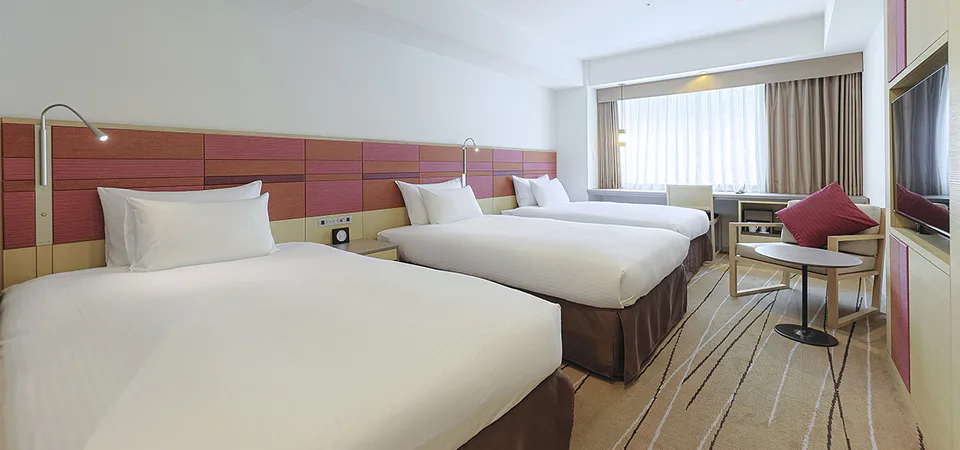
For three adults in Fukuoka, start by pricing one genuine triple room. For four unrelated adults, start by pricing a real quad and two twin/double rooms side by side rather than assuming one room is the bargain. The answer usually changes with stay length: one shared room is easiest to justify for one or two nights; after three or four nights, a second bathroom, a second luggage zone and separate sleep schedules can be worth a surprisingly small premium.
The useful comparison is not “one room versus two rooms” in the abstract. It is equal beds + bathroom throughput + luggage circulation + privacy versus the extra price per person per night. Fukuoka has enough purpose-built triple and quad inventory that groups do not need to accept a vague “sleeps four” label without checking what the fourth adult actually sleeps on.
Fukuoka hotels for 3 or 4 adults: the 30-second decision
↔ Scroll table left or right
Group | Start with | What would reverse it |
3 adult friends, 1–3 nights | One true triple | One person needs privacy, the third bed is inferior, or the two-room premium is small |
4 adult friends, 1 night | Real quad can be efficient | Four large cases, weak fourth bed, or a very small bathroom/wet area |
4 adult friends, 3+ nights | Two rooms as the benchmark | Choose one quad only when the room is unusually practical or the saving is meaningful |
2 couples | Two rooms | One large room only when everyone explicitly wants the shared-room setup and the saving is substantial |
Family with children | One room often gets stronger | Two rooms only when supervision, connecting-room availability and child policies still work |
Shopping-heavy / 4 large suitcases | Bias toward more floor area or two rooms | A large quad can still win if circulation remains usable with all bags inside |
Use a privacy-premium calculation instead of asking whether two rooms are “too expensive”
Live rates change too much for a permanent break-even price, but the calculation is simple:
Privacy premium per person per night = (two-room total − one-room total) ÷ number of adults ÷ number of nights.
Use the same cancellation conditions, meal basis and tax treatment. If one quad is JPY 36,000 per night and two comparable rooms total JPY 44,000, the extra cost is JPY 8,000 per night. For four adults, that is JPY 2,000 per person per night to buy a second bathroom, a second door, another luggage zone and the ability to split sleep schedules. That is a hypothetical example, not a Fukuoka market quote.
This reframes the decision. “Two rooms cost JPY 8,000 more” sounds large; “would I pay JPY 2,000 per person tonight for another bathroom and privacy?” is the question the group can actually answer. For a one-night stay after a late arrival, the answer may be no. For four nights with early Kyushu day trips, different bedtimes and four large cases, it may be yes.
Fukuoka accommodation tax is charged per guest, not per room
Fukuoka City currently charges accommodation tax per person per night: JPY 200 when the accommodation fee is under JPY 20,000 per person per night, and JPY 500 at JPY 20,000 or more. This matters because booking two rooms does not automatically double the accommodation tax merely because the group now has two doors.
However, the tax can still change indirectly. If the two-room option raises the accommodation fee per person above the JPY 20,000 threshold, the tax band can rise from JPY 200 to JPY 500 per person per night. So compare the final checkout total, but do not treat “two rooms means twice the city tax” as a valid shortcut.
Breakfast is similar: it is often priced per guest, so it should not be used to make one room look cheaper unless the actual package inclusions differ. Normalise room-only against room-only or breakfast against breakfast.
For three adults, equal beds are often worth more than extra lounge space
Fukuoka is unusually workable for three adult friends because several hotels publish genuine three-person configurations rather than a standard twin with a vague third-person allowance.
Solaria Nishitetsu Hotel Fukuoka has the strongest space case in this shortlist: its Deluxe Triple is published at 41.8 m² with three regular 120 × 205 cm beds. That gives roughly 13.9 m² of published gross room area per guest before allowing for the bathroom, furniture and circulation. The useful point is not the ratio itself; it is that nobody has to accept an auxiliary sleeping surface to keep the group together.
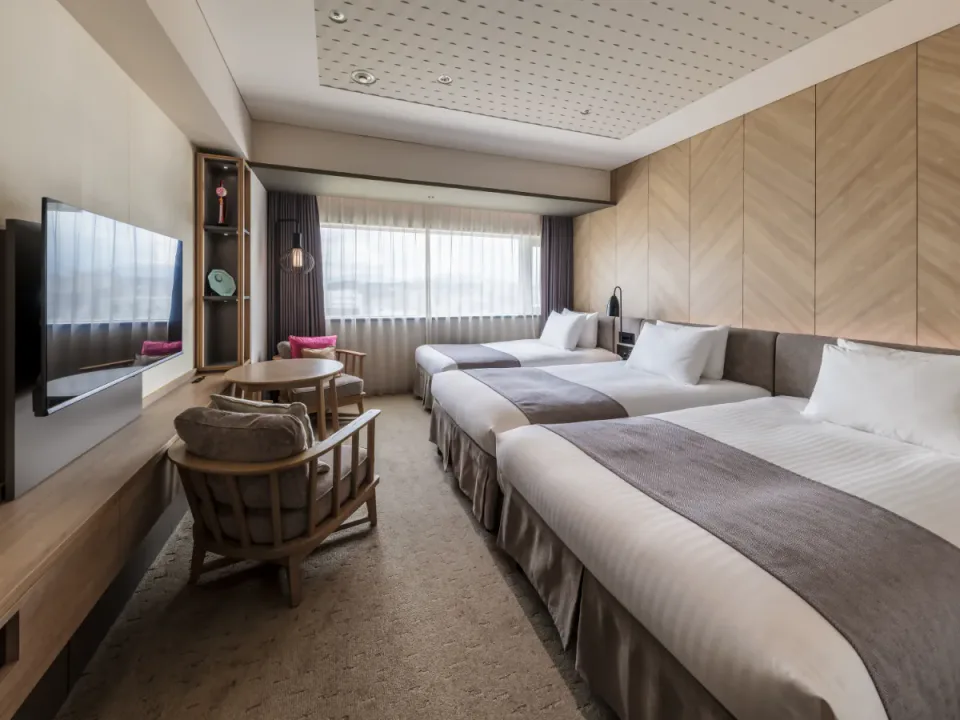
Mitsui Garden Hotel Fukuoka Gion solves a different problem. Its current official Standard 3 Beds room is 26.6 m² with three equal 1,110 mm beds. The gross area per guest is lower, about 8.9 m², but the bedding is equal. For friends who care more about bed fairness and a Hakata/Gion-side base than sitting space, that can be a better use of the room.
Nishitetsu Hotel Croom Hakata Gion adds another dimension: its three-person room is more compact, but the split toilet/bath/washbasin arrangement and guest public bath can improve morning throughput. JR KYUSHU HOTEL Blossom Hakata Chuo instead uses two main beds plus a trundle in its three-person Deluxe Twin, so the decision is really Hakata Station convenience versus equal-bed preference.
Three-adult rule: if all three adults get acceptable beds and the room is usable with the luggage, one room should normally win. Two rooms become rational when privacy or sleep schedules matter enough to justify paying for an otherwise unused fourth sleeping capacity.
For four adults, the bathroom can be a bigger bottleneck than the floor area
A four-person room can look generous on a floor plan and still feel inefficient at 07:00. Four adults preparing serially around one toilet, one washbasin and one shower create a synchronization problem that does not appear in the occupancy number.
A simple stress test is to imagine each person needs only 15 minutes of exclusive bathroom time before an early train. One bathroom can create a 60-minute serial block. Two rooms can potentially cut that to about 30 minutes because two people can prepare in parallel. This is a planning illustration, not a hotel-specific measured queue, but it shows why bathroom count matters more on an early-departure trip than on a lazy weekend.
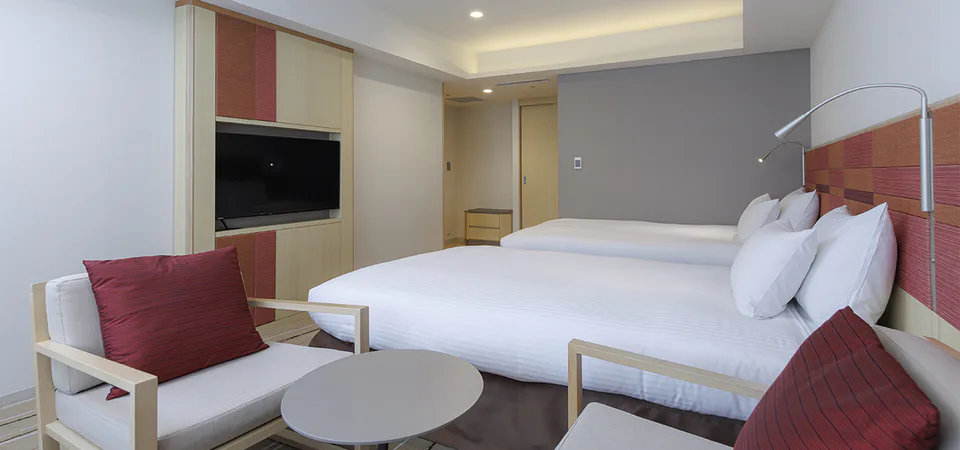
Solaria’s Deluxe Quad remains one of the strongest one-room examples because it is 41.8 m², but the published setup is three 120 × 205 cm regular beds plus a 100 × 195 cm day bed for the fourth guest. The room is large; the four sleeping positions are not identical.
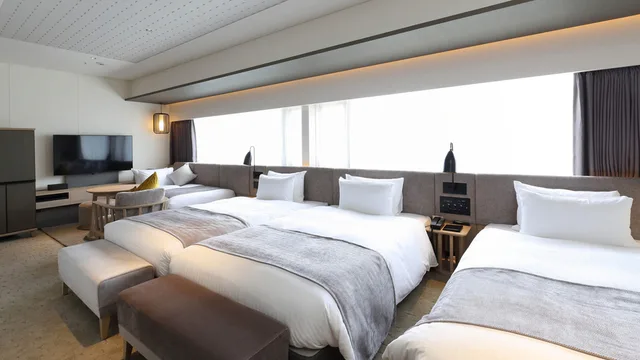
Croom Hakata Gion’s Fourth rooms are more compact at 30.4 m², but the separated toilet, bath and washbasin plus a guest public bath can partially reduce the one-bathroom problem. That only counts if the group will actually use the public bath and accepts the room’s bunk-style sleeping arrangement.
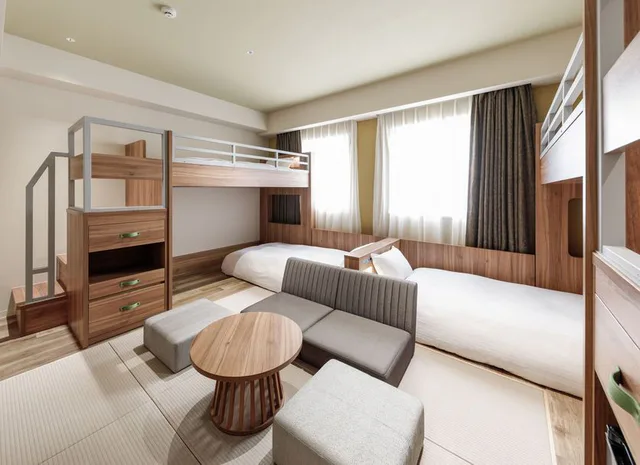
One public bath does not automatically replace a second private bathroom
A public bath can be genuine group-room infrastructure. If two adults are happy to bathe there while the others use the room bathroom, the morning or evening queue can shrink. But do not double-count it.
Public-bath opening hours, tattoo rules, child rules and personal preference can remove that benefit for part of the group. A couple that dislikes communal bathing still shares one private bathroom even if the hotel advertises a large bath upstairs. Count only facilities that the actual travellers will use.
Four large suitcases create a nightly tax that does not appear in the room rate
Hotels publish gross room area, not a guaranteed rectangle of empty floor. Beds, bathroom, desk, sofa and fixed furniture all consume the headline square metres. That means 41.8 m² versus 30.4 m² is directionally useful, but it cannot prove that four 28–29 inch suitcases can remain open at once.
For one night, luggage choreography is tolerable: open one case, close it, repack and leave. For four nights, repeating that process every morning and evening is a real cost. Shopping-heavy Tenjin trips also tend to add bags rather than reduce them.
This is where two rooms can win even when the combined published floor area is not dramatically larger. The value comes from two separate circulation zones. Nobody has to step over another person’s case to reach the door at 07:00.
The shortlist should be matched to the problem, not ranked from best to worst
↔ Scroll table left or right
Room / hotel | What it solves | Main compromise |
Solaria Deluxe Triple | 41.8 m² + three equal regular beds | Tenjin base may be wrong for a JR-heavy itinerary |
Mitsui Garden Standard 3 Beds | Three equal 1,110 mm beds near Gion/Hakata | 26.6 m² leaves less shared floor area |
Blossom Hakata Chuo Deluxe Twin for 3 | Hakata Station convenience | Third guest uses a trundle rather than an equal main bed |
Solaria Deluxe Quad | Large 41.8 m² one-room option for four | Fourth sleeping surface differs from the first three; still one bathroom |
Croom Hakata Gion Fourth | Separated wet area + public bath + group-room format | 30.4 m² and bunk-style sleeping need group buy-in |
Two twin/double rooms | Two bathrooms, two luggage zones, privacy | Higher room cost; rooms may not be adjacent unless the hotel confirms it |
Do not assume two rooms will be next door
Two rooms solve privacy only if the group can live with physical separation. Hotels may accept an adjacent-room request without guaranteeing it, and “same floor” is not the same as connecting rooms.
For four independent adults, this is usually a minor issue. For parents supervising younger children, it can be a hard veto. A one-room family setup may therefore remain rational even when two rooms are only slightly more expensive. If the family needs connecting rooms, verify that specific room type or guarantee before treating two rooms as the better product.
Choose Hakata or Tenjin before you fall in love with a group room
A 41.8 m² quad is not automatically worth moving the whole trip to Tenjin. Solaria makes the most sense when Tenjin shopping, dining, Nishitetsu or Dazaifu fit the itinerary. Mitsui Garden, Croom Hakata Gion and the Blossom properties get stronger when Hakata/Gion or wider Kyushu rail movement matters more.
If the group expects multiple early JR departures to Yufuin, Nagasaki, Kumamoto or other Kyushu destinations, a Hakata-side room can save repeated transport friction. If evenings repeatedly end in Tenjin, a larger Tenjin room may save the same time in the opposite direction. Use Hakata vs Tenjin before letting a rare quad room choose the district for you.
Stay length changes what “good value” means
One night: bias toward one room if the beds are acceptable. The group has little time to benefit from extra private space, and one booking/check-in is simple.
Two nights: still a genuine contest. Use the privacy-premium calculation and luggage test.
Three or four nights: two rooms become much stronger for four unrelated adults because bathroom, sleep and luggage friction repeat every day.
Five nights or more: I would need either an exceptional quad layout, a large saving, or a family-supervision reason before choosing one room for four adults. At this point the room is living space, not merely a place to sleep after sightseeing.
Three common booking mistakes
Mistake 1: comparing occupancy instead of sleeping surfaces. “Sleeps four” can mean four regular beds, three beds plus a day bed, two doubles, bunk beds, sofa beds or futons. The group should approve the actual setup.
Mistake 2: comparing one flexible rate with two non-refundable rooms. Match cancellation deadline, breakfast and payment timing before calculating the privacy premium.
Mistake 3: assuming the rare quad must be cheaper. Large group rooms can carry scarcity premiums on weekends and event dates. Two ordinary rooms can sometimes be surprisingly close in total price.
Final verdict
Three adults should begin with one genuine triple. Four adults should begin with a calculation. Price the real quad against two comparable rooms, convert the difference into a per-person-per-night privacy premium, then ask whether the group would pay that amount for a second bathroom, another luggage zone and independent sleep schedules.
For four adult friends staying one night, a practical quad can be the cleanest answer. For four adults staying three or more nights, two rooms are my default unless the one-room layout is unusually good or the saving is material. For two couples, I would normally choose two rooms. For a family with children, supervision can reverse the answer back toward one room.
The red-team condition is simple: if your “cheap” quad requires an inferior fourth bed, constant suitcase reshuffling and a 60-minute bathroom queue every morning, it is not cheaper in the way that matters. If two rooms cost only a modest amount more per person per night, buy the second bathroom.
Pair this with
For three adults, compare Mitsui Garden Fukuoka Gion vs Solaria and Mitsui Garden vs THE BLOSSOM. For four adults, use Solaria vs Croom Hakata Gion. If the group-room choice keeps moving because the district keeps moving, solve Hakata vs Tenjin first.
Sapporo Autumn Fest 2026: The One-Kilometre Food Route That Leaves Room for Dessert
Fukuoka Shopping Hotels: Dropping Bags Midday Matters More Than Saving Two Minutes to the Subway
Fukuoka Two-Night Hotels: Do Not Waste a Three-Day Trip Moving Hotels
Osaka Solo Travel Hotels: Pay for Less Friction, Not a Bigger Room
References
Mitsui Garden Hotel Fukuoka Gion — official room specifications · Solaria Nishitetsu Hotel Fukuoka — current Deluxe Triple and Deluxe Quad room specifications · Nishitetsu Hotel Croom Hakata Gion — current Triple/Fourth room specifications · JR KYUSHU HOTEL Blossom Hakata Chuo — Deluxe Twin specifications · THE BLOSSOM HAKATA Premier — current multi-person room specifications · Fukuoka City — accommodation tax. Checked August 25, 2026. Room inventory, occupancy rules, bed setup and live rates vary by date; verify the exact room before payment.