For a shopping-heavy Fukuoka trip, I would choose the hotel by how often the room re-enters the day—not by the smallest station-walk number. If you expect to shop in Tenjin, return at 15:00–17:00 to drop bags, rest, repack and then go out again for dinner, a Tenjin hotel can remove repeated friction several times across the stay. If you leave once in the morning and return only at night, that advantage is much smaller, and Hakata may be the better base once JR or Shinkansen mornings are added.
The useful question is therefore not “Which hotel is closest to shopping?” It is “What job does the room perform between the first purchase and bedtime?” Solaria is strongest when the room is part of the Tenjin shopping loop. ONE FUKUOKA HOTEL is strongest when you will actually use premium hotel time after dropping bags. Tokyu Stay becomes more valuable when laundry changes how much clothing competes with purchases in the suitcase. Hotel JAL City Fukuoka Tenjin is the quieter west-side answer when Daimyo/Akasaka matters more than being directly inside central Tenjin.
Fact-checked August 27, 2026 against current first-party hotel information. Hotel rates move by date, so this guide compares operational value rather than quoting a volatile nightly price.
Fukuoka shopping hotels in 30 seconds
↔ Scroll table left or right
Your shopping pattern | Start with | What the hotel is actually buying | What can reverse it |
Tenjin department stores / PARCO / underground mall + one or two midday returns | Solaria Nishitetsu Hotel Fukuoka | A repeatable shopping → room → shopping loop around Nishitetsu Fukuoka (Tenjin) and the bus terminal | Several mornings still require JR Hakata |
Premium Tenjin shopping + you will spend real time in the hotel between outings | ONE FUKUOKA HOTEL | Direct subway connection plus lounge, public bath/sauna and room time that make the return itself useful | You shop until late and use the room only as storage and a bed |
4–5 nights + shopping + you want to pack fewer clothes | Tokyu Stay Fukuoka Tenjin | In-room washer/dryer in every listed room type, plus microwaves and larger long-stay room options | The stay is too short for laundry to change packing |
Daimyo / Akasaka shopping + conventional 21 m²+ room | Hotel JAL City Fukuoka Tenjin | More western Tenjin geometry, room space and a one-minute headline walk from Akasaka Exit 3 | You repeatedly return from the central Tenjin core rather than Daimyo/Akasaka |
Hakata Hankyu / AMU Plaza / KITTE + JR the next morning | Stay around Hakata | Shopping and onward rail use the same base | Your evenings and repeated bag drops are overwhelmingly in Tenjin |
ValueNavi Shopping Return Utility: count room returns, not hotel stars
This article uses a simple decision model:
Shopping Return Utility = repeated room-return value + room-function value − repeated next-day positioning cost.
It is deliberately not a universal hotel score. A shopping hotel earns its location when the room does useful work during the day. The same property can be excellent for one itinerary and unnecessary for another.
↔ Scroll table left or right
Hotel | Midday-return fit | Room-function payoff | Main positioning penalty | Best use case |
Solaria Nishitetsu | Very high for central Tenjin | Moderate: the location is the product | Repeated Hakata JR mornings | Two-stage shopping days with a bag drop / break |
ONE FUKUOKA | Very high for subway-side Tenjin | Very high if lounge / bath / sauna / room time is used | Repeated Hakata JR mornings | Shopping day deliberately interrupted by premium hotel time |
Tokyu Stay Fukuoka Tenjin | High | Very high on longer stays because every listed room type has washer/dryer + microwave | Repeated Hakata JR mornings | Shopping and laundry competing for suitcase capacity |
Hotel JAL City Fukuoka Tenjin | High for Daimyo/Akasaka, lower for repeated central-Tenjin returns | High: all rooms are officially 21 m² or larger | Extra walk east if most shopping is around Tenjin Station | West-side shopping plus repacking space |
The practical break point is repetition. If the room re-enters the day twice on three shopping days, that is six useful hotel interactions. If the room re-enters only once at bedtime, you should give more weight to airport, rail and total-trip geography instead.
Still choosing the district? Settle Hakata vs Tenjin before choosing a shopping hotel
Solaria wins when Tenjin itself is the repeated loop
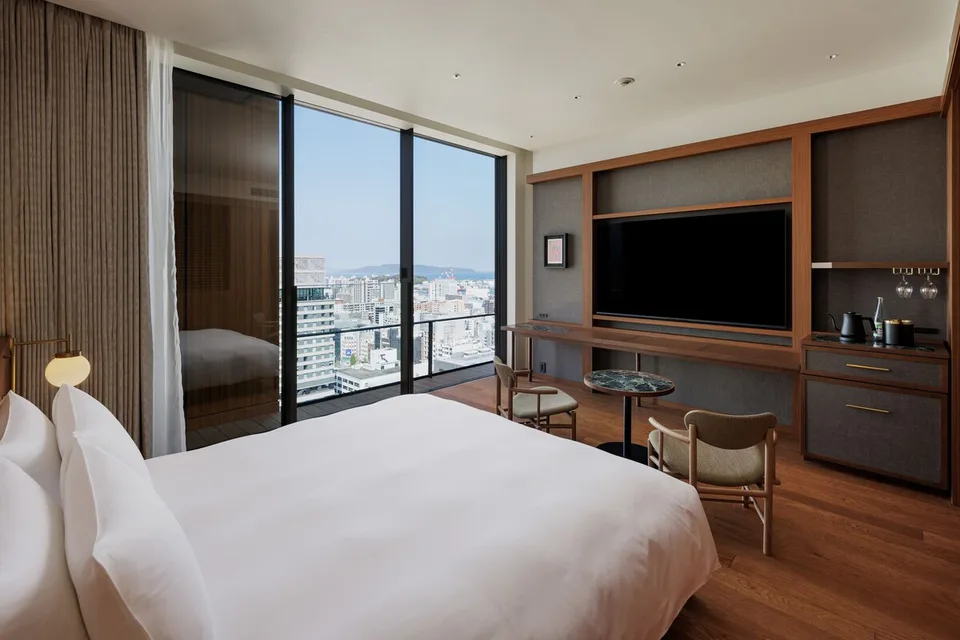
Solaria Nishitetsu Hotel Fukuoka is tightly integrated with Nishitetsu Fukuoka (Tenjin) Station, the Tenjin bus centre and the Solaria commercial complex. The hotel also lists subway Tenjin Station at roughly a five-minute walk. That combination is useful because a shopping day does not have to be one long outing: shop, return with bags, change shoes, rest, then go back out without first taking a train to another district.
The strongest version is not “I am shopping in Tenjin once.” It is “I will reuse Tenjin as the day’s base several times.” A couple doing department stores in the afternoon, dropping purchases before dinner and then returning late gets more value from Solaria than a traveller who leaves at 09:00 and sees the hotel again at 23:00.
The failure mode is allowing one shopping afternoon to dominate a rail-heavy trip. If two or three mornings start with JR or Shinkansen from Hakata, every one of those days adds a positioning leg back toward Hakata. Use the Miyako vs Solaria comparison before treating Solaria as the automatic “shopping winner.”
Shopping in Tenjin? Check whether Solaria removes a repeated return trip
ONE FUKUOKA only earns the premium when the return to the hotel becomes an activity
ONE FUKUOKA HOTEL is directly connected to Fukuoka City Subway Tenjin Station from the east ticket-gate side. The hotel currently lists a guest-only library lounge from 06:00–22:00, a public bath and sauna from 06:00–12:00 and 15:00–25:00, and 24-hour coin laundry. That makes the midday or early-evening return qualitatively different from dropping bags in a basic room.
This is where the hotel can justify a premium: shopping → room / lounge / bath → dinner. The return buys recovery, not only storage. That is especially useful on hot, rainy or shopping-heavy days when you deliberately want a 60–90 minute reset before going out again.
But the same facilities can become unused inventory. If you shop until stores close, return only to shower and sleep, then leave early, ONE FUKUOKA may be a beautiful but inefficient bag locker. The correct comparison is not “ONE is nicer than a mid-range hotel.” It is whether the hours you will spend inside justify paying for a hotel designed to be used.
Premium shopping stay: check whether ONE’s hotel time will actually be used
Tokyu Stay solves a different shopping problem: clothes are occupying purchase space
Tokyu Stay Fukuoka Tenjin is not the strongest choice because “laundry is convenient.” Its real shopping advantage appears when a longer stay forces clothing and purchases to share one return suitcase.
The current official room page lists a washer/dryer and microwave in every room type shown, from the 18 m² Moderate Single/Double through larger twin, deluxe and connecting rooms. Residential categories also add a kitchenette. That means laundry is not a communal amenity you have to queue around; it can operate while you are back in the room repacking or resting.
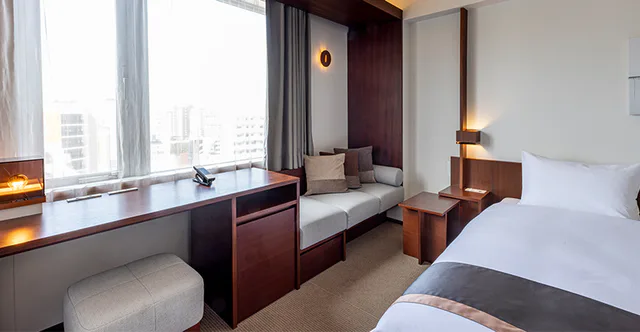
The derived value is straightforward: if washing during the trip lets you pack fewer duplicate outfits, you preserve more suitcase volume for purchases. The exact saving depends on your wardrobe and trip, so it would be fake precision to assign a universal kilogram figure. The important boundary is stay length. Over four or five nights, the feature can materially change packing. Over two nights, it may never justify a higher rate or weaker rail location.
Staying 4–5 nights? See whether laundry can free return-luggage space
JAL City is better when “Tenjin shopping” actually means Daimyo and Akasaka
Hotel JAL City Fukuoka Tenjin is officially one minute on foot from Akasaka Station Exit 3, and all guestrooms are listed at 21 m² or larger. That makes it a useful option when the shopping map extends west into Daimyo/Akasaka and you want a conventional room with enough floor area to reopen suitcases, sort purchases and still move around.
There is an important luggage caveat hidden inside the one-minute headline: the hotel’s current access page says Akasaka Exit 6 is the elevator route. A traveller arriving with two large suitcases should therefore not assume the shortest staircase exit is also the easiest luggage exit. This is exactly the kind of final 100 metres that matters more than a marketing walk time.
JAL City is weaker when your actual shopping is repeatedly centred east around Tenjin Station, PARCO, Iwataya and the core underground mall. In that case, the extra walk back toward Akasaka repeats every time you use the room as a bag-drop point. The hotel becomes stronger again if Daimyo is the evening as well as the shopping area.
Read the JAL City Fukuoka Tenjin guide before treating “Tenjin” in the hotel name as meaning “directly at Tenjin Station.”
The hidden shopping cost is the next morning
A hotel can be perfect between 14:00 and 22:00 and still be the wrong base for the whole trip. Shopping convenience is usually flexible; a reserved JR or Shinkansen departure is not.
Count the hard mornings before you book:
0–1 Hakata rail mornings: a Tenjin shopping hotel can dominate the decision if the evenings also stay central.
2–3 Hakata rail mornings: start comparing the repeated positioning cost against the number of midday shopping returns.
Most mornings start at Hakata: stay near Hakata unless Tenjin hotel time itself is one of the trip priorities.
This is not a claim that Tenjin is “far” from Hakata; it is close by subway. The issue is repetition. A six-minute subway leg is small once. Add station walking, platform margin and the same movement on several mornings, and it becomes a real itinerary tax.
Three shopping itineraries, three different winners
↔ Scroll table left or right
Trip | Best starting point | Why |
3 nights: Tenjin shopping on 2 days, late dinners, one Dazaifu day | Solaria | The room can be reused during both shopping days and Nishitetsu fits Dazaifu |
4 nights: premium shopping, one slow hotel afternoon, airport in/out, little JR | ONE FUKUOKA | Direct Airport Line access plus hotel facilities are deliberately used |
5 nights: shopping + laundry + mixed city days | Tokyu Stay | Washer/dryer and longer-stay room functions solve a packing problem, not just a location problem |
4 nights: Daimyo/Akasaka shopping, cafés, quieter evenings, one airport transfer | JAL City | The west-side location and 21 m²+ rooms are used repeatedly |
4 nights: Hakata shopping + two JR day trips + early Shinkansen departure | Hakata hotel | The railway geometry overwhelms Tenjin’s bag-drop advantage |
Red-team the recommendation: when is a “shopping hotel” not worth optimising?
You never return during the day. If the hotel is just morning departure + night return, choose the better whole-trip base.
Your shopping is split between Hakata and Tenjin. Do not pretend one district can eliminate all movement; use the area that matches the harder scheduled journeys.
You are buying mostly small items. Bag-drop convenience matters less when everything fits in one backpack.
The rate premium is large but the room feature is unused. A direct connection, lounge or washer/dryer only has value when your itinerary uses it.
You have multiple fixed Hakata departures. Shopping is flexible enough to travel for; a reserved train is less forgiving.
Final decision: choose the hotel by what happens after the first bags get heavy
Choose Solaria when the room repeatedly sits inside the Tenjin shopping day. Choose ONE FUKUOKA when the return becomes genuine hotel time. Choose Tokyu Stay when laundry changes what you can pack home. Choose JAL City when Daimyo/Akasaka and repacking space matter more than a central-Tenjin doorstep.
And choose Hakata when the next morning keeps pulling you back there. The best Fukuoka shopping hotel is not the one nearest the largest number of shops. It is the one whose location and room functions are reused often enough to beat the transport penalty they create elsewhere in the trip.
Sapporo Shopping Hotels: Stay Where You Can Drop Your Bags, Not Just Where the Shops Are
Okinawa Hotels With Washer-Dryers: On a 3-Night Trip, the Kitchen Usually Matters Less
Fukuoka Food Trip Hotels: Choose Where Dinner Ends, Not Where the Most Restaurants Are
Sources
Solaria Nishitetsu Hotel Fukuoka — official hotel and access information · ONE FUKUOKA HOTEL — official access · ONE FUKUOKA HOTEL — official rooms and facilities · Tokyu Stay Fukuoka Tenjin — official room equipment · Hotel JAL City Fukuoka Tenjin — official access · Hotel JAL City Fukuoka Tenjin — official room information. Checked August 27, 2026.