
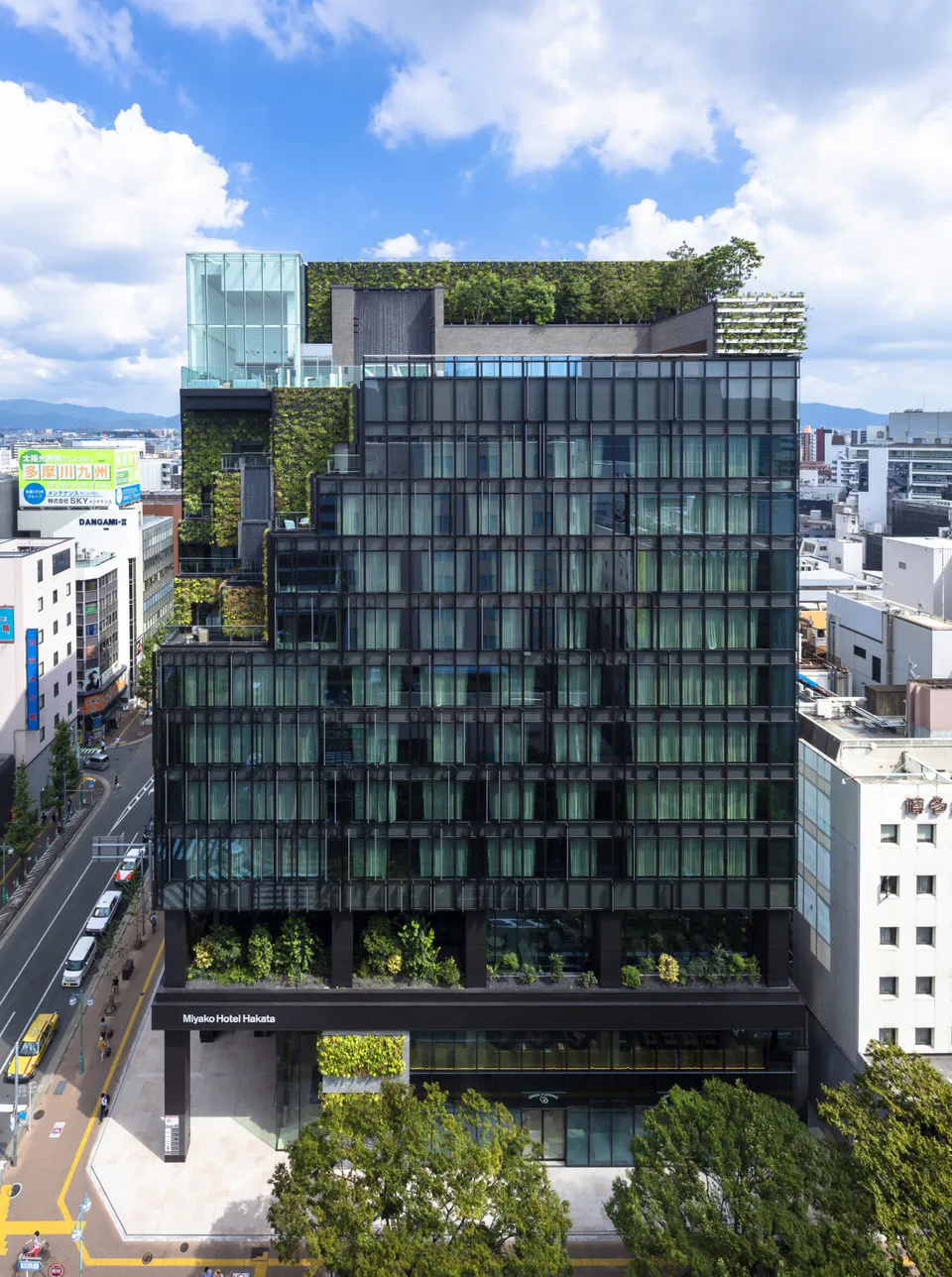
Choose Miyako Hotel Hakata when Hakata Station repeatedly does real work for your trip: JR or Shinkansen departures, luggage-heavy arrival and departure, a later 12:00 checkout, and Spa Lucida sessions you will actually use. Choose Solaria Nishitetsu Hotel Fukuoka when Tenjin repeatedly does the work: Nishitetsu trains, the bus centre, shopping, dinner and the ability to return to the room during a Tenjin-heavy day. The decision is not “better hotel versus better area.” It is which premium benefit you will reuse often enough to justify paying for it.
For two adults, the room-size gap is smaller than the location gap: Miyako's Superior Twin is 30–31 m² while Solaria's Moderate Twin is 28.4 m². For four people, however, Solaria changes category entirely with a 41.8 m² Deluxe Quad. Even then, capacity is not bed equality: the fourth sleeping surface is a 100 × 195 cm daybed, so four adults should check whether one-room convenience matters more than four equivalent beds.
↔ Scroll table left or right
Your trip pattern | Start with | What you are buying | Main reason to reverse |
Two or more JR / Shinkansen mornings | Miyako | Direct Hakata connection that gets reused, not just enjoyed once | Your evenings and daytime returns are overwhelmingly in Tenjin |
Dazaifu / Nishitetsu + Tenjin shopping and dinner | Solaria | Direct Nishitetsu Fukuoka (Tenjin) connection and a hotel inside the evening district | You keep crossing to Hakata for intercity departures |
Two adults, two large suitcases, 3–4 nights | Miyako, slightly | 30–31 m² baseline twin, direct station geometry and 12:00 checkout | The room is used little and Tenjin owns most waking hours |
Four people want one room | Solaria | 41.8 m² Deluxe Quad gives a clear four-person product | Four equal adult beds are a hard requirement; one sleeping surface is a daybed |
Hotel spa is part of the trip | Miyako | Spa Lucida adds an indoor bath and rooftop outdoor-spa programme | You return too late, leave too early or simply will not use it |
International late arrival | Usually Miyako if the next morning is Hakata-based | Once you reach Hakata, the final station-to-room chain is exceptionally short | Do not treat the airport as a five-minute door-to-door journey; the International Terminal currently needs a terminal transfer before the subway |
Count repeated friction events instead of comparing hotel labels
Both hotels can be excellent. The useful question is how many times each hotel's strongest advantage appears in your actual stay. Before booking, count these events:
Hakata events: JR or Shinkansen departure, Hakata highway-bus departure, luggage storage around a rail day, arrival through Hakata, departure through Hakata.
Tenjin events: Nishitetsu departure, Tenjin shopping block, Daimyo/Imaizumi evening, late dinner, midday return to unload shopping or rest.
Miyako-only hotel events: Spa Lucida session, 12:00 checkout that you can genuinely use, protected final station segment in bad weather.
Solaria-only room events: a four-person one-room stay where the 41.8 m² layout prevents a second-room booking or repeated group coordination.
If Miyako wins one arrival but Solaria wins three evenings, the first-night convenience should not decide a four-night stay. If Solaria wins one dinner but Miyako removes two early Hakata transfers plus the departure-day luggage problem, the result goes the other way. This is the simplest way to prevent one photogenic amenity or one airport journey from dominating the entire booking.
Miyako's strongest advantage is not “Hakata”—it is the East 7 connection
Miyako Hotel Hakata's official access instructions place the B1 hotel entrance directly at Hakata subway East Exit 7, with the JR/Shinkansen side about a one-minute walk from the Chikushi Exit. That is more specific than “near Hakata Station.” With two large suitcases, rain, a late arrival or an early reserved train, removing the final outdoor search can be worth paying for repeatedly.
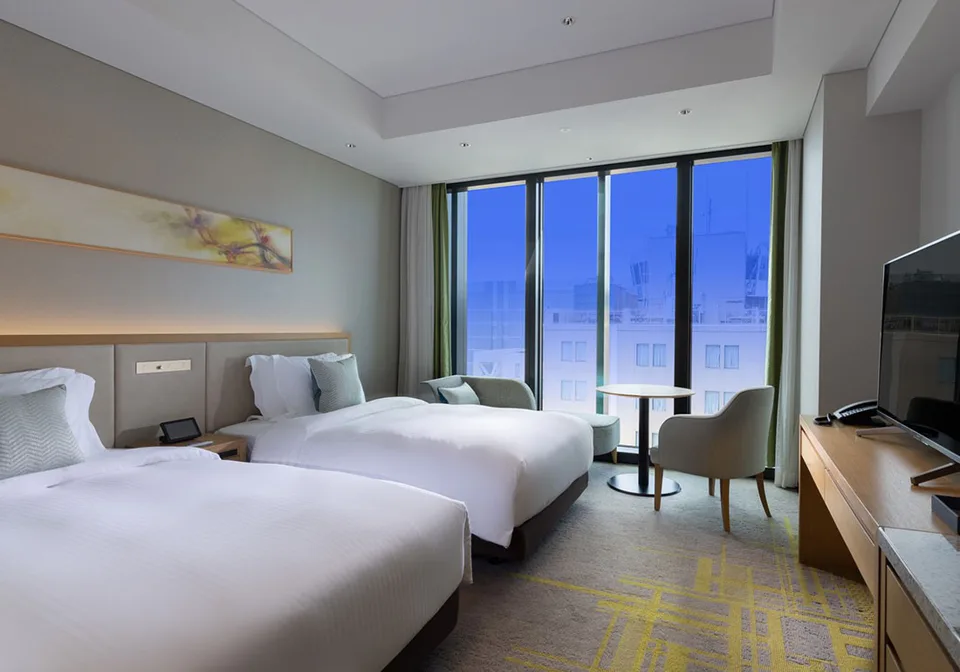
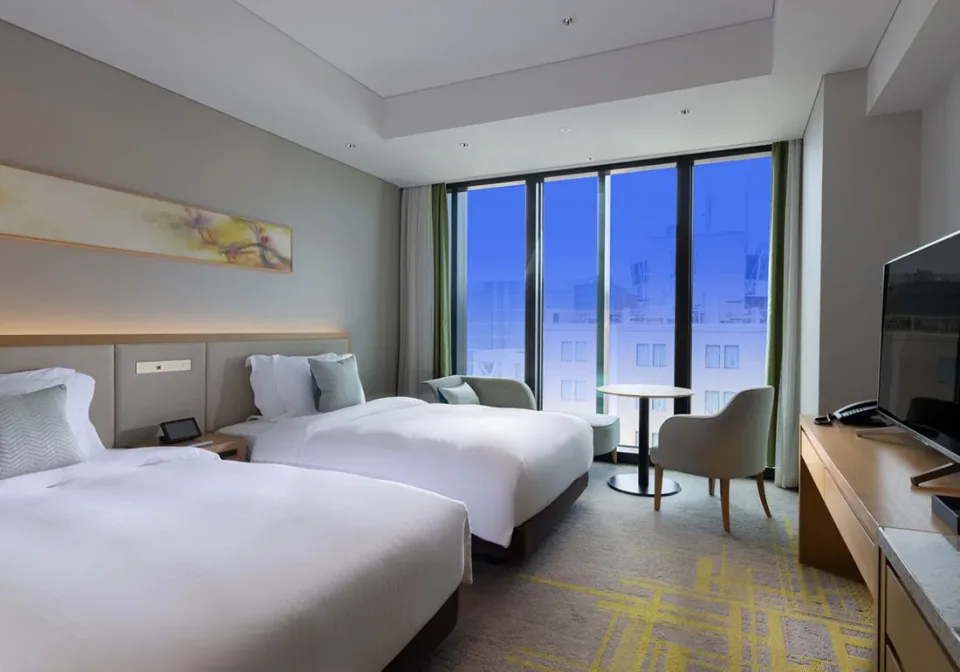
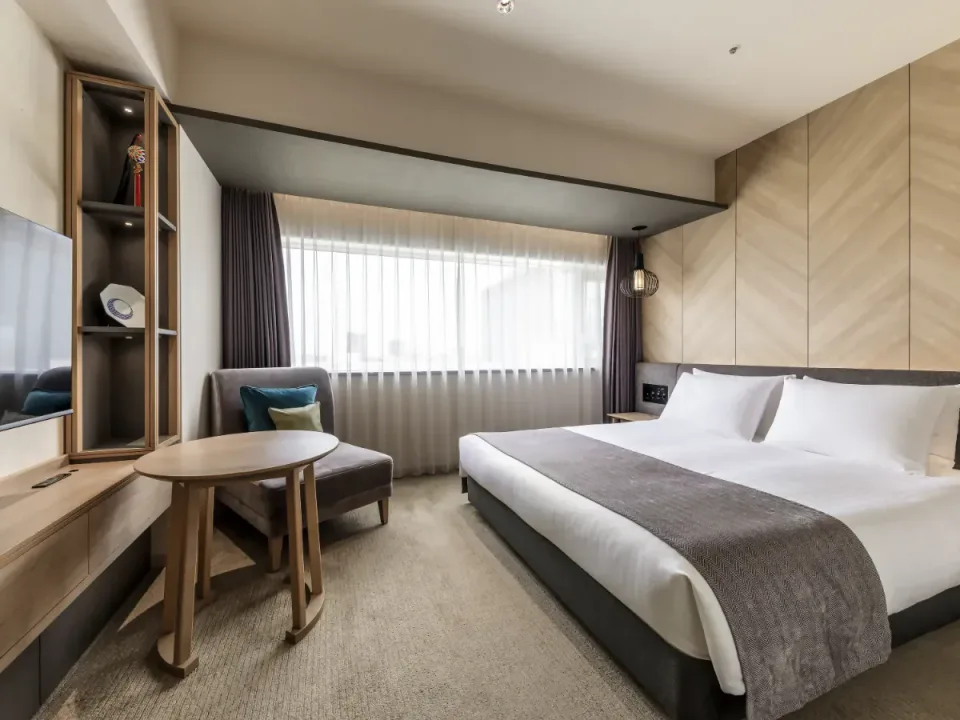
The official Superior Twin is 30–31 m² with two 120 × 205 cm beds and capacity for two. The room therefore combines station integration with a usable two-person floor area instead of forcing travellers to choose between connectivity and an ultra-compact room.
The premium is weakest when the station advantage appears only twice: arrival and departure. If all three complete days are Tenjin, Daimyo, Ohori and Nishitetsu-side trips, you can end up paying every night for a connection you use at the edges of the holiday while crossing town during the waking hours that matter more.
If you are still deciding the district rather than these two hotels, use Hakata vs Tenjin first. Hotel quality should not be used to rescue the wrong base.
Solaria's advantage is not just nightlife—it is a different transport ecosystem
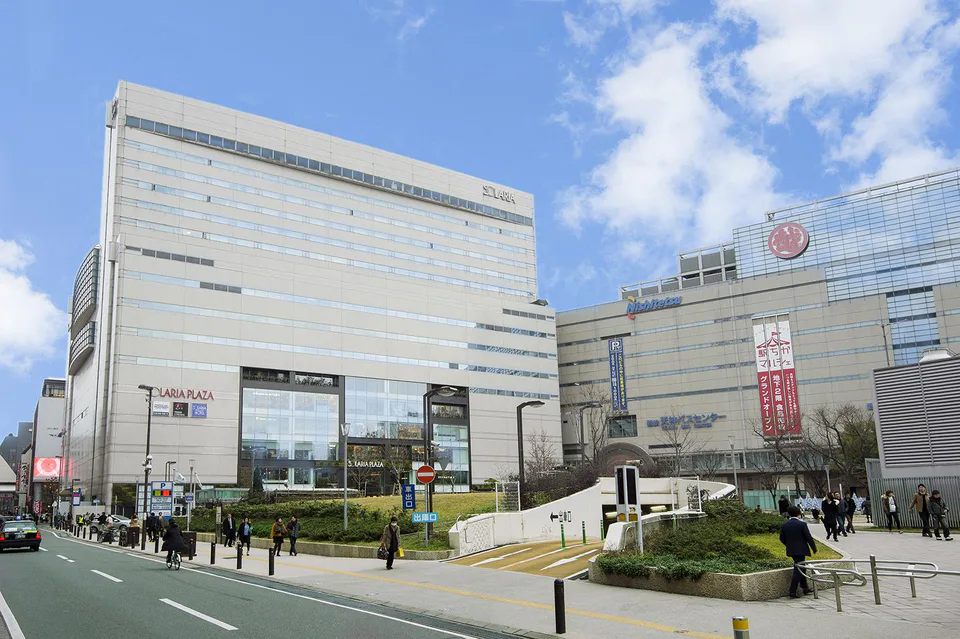
Solaria Nishitetsu Hotel Fukuoka is directly connected to Nishitetsu Fukuoka (Tenjin) Station and the Tenjin bus-centre complex. Its official access information places the Subway Airport Line's Tenjin Station roughly five minutes away on foot and Tenjin-minami on the Nanakuma Line roughly four minutes away.
That distinction matters because “Tenjin station” is not one platform under the hotel. The property is strongest when the trains and buses you need are the ones integrated with the Solaria/Nishitetsu complex, or when the surrounding district itself is the destination. Dazaifu is the obvious example: a Tenjin hotel can turn the morning into hotel → Nishitetsu rather than hotel → subway → another railway system.
The same geometry works at night. If dinner, shopping and drinks repeatedly finish in Tenjin, the hotel is not only close to entertainment. It deletes the final transport leg after the part of the day when your group is most tired.
The airport advantage is real—but international arrivals need a correction
Fukuoka Airport advertises roughly five minutes by subway from the airport station to Hakata and about eleven minutes to Tenjin. Those figures are useful for domestic-terminal rail planning. They should not be turned into “five minutes from an international flight to Miyako Hotel.”
The airport currently requires passengers moving between the International and Domestic terminal buildings to use the free terminal shuttle; the airport gives roughly ten minutes for the International Terminal → Domestic Terminal journey, with traffic able to make it longer. The subway station is on the Domestic Terminal side.
For an international arrival, the practical chain is therefore closer to:
International arrivals → terminal shuttle → Domestic Terminal/subway → Hakata or Tenjin → hotelMiyako still wins the final segment because Hakata East Exit 7 is directly connected. But the correct editorial conclusion is “Miyako removes the city-side final mile,” not “Miyako is five minutes from an international aircraft.”
For two adults, room size is a tiebreaker; for four guests, it can decide the booking
Miyako's 30–31 m² Superior Twin and Solaria's 28.4 m² Moderate Twin are close enough that I would not choose the district from the 1.6–2.6 m² difference alone. Two adults with two large suitcases may appreciate the extra circulation at Miyako, but a hotel in the wrong district can create far more movement than that space saves.
Four people are different. Solaria's Deluxe Quad is 41.8 m² and explicitly designed for four guests. The published bed information also exposes the trade-off: the room is based on the Deluxe Triple plus a 100 × 195 cm daybed, while the regular beds are 120 × 205 cm.
That creates two different “best” answers:
Family / group prioritising one-room coordination: Solaria can be the more useful product because one 41.8 m² room keeps everyone together.
Four adults prioritising equal sleeping surfaces: do not let “capacity four” end the comparison. Price two twins or another four-bed product before assuming the Quad is automatically superior.
Capacity is a legal/booking limit. It is not a comfort verdict.
Spa Lucida only counts when your timetable leaves usable sessions
Miyako's Spa Lucida is a genuine hotel differentiator, but it should be valued by sessions you can actually use. The hotel currently publishes the indoor bath at 06:30–12:00 and 14:00–24:00. The outdoor spa operates 06:30–12:00 and 14:00–23:00, with the outdoor area restricted to guests aged 18 and over from 19:00.
That means the same facility has different value for different stays:
Couple returning at 21:00: potentially strong value; the adults-only evening window can be part of the stay.
Family with younger children returning after 19:00: the outdoor-spa benefit is materially reduced because the evening age rule removes the children from that session.
Early JR departure every morning: the morning spa may be theoretically available but operationally irrelevant.
Late dinner followed by midnight return: the outdoor spa is already closed and the indoor bath window is nearly gone.
Remove unused spa sessions from the price comparison. A premium feature that never appears in your schedule is not part of the value you received.
The 12:00 vs 11:00 checkout matters most on the final day, not every night
Miyako currently lists checkout at 12:00; Solaria lists 11:00. It is easy to multiply that one-hour difference by the number of nights and overstate it. You only check out once.
The hour is valuable when your last day has a late-morning train, lunch in Hakata, children who need a slower start, or repacking after several Kyushu stops. It is much less valuable when the group leaves at 08:00 for a reserved train. Treat checkout as one specific final-day benefit, not a nightly amenity.
One night, three nights and five nights produce different winners
One late-arrival night + early JR departure: Miyako is the default. The direct station geometry is used on both sides of a very short stay. If you are only sleeping, however, compare the price gap with a simpler Hakata hotel before paying for Spa Lucida and a larger room you may not use.
Three-night city break dominated by Tenjin/Daimyo: Solaria gets stronger. One airport transfer is paid once; being able to finish dinner, shop and return to the room inside the district is used repeatedly.
Four- or five-night Kyushu hub with two or more JR days: Miyako gets stronger because Hakata is reused on several mornings and returns. The direct connection becomes a repeated operating advantage rather than an arrival luxury.
Four-person family with one room: Solaria's 41.8 m² Quad deserves the first quote, but check the daybed and bathroom routine before assuming it solves four-adult comfort.
Use a premium-per-use test when the rates are far apart
Hotel prices move too much to publish one permanent “worth it” threshold. Instead, calculate the total-stay difference and divide it by the number of meaningful advantages you will use.
Example: if Miyako costs materially more for a three-night stay but gives you two JR mornings, one rain-protected arrival, one Spa Lucida evening and a useful 12:00 checkout, the premium is spread across five real uses. If the only extra you will use is the direct arrival connection, the same total premium is buying one event.
Do the same for Solaria: count Nishitetsu departures, midday room returns, late Tenjin evenings and whether the Quad avoids a second room. This prevents “premium hotel” from becoming a vague reason to spend more.
Do not split Hakata and Tenjin just to experience both
For a normal three- or four-night Fukuoka stay, one hotel is usually better. Hakata and Tenjin are close enough that a checkout, luggage transfer and second check-in need a real operational reason.
A split becomes defensible when the itinerary changes phase—for example, one late Hakata arrival followed by several Tenjin-centred days, or several Tenjin days followed by an unusually early Shinkansen departure with large luggage. If the move only saves one ordinary subway ride, keep the room.
Final verdict
Miyako Hotel Hakata is the better premium when Hakata Station, larger two-person room space and Spa Lucida are repeated parts of the itinerary. Solaria Nishitetsu Hotel Fukuoka is the better premium when Tenjin is both your transport node and your evening neighbourhood, or when four guests need a credible one-room option.
For two adults, do not let a roughly two-square-metre room difference choose the district. For four adults, do not let a four-person capacity label hide the daybed. For international arrivals, do not turn the domestic-terminal five-minute subway figure into a door-to-door airport claim. Write down the five or six moments when the hotel will actually make the trip easier; whichever property wins more of those moments is usually the rational booking.
Compare stays around Hakata Station
Compare stays around Tenjin
Niseko vs Furano: Which Ski Base Is Better for Your Hokkaido Trip?
Tokyo Station vs Shinjuku: Which Base Fits Your Japan Itinerary?
Miyako Hotel Hakata vs Nishitetsu Hotel Croom Hakata: Which Is Worth It?
WeBase Hakata vs UNPLAN Fukuoka: Which Is Better for Remote Work?
Fukuoka Self-Drive Hotels: Choose Your Car Days Before You Choose Hakata, Tenjin or Uminonakamichi
References
Miyako Hotel Hakata — access and check-in/out · Miyako Hotel Hakata — Superior Twin · Miyako Hotel Hakata — Spa Lucida · Solaria Nishitetsu Hotel Fukuoka — official hotel information · Solaria — Moderate Twin · Solaria — Deluxe Quad · Fukuoka Airport — terminal transfer. Checked August 25, 2026. Hotel facilities, room inventory and transport arrangements can change; verify the exact stay date before payment.