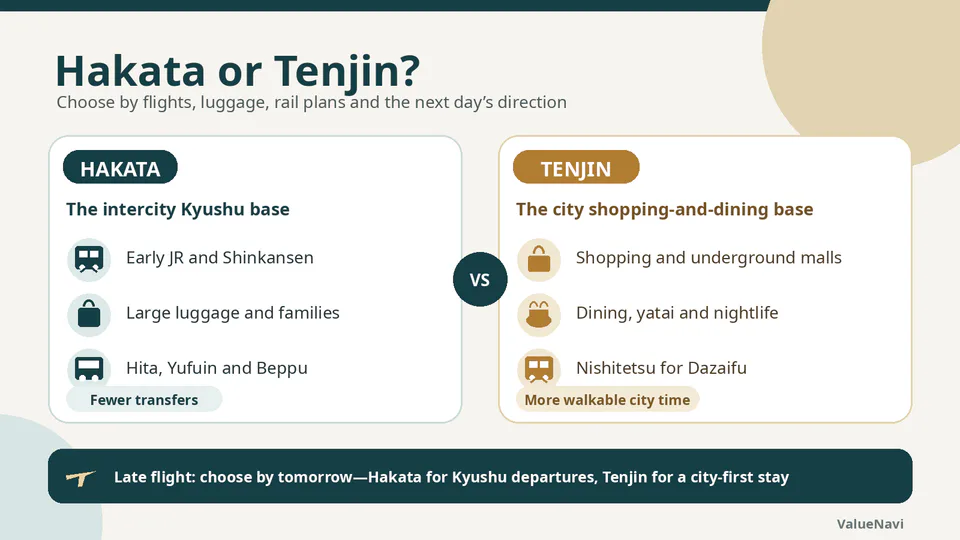
Choose Hakata when your Fukuoka stay is really the front door to a wider Kyushu trip: two or more time-sensitive JR or Shinkansen departures, a luggage-heavy transfer day, or a short transit-focused stay. Choose Tenjin when Fukuoka itself is the trip: repeated evenings around Tenjin, Daimyo or Nakasu, shopping, restaurants and a Dazaifu-focused day. The airport should usually be a tiebreaker, not the deciding factor. Fukuoka Airport currently quotes about five minutes by subway to Hakata and 11 minutes to Tenjin from the Domestic Terminal—a six-minute difference that is easy to overvalue across a multi-night stay.
The more useful question is which inconvenience will repeat. From Tenjin, every early JR morning adds a positioning ride to Hakata before the journey that actually matters. From Hakata, every late Tenjin evening ends with one more ride after dinner. Count those repeated edges before comparing hotel brands or nightly rates.
Checked August 25, 2026. Fukuoka Airport’s Domestic Terminal is directly connected to the subway. International passengers who want the subway must first move to the Domestic Terminal; the airport currently gives about 10 minutes for the free inter-terminal shuttle and warns that traffic can make it longer. Fukuoka City Subway currently states that trains operate roughly 05:30–00:25 at intervals of about 4–8 minutes, but exact first and last departures vary by station and date.
The stronger Fukuoka base is usually the one that removes the journey you would otherwise repeat.
Hakata vs Tenjin: choose by the part of the day that has the least margin
↔ Scroll table left or right
Your trip pattern | Start with | Why | What can reverse it |
Two or more early JR / Shinkansen mornings | Hakata | Removes a Tenjin→Hakata positioning trip before the least-forgiving journeys | Your rail departures are late and most evenings end in Tenjin |
Yufuin / Beppu by reserved rail with large luggage | Hakata | Yufuin no Mori and Sonic are centred on Hakata | You are using a direct highway bus that serves Tenjin and fits the trip better |
Two or more Tenjin / Daimyo / Nakasu evenings | Tenjin | Dinner, shopping and nightlife can end close to the hotel | Most mornings begin on JR at Hakata |
Dazaifu is a major day but the rest of the trip is city-focused | Tenjin, slight edge | Nishitetsu Fukuoka (Tenjin) is the natural rail hub for Dazaifu | Hakata also has a direct Dazaifu liner bus, so one Dazaifu day should not override several Hakata departures |
Only one Fukuoka night before wider Kyushu | Hakata | Arrival, luggage and the next intercity departure can stay around one hub | The night’s main purpose is Tenjin and the next departure is late |
Two to four city-focused Fukuoka nights | Tenjin, often | The useful hours are more likely to be food, shopping and evenings | Two or more days require time-sensitive Hakata departures |
The airport difference is six minutes on the subway, not a reason to choose four hotel nights
Fukuoka Airport is unusually close to central Fukuoka. The airport currently describes the subway ride from the Domestic Terminal as about five minutes to Hakata and 11 minutes to Tenjin. Both are on the Airport Line. For an ordinary domestic arrival, either area is therefore a low-friction base.
International arrivals need a different calculation. The subway station is on the Domestic Terminal side, and the airport’s free terminal shuttle takes about 10 minutes from International to Domestic before waiting and traffic variation are counted. The International Terminal also currently has direct local-bus options to both Hakata and Tenjin, so a late-arrival route should be compared door to door rather than by the subway headline alone.
ValueNavi rule: do not pay a multi-night location premium to save six airport minutes once. The airport becomes decisive only when the Fukuoka stay is essentially one transit night, the flight sits close to the first/last public-transport window, or one area creates a materially simpler luggage route to the hotel door.
Hakata wins when expensive mornings repeat

Hakata is strongest when the station is a repeated starting point, not merely because it is Fukuoka’s biggest transport hub.
JR Kyushu’s current 2026–27 timetable places major Shinkansen and limited-express movement at Hakata. Yufuin no Mori is reserved-seat-only and runs from Hakata toward Yufuin, with selected services continuing toward Oita/Beppu; Sonic connects Hakata with Beppu/Oita. Missing one of these journeys is more expensive than taking an ordinary subway one stop later than planned.
That makes an 08:00 intercity departure different from an 11:00 sightseeing ride. With an early reserved train, a Tenjin→Hakata subway ride consumes the buffer before the hard departure. With a late train, the same transfer may be trivial.
Count a high-cost Hakata morning when at least one of these is true:
the train is reserved or missing it would be costly;
you are checking out with large luggage;
the journey begins a multi-city Kyushu segment;
a missed connection would damage a ryokan dinner, flight or paid itinerary.
If two or more mornings meet that test, Hakata normally earns the hotel location even when Tenjin is more attractive after dark.
Tenjin wins when the useful hours repeat after dinner
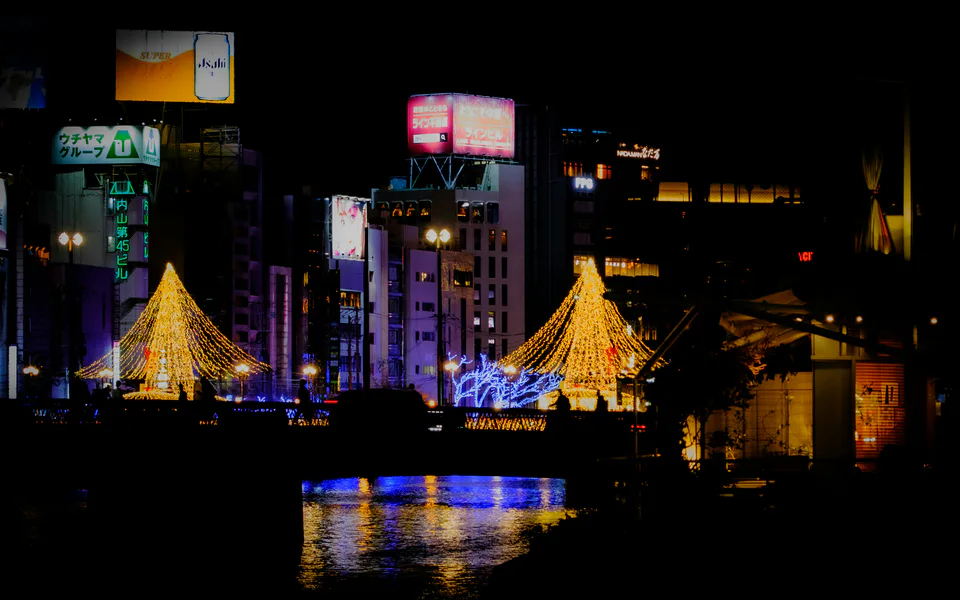
Tenjin is strongest when the hotel sits inside a repeated food, shopping and evening loop.
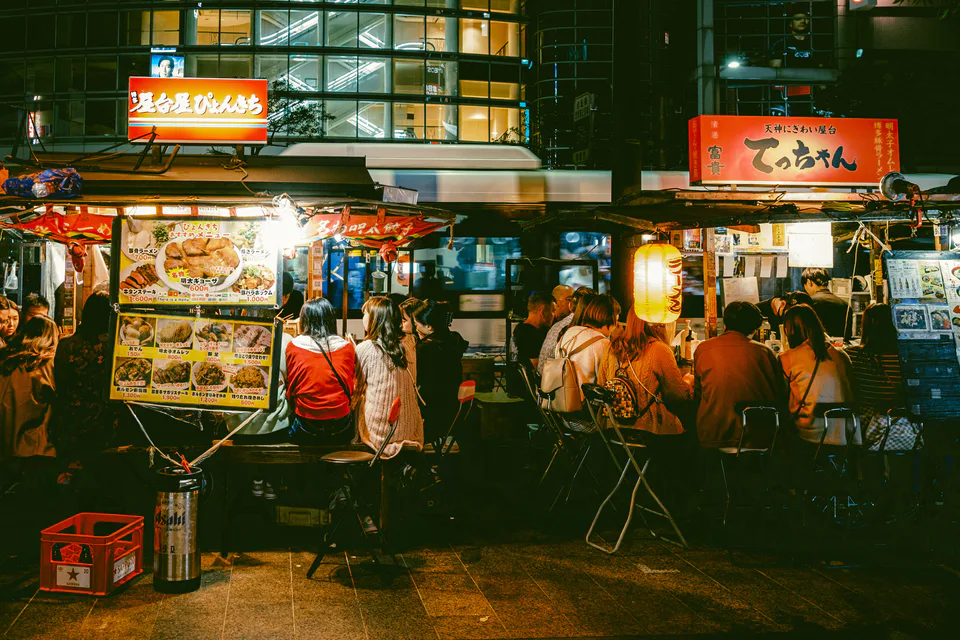
Tenjin’s advantage appears at the opposite end of the day. Department stores, Daimyo, Imaizumi, restaurants, bars and the walk toward Nakasu can make several evenings end without another transport decision. A Hakata hotel turns each of those nights into “one last ride” after the point when the group is already tired.
Frequency is what changes the answer. One Tenjin dinner should not outweigh three Hakata rail mornings. Three Tenjin evenings can outweigh one late-morning JR day. The better base is the one that removes the friction you pay repeatedly, not the inconvenience that appears once on the itinerary.
Yufuin and Beppu do not automatically mean Hakata — the transport mode matters
This is one of the easiest Fukuoka hotel rules to overgeneralise. If you are taking JR, Hakata is the clear base. Yufuin no Mori is reserved-seat-only, and Sonic is a Hakata-centred route toward Beppu/Oita. A luggage-heavy checkout followed by one of those trains is exactly the situation where eliminating the Tenjin→Hakata leg has real value.
If you are taking the highway bus, the answer is less one-sided. The current Yufuin-go serves Nishitetsu Tenjin Expressway Bus Terminal, Hakata Bus Terminal and Fukuoka Airport International, runs 14 round trips a day under the normal schedule, and lists roughly 2 hours 25 minutes between Tenjin and Yufuin. The current Beppu–Fukuoka highway bus likewise serves both Tenjin and Hakata, with 10 round trips a day under the normal schedule.
That means “Yufuin is on my itinerary” is not enough to choose Hakata. Write the transport product first:
Yufuin no Mori / Yufu / Sonic: Hakata gets a strong location advantage.
Reserved highway bus from Tenjin: Tenjin may remain the better hotel if the rest of the stay is city-centred.
International arrival followed directly by Yufuin or Beppu: check the current bus from the International Terminal before moving into the city simply to move back out again.
The wider route matters more than a slogan such as “Hakata is best for Kyushu.”
Dazaifu gives Tenjin an advantage, but not a monopoly
Nishitetsu Fukuoka (Tenjin) is the natural rail starting point for Dazaifu. The route map runs south toward Nishitetsu Futsukaichi, where the Dazaifu Line branches. For a city-focused stay that already favours Tenjin, this makes Dazaifu fit neatly into the base.
But Dazaifu is not a hard reason to move a rail-heavy trip to Tenjin. Nishitetsu currently also operates the Dazaifu Liner Bus “Tabito” directly from Hakata Bus Terminal to Dazaifu, with a published standard journey of about 40 minutes. A Hakata guest therefore has a viable direct option without first relocating to Tenjin.
The derived decision is more useful than “Tenjin = Dazaifu”: one Dazaifu day is a tiebreaker; a transport node you use three or four times is a base-defining constraint.
Do not compare district names until you compare the exact station stack
“Hakata” and “Tenjin” each hide several different walks.
Hakata: Hakata Exit and Chikushi Exit serve opposite sides of a very large rail complex, and subway exits add another layer. A hotel described as three or five minutes from Hakata Station can still be inconvenient for the platform you use each morning. With large luggage, check which side of the station the hotel occupies and whether the practical route has lifts.
Tenjin: Tenjin subway station, Nishitetsu Fukuoka (Tenjin) Station and the highway-bus terminal are close but are not one platform. The underground network helps in rain, yet a luggage route through malls and lifts can be longer than the map pin suggests. Hotels on the Akasaka, Tenjin-minami and Nakasu edges also behave differently from properties directly beside the Airport Line.
A well-positioned hotel on the nominally “wrong” side can therefore beat a badly positioned hotel in the “right” district. Compare hotel door → platform and hotel door → evening destination, not district label → district label.
Large luggage changes the cost of repetition, not the basic geography
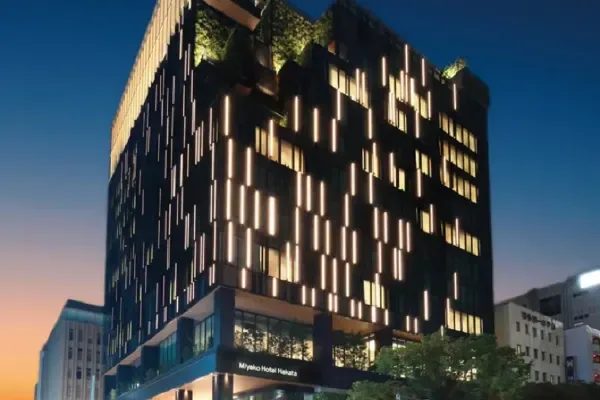
Hakata is usually the more resilient base for a multi-city trip because JR, Shinkansen, subway and bus departures concentrate around one hub. But that benefit depends on a sensible station-side hotel. Crossing a large station complex with two 29-inch cases can erase much of the theoretical convenience.
Tenjin is not automatically poor with luggage. If you arrive once, leave once and spend four nights locally, the cases may move only twice. In that trip, sleeping in Hakata purely “for luggage” can mean commuting back from the neighbourhood you actually use every evening.
Think of luggage over the whole stay:
Total luggage friction =
arrival handling
+ checkout handling
+ any hotel move
+ luggage carried on positioning trips before intercity travel
If Hakata deletes a luggage-bearing Tenjin→Hakata transfer on checkout morning, that is a meaningful win. If the luggage never leaves the Tenjin room until departure, it is not.
Families should price the room layout before they price a six-minute location difference
A family of four can get the “right” district and still buy the wrong room. Real beds, floor space with luggage open, a separate bath and toilet, stroller circulation and the hotel’s lift route can matter more than a few minutes on the Airport Line.
This is another reason not to turn Hakata vs Tenjin into a universal ranking. Hakata has many transport-oriented hotels and is often easier for a wider-Kyushu family route. Tenjin has department stores, indoor shopping and strong rainy-day convenience. If one area offers a materially better four-person room at a comparable total price, that room can outweigh a small transport edge—unless the trip contains multiple hard departures.
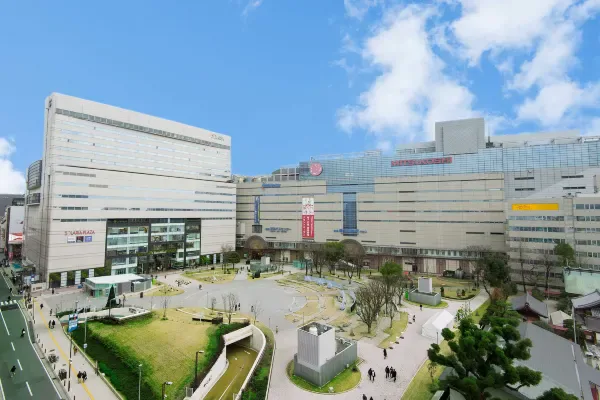
Once the area is decided, use the hotel-level comparisons rather than rebuilding the district decision around one brand: Miyako Hotel Hakata vs Solaria Nishitetsu Fukuoka is useful when the choice has narrowed to premium Hakata transport versus central Tenjin access.
Late arrival: choose the next morning, not a generic “airport-friendly” district
If public transport is still comfortably available, both areas work after a normal evening arrival. Domestic-terminal subway time is about five minutes to Hakata and 11 minutes to Tenjin. International passengers must add immigration, baggage and either the inter-terminal shuttle before the subway or a direct bus from the International Terminal.
Then look at the next morning:
Reserved JR / Shinkansen departure: Hakata.
Shopping, slow city morning or Dazaifu: Tenjin can be better.
Arrival close to the final public-transport window: stop optimising six minutes and compare the simplest taxi, direct-bus and late-check-in chain.
A scheduled landing is not a station-ready time. This matters most for an international arrival where immigration, baggage and the terminal transfer sit between touchdown and the city train.
Early flight: if the first train is too late, Hakata is not a magic fix
Hakata is physically closer to the airport, but a very early flight can put both districts outside the useful subway window. International departures add the terminal-transfer step from the Domestic Terminal/subway side to the International Terminal, for which the airport currently publishes roughly 10 minutes before traffic variation.
Work backwards from the airline’s required terminal-arrival time. If the first train does not leave a comfortable margin, the answer may be a pre-arranged taxi rather than moving one hotel from Tenjin to Hakata. Once public transport is outside its useful operating window, a six-minute daytime rail difference is no longer the main variable.
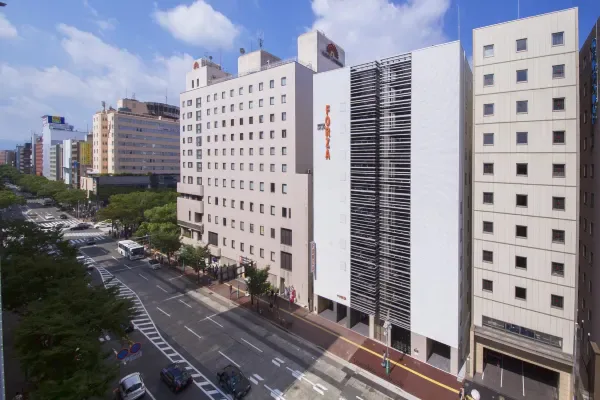
Two to four nights: usually keep one hotel
The Hakata–Tenjin subway gap is too small to justify a routine hotel move. A split adds packing, checkout, luggage handling, second check-in and the possibility that neither hotel is available when you actually want the room.
For a normal two-, three- or four-night Fukuoka stay, choose one base and commute to the other area. The split starts making sense when the two Fukuoka stays have different jobs—for example, Hakata before a wider-Kyushu rail segment and Tenjin after returning to Fukuoka for shopping and final meals.
That pattern is especially useful on a five-to-seven-day Kyushu trip. It is not “move hotels for variety.” It is Hakata first for transport, Tenjin later for the city, with a regional itinerary between them.
Nakasu and Ohori Park are specialist alternatives, not automatic compromises
Nakasu is a night-first alternative, not simply a midpoint between Hakata and Tenjin.
Nakasu makes sense when nightlife, riverfront evenings and Nakasu-Kawabata Station are the main priorities. It is not automatically “the best of both worlds”: JR still centres on Hakata, luggage still has a final walk and some streets are much livelier at night than a family or light sleeper may want.
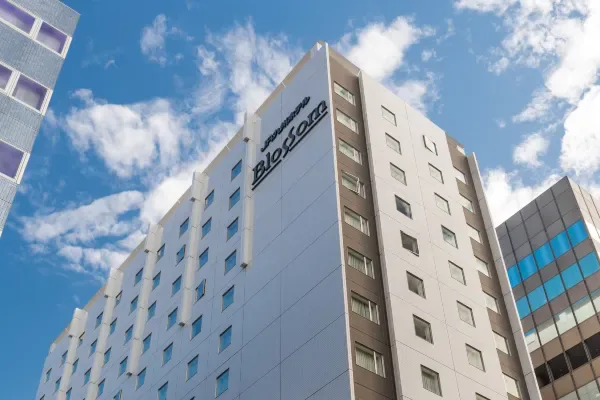
Ohori Park / Akasaka can be stronger for a longer, calmer stay, running or remote work. For a first two- or three-night visit with multiple transport tasks, Hakata or Tenjin is usually easier to justify.
Four itinerary tests
Three nights, then wider Kyushu
Hakata normally wins. If Day 4 begins with Yufuin no Mori, Sonic, Shinkansen or another hard intercity departure, keeping the hotel beside the transport hub protects the least flexible morning. Tenjin remains easy to visit for dinner.
Three nights focused on Fukuoka city plus Dazaifu
Tenjin normally wins. The daily geography stays around the city centre and Nishitetsu side. Hakata’s direct Dazaifu bus means the answer is not absolute, but one casual Hakata visit is not enough to move the whole stay east.
Four nights with one JR day and three Tenjin evenings
Tenjin can still win. Accept one Tenjin→Hakata positioning trip instead of repeating Hakata→Tenjin after dinner three times. One intercity day should not automatically choose all four nights.
Fukuoka at both ends of a Kyushu loop
Use the two areas asymmetrically. Hakata before the intercity section; Tenjin after it when shopping and food are the final priorities. This is one of the few split patterns where changing area solves a real route change rather than manufacturing variety.
Final verdict: Hakata for repeated hard departures, Tenjin for repeated useful evenings
Hakata is the better base when expensive mornings repeat. Use it for two or more early JR/Shinkansen starts, Yufuin or Beppu by rail with luggage, a one-night Kyushu transit stop, or a stay where checkout itself begins an intercity transfer.
Tenjin is the better base when useful evenings repeat. Use it when Fukuoka city life, shopping, food, yatai and two or more late evenings dominate the stay, with Dazaifu adding another reason rather than deciding the trip by itself.
Do not let a six-minute airport difference decide four hotel nights. Do not let one Dazaifu day override three Hakata departures. Do not let one Yufuin day override three Tenjin evenings when you are taking the highway bus anyway. Write down the journeys that happen more than once; the stronger base is usually the one that deletes the most tiring repetition.
Compare Fukuoka hotels after choosing your base
Continue planning
References
Fukuoka Airport — airport access overview · Fukuoka Airport — Domestic/International terminal shuttle · Fukuoka Airport — current bus destinations · Fukuoka City Subway — route and operating hours · JR Kyushu — reserved-seat-only trains · JR Kyushu — Sonic · Nishitetsu — Dazaifu Liner Bus “Tabito” · Kamenoi Bus — current Fukuoka–Yufuin/Beppu highway buses. Checked August 25, 2026; recheck the exact train or bus for the travel date.