
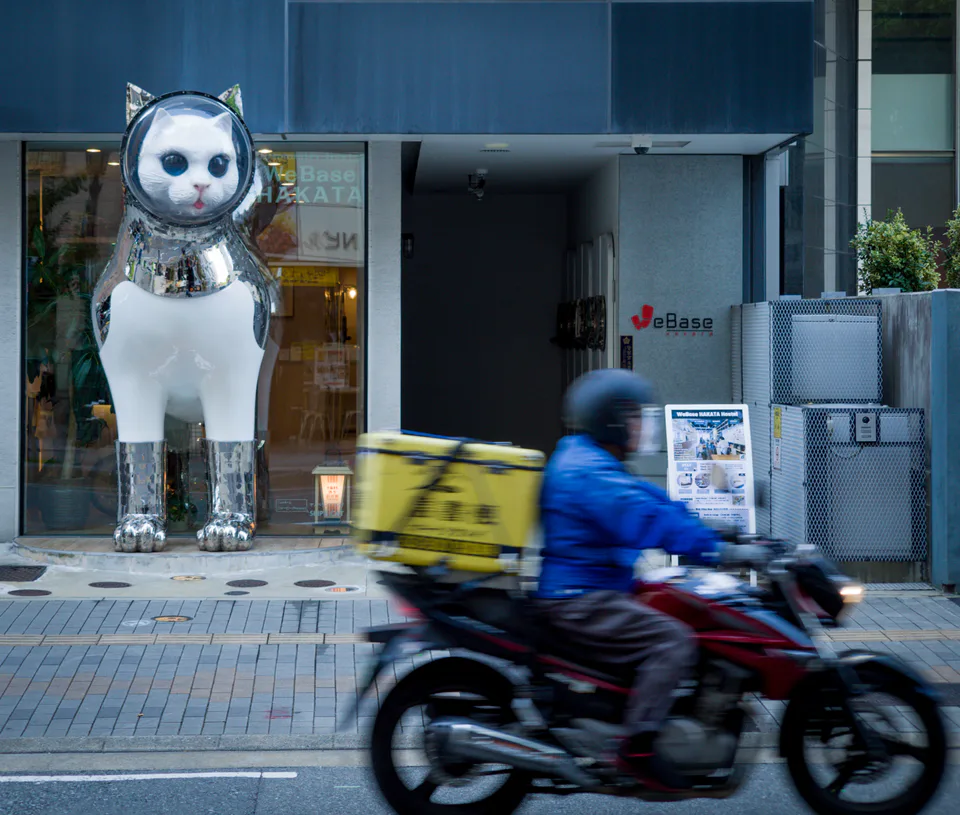
Choose WeBase Hakata when remote work has to fit around a short first visit to Fukuoka: its 24-hour Books & Lounge, 24-hour front desk and Nakasu-Kawabata location make airport, Hakata Station, Tenjin, meals and late returns easier to combine with laptop hours. Choose UNPLAN Fukuoka when the workday itself is a larger part of the stay: its 24-hour lounge has powered tables, a full kitchen and a much larger published event-space footprint, while Ohori Park gives you a lower-density routine outside the hostel.
The biggest catch is the same at both properties: a shared lounge is not a private meeting room. Neither operator promises acoustic privacy, a guaranteed quiet desk or a reservable video-call booth for ordinary guests. If a confidential client call or interview cannot tolerate background conversation, music, kitchen activity or other guests, book a private room and have an external coworking/meeting-room backup. That boundary matters more than a small difference in hostel price.
The 30-second decision: match the hostel to the type of work
↔ Scroll table left or right
Your work pattern | Start with | Why | Main catch |
2–4 laptop hours around sightseeing | WeBase Hakata | 24-hour coworking-style lounge plus much stronger Hakata/Tenjin/airport geometry | Private rooms are extremely compact and bathrooms are shared |
Long workday with several breaks | UNPLAN Fukuoka | Large 24-hour lounge, powered tables, kitchen and Ohori Park directly outside the daily routine | The lounge also contains TV, speaker, social and laundry functions; it is not guaranteed silent |
Confidential calls / interviews | Neither shared lounge | No ordinary guest call booth or guaranteed acoustic privacy is published | Use a private room plus headphones, or reserve an external private workspace |
Late US/Europe-time work plus need for staff support | WeBase | Lounge and front desk are both published as 24 hours | 24-hour staffing does not make the lounge quiet |
Repeated Hakata Station / Shinkansen mornings | WeBase | Nakasu-Kawabata is two subway stops from Hakata Station | If every morning starts at Hakata before 07:00, a true Hakata Station hotel may still beat both |
Running, walking and a calmer long-stay routine | UNPLAN | One minute from Ohorikoen Station and directly beside the Ohori Park area | You give up some of Nakasu/Hakata’s centrality |
Both lounges are open 24 hours, so “has a workspace” is not the differentiator
WeBase explicitly describes its ninth-floor Books & Lounge as a coworking-capable space for guests, open 24 hours with plenty of outlets, free Wi-Fi and a shared kitchen. UNPLAN likewise gives staying guests 24-hour access to its fifth-floor lounge, with tables that have built-in power sockets, free Wi-Fi, sofas and a kitchen.
That means a comparison such as “WeBase for work, UNPLAN for socialising” is too simplistic. Both are work-capable shared hostels. The useful difference is how the space sits inside the rest of your day.
WeBase places the workspace inside a very central travel node. The official site lists Nakasu-Kawabata Station three minutes away, Fukuoka Airport four subway stops / about nine minutes away, Hakata Station two stops / about three minutes, and Tenjin one stop / about one minute before the final walk. If your trip alternates between laptop blocks and sightseeing, those repeated city movements can matter more than lounge size.
UNPLAN publishes a much larger physical lounge envelope: its event-space page gives the fifth-floor lounge as 96.13 m² with a 40-seat event configuration and capacity for 50. That does not guarantee 40 work seats will always be free for hostel guests—the page describes a rental/event layout—but it does show why UNPLAN can feel like the more substantial long-session workspace on paper.
The hidden remote-work constraint is acoustic privacy
A powered table solves charging. It does not solve a client call.
WeBase’s lounge is also a library, kitchen, breakfast area and social space. UNPLAN’s lounge explicitly includes a TV, Bluetooth speaker, board games, sofas, kitchen and 24-hour laundry machines. Those are useful hostel features, but they also show why neither operator should be described as a guaranteed quiet office.
For asynchronous work—email, coding, writing, design, research—either lounge can be a strong budget solution.
For scheduled ordinary calls, use headphones and a private room as your fallback, and avoid promising yourself that a particular lounge corner will be empty at 21:00.
For confidential calls, interviews or presentations, I would not make either shared lounge the only plan. The failure cost of one noisy call is larger than the savings from choosing a hostel over a private-workspace option.
This is the deletion test for a remote-work hotel: if the stay stops working the moment someone else starts talking nearby, you have not actually solved the work requirement.
WeBase has the clearer published Wi-Fi ceiling—but it is not a speed guarantee
WeBase’s current FAQ publishes free Wi-Fi with stated maximum speeds of up to 150 Mbps download and 250 Mbps upload. UNPLAN confirms free Wi-Fi throughout the building but does not publish an equivalent speed ceiling on its current guest pages.
That makes WeBase easier to assess before booking if upload-heavy work matters. It does not prove that every device will receive those speeds at every hour. Hostel Wi-Fi performance still depends on access-point load, device capability, interference and how many guests are online.
For work that cannot survive an outage, use a second connection. A Japan eSIM with hotspot capability is more useful as resilience than as a reason to choose one hostel over the other.
Private-room geometry changes the answer more than the word “private”
Remote workers often assume that upgrading from a dorm to a private room solves the entire work problem. At WeBase, the official room dimensions show why that is not automatically true.
The WeBase King Room is 8.90 m² for two people. Its Twin Room is only 6.98 m², although the Twin does include a desk and chair. The two-person private bunk room is 4.78 m². All of these use shared shower rooms and lavatories.
Those rooms can be completely rational for sleep plus a 24-hour lounge. They are much weaker as all-day private offices. A 6.98 m² twin with two beds, luggage and a desk is a very different remote-work product from a standard business-hotel room with a private bathroom.
UNPLAN does not publish square metres for every guest room on its main stay page, so I would not invent a size advantage. What it does publish is more directly relevant to working: the Private Double and Private Twin include a folding table and two chairs; the Private Family Room also has a folding table, two chairs and under-bed luggage storage. The Pod Dormitory even gives each pod a folding table and shelf. Bathrooms remain shared.
Decision rule: choose the private room for sleep/privacy first. If you also need a private eight-hour office, compare the actual room workstation and floor area rather than assuming “private room” means “good remote-work room.”
WeBase is materially easier when Hakata, Tenjin and the airport keep repeating
WeBase is three minutes from Nakasu-Kawabata Station. Its official access information gives four stops / roughly nine minutes from Fukuoka Airport Station, two stops / roughly three minutes from Hakata Station and one stop / roughly one minute from Tenjin Station, before the final station walk.
UNPLAN is only about 40 metres from Ohorikoen Station Exit 4, which is excellent final-metre access. Its official access page gives about 20 minutes by train from Fukuoka Airport.
This creates a useful trade-off:
WeBase: more time saved across airport, Hakata, Tenjin and Nakasu movement.
UNPLAN: extremely short final walk from Ohorikoen Station and a less central daily environment.
If you have three Shinkansen mornings, restaurant nights in Nakasu and only two short work blocks, WeBase’s transport savings repeat several times. If you work six hours a day and only go into central Fukuoka once each evening, UNPLAN’s daily routine can be more valuable than saving a few subway stops.
If the trip is really built around Hakata Station rather than remote work, reopen the broader Hakata vs Tenjin accommodation decision. A budget hostel should not force you into repeated transport that a slightly more expensive hotel would remove.
Late-night work: both spaces stay open, but only WeBase publishes 24-hour front-desk coverage
Both hostels publish 24-hour guest lounge access. WeBase additionally publishes 24-hour front-desk staffing and currently advertises check-in as late as 02:00 with advance notice for a late arrival. Its formal rules page gives a narrower standard check-in window, so anyone arriving very late should still notify the property rather than treating 02:00 as a no-questions-asked guarantee.
UNPLAN’s current About page lists reception from 10:00 to 23:00, with check-in from 16:00 and checkout by 11:00. Its access page currently contains conflicting duplicated reception text—10:00–23:00 in one block and 10:00–19:00 in another—so a late arrival should be confirmed directly.
For someone taking North American calls after midnight, the lounge access is available at both. WeBase’s 24-hour front desk is an extra recovery layer if a keycard or facility issue occurs overnight. It is support value, not acoustic value.
Laundry can support a long stay—or interfere with the workspace
WeBase publishes a 24-hour laundry room separate from the ninth-floor lounge, and its Japanese FAQ currently lists JPY 200 per wash and JPY 100 per 30 minutes of drying. UNPLAN places its 24-hour laundry machines inside the fifth-floor lounge, currently JPY 300 per wash and JPY 100 per 20 minutes of drying.
For a one-week stay, either solves a practical travel problem. From a work perspective, the layout difference matters: UNPLAN lets you work while a wash cycle runs a few metres away, but machine use is another reason not to assume the lounge will remain acoustically office-like at every hour.
UNPLAN also offers free luggage storage before check-in and, on checkout day, currently states free storage until 19:00. WeBase provides a self-service cloakroom under its published operating rules. For workers carrying a large suitcase plus laptop bag, that matters more than a decorative hostel amenity.
UNPLAN’s Ohori Park location is a work-routine advantage, not just a sightseeing advantage
UNPLAN sits one minute from Ohorikoen Station and describes its setting as a quiet area overlooking Ohori Park. For a longer remote-work stay, the useful feature is not simply “the park is pretty.” It is that the park can become a repeatable break without another train journey.
If your day is four hours of work, lunch, another three hours of work and an evening out, a walk or run at Ohori can create a cleaner work/rest boundary than spending every break inside the same hostel.
That advantage matters less on a three-night first visit when most waking hours belong to sightseeing. In that case Nakasu-Kawabata’s access to Hakata Old Town, Nakasu and Tenjin can create more total value.
UNPLAN’s rooftop terrace should not be counted as an extra current work zone: the operator still states that rooftop-terrace service is suspended for maintenance.
Three worker profiles produce three different answers
1. Short first visit: sightseeing first, work second
I would choose WeBase. You are likely to value being three minutes from Nakasu-Kawabata, moving quickly to Hakata/Tenjin, using the 24-hour lounge for two- to four-hour blocks and keeping late-night front-desk support.
The trade-off is the room. If you book a tiny private twin because you expect to work privately all day, the hostel’s centrality does not fix the floor-space problem.
2. One- to two-week stay: several full workdays
I would lean UNPLAN when the itinerary can tolerate Ohorikoen. The published 24-hour lounge, large physical workspace envelope, folding tables in private rooms, kitchen, laundry and Ohori Park create a more coherent daily routine.
The trade-off is repeated transport. If every evening and every weekend day begins at Hakata or Nakasu, the commute you accepted for a calmer routine may become the largest hidden cost.
3. Remote job with sensitive calls
I would choose neither hostel purely for the shared workspace. Pick the property whose location and sleeping setup you prefer, then secure a private call solution. A budget shared lounge is excellent for asynchronous work; it should not carry a meeting requirement the operator never promised.
What would reverse the recommendation?
Choose UNPLAN over WeBase even for a short stay if you have only one central sightseeing day, expect long laptop sessions, actively want Ohori Park and find a private-room rate that works.
Choose WeBase over UNPLAN even for a longer stay if repeated Hakata Station journeys, airport movement, Nakasu/Tenjin evenings and 24-hour front-desk support save more time than the larger lounge and park routine.
Choose a normal private hotel instead of either if you need a private bathroom, a guaranteed in-room office, frequent confidential calls, or enough floor space to leave large luggage open for a week. “Budget remote-work hostel” stops being good value when you have to rent an external meeting room every day to make the job possible.
Final verdict
WeBase Hakata is the better default for a short first Fukuoka stay that includes remote work; UNPLAN Fukuoka is the more interesting long-workday base when the Ohori Park location and larger shared workspace are part of the routine. The reason is not that one has Wi-Fi and the other does not—both publish 24-hour work-capable lounges. WeBase wins on repeated city/airport geometry and overnight staff coverage. UNPLAN wins when workspace scale, in-room folding tables and a park break matter more than being close to Nakasu and Hakata.
The hard boundary is calls. For confidential or business-critical video meetings, neither shared lounge should be treated as a guaranteed private office. Solve that requirement separately before choosing the cheaper bed.
Related planning
References
WeBase HAKATA — location, breakfast, front desk and 24-hour lounge · WeBase HAKATA — current room dimensions and facilities · WeBase HAKATA — Wi-Fi and shared facilities · UNPLAN Fukuoka — rooms, 24-hour lounge, laundry and current rooftop status · UNPLAN Fukuoka — reception and luggage service · UNPLAN Fukuoka — Ohorikoen and airport access. Checked August 25, 2026. Shared-space noise, seat availability and real Wi-Fi performance vary; recheck current operating rules before booking.