
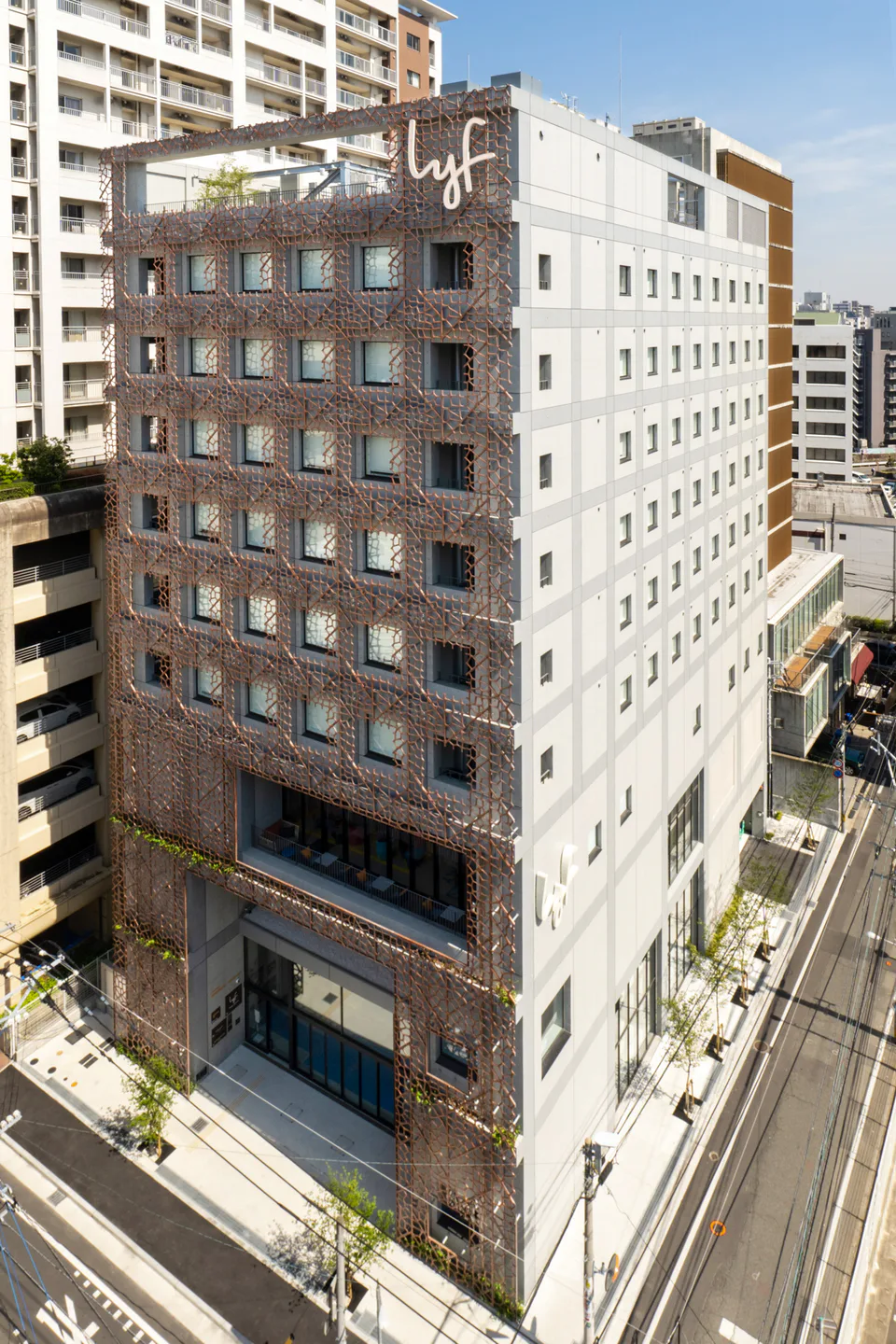
lyf Tenjin Fukuoka is worth the 12m² room only when you deliberately move part of your stay out of the room. The standard double and standard twin are both 12m², so changing to twin beds does not buy extra floor area. What you get instead is a real shared-living system: BOND social kitchen, WASH & HANG laundry and a 24-hour coworking/lounge area. For a solo traveller or a light-packing couple who spends evenings around Tenjin and will actually use those spaces, that trade can work. For two large suitcases, long private-room downtime or repeated early Hakata departures, I would price the 16m² Side by Side Plus or a different hotel before booking.
The key correction is that a longer stay does not automatically make lyf better. A four-night stay creates more chances to use the kitchen and laundry, but it also means living with the small room for four nights. The hotel becomes stronger only when the shared facilities replace functions you would otherwise need inside the room.
If you have not chosen the Fukuoka base yet, start with Hakata or Tenjin. lyf makes the most sense after Tenjin has already won that area decision.
lyf Tenjin Fukuoka: the 30-second decision
↔ Scroll table left or right
Your real use case | My verdict | Why |
Solo, light luggage, 2–4 nights, Tenjin-led evenings | Book | 12m² is easier for one person, while the shared kitchen/lounge can genuinely replace private-room functions |
Two adults, compact luggage, mostly outside all day | Book conditionally | The room works if you are comfortable using common space rather than expecting a private living area |
Two adults + two large suitcases, 3–5 nights | Price the 16m² room first | Side by Side Plus adds 4m², or about 33% more published floor area |
Long private work calls or lots of room downtime | Compare another hotel | A shared lounge cannot guarantee privacy, quiet or an available preferred seat |
Two or more early JR/Shinkansen mornings from Hakata | Recheck the base | Tenjin nightlife convenience may be outweighed by the repeated first transfer to Hakata |
Kyushu self-drive | Usually skip | No on-site parking means the hotel’s walking-and-transit strengths are not doing much work |
The real question: can shared space replace at least two room functions?
“Co-living” is too vague to justify a 12m² room. Use a substitution test instead. Ask which of these things you would normally do in the room:
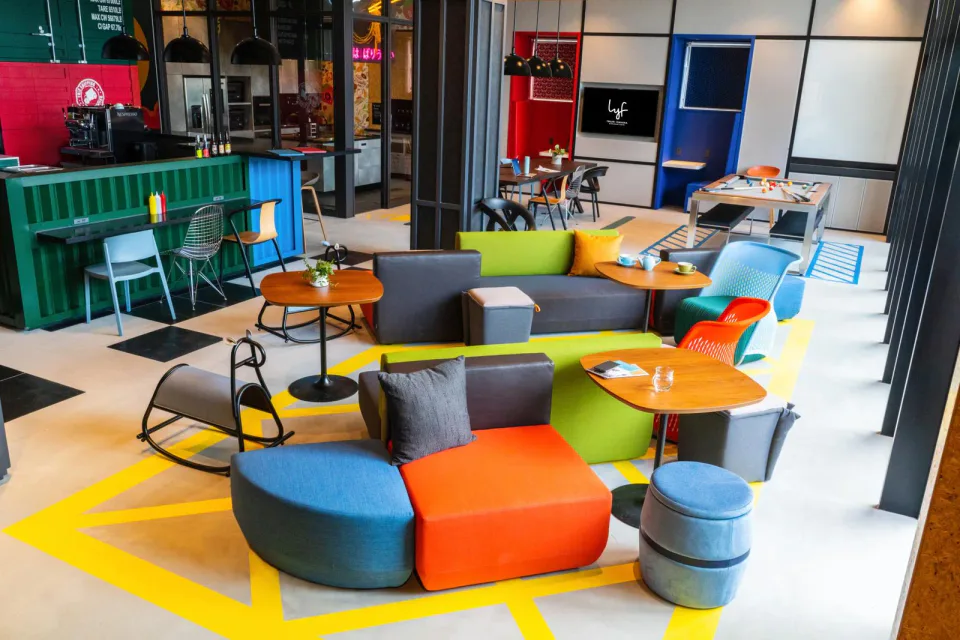
Eat or prepare simple food: BOND can move that task into the shared kitchen.
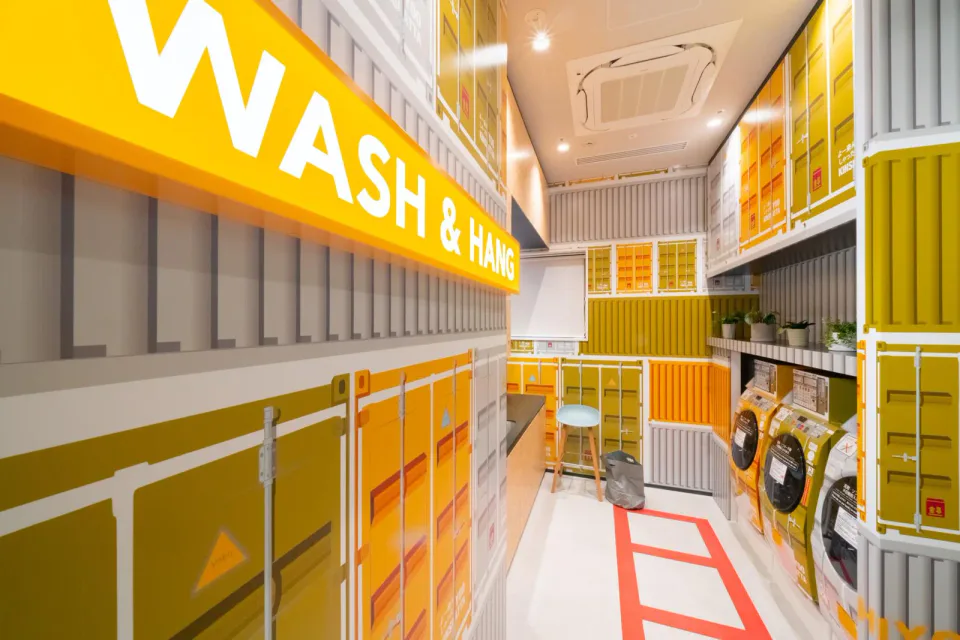
Wash clothes: WASH & HANG can reduce the need to pack several extra outfits.
Work, plan the next day or edit photos: the 24-hour common workspace can move a short laptop session out of the room.
Sit somewhere other than the bed: the lounge can function as an additional place to spend awake hotel time.
If none or only one of those substitutions applies, the common areas are mostly amenities you admire while still living in 12m². If two apply, the trade becomes plausible. If three or four apply and you are comfortable with shared space, lyf’s design starts to work as intended.
This is the deletion test for the hotel: imagine BOND, WASH & HANG and the 24-hour lounge were removed. If you would no longer book the 12m² room at the same price, those shared facilities are genuinely part of the value. If you would still book it only because the photos look stylish, the room itself should carry more weight.
12m² vs 16m²: the upgrade is larger than the numbers first look
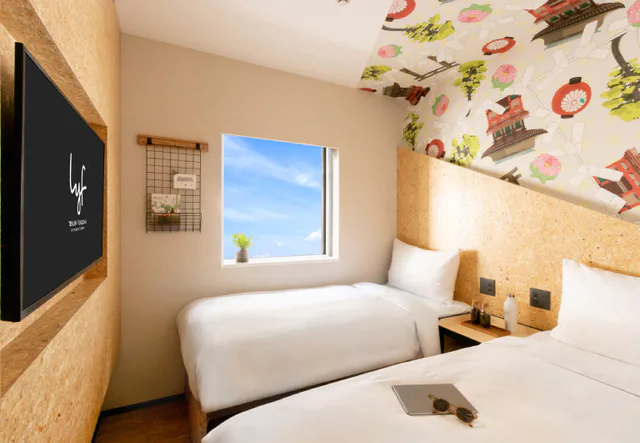
The official room list currently gives One of a Kind (Studio Double) and Side by Side (Studio Twin) as 12m², both for up to two guests. Side by Side Plus (Studio Corner Twin) is 16m², while One of a Kind Plus is a 22m² accessible room.
For two occupants, the published gross room area works out to 6m² per person in a 12m² room and 8m² per person in a 16m² room. That is not a measurement of usable walking space—the bathroom, beds and furniture are inside those figures—but it shows why the upgrade should not be dismissed as “only four square metres.” The 16m² category has about 33% more published floor area.
↔ Scroll table left or right
Room | Published size | Best fit | Main caution |
One of a Kind | 12m² / double | Solo or light-packing couple | Private-room space is the main compromise |
Side by Side | 12m² / twin | Two travellers who need separate beds | Twin beds do not create a space upgrade |
Side by Side Plus | 16m² / corner twin | Two people with more luggage or a longer stay | Compare the total premium across all nights, not just one-night difference |
One of a Kind Plus | 22m² / accessible | Guests who need the accessible layout | Do not use accessible inventory as a generic “largest room” shortcut |
The hotel does not publish a guarantee that two 28-inch suitcases can remain fully open in the 12m² rooms. I would therefore treat luggage as a veto rather than inventing a precise suitcase layout. Two large cases plus shopping for several nights is enough reason to price Side by Side Plus before committing to the standard twin.
The Tenjin walk is less precise than the old article implied
There is a current first-party-source mismatch that matters for luggage planning. lyf’s own location information lists Nishitetsu Fukuoka (Tenjin) Station at about six minutes on foot, Tenjin-minami at about five minutes and the Airport Line’s Tenjin Station at about ten minutes. Fukuoka Prefecture’s official tourism site, however, currently lists the Airport Line Tenjin walk at about six minutes and also lists Tenjin-minami and Yakuin at about five minutes.
I would not resolve that by pretending one number is universally correct. The exact route changes with exit, underground walking and where you start timing. For a traveller arriving from Fukuoka Airport on the Airport Line with large luggage, I would budget closer to ten minutes from the subway platform/exit system to the hotel rather than treating six minutes as a door-to-door promise.
This does not make the location bad. It clarifies what the hotel is good at. lyf is a Tenjin/Imaizumi lifestyle base, not an exit-to-lobby airport or Shinkansen hotel. Its payoff is strongest when dinner, cafés, shopping and late walking keep ending near the hotel.
If two of your first three mornings start with long-distance JR from Hakata, compare the repeated transfer using the Fukuoka transport guide and Fukuoka to Yufuin transport comparison before choosing Tenjin on atmosphere alone.
BOND and WASH & HANG are real operating facilities, not just branding
The hotel’s current official material describes BOND as a social kitchen, and the downloadable lyf property guide lists two cooking stations with induction hobs, ovens and microwaves, plus shared refrigerators and an ice machine. That is enough infrastructure for breakfast, reheating food and simple cooking. It is still a common kitchen, not a private kitchenette attached to your 12m² room.
The same official property guide lists WASH & HANG laundry charges at JPY 600 for a 120-minute wash-and-dry cycle, JPY 300 for a 35-minute wash and JPY 100 for 30 minutes of drying. Because hotel operating details can change, confirm the machine instructions on arrival; the planning point is that laundry is a concrete paid function that can reduce packing volume, not simply a decorative “long-stay” promise.
Fukuoka Prefecture’s official tourism site currently describes the free coworking space and terrace lounge as open 24 hours. That makes late-night itinerary planning or a short laptop session unusually flexible. It does not guarantee silence, privacy or a particular desk whenever you want it.
One night, four nights and thirty nights are three different products
Stay length changes both sides of the trade.
One or two nights
The shared kitchen and laundry may contribute almost nothing because you simply do not need them. A light-packing solo traveller can still love the room because 12m² is easier for one person. For two adults with luggage, however, a short stay does not magically make the room larger. Book because the Tenjin location works, not because you expect to “use all the facilities.”
Three to six nights
This is where the hotel either becomes clever or becomes tiring. Laundry can remove clothing from the suitcase, BOND can absorb simple meals, and the lounge can move some awake time outside the room. But the room-size penalty also repeats every night. The correct question is not “long stay = better value”; it is whether your shared-space use increases faster than your frustration with the private room.
Thirty nights or more
lyf currently advertises extended stays above 30 nights. At that point, I would not choose solely from the hotel’s long-stay label. Test privacy, storage, laundry frequency, work-call needs and whether you actually enjoy a social common-space model. A 30-night stay magnifies both the benefits and the compromises.
Remote work: useful for short sessions, weaker for confidential work
The 24-hour common workspace is a genuine advantage for travellers who need 30–90 minutes for email, itinerary changes, photo backups or routine laptop work. It is much less convincing as a substitute for a private office.
Shared space comes with three uncertainties: other guests, background noise and seat availability. If your job depends on long private calls, confidential screens or several hours of uninterrupted work every day, I would choose a hotel where the private room itself can support that work. The Tokyu Stay Fukuoka Tenjin model is a useful contrast because more long-stay functionality sits inside the room rather than outside it.
Who gets the strongest location value?
Tenjin, Imaizumi and Daimyo are the natural fit. Shopping, cafés and dinner can all end near the hotel, so the location pays you back most clearly at night. The Fukuoka yatai guide and Fukuoka breakfast guide are useful tests: if your actual food plan keeps returning to central Fukuoka, lyf’s base makes sense.
A single Yufuin or Aso excursion does not automatically make Tenjin wrong. Repeated Hakata departures do. If two or three mornings begin with JR, Shinkansen or a highway-bus connection at Hakata, add that repeated first transfer to the hotel comparison.
Self-driving is the clearest mismatch. Fukuoka Prefecture’s tourism listing currently says there is no hotel parking. Nearby paid parking may be perfectly manageable for one night, but a multi-day Kyushu road trip turns that into a daily cost and task. I would rather use a hotel whose parking strategy is part of the product.
Three nearby alternatives solve different weaknesses
Tokyu Stay Fukuoka Tenjin: compare it when washer-dryer access and more private-room functionality matter more than social common space.
LAMP LIGHT BOOKS HOTEL Fukuoka: compare it when you like compact rooms but want the shared-space proposition to centre on the bookstore/café experience rather than cooking and laundry. See the LAMP LIGHT BOOKS HOTEL Fukuoka guide.
Solaria Nishitetsu Hotel Fukuoka: compare it when you want a more conventional Tenjin hotel and stronger station-led convenience instead of the co-living trade. See Solaria Nishitetsu Hotel Fukuoka vs Hakata.
The point is not that any one alternative is universally better. Each one removes a different objection. If your objection to lyf is the 12m² room, compare private space. If your objection is shared work space, compare room-based facilities. If your objection is station friction, compare a more transport-led hotel.
Compare the room upgrade before comparing the hotel brand
If lyf’s location and shared-space model already fit the trip, price Side by Side Plus against Side by Side first. The upgrade adds about 33% published floor area without changing the basic hotel model. Only after seeing that total premium across the full stay should you compare another brand.
For example, a nightly upgrade premium that looks modest becomes four times as large on a four-night stay. Conversely, rejecting the upgrade because it costs more per night can be false economy if the 12m² room is the one feature most likely to annoy you every day. The correct comparison is total-stay premium versus the specific problem the extra 4m² solves.
Booking.com | Check lyf Tenjin Fukuoka rooms
Trip.com | Compare the same room type
Agoda | Check current lyf Tenjin Fukuoka options
Final verdict: when is the 12m² room actually worth it?
I would book the 12m² room for a solo traveller or light-packing couple when Tenjin/Imaizumi is the real activity zone and at least two shared functions—kitchen, laundry, lounge/workspace—will genuinely replace things you would otherwise do in the room.
For two travellers with large luggage or a three-to-six-night stay, I would not automatically reject lyf, but I would price the 16m² Side by Side Plus first. Its 4m² increase is roughly one-third more published room area and can matter more than another hotel amenity.
I would skip lyf when private-room downtime is central to the holiday, confidential remote work is frequent, the itinerary repeatedly starts at Hakata, or the trip is self-drive. In those cases, the hotel’s clever shared-space design is solving the wrong problem.
THE LUIGANS Spa & Resort Fukuoka: Is a 33m² Sea-View Room Worth Leaving Hakata for One Night?
Mitsui Garden Hotel Fukuoka Gion: Is the 26.6 m² Triple Room Worth It for 3 Adults?
Hotel Sonia Otaru: Is a Canal-View Room and Rooftop Onsen Worth the 8-Minute Station Walk?
THE BASICS FUKUOKA: Chapter or Episode — Is NOMBRE Lounge Worth the Upgrade?
Hotel Mei Fukuoka Tenjin: Is Haruyoshi Worth the Final Walk?
Sources
The Ascott Limited — lyf Tenjin Fukuoka official rooms and facilities · The Ascott Limited — location and access · lyf Tenjin Fukuoka — property guide for BOND and WASH & HANG · Crossroad Fukuoka — 24-hour common space, access and parking. Checked August 25, 2026. Room inventory, laundry charges, access wording and rate conditions can change; verify the live hotel page and booking conditions for your dates.