For a solo Fukuoka stay, I would not start with the cheapest single room. I would start with the repeated friction you will pay alone. If two mornings begin with an early JR train or airport transfer, Hakata Station can be worth more than a trendy neighbourhood. If you return late around Nakasu, a compact room at THE LIVELY can work because the location and shared space do part of the job. If you are staying five nights, opening a suitcase every day, doing laundry or working in the room, a 12 m² lifestyle room can become a repeated compromise rather than a clever saving.
The useful question is: where are you willing to move the missing square metres? Into a lobby and coworking space? Into a social kitchen? Into cafés and the city? Or do you want to pay for a larger private room so that the hotel itself is the recovery space? Solo travel makes that trade-off sharper because one person pays the entire room premium—but also the entire taxi fare, luggage effort and navigation penalty when the location is wrong.
↔ Scroll table left or right
Your solo pattern | Start with | What you are buying | Main trade-off |
1–2 nights, late arrival or early JR | HOTEL FORZA Hakata Station | One-minute-scale Hakata final leg and an 18 m² standard double | You are paying for transport efficiency more than neighbourhood atmosphere |
Late Nakasu returns + you will use a lobby/coworking space | THE LIVELY FUKUOKA HAKATA | Nakasu-Kawabata access and shared space that can replace some room time | A compact private room still remains compact when you want to stay in |
4–7 nights + kitchen/laundry/shared-space use | lyf Tenjin Fukuoka | 12–16 m² rooms backed by BOND kitchen, WASH & HANG and social areas | The model only works if you actually use the communal facilities |
Private-room recovery matters more than social space | Hotel JAL City Fukuoka Tenjin | 21 m²+ rooms and Akasaka Station access | Akasaka is not Hakata Station and not the middle of every Tenjin night |
Use a room-hour test before deciding that 12 m² is “enough for one person”
Passenger count is a weak way to size a solo room. One traveller can still have a 28-inch suitcase, shopping bags, a laptop, wet clothes, camera equipment and five nights of unpacking. The better question is how many awake hours the room must support.
As a ValueNavi planning rule, I would be relaxed about a compact room when I expect to spend less than roughly one or two awake hours there each day beyond showering and sleeping. The compromise gets harder when the hotel must support several evenings of work, repacking, laundry, eating or simply sitting somewhere private. This is editorial guidance, not an official hotel-size standard.
That is why a 12 m² room can be excellent for a two-night city break and tiring for a six-night base. The floor area did not change; the number of room resets did.
HOTEL FORZA: choose Hakata when the station solves two or more hard movements
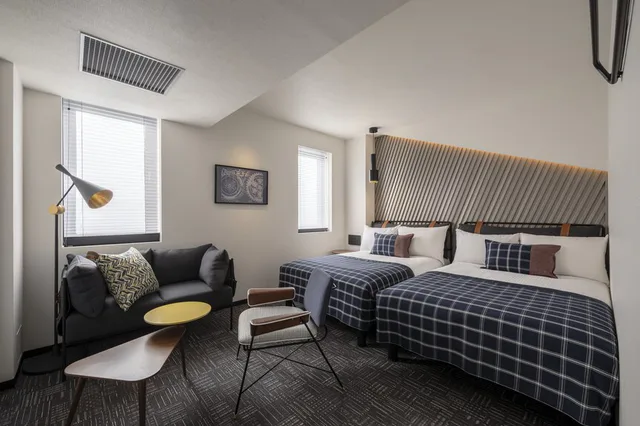
HOTEL FORZA Hakata Station Chikushi-guchi I is the cleanest transit-first option in this group. The hotel currently states that it is about one minute on foot from Hakata Station and about ten minutes from Fukuoka Airport by subway or car. Its standard Forza Double is 18 m² with a 1,500 mm bed.
That location earns its premium when Hakata is not a one-off convenience but a repeated node: airport arrival, early Shinkansen, Yufuin/Beppu rail day, or a departure with luggage. A solo traveller cannot split a taxi fare or hand one suitcase to somebody else while checking the platform. Removing one awkward final leg can therefore carry more value per person than it does for a group.
The answer reverses when Hakata appears only on arrival and departure but every evening is in Tenjin or Nakasu. In that case you may be moving the inconvenience from two transfer days into every night of the stay.
Read the HOTEL FORZA Hakata Station room-and-access decision guide.
THE LIVELY: the small-room trade only works if Nakasu and the shared space both matter
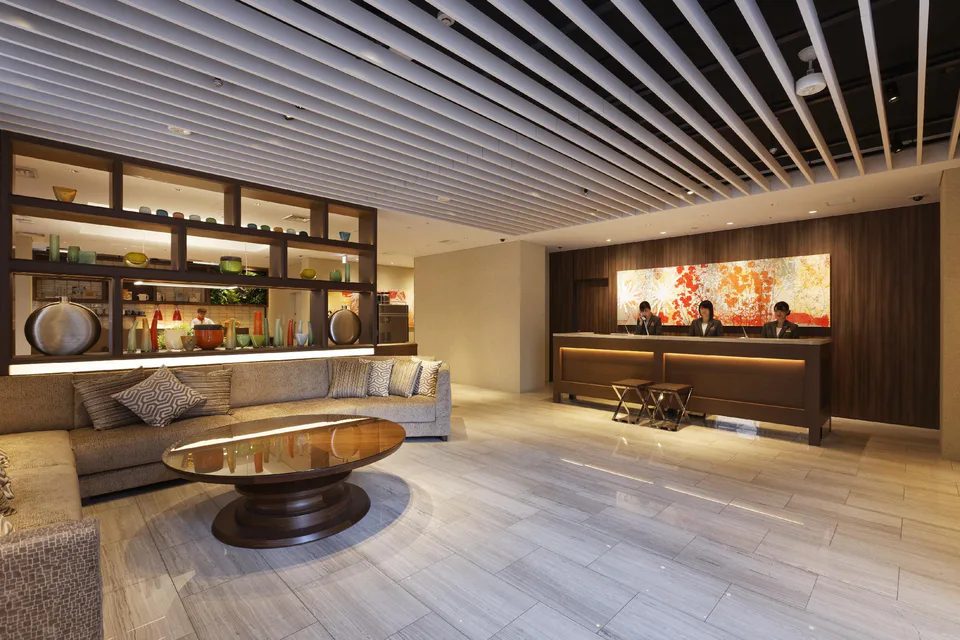
THE LIVELY FUKUOKA HAKATA is currently about one minute on foot from Nakasu-Kawabata Station. The useful solo proposition is not “small but stylish.” It is that a central late-return location and hotel common areas can move some sitting, working and social time out of the private room.
This works particularly well when the trip keeps returning to Nakasu, Kawabata or nearby nightlife and you do not need a large private workspace. You can finish the evening near the hotel, use the lobby/coworking environment when you are still awake, then treat the bedroom mainly as a sleep-and-shower product.
It fails when you dislike shared space. If every email, takeaway meal and hour of downtime must happen behind your own door, common areas cannot be counted as replacement square metres. At that point a compact room is simply a compact room.
The THE LIVELY FUKUOKA HAKATA guide is the better next read if Nakasu-Kawabata is already the chosen base.
lyf Tenjin: a 12 m² room becomes rational only when BOND and WASH & HANG are part of the stay
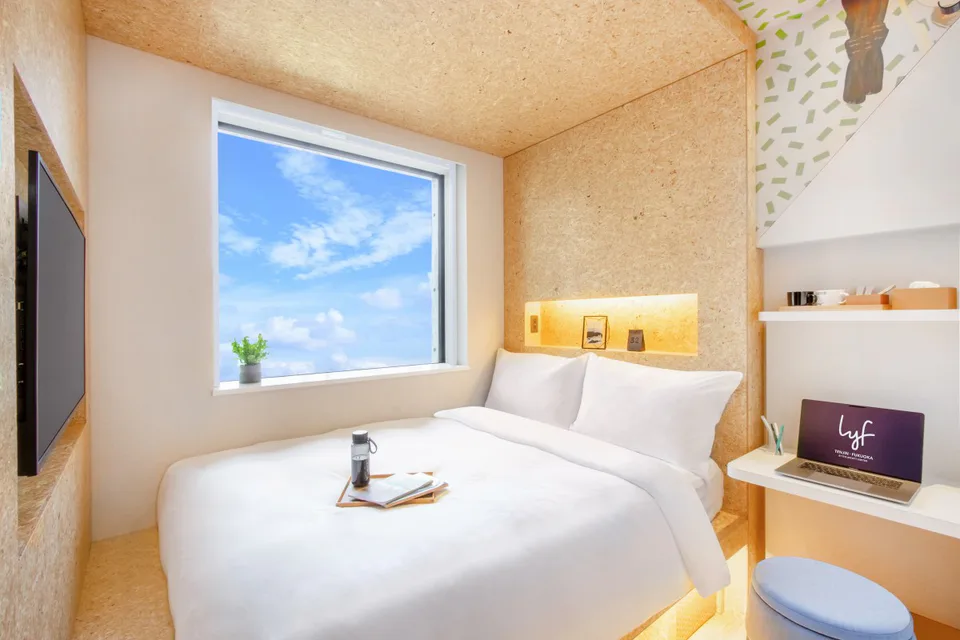
lyf Tenjin Fukuoka currently lists its Studio Double and Studio Twin at 12 m², the Corner Twin at 16 m² and an accessible studio at 22 m². The property also explicitly provides the BOND social kitchen and WASH & HANG launderette, alongside other shared social spaces.
That makes lyf a clearer long-stay experiment than a conventional hotel. You are not merely tolerating a 12 m² room; you are accepting that cooking, some work, social time and laundry move elsewhere in the building.
For four to seven nights, that can be efficient if you actually cook occasionally, wash clothes and spend time outside the bedroom. If the plan is restaurant every meal, no laundry and every evening privately in the room, the shared-space proposition is underused. Pay attention to that before letting a low solo rate decide the stay.
For the property-level trade-off, use the lyf Tenjin Fukuoka review.
JAL City Fukuoka Tenjin: pay for the private room when the room is genuinely the recovery space
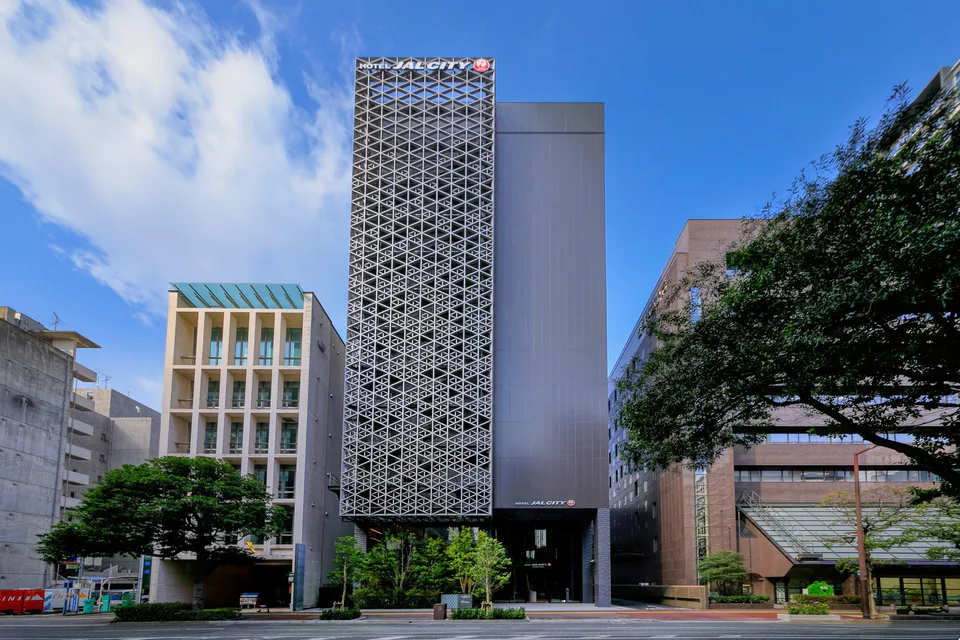
Hotel JAL City Fukuoka Tenjin currently states that all guest rooms are at least 21 m². Its access page places the hotel one minute on foot from Akasaka Station Exit 3, with Fukuoka Airport about 13 minutes by subway to Akasaka and Hakata Station about eight minutes by subway. The hotel also explicitly notes that travellers with luggage should use Exit 6 because it has an elevator.
That last detail is a useful example of why “one minute from the station” is not one universal route. With a carry-on, Exit 3 may be the fastest. With a heavy case, the elevator route can be the more rational final mile even if it is not the shortest line on a map.
I would pay the JAL City private-space premium when the solo trip includes several room evenings, substantial luggage, remote work or simply a strong preference to recover without moving into a communal lounge. I would not pay it automatically for a two-night trip where the room is empty from breakfast until midnight.
The hotel is also around a ten-minute walk from central Tenjin according to its current area guide. That makes it a useful quiet-edge choice, but not the same product as sleeping directly inside the busiest Tenjin streets.
Hakata, Nakasu, Tenjin or Akasaka? Count repeated endpoints, not neighbourhood reputation
Fukuoka is compact enough that several areas can look equally central. The better solo decision is to count where the day repeatedly begins or ends:
Two or more early JR / Shinkansen / airport movements: Hakata gains weight.
Two or more late Nakasu/Kawabata evenings: Nakasu-Kawabata gains weight.
Shopping, cafés, nightlife and several Tenjin evenings: Tenjin/Imaizumi gains weight.
You want Tenjin access but a quieter return and larger private room: Akasaka becomes a rational compromise.
This is more useful than asking which district is “best for solo travel.” The same solo traveller can have four different answers depending on the itinerary.
Fukuoka City Subway currently lists Hakata–Fukuoka Airport at about five minutes, Tenjin–Fukuoka Airport at about 11 minutes and Tenjin–Hakata at about five minutes. Those short rail times are why the hotel-area decision should focus on the final walk and the repeated endpoint rather than pretending any one district is isolated.
Solo travellers should price taxi dependence differently
A taxi does not become cheaper because only one person is inside. This matters when comparing a cheaper hotel that repeatedly requires a late taxi with a slightly more expensive hotel beside the station or nightlife district.
I would not assign a universal yen value to “one avoided taxi” because the distance, hour and traffic vary. The important economics are structural: a couple can split that transport cost across two travellers; a solo traveller absorbs all of it. The same is true for a room upgrade in reverse—the solo traveller also pays the full private-space premium.
That is why the correct solo comparison is often room premium versus repeated solo friction, not cheapest nightly rate versus cheapest nightly rate.
One or two nights: optimise the terminal; four to seven nights: optimise the daily reset
Stay length should change the weight of each criterion.
For one or two nights, I would overweight arrival, departure and late return. A compact room near Hakata or Nakasu can be an excellent product because the hotel mostly exists to remove a difficult final leg.
For four to seven nights, repeated room behaviour becomes much more important. Laundry, suitcase position, desk use, shared kitchen use, whether you have somewhere to sit and how often you reset the room all compound. The cheapest 12 m² room can stop being the cheapest-feeling option by night five.
This does not mean “long stay = large room.” lyf can still work extremely well precisely because the building moves several functions out of the room. The condition is that you genuinely use those functions.
Do not split a short Fukuoka stay just to optimise two neighbourhoods
On a three- or four-night Fukuoka stay, moving from Hakata to Tenjin or Nakasu usually creates a checkout, luggage move and second check-in to solve a distance the subway already handles quickly. The second hotel needs a specific job.
A split can make sense when the trip itself changes shape—for example, two transport-heavy Hakata nights followed by a longer Tenjin segment where the city experience is the purpose. It is weak when the only argument is that both neighbourhoods are popular.
If the larger base choice is still unresolved, use Hakata vs Tenjin before choosing an individual property.
Final verdict: choose where your missing square metres should live
For a short solo transit-heavy stay, I would start with HOTEL FORZA near Hakata. For late Nakasu returns and a traveller who will genuinely use common space, THE LIVELY is more coherent. For a longer stay where kitchen, laundry and social space can replace private square metres, lyf Tenjin is the strongest shared-space proposition. For a traveller who wants the room itself to be the private recovery space, JAL City Fukuoka Tenjin is the cleaner upgrade.
The recommendation reverses when your repeated endpoint changes. Do not choose a “solo hotel” identity. Count room hours, early departures, late returns, luggage and the shared facilities you will really use. The best solo hotel is the one that removes the most repeated friction without charging you for space or facilities you will leave untouched.
Fukuoka Food Trip Hotels: Choose Where Dinner Ends, Not Where the Most Restaurants Are
Fukuoka Hotels With Public Baths: Will You Actually Use the Onsen, Spa or Sauna?
Japan Autumn Leaves Without Changing Hotels: Tokyo, Sendai, Osaka and Fukuoka Bases
Early Flight or Late Arrival at KIX: Should You Move Hotels for the Last Night in Osaka?
References
THE LIVELY — current Fukuoka location · lyf Tenjin Fukuoka — current rooms and shared facilities · Hotel JAL City Fukuoka Tenjin — current access · Hotel JAL City Fukuoka Tenjin — current rooms · HOTEL FORZA Hakata — current access · HOTEL FORZA Hakata — current room sizes · Fukuoka City Subway — current travel-time examples. Checked August 25, 2026. Room inventory, hotel facilities and operating arrangements can change; verify the exact stay date.