THE BASICS FUKUOKA: the 30-second answer
I would think twice if your Fukuoka days begin before 08:00 and you regularly return around 22:00 or later. NOMBRE is currently listed from 08:00 to 22:00. Baked snacks are offered in the 15:00–18:00 period, while the evening 18:00–22:00 period adds items such as smoked salmon and cheese. If those hours are consistently spent in Tenjin, Nakasu, at yatai or on day trips, the Episode premium becomes much harder to justify purely because it includes a lounge.
Hotel snapshot: choose the room tier before the dramatic lobby
↔ Scroll table left or right
Item | Verified setup | Trip impact |
Hakata Station | Still a Hakata base, but the final walk repeats every day | |
Scale | 20 room types, 238 guestrooms | The hotel name alone tells you little; choose the room tier carefully |
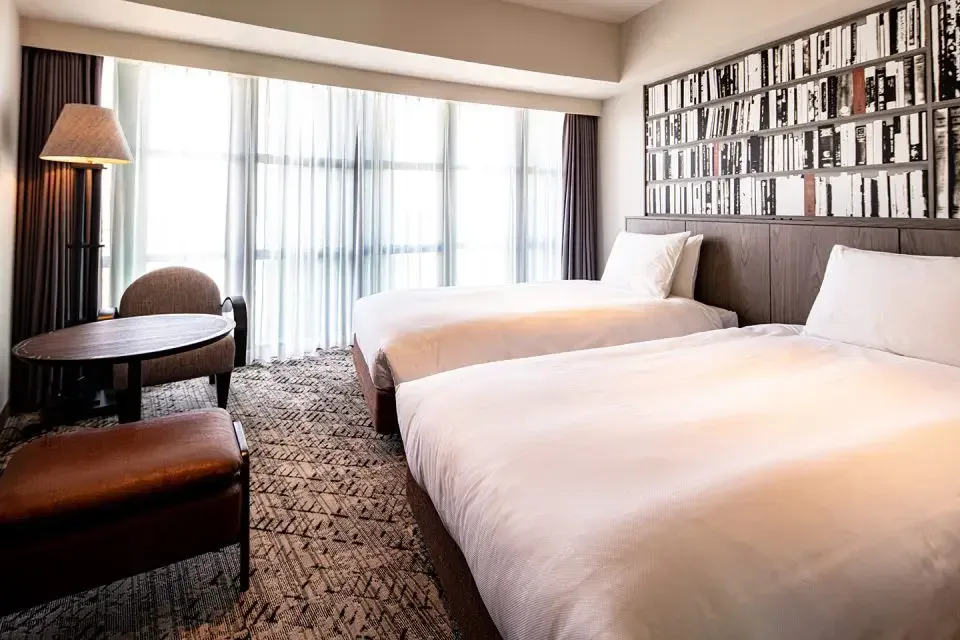
Chapter 1 Twin | 20 m², two 1150 mm beds, unit bath | Entry-level does not mean large; be conservative with two large suitcases |
Chapter 3 / Episode 3 Twin | Both 35 m², two 1200 mm beds, separated bath/toilet | Same-size comparison exposes whether lounge access is actually worth paying for |
Chapter 4 / Episode 4 Twin | Both 45 m², up to 4 guests, separated bath/toilet | For four people, decide whether you need NOMBRE instead of assuming Episode is larger |
NOMBRE | Episode / Story guests, 08:00–22:00 | The upgrade is valuable only if you are actually at the hotel to use it |
SELF CLOAK | 1F, guest use, 06:00–24:00 | Adds flexibility around check-in and checkout luggage |
Breakfast | Buffet 06:30–10:00, last entry 09:30 | Early JR departures require counting breakfast plus the walk back to Hakata |
The hotel currently lists 20 room types and 238 guestrooms divided among Chapter, Episode and Story. The naming makes it tempting to assume every later tier is simply larger, but the useful distinction is functional. Chapter is the core standard-room family; Episode and Story guests can use NOMBRE. In practice, THE BASICS FUKUOKA has at least two separate upgrade axes: room area and lounge access. Treating those as separate decisions is the key to avoiding an expensive mismatch.
Arrival reality: the seven-minute Hakata walk is a repeated cost
The official access information lists about seven minutes on foot from JR Hakata Station's Chikushi Exit, on the Shinkansen side. If you arrive by subway from Fukuoka Airport, the real sequence is getting off the train, finding the right route through the station, exiting at Chikushi and then completing the final street walk. With light luggage in dry weather, that is ordinary. In rain, with two large suitcases, a stroller or an older traveller, the same last seven minutes can feel very different.
I would describe it as a Hakata-base hotel, not a station-front zero-walk hotel. That distinction matters most on cross-prefecture itineraries. If three days out of five start with an early JR trip to Yufuin, Beppu, Kumamoto or Nagasaki, the walk repeats morning and evening. On a simple two-night city stay, it is usually just a short part of the accommodation route. Location should be judged by how many times you repeat the friction, not just by the first arrival.
The first-floor SELF CLOAK is currently listed for guest use from 06:00 to 24:00. It is useful when you arrive before check-in or want to leave luggage after checkout and return later before a train. It solves timing around luggage; it does not erase the final walk from Hakata Station.
If your trip depends heavily on city transport, map the repeated journeys with the Fukuoka transport guide. For a first visit, compare that against the three-day Fukuoka itinerary. If the hotel is mainly a launch point for a day in Yufuin, the Fukuoka-to-Yufuin transport comparison is more useful than judging the hotel from a map pin alone.
Room decision: compare 20 m², 35 m² and lounge access
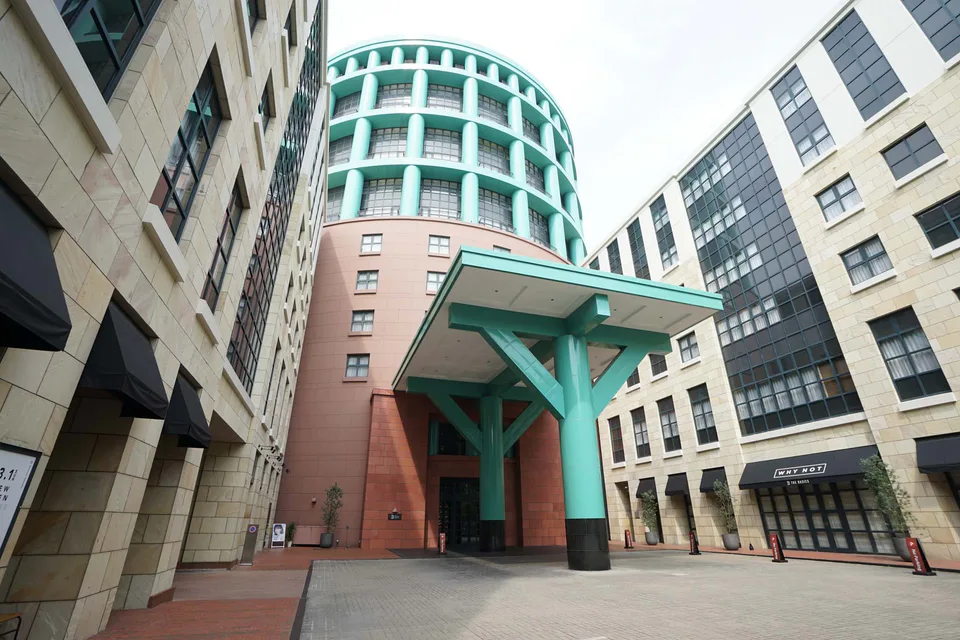
Chapter 1 Twin is the room that keeps expectations realistic. The official specification is 20 m² with two 1150 mm beds and a unit bath. The lobby is large and visually dramatic, so hotel and OTA photography can easily create an impression that the entire property is spacious. Chapter 1 Twin is the reminder that public-space scale cannot be projected onto every guestroom. With two travellers and two large suitcases, I would not promise that both 28-inch cases can stay fully open just because the hotel itself looks expansive.
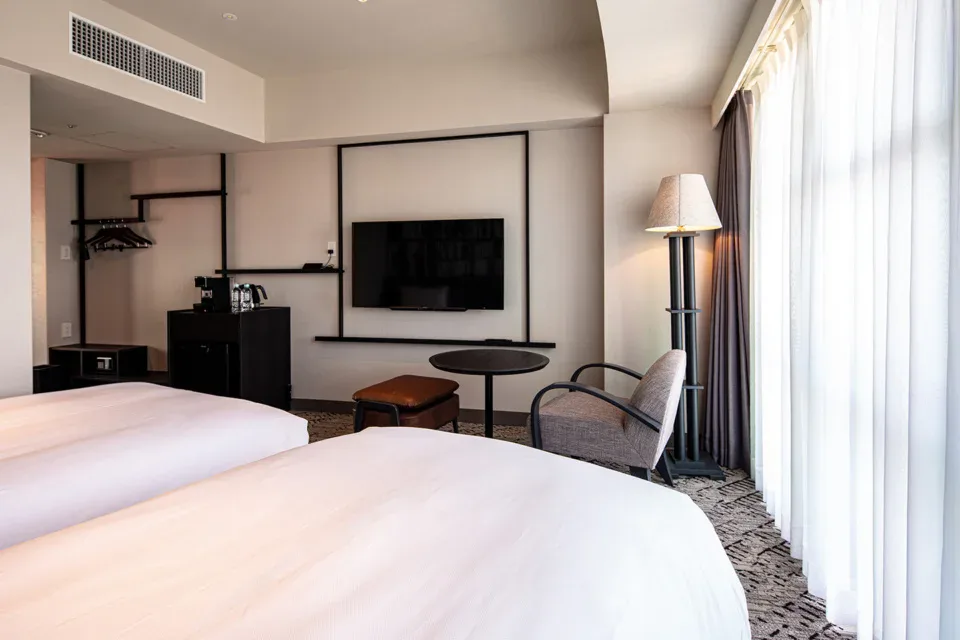
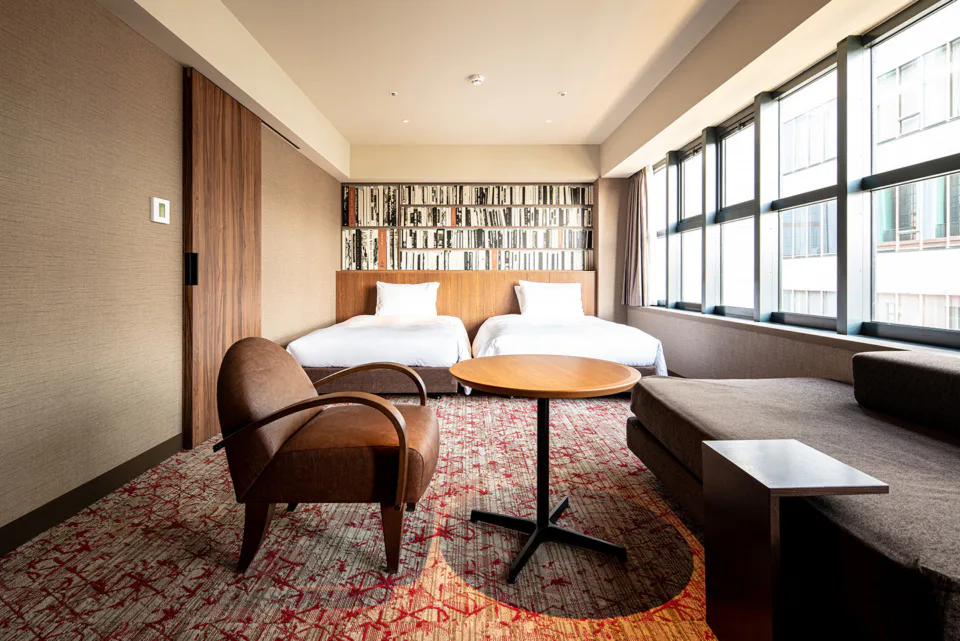
For two people who want the room itself to feel materially easier to use, Chapter 3 Twin is my baseline. It is listed at 35 m², accommodates up to three guests, has two 1200 mm beds and separates the bath and toilet. The extra 15 m² compared with Chapter 1 is not an abstract number: it gives more room for changing, sorting purchases, using the bathroom and toilet independently, and living out of luggage on a multi-night stay.
Episode 3 Twin is the most revealing comparison because the official data is also 35 m² with two 1200 mm beds and a separated bath and toilet. You cannot justify the Episode premium by saying the room is larger. What you are actually buying is NOMBRE access, Episode-level amenities and services, and whatever value those benefits create during the hours you are actually at the hotel.
The four-person comparison is just as clear. Chapter 4 Twin and Episode 4 Twin are both listed at 45 m², accommodate up to four guests and separate the bath and toilet. If the core problem is giving four people enough shared space, Chapter 4 already secures the 45 m². Episode 4 should be judged by lounge use, not by the assumption that a higher room label automatically means a larger room. Always confirm the exact bed setup or extra-bed rules for the rate you are booking.
That leads to the most important booking rule for THE BASICS FUKUOKA: choose area first, then benefits. If Chapter 1 Twin feels too tight for two, I would put the next part of the budget into Chapter 3 Twin before chasing Episode. If four travellers need 45 m², I would check Chapter 4 first. Only once the space requirement is solved would I ask how many hours I will realistically spend in NOMBRE. This avoids treating room tiers like a luxury ranking.
↔ Scroll table left or right
Room type | Area / guests | Bathroom | NOMBRE | My take |
Chapter 1 Twin | 20 m² / up to 2 | Unit bath | No | Works for a short stay, but do not infer a large room from the lobby |
Chapter 3 Twin | 35 m² / up to 3 | Separated bath/toilet | No | My baseline for two travellers buying usable room space |
Episode 3 Twin | 35 m² / up to 3 | Separated bath/toilet | Yes | Same floor area; the meaningful upgrade is lounge access and benefits |
Chapter 4 Twin | 45 m² / up to 4 | Separated bath/toilet | No | Four travellers can start here when space is the priority |
Episode 4 Twin | 45 m² / up to 4 | Separated bath/toilet | Yes | Still 45 m²; only persuasive if the group will use the lounge |
Use a one-day timeline to test whether Episode is worth it
If I were actually staying here, I would test Episode with a timeline. Imagine checking in at 15:30, using NOMBRE at 16:00, returning to the room at 17:00 to organise shopping, going out for dinner at 18:30 and using the evening snacks and drinks again at 20:30. The lounge has then shaped the day twice, so it is not just decoration. If your day is 08:30 departure, 21:50 arrival back at Hakata and 22:10 arrival at the hotel, NOMBRE has almost no role in the stay.
NOMBRE is currently listed from 08:00 to 22:00 for Episode and Story guests. Drinks include a selection of red and white wines and sake, while food changes by time: baked snacks in the 15:00–18:00 period and evening bites such as smoked salmon and cheese from 18:00–22:00. That matters because “lounge access” is not a binary benefit. You need to ask whether your hotel time overlaps the hours when the items you care about are actually available.
I would be conservative about treating the lounge as a dinner replacement. The listed evening items suit snacks and drinks, but they are not evidence that every guest can comfortably replace a full dinner. If you already intend to eat in Hakata or Tenjin, measure NOMBRE as an experience and convenience benefit, not as a made-up meal saving. The Fukuoka yatai guide and Fukuoka mentaiko guide are a better way to see how much of the 18:00–22:00 window your evening plans will consume.
Facilities with consequences: breakfast, fitness and luggage
Breakfast is currently listed as a buffet from 06:30 to 10:00, with last entry at 09:30. That start time is flexible for many travellers, but it still has to be measured against the train. If you need to leave Hakata at 07:20, you must include eating, returning for luggage and walking to the station. I would not assume a breakfast-included rate is automatically better just because breakfast exists. Prices and package inclusions can change, so check the actual stay date. The Fukuoka breakfast guide is useful when an early departure makes the hotel buffet awkward.
The fitness room is another facility that looks simple until the conditions are read. It is currently listed as free for guests and open 24 hours on the first floor, but there are no showers or lockers and no towels, sportswear or shoes are provided; guests under 16 cannot use it. If you already travel with training gear, it can improve a multi-night stay. If “24 hours” is the only reason it sounds valuable, the practical restrictions may lower your real use.
If the next morning continues beyond Fukuoka, compare the Fukuoka, Hita, Yufuin and Beppu three-day route with a slower Route 210 road trip to Yufuin. Those choices can matter more to your hotel decision than the breakfast buffet itself.
Location × itinerary: your return time rewrites the Chapter–Episode answer
Once THE BASICS FUKUOKA is placed inside a real itinerary, I first ask how many times you return to the hotel during the day. If you spend the morning in the city, return to Hakata in the afternoon and go out again for dinner, Episode can overlap both the 15:00–18:00 and 18:00–22:00 lounge periods. If you stay out from morning until late night, Chapter becomes more direct. The value of the room tier changes with your daily return pattern, not only at check-in.
On rail-heavy multi-day itineraries, I put more weight on the room itself. The seven-minute walk is a fixed cost that happens every day, while lounge use depends on the return time. After a cross-prefecture day, the things you repeatedly use are the room, bathroom and luggage space. When one cost is guaranteed to repeat and one benefit may be used once, the Episode label alone is not a reason to upgrade.
If the trip centres on Tenjin, Nakasu, yatai and dinner, watch for a direct clash in timing. Fukuoka's strongest evening experiences often occupy the same 18:00–22:00 period when NOMBRE is most interesting. If you leave for Nakasu at 19:00 and return after 22:30, the lounge benefit disappears for that night. Two nights like that can materially reduce the value of Episode. The issue is not that the lounge is poor; your itinerary has simply spent its most valuable hours somewhere else.
A slower trip can produce the opposite answer. On a three-night stay with one main area per day and a deliberate afternoon break, the large lobby, larger rooms and NOMBRE become part of the trip instead of background scenery. That is the traveller for whom an Episode premium has a better chance of buying real time rather than just a higher room label. If weather may push you back indoors, the Fukuoka rainy-day route is a useful reality check.
↔ Scroll table left or right
Trip pattern | Main friction | How I would choose |
Daily early JR / Shinkansen | Seven-minute final walk repeats | Prioritise room function and compare closer station alternatives; do not pay for lounge by default |
City itinerary with afternoon returns | NOMBRE hours are easier to use | Compare Chapter 3 and Episode 3 by the actual price difference |
Tenjin / Nakasu dinner and yatai | 18:00–22:00 overlaps NOMBRE's strongest evening period | Chapter is often more direct if you return late |
Three or more slow-travel nights | Room and public spaces are used repeatedly | Episode's time value becomes easier to realise |
For a city-first trip, the three-day Fukuoka itinerary helps show whether you will return to Hakata in the afternoon. For a longer cross-prefecture route, use the Fukuoka–Hita–Yufuin–Beppu itinerary. If you are deciding whether another long day trip belongs in the same stay, the Fukuoka-to-Aso day-trip guide is another useful test of how much of your hotel time disappears into transport.
What are you giving up by staying here?
The first trade-off is the final few minutes from the station. THE BASICS FUKUOKA is still in the Hakata Station orbit, but it is not immediately outside the gates. For a one-night stay after a late flight followed by the earliest JR departure, those repeated minutes can matter more than the lobby or lounge. On a three-night city stay, the same walk is usually much easier to accept.
The second trade-off is the gap between public-space drama and entry-room reality. The lobby is distinctive, but Chapter 1 Twin is still 20 m². If the lobby photos are what convinced you that every room must be large, this is where a booking mistake happens. I would put the room dimensions ahead of the design language. The hotel's strength is that it offers enough room categories to solve the space problem—not that every category is automatically spacious.
The third trade-off is the Episode premium versus usable time. Chapter 3 and Episode 3 are both 35 m²; Chapter 4 and Episode 4 are both 45 m². Those comparisons are enough to show that moving to Episode is not necessarily moving to more space. If you will be in the hotel during the lounge window, the upgrade can make the night feel more complete. If you are out all day, Chapter may be the more rational way to keep the budget in room space and the trip itself.
For a slower afternoon around the city, the Fukuoka coffee and dessert walk gives one example of an itinerary that can still leave time to return to the hotel. If your plan instead keeps expanding into Kyushu, the Fukuoka–Hita–Yufuin–Beppu route is a better reality check for how little lounge time remains.
Compare the exact same room on three platforms
Keep the stay dates, guest count, room name, breakfast inclusion and cancellation deadline identical before comparing prices. At THE BASICS FUKUOKA, Chapter and Episode labels make it particularly easy to see “Twin” and assume two rates are equivalent. Confirm the exact tier, floor area and whether NOMBRE access is included before judging the total price. The booking platform is only the price outlet; the room conditions are the decision.
Booking.com — check THE BASICS FUKUOKA rooms
Trip.com — check THE BASICS FUKUOKA rooms
Agoda — check THE BASICS FUKUOKA rooms
Final decision: would I book it?
↔ Scroll table left or right
Decision | Core condition |
I would book | Two travellers: start with Chapter 3. Four travellers: start with Chapter 4. Compare Episode only when you know you will use NOMBRE. |
I would reconsider | You are out from morning to late evening and your dinners or nightlife occupy 18:00–22:00, so Episode lounge use may be too low. |
I would skip | You care most about a one-to-two-minute Hakata Station walk, take early JR services daily and use the hotel only to sleep. |
My final answer is not that Episode is automatically better. For two travellers buying space, I would start with Chapter 3 Twin. For four travellers needing 45 m², I would start with Chapter 4 Twin. I would put Episode 3 or 4 first only when the trip leaves a meaningful block of hotel time inside NOMBRE's 08:00–22:00 window and the premium is acceptable. What makes THE BASICS FUKUOKA interesting is that the same 35 m² or 45 m² can be sold as two different stay experiences. Decide whether you need the area or the lounge time before deciding how much more to spend.
THE BASICS FUKUOKA FAQ
How long is the walk from Hakata Station to THE BASICS FUKUOKA?
The official access page currently lists roughly seven minutes on foot from JR Hakata Station's Chikushi Exit. Treat that as a baseline in straightforward conditions, not a guarantee for every traveller. Allow extra time with large luggage, rain, children or older travellers.
What is the main difference between Chapter and Episode?
The difference cannot be explained by room area alone. Chapter 3 Twin and Episode 3 Twin are both 35 m², while Chapter 4 Twin and Episode 4 Twin are both 45 m². Episode and Story guests can use NOMBRE, so lounge use is an important part of the upgrade decision.
Which room should two travellers with two 28-inch suitcases choose?
The hotel does not publish enough floor-plan circulation detail to guarantee that two 28-inch cases can remain fully open in every room type. I would be conservative with the 20 m² Chapter 1 Twin and compare the 35 m² Chapter 3 Twin or Episode 3 Twin first, then decide whether lounge access is worth the Episode premium.
What time is NOMBRE Lounge open?
The current published hours are 08:00–22:00 for Episode and Story guests. Baked snacks are listed for 15:00–18:00, while evening snacks such as smoked salmon and cheese are listed for 18:00–22:00. If your itinerary keeps you outside throughout those periods, Episode's practical value falls.
Can I store luggage after checkout?
The first-floor SELF CLOAK is currently listed for guest use from 06:00–24:00 around check-in and checkout. Follow the latest on-site rules for eligible luggage and exact use, but it can make the time between checkout and an evening train easier to manage.
What time does breakfast start?
Breakfast is currently listed as a buffet from 06:30–10:00 with last entry at 09:30. For an early JR or Shinkansen departure, add the time needed to eat, collect luggage and walk back to Hakata Station. Breakfast pricing and whether it is included depend on the rate for your stay date.
Fukuoka Coffee and Dessert Walk
Fukuoka Breakfast Guide: Mentaiko, Udon or Onigiri?
Fukuoka Yatai Guide: Nakasu, Tenjin or Nagahama?
Fukuoka Mentaiko Guide: Mentaiju, Yamaya or Fukuya?
Fukuoka, Hita, Yufuin and Beppu: 3-Day Itinerary
Fukuoka to Aso: Day Trip or Overnight?
Where to Stay
Nishitetsu Hotel Croom Hakata Gion: Washer-Dryer or Separate Bath?
Miyako Hotel Hakata: Is a Direct Hakata Station Connection Worth the Premium?
LAMP LIGHT BOOKS HOTEL Fukuoka: Is a 24-Hour Bookstore Worth Staying in Daimyo?
Ryukyu Hotel & Resort Nashiro Beach: Is the Last Night by the Sea Worth Moving Hotels?
Kanmon Strait Museum: When the ¥500 Ticket Is Worth It—and When the Free Areas Are Enough
Seishun 18 Ticket: 3 Days or 5? The ¥2,050 Upgrade Is Not Always the Better Deal
teamLab Planets Tokyo Review: Is the Barefoot Water Experience Worth It?
Yanagawa Ninja Boatman Cruise: Is the 40-Minute Loop Worth It?
Sources
THE BASICS FUKUOKA official website
Official NOMBRE Lounge information
Official facilities information
Official Fitness Room information
Booking.com: THE BASICS FUKUOKA
Trip.com: THE BASICS FUKUOKA