For 2026, choose the 3-day Seishun 18 Ticket when you have one dense block of three consecutive JR local-train days. Upgrade to the 5-day version only when Days 4 and 5 already contain more than ¥2,050 (about US$12.90) per person of eligible JR ordinary/rapid travel combined—and the slower trains still fit the trip. The ¥2,050 (about US$12.90) upgrade is cheap in isolation, but it is not two flexible bonus days. The clock keeps running for five consecutive days, and a museum day, onsen night, private-railway day or Shinkansen jump still consumes a calendar day.
There is an even more important first test: should you buy either ticket? The 3-day pass costs ¥10,000 (about US$62.70) and the 5-day pass ¥12,050 (about US$75.60). If your planned eligible JR local/rapid fares do not exceed those totals, the pass has not earned its place. And even when the cash arithmetic works, a first-time visitor should still compare the hours lost to slow trains with the faster alternative.
↔ Scroll table left or right
Your real trip | Default call | Why | What reverses it |
Three consecutive heavy JR local-train days, then city/onsen time | 3-day | You pay only for the useful rail block | Days 4–5 already exceed ¥2,050 (about US$12.90) of eligible JR fare per person |
Five consecutive days moving by JR local/rapid trains | 5-day | The extra two days cost only ¥2,050 (about US$12.90) per person | A Shinkansen/limited express or private railway is actually the sensible transport on those days |
Tokyo–Kyoto/Hiroshima first trip with limited vacation days | Usually neither | The pass does not cover normal Shinkansen travel, and time can be more valuable than fare savings | The slow-rail journey itself is one of the reasons for the trip |
Family with school-age children | Recalculate per traveller | Seishun 18 has no child price, while ordinary JR child fares are normally half adult fare | The children also have unusually expensive eligible local-rail days |
Weather-sensitive mountain/onsen trip | 3-day or neither | Five consecutive days create more exposure to a low-rail or disrupted day | The route has five robust rail days regardless of weather |
Hokkaido crossing is central | Rebuild the comparison | The special Hokkaido Shinkansen option costs another ¥4,650 (about US$29.20) per person and has narrow conditions | The exact local-rail itinerary still beats faster regional alternatives |
Checked August 27, 2026. JR currently prices the 3-day ticket at ¥10,000 (about US$62.70) and the 5-day ticket at ¥12,050 (about US$75.60), with no separate child price. Both are valid for consecutive days from the chosen start date, one ticket cannot be shared by multiple travellers, and the 3-day and 5-day products cannot be converted into each other later. Recheck the operator page before purchase.
ValueNavi Pass Fit Score: cheap rail is not good value when the itinerary has to bend around it
This editorial score weights fare efficiency 25%, time efficiency 20%, consecutive-day fit 20%, network coverage 15%, disruption resilience 10% and luggage/transfer friction 10%. It scores the fit between the ticket and a specific trip—not the romance of local-train travel.
↔ Scroll table left or right
Trip pattern | Best-fit product | ValueNavi fit | Why |
Three dense consecutive local-rail days, then several stationary city days | 3-day | 9.2/10 | The pass isolates the expensive slow-rail block without wasting validity on low-rail days. |
Five linear days where every day already contains meaningful eligible JR travel | 5-day | 9.0/10 | The route uses the extra validity naturally instead of inventing rides to justify the ticket. |
First Japan trip: Tokyo → Kyoto → Hiroshima with limited holiday time | Neither | 3.3/10 | Normal Shinkansen travel protects scarce days; the pass excludes the fast product that makes the route efficient. |
Two adults + two school-age children with only modest local-rail fares | Usually neither / adult-only recalculation | 4.9/10 | Children pay the same pass price even though normal child fares are usually discounted. |
Five-day weather-sensitive mountain route where days may need to move | 3-day or neither | 5.2/10 for the 5-day ticket | The consecutive clock keeps running through disruption and cannot be paused. |
The score makes one principle explicit: the 5-day ticket is not automatically “more flexible.” It can be financially efficient while operationally rigid because it commits five consecutive calendar days to one slow-rail strategy.
The ¥2,050 rule: Days 4 and 5 must earn the upgrade
The cleanest 3-vs-5 calculation is:
5-day ticket cost − 3-day ticket cost = ¥12,050 − ¥10,000 = ¥2,050 per person (about US$12.90).
So if you have already decided that the 3-day ticket is worth buying, the 5-day version becomes cheaper in pure cash terms when the eligible JR ordinary/rapid fares you would otherwise pay on Days 4 and 5 exceed ¥2,050 (about US$12.90) combined.
Day 4 eligible JR fare ¥900 (about US$5.60) + Day 5 ¥800 (about US$5.00) = ¥1,700 (about US$10.70) → keep the 3-day ticket and pay those days separately.
Day 4 ¥1,100 (about US$6.90) + Day 5 ¥1,100 (about US$6.90) = ¥2,200 (about US$13.80) → the 5-day ticket is ¥150 (about US$0.90) cheaper in cash.
Day 4 ¥2,500 (about US$15.70) + Day 5 ¥0 = ¥2,500 (about US$15.70) → the 5-day ticket can still win; both extra days do not have to be expensive.
But the middle example exposes the weakness of a simple break-even test. Saving ¥150 (about US$0.90) is not a reason to turn a four-hour fast journey into a much longer local-train day. Once the cash difference becomes small, schedule quality should decide the ticket, not the pass.
Do not use the upgrade formula before checking whether the 3-day ticket breaks even
The ¥2,050 (about US$12.90) rule assumes the 3-day ticket is already the baseline. That is not always true.
For the 3-day ticket, add the eligible JR local/rapid fares for the three consecutive days you plan to cover. If the total is below ¥10,000 (about US$62.70), individual tickets are cheaper. For the 5-day ticket, do the same across five consecutive days and compare with ¥12,050 (about US$75.60).
This creates a useful four-way decision:
↔ Scroll table left or right
3-day eligible fare total | 5-day eligible fare total | Better starting point |
≤ ¥10,000 (about US$62.70) | ≤ ¥12,050 (about US$75.60) | Neither pass |
> ¥10,000 | Days 4–5 add ≤ ¥2,050 (about US$12.90) | 3-day |
> ¥10,000 | Days 4–5 add > ¥2,050 (about US$12.90) | 5-day, if the local-train timetable is still rational |
≤ ¥10,000 | > ¥12,050 across all five days | 5-day can win even though the first three days alone do not justify the 3-day pass |
The last row matters. A traveller can have five moderately expensive rail days where the 5-day ticket makes sense even though no three-day block reaches ¥10,000 (about US$62.70). Do not force every calculation through the 3-day ticket first.
The consecutive-day rule is now the real product constraint
Old Seishun 18 advice is particularly dangerous because many travellers remember a more flexible product. In 2026, JR states that the ticket is valid for three consecutive days or five consecutive days from the start date chosen at purchase. One ticket cannot be used by several people.
That means you cannot do this:
Day 1: Tokyo → Shizuoka by local train
Day 2: Shizuoka sightseeing — pause pass
Day 3: Shizuoka → Nagoya — resume pass
Day 4: Nagoya sightseeing — pause pass
Day 5: Nagoya → Kyoto — resume pass
If the 5-day ticket starts on Day 1, all five calendar days are consumed. The sightseeing days are still pass days even if you barely use JR.
This is why I would describe the 3-day ticket as a dense rail-block product and the 5-day ticket as a continuous slow-travel product. If your itinerary alternates long transfer days with stationary city or onsen days, the longer pass can be cheap but poorly matched.
You cannot buy 3 days and “top up” to 5 later
JR currently allows one change to the start date while the ticket remains unused, subject to the rules. It does not allow a 3-day ticket to be converted into a 5-day ticket or vice versa.
That creates a booking decision before the first gate. If your fourth and fifth days are uncertain, you cannot safely buy three days and simply pay another ¥2,050 (about US$12.90) later when the weather looks good. The products are separate.
The practical response is not “always buy five to be safe.” It is to resolve the uncertainty that matters:
If Days 4–5 are genuinely optional sightseeing days, 3-day protects flexibility.
If Days 4–5 are already fixed intercity local-train days, 5-day is easier to justify.
If the route is still changing enough that you cannot tell which operator or train type you will use, do not let a ¥2,050 (about US$12.90) difference lock the itinerary.
Shinkansen and limited express trains are the biggest false break-even
The 2026 ticket covers JR ordinary and rapid trains in ordinary-car unreserved seating, JR BRT and the JR West Miyajima Ferry. The Miyajima visitor tax of ¥100 (about US$0.60) is still paid separately. JR buses are not covered.
More importantly, the pass generally does not cover Shinkansen, limited express or express trains. If you decide to use one, you normally need to buy the basic fare as well as the relevant express/limited-express ticket. You cannot usually keep the Seishun 18 Ticket as the base fare and pay only the supplement.
That means a Day 5 Shinkansen fare cannot be counted toward the ¥2,050 (about US$12.90) upgrade test. The pass does not save that money.
There are narrow official exceptions on sections where ordinary trains are limited or special operating rules apply—for example Shin-Aomori–Aomori, Shintoku–Shin-Yubari, Higashi-Muroran–Muroran, Miyazaki Airport–Miyazaki and Haiki–Sasebo under stated conditions. Treat those as route-specific exceptions, not evidence that the ticket is a limited-express pass.
Ordinary/rapid-train Green Car unreserved seats can be used by buying the separate Green ticket, and ordinary-car reserved seats on ordinary/rapid trains can be used with the separate seat-reservation ticket. The key distinction is train category.
Family economics are worse than the adult headline suggests
The Seishun 18 Ticket has no child version: JR lists ¥10,000 (about US$62.70) for the 3-day ticket and ¥12,050 (about US$75.60) for the 5-day ticket, with no child fare. By contrast, ordinary JR basic fares for children aged 6–11 are normally half the adult fare.
That means the familiar ¥2,050 upgrade threshold only applies cleanly to an all-adult party. When children are buying full-price Seishun 18 Tickets but would otherwise pay half-fare ordinary tickets, the party-level break-even rises.
For travellers following the same Days 4–5 route, a useful derived threshold is:
Adult-fare equivalent needed on Days 4–5
=
¥2,050 × (number of pass holders)
÷
(adults + 0.5 × children aged 6–11)
↔ Scroll table left or right
Party | Adult-fare equivalent on Days 4–5 needed before upgrading everyone breaks even | What it means |
2 adults | ¥2,050 ≈ US$12.90 | The headline threshold works as written |
2 adults + 1 child | about ¥2,460 ≈ US$15.40 | A route that barely clears ¥2,050 for adults can still be cheaper with normal child fares |
2 adults + 2 children | about ¥2,733 ≈ US$17.10 | The family needs roughly one-third more adult-equivalent fare before upgrading all four passes breaks even |
1 adult + 2 children | about ¥3,075 ≈ US$19.30 | The pass upgrade has to work much harder because two travellers give up half-fare ordinary tickets |
This is a ValueNavi derived calculation using JR's current no-child-price pass structure and the normal half-adult child basic-fare rule. Exact ordinary fares can differ slightly because JR rounds child fares under its fare rules, so use your actual route fares before buying.
Example: if Days 4 and 5 would cost ¥2,300 per adult (about US$14.40), upgrading two adult passes costs ¥4,100 (about US$25.70) and saves ¥500 (about US$3.10) compared with paying ¥4,600 in adult fares. Add two school-age children, however, and their ordinary fares for the same route are roughly ¥1,150 each. The family's pay-as-you-go total becomes about ¥6,900 (about US$43.30), while upgrading four passes costs ¥8,200 (about US$51.40). The adult-only calculation says “upgrade”; the party calculation says do not.
For children under six, ordinary JR fare rules can make a pass even less compelling depending on seating and accompaniment. Do not buy a full-price Seishun 18 Ticket for a young child simply because the adults are using one.
Measure the pass by yen saved per extra hour, not only yen saved
Seishun 18 can produce excellent travel days when local rail is part of the experience: seaside lines, rural transfers, station stops and a route that deliberately moves slowly. It is a weak product when you use local trains only because the pass exists.
For each long day, compare:
Cash saved with Seishun 18
÷
Extra travel hours versus the fastest sensible alternative
=
Savings per extra hour
If the 5-day version saves ¥1,000 (about US$6.30) but Day 5 adds several hours and multiple transfers, that may be poor value on a 10-day first Japan trip. If the slower railway is itself one of the trip's experiences, the extra time is not necessarily a cost.
This is the main editorial boundary: the Seishun 18 Ticket is best for travellers who value the slow journey, not travellers who merely tolerate it to minimise fare.
FX assumption: ¥1 ≈ US$0.00627 (¥1,000 ≈ US$6.27), checked August 27, 2026. USD figures are rounded planning equivalents, not guaranteed card or cash exchange rates.
Three itinerary shapes: 3-day, 5-day and neither
3-day winner: one slow-rail transfer block, then stop moving
Example shape: three consecutive days progress through regional cities by ordinary/rapid JR trains, then you stay several nights in Kyoto, Osaka or another base using walking, subway, buses and private railways. The 3-day ticket isolates the expensive JR block without making the city days part of the pass.
This also works well when a mountain or onsen stay follows the rail block. Do not pay for two extra pass days just because the holiday continues.
5-day winner: the route keeps moving in one direction every day
Example shape: five consecutive days where each day contains a meaningful JR local/rapid segment and the slow progression is intentional. The extra two days already exceed ¥2,050 (about US$12.90) of eligible fare per person, and there is no day where a Shinkansen or limited express is clearly the better tool.
The 5-day pass is especially coherent when the overnight bases sit on the route rather than requiring backtracking. A cheap pass does not make a zigzag itinerary efficient.
Neither: first-trip long-distance Japan where fast rail protects scarce days
If the real itinerary is Tokyo → Kyoto → Hiroshima with ten or twelve days in Japan, a normal Shinkansen or an appropriate regional/national product may be the better purchase even when it costs more. The Seishun 18 Ticket excludes the fast trains that make that route practical.
Use the JR Pass comparison or the Northern Kyushu Rail Pass guide when limited expresses and Shinkansen are central to the trip.
Disruption risk rises with the 5-day version because the clock does not stop
JR's current rules say that after use begins, delays or suspended services do not trigger a refund of the Seishun 18 Ticket. The consecutive validity also keeps running.
This makes the 5-day product more fragile on trips with typhoon risk, heavy snow, mountain weather or outdoor days that may need to move around. A disrupted Day 2 can reduce the value of Day 4 or Day 5 because you cannot pause the ticket and resume later.
The 5-day ticket is therefore not simply “more flexible because it covers more days.” In one sense it is less flexible: you commit more consecutive calendar days to one transport system.
If weather uncertainty is central, use the 3-day pass for the fixed rail block and keep the later days open—or skip the pass if the route itself needs to remain movable.
Hokkaido is a separate cost branch, not a hidden Shinkansen benefit
For 2026, JR also sells a Seishun 18 Ticket Hokkaido Shinkansen Option Ticket. It currently costs ¥4,650 per person (about US$29.20) and, when used with a valid Seishun 18 Ticket, covers one one-way use of the Hokkaido Shinkansen between Shin-Aomori and Kikonai plus the Donan Isaribi Railway between Kikonai and Goryokaku under specific same-day conditions.
That option is more expensive than the entire ¥2,050 (about US$12.90) upgrade from 3 days to 5 days. It also does not turn the rest of the Shinkansen network into a covered service.
If crossing into Hokkaido is central to the trip, add ¥4,650 (about US$29.20) per traveller to the actual pass cost and compare the entire door-to-door plan with flights, ferries or other rail products. Do not choose five days merely because Hokkaido appears on the itinerary.
Miyajima is included, but one included ferry does not rescue a weak pass
The JR West Miyajima Ferry is included in the Seishun 18 Ticket, while the local ¥100 (about US$0.60) Miyajima visitor tax remains separate. That is useful if Hiroshima/Miyajima already lies inside a qualifying rail block.
It should not determine the pass on its own. Whether you stay in Hiroshima or Miyajima affects evening atmosphere, luggage and the next morning far more than the small ferry component. Decide the accommodation first, then credit the pass for the transport it genuinely covers.
Long local-train days make hotel and luggage mistakes more expensive
Ordinary trains are less forgiving of a bad hotel location because the rail day already contains more transfers. A 15-minute morning trip from the hotel to the first station can be trivial before a Shinkansen but irritating when the day already has five local connections.
The same applies to luggage. A five-day slow-rail route with one hotel every night can turn the pass into a suitcase-transfer project. Use luggage forwarding when it allows you to carry a smaller overnight bag through the local-train block.
Do not choose Namba, Shinjuku or another hotel district simply because the pass works on one JR line nearby. The hotel should still fit the evenings and the next morning. A pass is a transport tool, not a reason to accept the wrong base.
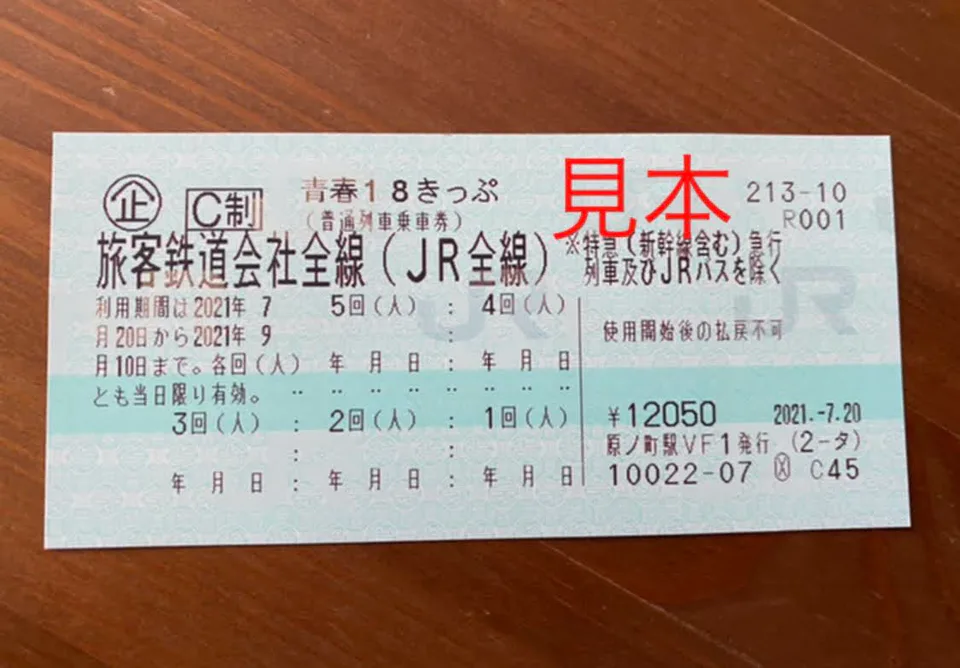
Historical 2021 ticket image only. Do not use it to infer the 2026 design or the current consecutive-day rules.
2026 buying dates matter near the end of each season
JR currently sets the 2026 use periods as March 1–April 10, July 18–September 8 and December 11, 2026–January 11, 2027. Tickets are sold from one month before the chosen start date within the stated sales windows.
The 5-day ticket stops selling earlier than the 3-day ticket near the end of each season because five consecutive days must still fit. The practical edge-of-season dates are:
↔ Scroll table left or right
Season | Use period | Latest 5-day purchase/start window | Latest 3-day purchase/start window |
Summer 2026 | Jul 18–Sep 8 | Sales through Sep 4 | Sales through Sep 6 |
Winter 2026–27 | Dec 11–Jan 11 | Sales through Jan 7 | Sales through Jan 9 |
This creates a small but real planning trap: near the season boundary, “I can still use Seishun 18 this week” does not mean both products are still available for a new five-day start.
If your first train leaves very early, buy the ticket beforehand. JR specifically warns that some ticket counters or machines may not sell the product at every hour even when the station is open.
Final decision tree
List only eligible JR ordinary/rapid fares. Do not count Shinkansen, limited express, buses, subway or private railways as pass savings.
Find your best three consecutive rail days. If the eligible fare total does not exceed ¥10,000 (about US$62.70), test individual fares before buying any pass.
Then test all five consecutive days. If the full five-day eligible fare total exceeds ¥12,050 (about US$75.60), the 5-day ticket may work even if the first three days alone did not.
If the 3-day ticket is already justified, test Days 4 + 5 against ¥2,050 (about US$12.90) per adult traveller.
For families, replace the adult headline with the party threshold. When school-age children would otherwise pay half-fare ordinary tickets, the break-even can rise to roughly ¥2,460–¥3,075 of adult-equivalent fare depending on party composition.
Compare time. Remove any “saving” that requires a slow-train day you would not willingly choose without the pass.
Stress-test disruption. If one bad-weather day breaks the five-day block, the 3-day ticket may be the more resilient purchase.
Final verdict: 5 days is cheap only when you already wanted five slow-rail days
For most travellers choosing between the two, I would start with the 3-day ticket and make the 5-day version prove itself. The proof is not “two more days for only ¥2,050 (about US$12.90).” It is that the complete five-day block already exists, Days 4 and 5 clear the relevant party-level break-even, and you would still choose those slow trains if the pass disappeared.
The 5-day version is excellent for a deliberately linear local-rail journey. It is weak for a trip with two stationary city days, a Shinkansen jump, a weather-sensitive mountain stop or school-age children whose normal fares are discounted. If you have to redesign the itinerary to use the pass, the pass has already lost.
Tokyo Family Hotels: “Sleeps Four” Is Not the Same as “Works for Four”
Osaka Kuromon Market Food Tour 2026: You’re Paying for a Guide, Not the Food
Suzuka Circuit Park Is Better for a 5-Year-Old Than an F1 Fan — Height Rules Decide the Day
Munakata Shrine & Izu Honten Day Tour: I’d Pay for the Route, Not the Four Stops
References
JR East — Seishun 18 Ticket 3-day conditions · JR East — Seishun 18 Ticket 5-day conditions · JR Hokkaido — current Seishun 18 Ticket conditions and exceptions · JR Hokkaido — Hokkaido Shinkansen Option Ticket · JR East — adult/child fare rules. Checked August 27, 2026. Fares, sales windows and operating rules can change; verify the live JR product page before purchase.