
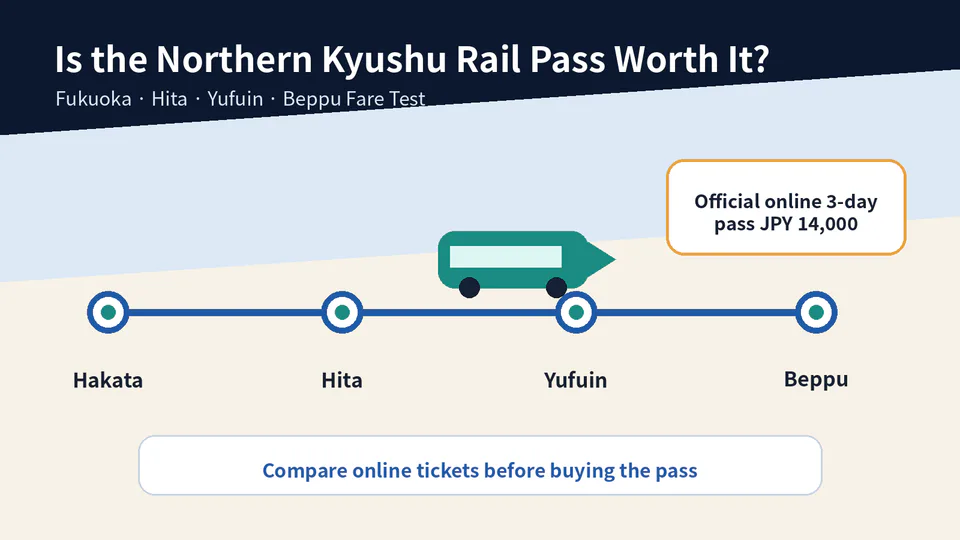

The Northern Kyushu Rail Pass is usually not worth buying for one return trip from Fukuoka to Yufuin, Beppu, Nagasaki or Kumamoto. In 2026, JR Kyushu’s own discounted tickets push the break-even point much higher than a comparison based on walk-up fares suggests. The 3-day Northern Kyushu Pass currently costs JPY 14,000 through JR Kyushu Rail Pass Online Booking. A Hakata–Nagasaki return can be JPY 9,000 on the current KAMOME net fare; Hakata–Yufuin can be JPY 8,600 return on the current Sonic-plus-local Yufuin ticket; and Hakata–Beppu can be as low as JPY 5,900 return with the current 3-day advance fare.
The pass starts to make sense when you compress several long, eligible JR journeys into the same consecutive 3- or 5-day window. A Fukuoka-based Nagasaki return plus a Kumamoto return can already push realistic discounted tickets above JPY 14,000. That is the kind of route where the pass becomes a transport product rather than a souvenir.
↔ Scroll table left or right
Route pattern | Realistic 2026 ticket benchmark | 3-day pass verdict |
Hakata ↔ Yufuin via current Sonic + local discount ticket | JPY 4,300 each way = JPY 8,600 return | Buy tickets. Pass costs JPY 5,400 more before any other JR travel. |
Hakata ↔ Yufuin on Yufuin no Mori using current Kyushu Net ticket | JPY 5,600 each way = JPY 11,200 return | Usually tickets. Still JPY 2,800 below the online pass. |
Hakata ↔ Beppu | JPY 3,500 Kyushu Net each way; JPY 2,950 with current Early 3 when available | Buy tickets. Return is roughly JPY 5,900–7,000. |
Hakata ↔ Nagasaki | Current KAMOME net ticket JPY 4,500 each way = JPY 9,000 return | Buy tickets unless another long JR trip sits inside the same pass window. |
Hakata ↔ Kumamoto | Current Kyushu Net Early 7 dynamic fare JPY 3,900–4,800 each way = JPY 7,800–9,600 return | Buy tickets for a simple Kumamoto return. |
Nagasaki return + Kumamoto return from Fukuoka within three consecutive days | About JPY 16,800–18,600 using the current discounted benchmarks above | 3-day pass starts winning by roughly JPY 2,800–4,600 before other eligible JR rides. |
These are current JR Kyushu published discount examples, not guaranteed fares for every train or date. Advance products have purchase deadlines, limited inventory or other conditions. The useful comparison is the cheapest ticket you would realistically buy for your actual dates—not an artificially expensive walk-up fare and not a promotional fare you cannot qualify for.
The price looks simple; the purchase channel changes the break-even
JR Kyushu currently sells the Northern Kyushu Pass for JPY 14,000 for three consecutive days and JPY 16,000 for five consecutive days through JR KYUSHU RAIL PASS Online Booking. The current station/travel-agency prices are JPY 15,000 and JPY 17,000 respectively. Children aged 6–11 are half price.
That JPY 1,000 purchase-channel difference belongs in the calculation. If you use JPY 15,000 as the three-day benchmark, a route can look closer to break-even than it really is for a traveller who was perfectly able to buy online for JPY 14,000. The reverse is also true: do not claim a JPY 14,000 break-even if your own purchase situation forces you into the higher channel.
Validity is by consecutive calendar days, not a rolling 72- or 120-hour clock. If you land at 20:30, ride the Fukuoka City Subway to the hotel and do not take a meaningful JR intercity train until the next morning, starting the pass on arrival night usually burns value for no reason. Use the Fukuoka transport guide to keep subway and Nishitetsu trips outside the JR calculation.
The biggest 2026 mistake is comparing the pass only with full fares
A pass article can make almost any pass look attractive by adding full ordinary fares. That is not how a price-sensitive traveller actually buys many Kyushu trips in 2026.
JR Kyushu currently sells a renewed “You can go this way too! Yufuin Ticket” for travel from July 1, 2026 through March 31, 2027. It is JPY 4,300 one way between Fukuoka/Hakata and Yufuin, using a limited express such as Sonic between Hakata and Oita plus a local train between Oita and Yufuin. If your goal is simply to reach Yufuin rather than ride Yufuin no Mori itself, JPY 8,600 return leaves a very large gap to the JPY 14,000 three-day pass.
Beppu is an even clearer example. JR Kyushu’s current reference fares list Hakata–Beppu/Oita at JPY 3,500 one way on the Kyushu Net ticket, with a current Early 3 fare of JPY 2,950 when its conditions are met. A simple Beppu return can therefore sit around JPY 5,900–7,000—less than half the online three-day pass.
Nagasaki and Kumamoto do not rescue the pass on their own either. The current KAMOME net ticket is JPY 4,500 one way from Hakata to Nagasaki. Hakata–Kumamoto Kyushu Net Early 7 currently uses dynamic pricing of JPY 3,900–4,800 one way. Each destination is expensive enough to feel like “pass territory,” but one return trip is still well below JPY 14,000.
Where the 3-day pass actually starts to win: stack long JR trips, not cheap local rides
The cleanest winning pattern is a Fukuoka base with two genuinely long JR day trips inside the same three-day window. Using the current discounted examples, a Nagasaki return is JPY 9,000 and a Kumamoto return is about JPY 7,800–9,600. Combined, that is roughly JPY 16,800–18,600.
Now the JPY 14,000 pass has a real advantage of roughly JPY 2,800–4,600 before you count any additional eligible JR movement. That margin is large enough to survive small itinerary changes and starts paying for flexibility rather than merely matching the fare total.
This is a better break-even pattern than adding a pile of short JR hops to force the maths. If you would not have taken the trip without the pass, it is not a saving. The pass should cover an itinerary you already want.
The same logic applies to a multi-city route. If your Kyushu itinerary naturally contains Nagasaki, Kumamoto and another eligible northern-Kyushu rail sector inside three consecutive days, price those sectors first. If half the route switches to highway buses, rental car or ferries, remove those days from the pass fantasy before doing the arithmetic.
The 5-day pass is not “better value” just because it costs only JPY 2,000 more
The online five-day pass is currently JPY 16,000, only JPY 2,000 above the three-day pass. That small step-up can be rational—but only if days four and five contain more than JPY 2,000 of JR travel you would otherwise buy, or if the extra flexibility genuinely matters.
A useful current benchmark is Hakata–Saga. JR Kyushu’s current Kyushu Net reference fare is JPY 1,300 one way. A Saga return on day four or five is about JPY 2,600. If the first three days already justify the JPY 14,000 pass, extending to five days for an additional Saga return can beat buying the three-day pass plus separate Saga tickets by about JPY 600.
But a Fukuoka shopping day, a Dazaifu day on Nishitetsu, a Kurokawa Onsen bus day or a rental-car day contributes zero to the rail-pass break-even. Five calendar days are not the same as five JR days.
Yufuin no Mori is a seat-availability decision before it is a pass decision
Yufuin no Mori is reserved-seat only. A Northern Kyushu Pass does not create a seat on a sold-out train.
Once the pass has been exchanged in Japan, JR Kyushu currently allows Northern Kyushu Pass holders up to six reserved-seat reservations without an extra charge on eligible trains. If you reserve popular sightseeing trains in advance through JR KYUSHU RAIL PASS Online Booking before receiving the pass, however, that advance reservation is a paid service. JR Kyushu currently lists Yufuin no Mori advance seat reservation at JPY 1,500. Advance paid reservations do not count toward the six free reservations.
That creates a real trade-off:
Wait until Japan: reserve within the pass limit for no additional charge, but popular departures may already be sold out.
Reserve before arrival: pay for certainty on a high-demand sightseeing train.
If a ryokan dinner or hotel pickup depends on one exact Yufuin no Mori, the price of certainty may be worth paying. If the train itself is not the purpose, the current JPY 4,300 Sonic-plus-local Yufuin ticket can be a much cheaper and more flexible alternative. Use the Yufuin no Mori reservation guide before making a hotel night depend on one train.
Six free reservations sound generous—until you count journeys instead of days
The Northern Kyushu Pass currently allows up to six free reserved-seat bookings. A Hakata–Nagasaki journey that transfers between a limited express and the Nishi Kyushu Shinkansen at Takeo-Onsen counts as one reservation when the connection is made without leaving the gates.
So a Fukuoka-based itinerary with Nagasaki return plus Kumamoto return normally uses four reserved-seat bookings. Add a Yufuin no Mori return and you can reach all six. A seventh reserved-seat journey requires buying the relevant limited-express ticket separately.
This does not make the pass bad. It means “unlimited rides” and “unlimited reserved seats” are not the same promise on the Northern Kyushu product. If the itinerary contains many reserved sightseeing trains, count them before purchase.
Current 2026 Yufuin no Mori operations have changed again—check the travel date, not an old disruption notice
JR Kyushu’s latest operating notice now says the vehicle substitution for Yufuin no Mori 3 and 4 runs only through September 18, 2026. Until that date, those services operate as limited express Yufu 73 and 74 because of the vehicle issue, while Yufuin no Mori 1, 2, 5 and 6 operate normally.
From September 19 through September 30, JR Kyushu now plans Yufuin no Mori 1–6 to operate normally. From October 1 onward, 1–6 are likewise scheduled to return to normal operation, subject to individual inspection-related non-operating days shown on the official operating calendar.
This matters to the pass decision because an older July disruption notice can make a September traveller avoid Yufuin no Mori 3 or 4 unnecessarily. If your trip is on or after September 19, do not price a different train or pay for a different departure simply because you saw the earlier “through September 30” substitution notice. Check the exact date, train number and latest official operating calendar before paying for an advance seat reservation.
Three failure modes can make a pass that “breaks even” the wrong purchase
1. The itinerary depends on buses
The Northern Kyushu Pass covers eligible JR Kyushu trains within its area. It does not cover Fukuoka City Subway, Nishitetsu, ordinary highway buses or private operators. A route through Aso and Kurokawa can look geographically perfect for a northern-Kyushu pass while much of the actual journey sits on buses. Use the Kyushu Odan Bus guide to separate the JR spine from the bus spine.
2. You accidentally count the Hakata–Kokura Shinkansen
The pass does not cover the Sanyo Shinkansen between Hakata and Kokura. That segment is easy to misread because both stations are in Kyushu. The pass can be used on eligible JR Kyushu conventional-line services in the covered area, but do not add a Hakata–Kokura Shinkansen fare to your “pass savings” unless you are also planning to buy that ticket separately.
3. You buy the pass before solving luggage and hotel timing
A pass does not make a sparse connection more frequent and it does not carry a suitcase from the station to a ryokan. If a Yufuin dinner has a hard check-in deadline or a Hita transfer becomes awkward with two large cases, solve the timetable and luggage first. The Hakata–Yufuin luggage guide and Beppu vs Yufuin stay decision are more useful than forcing another JR sector into the pass calculation.
The pass has a convenience premium—but do not use “flexibility” to hide a large fare gap
A rail pass can still be rational when point-to-point tickets are slightly cheaper. It removes repeated ticket purchases, allows spontaneous eligible JR rides and can reduce the mental cost of changing plans. But the size of the fare gap matters.
If realistic tickets total JPY 13,500 and the online pass costs JPY 14,000, JPY 500 may be a reasonable price for flexibility. If realistic tickets total JPY 8,600, calling the extra JPY 5,400 a “convenience premium” is much harder to defend.
There is no universal yen threshold. Name the uncertainty the pass is buying: an extra JR day, the freedom to return earlier, an alternate JR route, or several unplanned eligible rides. If you cannot name the flexibility you expect to use, price it at zero.
Online purchase is cheaper, but the pass still has a collection step
Buying through JR KYUSHU RAIL PASS Online Booking does not turn the Northern Kyushu Pass into a phone-only ticket. JR Kyushu currently requires the pass to be received at a designated counter, with the passports of all users.
Current reception hours include Hakata Station from 07:00 to 22:00. The Fukuoka Airport JR Kyushu Rail Pass Exchange Counter is currently 09:00 to 17:00 and is for redemption/seat-ticket pickup rather than an all-hours airport solution. A late flight therefore should not be planned around “I will activate the pass at the airport when I land.”
If your first expensive JR ride is early the next morning, collect the pass the previous day when practical. Otherwise the cheapest pass can create the very station-counter friction you were buying it to remove.
Who should buy the Northern Kyushu Pass?
Buy it when: at least two long eligible JR trips sit inside the same three-day window; your realistic discounted ticket total is clearly above the pass; you value flexibility on additional JR sectors; and the route is not dominated by buses or rental-car days.
Usually skip it when: the trip is only Fukuoka–Yufuin return, Fukuoka–Beppu return, one Nagasaki return or one Kumamoto return; your expensive journeys fall outside the same consecutive validity window; or the route uses Kurokawa/highway buses as heavily as JR.
Choose five days rather than three when: the extra two days add more than the JPY 2,000 price step in real eligible JR travel or materially useful flexibility. Do not extend the pass simply because your holiday lasts five days.
Final verdict
The Northern Kyushu Rail Pass is a route-density product, not a destination checklist. In 2026, JR Kyushu’s own discounted tickets mean a simple Yufuin, Beppu, Nagasaki or Kumamoto return from Fukuoka usually does not justify the JPY 14,000 online three-day pass. The pass starts to earn its price when two or more long JR journeys are packed into the same validity window—such as Nagasaki plus Kumamoto from a Fukuoka base—or when a route that already breaks even also benefits from additional eligible JR flexibility.
Calculate with the tickets you would actually buy, count only JR-covered sectors, count reserved-seat uses separately from rides, and make the pass support the itinerary rather than adding destinations to justify the pass.
Check the current Northern Kyushu Rail Pass price on Klook
THE RAIL KITCHEN CHIKUGO 2026: ¥13,000 Isn’t a Train Fare — It’s a Moving Lunch
USJ Express Pass 2026: Is It Worth Paying More for Certainty?
Nezu Museum 2026: The Garden Isn’t Free — and That Changes Whether ¥1,400 Is Worth It
Sanrio Puroland Tickets 2026: Save on the 2 PM Pass Only If You Know What You’ll Skip
KidZania Fukuoka Tickets 2026: 4 vs 6 vs 8 Hours — and Is the English Program Worth It?
References
JR Kyushu — Rail Pass prices and reserved-seat limits · JR Kyushu — Rail Pass reserved-seat FAQ · JR Kyushu — advance sightseeing-train seat reservations · JR Kyushu — 2026 Yufuin discount ticket · JR Kyushu — Yufuin no Mori fares and timetable · JR Kyushu — current Yufuin no Mori operating notice · JR Kyushu — current Kyushu Net / Early 3 reference fares · JR Kyushu — KAMOME net fare · JR Kyushu — Hakata–Kumamoto Early 7 dynamic pricing · JR Kyushu — current pass reception locations and hours. Checked August 25, 2026. Discount-ticket inventory, operating notices and train schedules can change; recheck the exact travel date before purchase.