
For a first KidZania Fukuoka visit, the 09:00–15:00 six-hour ticket remains the best default after the September 1, 2026 reservation change. It gives the child access to the first activity wave, enough time to absorb imperfect return times and a meal break, and avoids paying for an eight-hour day before you know the child will enjoy that much role-play.
The bigger decision for an English-speaking family is now whether to pay for the English Activities Program (EAP). On a normal weekday, the current child/junior EAP price is JPY 8,500 versus JPY 4,800 for the ordinary six-hour 09:00 ticket — a JPY 3,700 premium, about 77%. That premium does not buy more hours. It buys five consecutive pre-reserved activities in English, a Global Staff guide and far less scheduling uncertainty. For a child who needs English to participate confidently, that can be excellent value. For a confident child who mainly needs one or two English activities, ordinary admission plus the published E@K English-activity schedule can be the smarter buy.
↔ Scroll table left or right
Your child / trip | Start with | Why | Main catch |
First visit, no extreme must-do list | 09:00–15:00, 6 hours | First-wave availability plus enough time for several jobs and a meal | You give up the final two hours |
Child needs English throughout and would be stressed by Japanese instructions | EAP | Five English activities are pre-reserved and guided in a group of up to five children | Weekday child price is JPY 8,500 — JPY 3,700 above the ordinary 6-hour ticket |
Child can cope with ordinary KidZania but wants some English activities | Ordinary ticket + E@K schedule | Specific activities are conducted in English from start to finish on published days | The English activity may not be the child's preferred job and the schedule can change |
Family needs a slow morning | 11:00–17:00, 6 hours | Same duration as 09:00 without an early start | Two hours of activity capacity have already been allocated |
Curious child, no must-do job | 13:00–17:00, 4 hours | Cheaper trial visit | Popular jobs can already be full |
Older child with a long ranked wish list | 09:00–17:00, 8 hours | Lowest cost per hour and maximum scheduling flexibility | Fatigue can make the last two hours worthless |
September 1 makes ordinary admission easier — but it does not create more capacity
KidZania has announced that from September 1, 2026, a child can hold up to two activity reservations at the same time. Activities marked “Join Now” can still be taken while those reservations are held. This is a meaningful reduction in scheduling friction because one future return time no longer has to dominate the whole day.
It does not make a popular job unlimited. Firefighter, pilot, sushi chef or another high-demand activity can still fill. Arriving early still matters when a particular job is the reason for the visit.
The new rule changes the first-hour strategy rather than eliminating it. Before arrival, ask the child for three levels of priority:
Must do: one or two jobs that would define success.
Would like: two or three jobs worth taking if the return time fits.
Happy fallback: activities the child will enjoy without waiting for a famous option.
After September 1, ordinary admission becomes more resilient because you can protect two future jobs and still use immediate openings. This is one reason the EAP premium should now be justified primarily by English support and guaranteed structure, not merely by fear of the normal reservation system.
EAP costs about 77% more on a normal weekday — what exactly are you buying?
The current Fukuoka English Activities Program costs JPY 8,500 for a child or junior on a normal weekday first shift. The ordinary weekday 09:00–15:00 six-hour child/junior ticket is JPY 4,800. The difference is JPY 3,700, or about 77% more.
The EAP product is materially different:
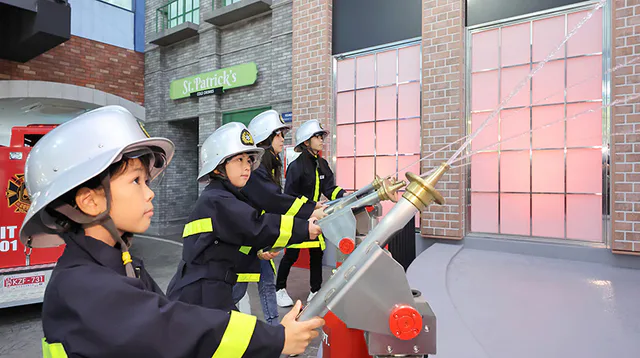
five consecutive activities are conducted in English;
those five activities are reserved in advance, so the child does not have to make reservations or wait for them;
a group of up to five children is guided by Global Staff;
Japanese ability is not required;
after the EAP sequence ends, the child can reserve ordinary activities outside the program.
That makes the premium easiest to justify for a child who would otherwise participate less because of language, or a family whose real goal is a structured English experience rather than maximum freedom to choose any five jobs.
The premium is harder to justify when the child speaks some Japanese, is comfortable following demonstrations, or cares deeply about a specific job that is not part of that day's EAP sequence. A pre-reserved five-activity tour is only valuable when you want the activities it actually delivers.
E@K is the important middle option most English families should check first
KidZania Fukuoka separately publishes an E@K Activity schedule: selected normal KidZania activities are conducted in English from start to finish on particular days of the week. This gives an English-speaking family a third option between “ordinary Japanese-heavy day” and “pay for the full EAP.”
The current schedule includes examples such as:
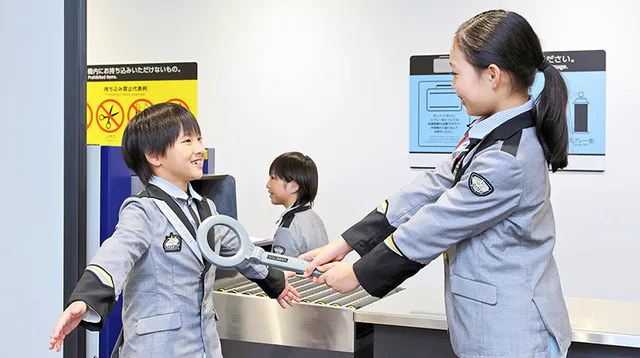
Monday: Fire Station, DX Engineer and Shoe Factory.
Friday: Magic Studio, Pen Shop and Airplane (Pilot).
Saturday: Nursery, Hospital (Nurse), Kampo Laboratory and Airplane (Pilot).
Sunday: Airplane (Cabin Attendant), Medical Lab and DX Engineer.
The schedule can change, so it should be rechecked for the visit date. But the planning insight is stable: if one or two published E@K activities already match the child's wish list, ordinary admission may give enough English support without the JPY 3,700 weekday EAP premium.
EAP remains the stronger product when the child needs English throughout, does not speak Japanese and would benefit from one guide staying with the group from activity to activity.
09:00 and 11:00 six-hour tickets cost the same but are not the same product
KidZania's current one-shift structure offers 09:00–15:00 and 11:00–17:00 six-hour tickets at the same standard weekday child price of JPY 4,800. The late ticket does not lose hours; it loses access to the first two hours of capacity.
Choose 09:00 when a must-do job matters. KidZania opens admission before the nominal activity start, so a family that arrives in time can use the first wave rather than entering after several return slots have already been allocated.
Choose 11:00 when the morning itself has value: the child needs sleep after a late arrival, the family will not function happily at 08:00, or another nearby plan is genuinely more important. A theoretically better ticket is worse when the people using it cannot arrive early enough to exploit it.
If your Fukuoka base is still undecided, compare Hakata vs Tenjin. The family schedule should decide the ticket; the ticket should not force an unrealistic hotel morning.
Four hours is a trial product, not a cheap substitute for the first shift
The current standard weekday child/junior price is JPY 3,300 for 13:00–17:00 versus JPY 4,800 for six hours. You save JPY 1,500 and two hours, but you enter after four hours of the day have already passed.

That makes four hours excellent when the child is flexible and KidZania is deliberately an afternoon sample. It is weak when one job is non-negotiable.
Use a simple veto: would the family still consider the visit successful if the child's first-choice activity is full? If yes, four hours can work. If no, buy a morning product.
Eight hours is cheapest per hour, but fatigue can erase the arithmetic
Using the current normal weekday child prices:
4 hours at JPY 3,300 ≈ JPY 825 per hour.
6 hours at JPY 4,800 = JPY 800 per hour.
8 hours at JPY 5,900 ≈ JPY 738 per hour.
The eight-hour ticket is mathematically the cheapest per scheduled hour. It is not automatically the best value. The last two hours are valuable only if the child still wants to make decisions, change uniforms, wait for return times and keep role-playing after lunch.
I would choose eight hours for an older or repeat child with five or more serious priorities. I would not choose it for a three- or four-year-old simply because JPY 738 per hour looks efficient.
Same-day web reservation exists — but it is a backup, not a reason to wait
KidZania Fukuoka currently states that web reservations for the first shift can be made until 12:00 and for the second shift until 18:00 on the day of the visit, while inventory remains. Sales stop when tickets sell out.
That can rescue a rainy day or a flexible Fukuoka afternoon. It should not be used as evidence that a peak holiday date is safe to leave unbooked. If KidZania is one of the trip's main child priorities, reserve once the date is stable enough.
Age 3–15 is one admission category covering very different usable days
KidZania's standard role-play activities are aimed at ages 3–15. A three-year-old and a 14-year-old can legally buy into the same concept while having completely different fatigue limits, reading ability and desire to manage their own schedule.
For younger children, the number of successful activities matters more than the number of hours purchased. For older children, the ability to hold two reservations after September 1 can make a long day much more satisfying because they can manage several priorities themselves.
An under-three sibling can enter under the current structure but is not using the standard job product in the same way. Do not treat toddler-support facilities as proof that an eight-hour ticket creates equal value for both children.
Final verdict
For most first visits after September 1, 2026, buy the 09:00–15:00 six-hour ticket. The two-reservation rule makes the ordinary day less fragile while the early start protects popular activity capacity.
Pay for EAP when English support is a hard participation constraint. On a normal weekday, the JPY 3,700 child premium buys five pre-reserved English activities and Global Staff, not more hours. If the child mainly wants one or two English jobs, check the E@K schedule first and keep ordinary admission in the comparison.
Choose four hours only when this is a low-stakes trial. Choose eight hours only when the child has the attention and wish list to use the final two hours. The best KidZania ticket is the one that protects the child's must-do jobs without buying hours or language support the family will not use.
References
KidZania — activity reservation change from September 1, 2026 · KidZania Fukuoka — one-shift ticket times and prices · KidZania — current English Activities Program fees · KidZania Fukuoka — English Activities Program · KidZania Fukuoka — E@K English activity schedule · KidZania Fukuoka — current same-day web reservation rules. Checked August 25, 2026.