
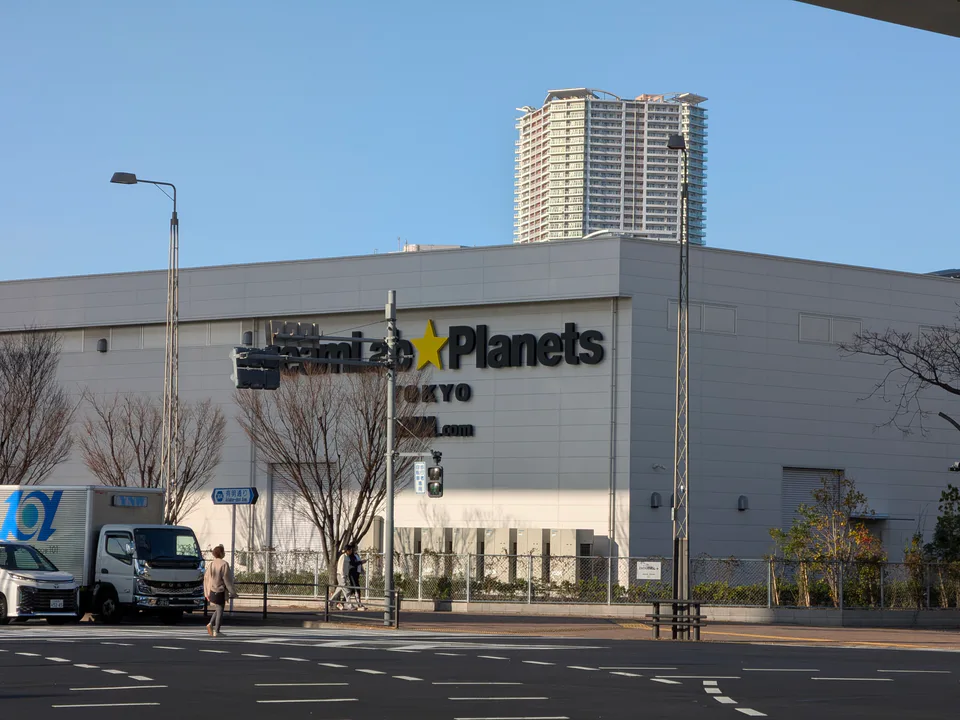
teamLab Planets is worth it when the barefoot water-and-texture format sounds like the reason to go, not a nuisance you are willing to tolerate for the photos. The official adult Entrance Pass currently starts at JPY 3,600 (about US$23). The bigger cost, however, is the Toyosu half-day: transport, the admission buffer, lockers, a published 2–2.5-hour full-venue visit, getting shoes and belongings back, and the trip onward.
My default is therefore simple: buy the standard timed ticket and make Toyosu serve more than one purpose. Upgrade to the JPY 12,000 (about US$75) Premium Pass only when schedule uncertainty is genuinely expensive. Premium lets you enter flexibly and bypass the admission queue, but the operator explicitly says it does not skip queues inside individual artworks.
Checked August 26, 2026. Approximate USD conversions use the August 25 ECB EUR reference rates, which imply about JPY 159.2 = US$1. Exchange rates move.
ValueNavi Decision Table: when does Planets deserve the half-day?
↔ Scroll table left or right
Your trip | ValueNavi call | Why | What reverses it |
You actively want barefoot water, textures and unstable surfaces | Strong go | You are buying the feature that is hardest to substitute | The physical format turns out to be a stressor for someone in the group |
You mainly want dramatic digital-art photos | Compare Borderless first | Planets adds clothing and water friction you may not value | The water sequence itself is the photo/experience you care about most |
Toyosu Market / Tokyo Bay is already in the day | Strong route fit | The transport cost is shared with another useful block | A fixed booking elsewhere forces an immediate cross-city exit |
Only 3 full Tokyo days, staying in Shinjuku/Shibuya | Conditional | The half-day opportunity cost becomes high | teamLab is a top-two or top-three Tokyo priority |
Young child who loves water and physical interaction | Often strong | The venue can function more like an activity than a gallery | The child dislikes darkness, bare feet or changing floor textures |
Pregnancy / mobility limits / need for predictable flooring | Check before buying | Some works have specific safety/access limits | The unavailable works are not central to your group’s value |
ValueNavi Score: high uniqueness, middling time efficiency
This is ValueNavi editorial analysis, not an official rating. A higher score means the dimension is more favourable to the traveller.
Dimension | Score | Interpretation |
|---|---|---|
Money Cost | The base ticket is defensible for a major Tokyo attraction; Premium weakens value sharply | |
Time Cost | 2–2.5 hours inside before cross-city transport and entry/exit friction | |
Booking Risk | Timed entry matters, though official-store tickets have conditional changeability | |
Weather Risk | A strong indoor anchor on wet or very hot days | |
Crowd Risk | Crowds reduce flow and photo outcomes even when the core experience remains usable | |
Route Fit | Strong with Toyosu/Ginza/Tokyo Bay; weaker as a standalone western-Tokyo detour | |
Uniqueness | The barefoot water-and-body format is unusually difficult to replace |
ValueNavi True Time Cost: a two-hour attraction can consume 3–4 hours
The official group-ticket FAQ currently estimates 2–2.5 hours from entry to exit for the full venue. That is the inside time, not the itinerary cost.
↔ Scroll table left or right
Block | Planning allowance | Why it exists |
Travel to Toyosu | 30–60+ min depending on origin | Toyosu is not on every first-time Tokyo corridor |
Admission / belongings | 20–30 min | Arrival margin, ticketing flow, lockers/shoes |
Inside | 2–2.5 h | Operator’s current full-venue estimate |
Exit / reset | 15–30 min | Dry off, recover shoes/bags, regroup |
Real planning block | roughly 3–4+ hours | This is what should compete with another Tokyo half-day |
These are ValueNavi planning allowances rather than operator guarantees. The useful point is substitution: if Planets enters the day, something else leaves.
The defining constraint is literal: some water reaches adult knee height
teamLab’s visitor guidance says the Water Area is experienced barefoot and that water in some works can reach adult knee height. Treat clothing as operating equipment: trousers or shorts that stay above the knee, shoes that are easy to remove, and a change of clothes for children who may get wet.
Mirrored floors add another clothing constraint. Free wraps/shorts are available where needed, but the higher-value solution is arriving already comfortable with the format rather than spending paid attraction time fixing the outfit.
Use the works as fit tests, not a must-see checklist
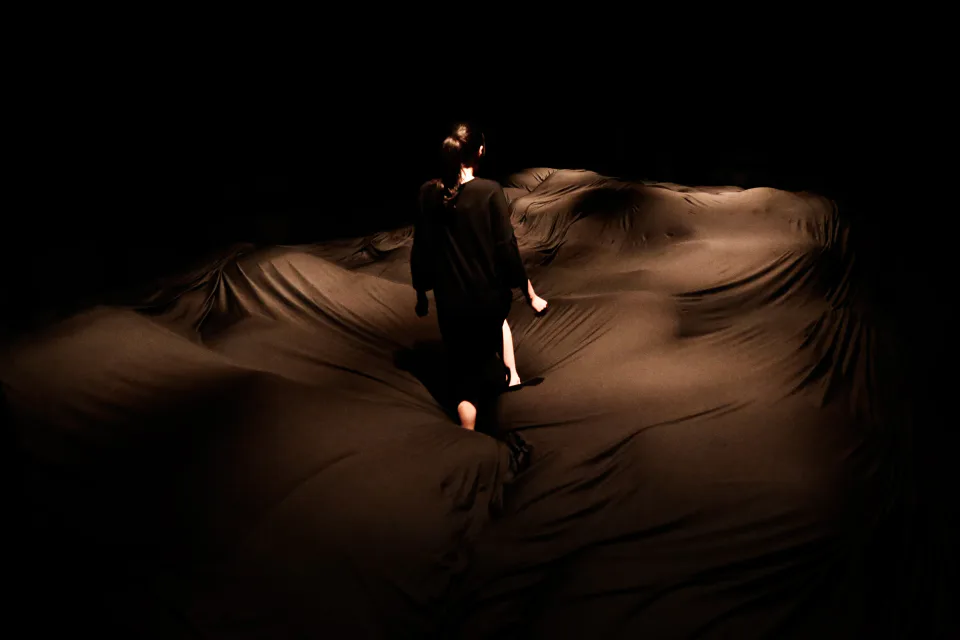
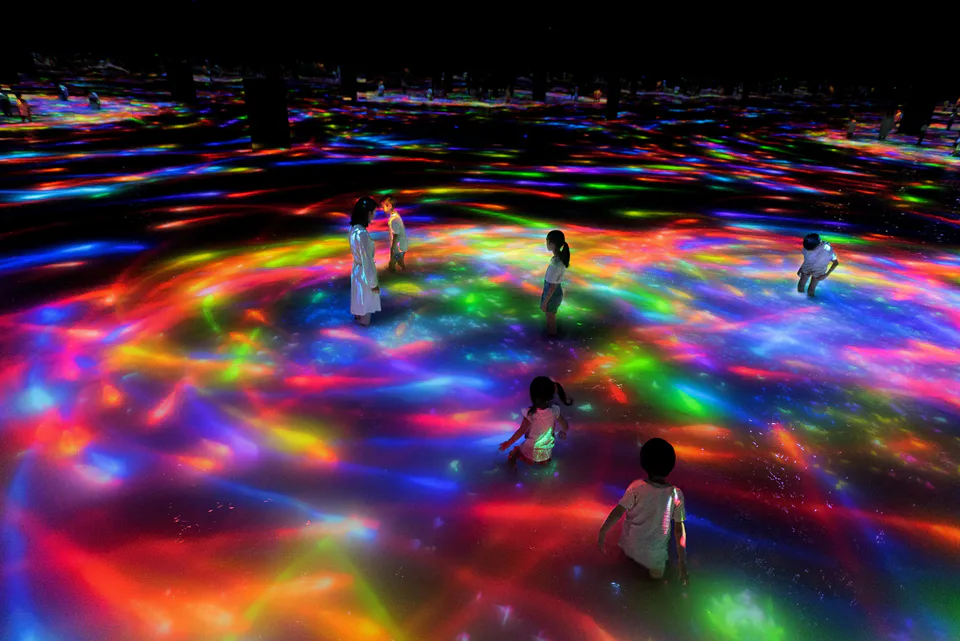
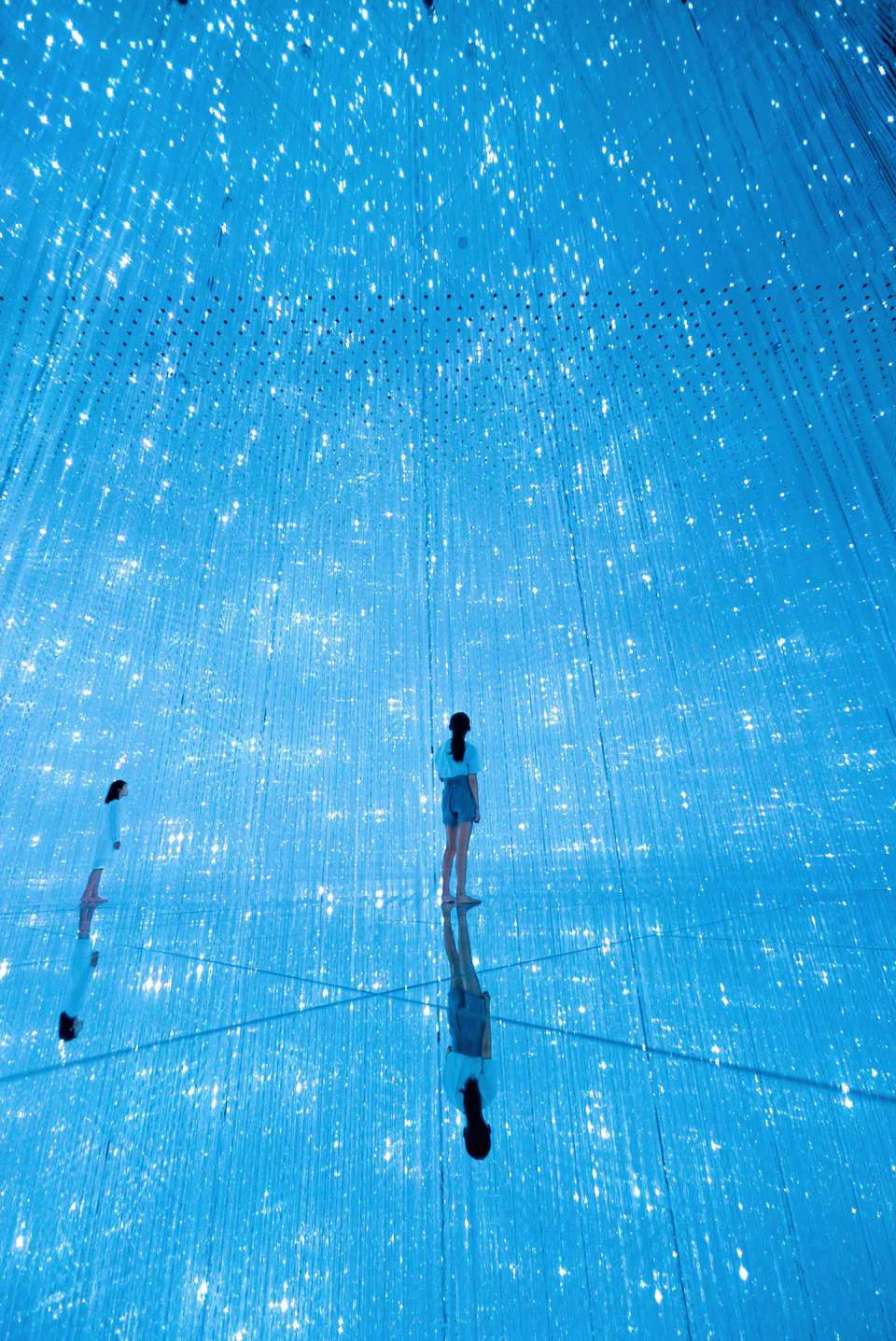
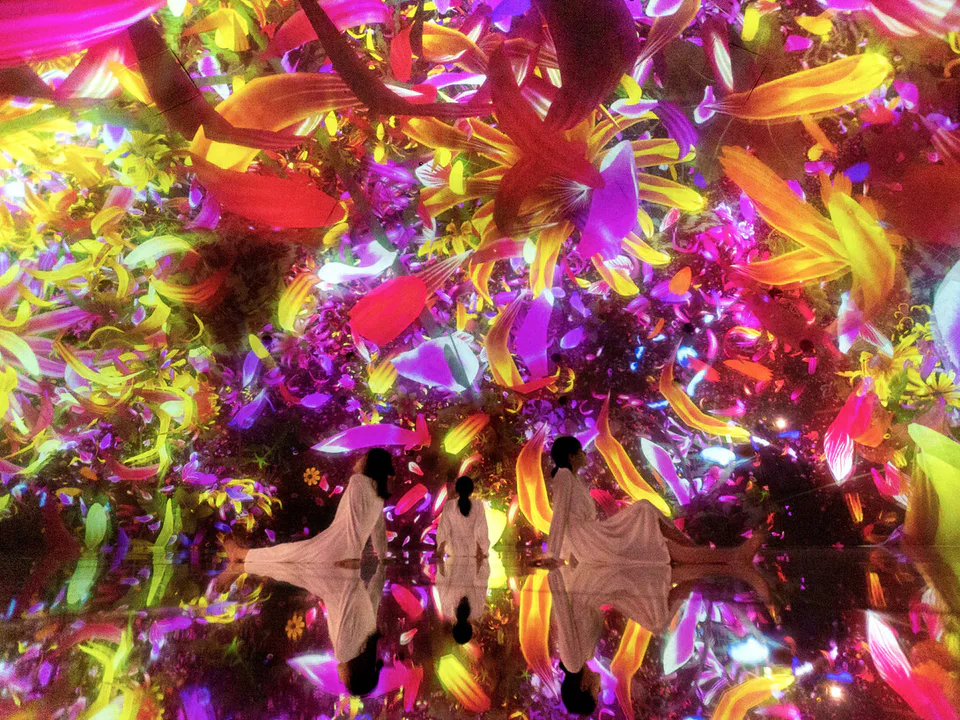
Soft Black Hole is a useful mobility/sensory test: the changing floor matters more than its photo value. Drawing on the Water Surface is the cleanest purchase test: if entering the water is the part you want, Planets is aligned with you. The Infinite Crystal Universe has high visual value but no guarantee of an empty room, so photo perfection is a weak reason to buy the ticket.
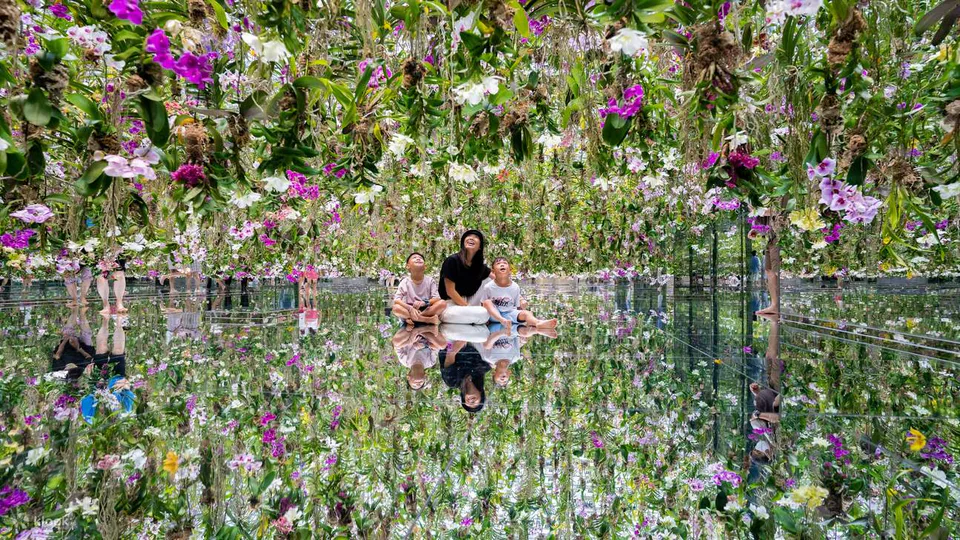
Floating Flower Garden adds real suspended orchids rather than another screen-only room. The broader point is that Planets is strongest when physical materials, balance and spatial interaction matter—not when every room is reduced to a photo target.
Standard vs Premium: the JPY 8,400 (~US$53) gap must solve a real risk
The official store currently lists the adult Entrance Pass from JPY 3,600 (~US$23) and Premium at JPY 12,000 (~US$75). At the minimum adult price, that is an JPY 8,400 (~US$53) upgrade.
Premium allows admission at a flexible time on the specified date and lets you bypass the admission queue by going to the information counter. It does not skip lines inside individual artworks. I would therefore buy it only for a real scheduling risk: same-day flight, uncertain intercity arrival, business/event finish time or another constraint you cannot buffer cheaply.
The standard official-store ticket is more resilient than “fixed time” sounds: eligible tickets can currently be changed up to three times, with the Entrance Pass change deadline two hours before the booked entry time, subject to availability and ticket rules.
Families: price is not the hard part; sensory fit is
Children three and under currently enter free, but that should not drive the decision. The venue combines darkness, bare feet, water, soft surfaces and changing physical conditions. That can be excellent for a child who likes movement and terrible for one who needs predictable flooring or refuses wet clothing.
Strollers are left outside the exhibition area. For families, the best predictor is therefore not “child-friendly?” but whether the most sensitive person in the group likes the format.
ValueNavi Last-Minute Card
↔ Scroll table left or right
Question | Action |
Rain today? | Keep Planets; solve the wet journey to Toyosu rather than replacing the attraction |
Clothing cannot go above the knee? | Change outfit or use venue-provided options before the Water Area |
Large suitcase? | Store it at the hotel/station instead of making Planets a transfer-day luggage stop |
Running late? | Check your exact ticket rules immediately; do not assume a missed slot creates a guaranteed rebooking |
Hard reservation after? | Leave real exit/transport buffer; the inside visit is not a fixed two-hour tour |
Choosing Borderless too? | Buy both only if immersive digital art deserves two separate Tokyo half-days |
Final verdict
Buy teamLab Planets when the barefoot water experience is the attraction. Make Toyosu part of a coherent half-day, dress for the water and protect a 3–4-hour real planning block rather than a fantasy two-hour slot.
For most travellers, start with the standard Entrance Pass. Premium at JPY 12,000 (~US$75) becomes rational only when flexibility protects a concrete risk. If wet feet, unstable floors or clothing management are things you will merely endure for photos, choose another immersive venue—most obviously teamLab Borderless.
References
teamLab Planets official ticket store · official ticket-change and Premium Pass rules · official estimated visit duration · ECB reference rates for approximate USD conversion.