
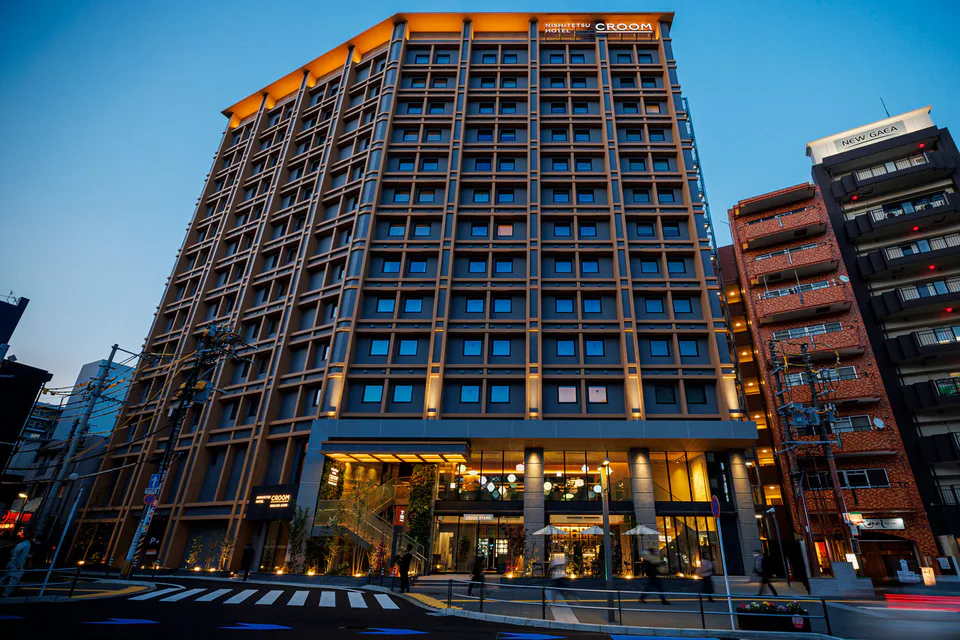
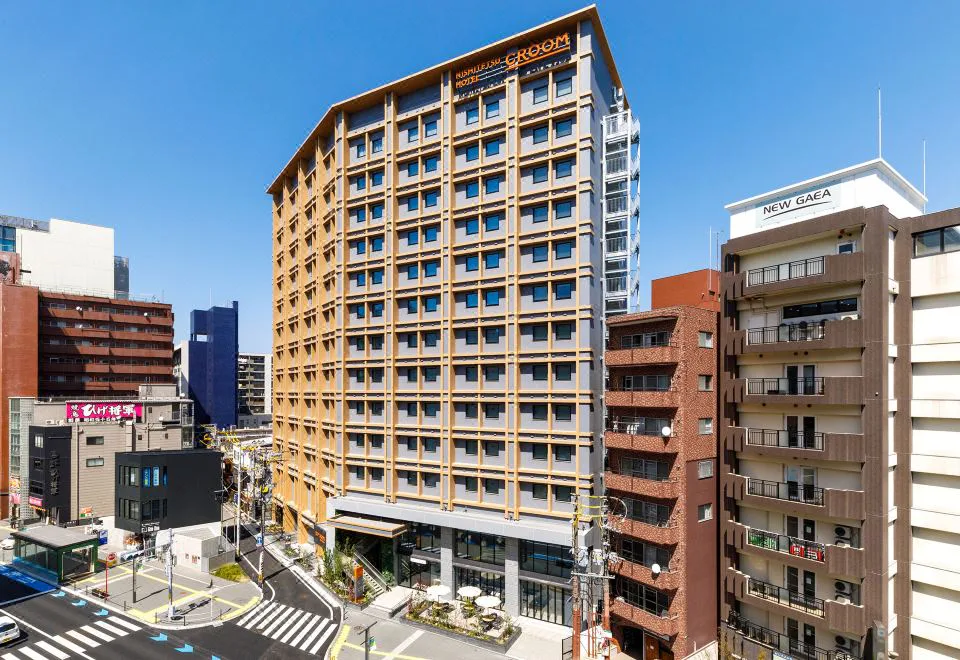
Nishitetsu Hotel Croom Hakata Gion is easy to misread as simply a very convenient hotel beside Kushida Shrine Station. The more useful decision is inside the 15 m² room category. A 15.4 m² Stay Type room uses its limited area for an in-room washer-dryer, microwave, kitchenette, single IH hob, refrigerator, iron, detergent, folding desk and under-bed storage, but keeps a unit bath. The regular 15.9 m² Double is only 0.5 m² larger, yet its bathroom routine is different: the hotel lists a separated toilet, shower and washbasin. For a four- or five-night stay, that is not a tiny specification difference. It is a choice between long-stay tools and a more independent private-bath routine.
My answer depends on repeated use. I prioritise Stay Type when the stay is four or five nights, laundry will genuinely change the packing list, simple food reheating is useful and most evenings return before the public bath closes at 25:00. I lean back toward the regular Double for one or two nights, for two travellers who value a separated private bathroom, or when the washer-dryer and kitchenette are likely to sit unused. If two separate beds or more raw floor area matter, the 19.2 m² Twin becomes a third product rather than a simple size upgrade.
Nishitetsu Hotel Croom Hakata Gion: the 30-second answer
↔ Scroll table left or right
Decision point | Verified setup | Trip impact |
Kushida Shrine exit | Exit 4 about 1 min, stairs; Exit 5 about 2 min, escalator | With large luggage, one extra minute can be cheaper than carrying a case on stairs. |
Stay Type | 15.4 m²; unit bath; washer-dryer, microwave, kitchenette, single IH hob | The repeated equipment value becomes clearer over four to five nights. |
Double | 15.9 m²; toilet, shower and washbasin separated | For a short two-person stay, private-bath usability can matter more than long-stay equipment. |
Twin | 19.2 m²; two beds; separate toilet and bathroom with washing area | A different bed-and-space product, not merely 3–4 extra square metres. |
Public bath | 15:00–25:00; 06:00–09:30 | Whether you return before 25:00 directly changes the Stay Type trade-off. |
Breakfast | 06:30–10:00; final entry 09:30 | An early JR departure can make a hotel breakfast poor value. |
The station distance also has two versions. Exit 4 is the shortest published route but uses stairs. Exit 5 is about one minute farther and has an escalator. With a cabin bag, I can understand choosing Exit 4. With a 28-inch case, a stroller or limited mobility, I would willingly spend the extra minute to reduce lifting. The fastest route and the lowest-friction luggage route are not always the same thing.
The room comparison is equally easy to oversimplify. Stay Type is not “a tiny room with a washing machine,” and Double is not “the same room without appliances.” The 15.4 m² Stay Type deliberately spends scarce space on long-stay equipment and storage; the 15.9 m² Double spends its value on a separated private-bath routine. The 19.2 m² Twin adds two beds, a different bathroom setup and more raw space. Decide which function repeats every day before looking at the lowest OTA rate.
Arrival reality: the one-minute exit is not always the large-luggage answer
From Fukuoka Airport, the hotel's current guidance is to take the Airport Line to Hakata, then transfer to the Nanakuma Line for one stop to Kushida Shrine. The hotel describes the overall transport at roughly thirty minutes, but that is not a room-door guarantee. Waiting, changing platforms, lifts, finding the correct exit and the final walk all sit outside a neat timetable figure. The Fukuoka transport guide is the better place to understand how the Airport Line, Nanakuma Line and JR roles differ.
The first practical decision after reaching Kushida Shrine is therefore not “which exit is one minute?” but “which exit fits this luggage?” Exit 4 works for lighter travellers who are comfortable with stairs. Exit 5 adds roughly a minute but gives an escalator. In daylight the difference can feel trivial; after a late flight, in rain, with children or with older family members, the final hundred metres can feel much more expensive.
A second mistake is treating this as a hotel at JR Hakata Station. Hakata is only one Nanakuma Line stop away, but an early Shinkansen, Yufuin no Mori or other JR departure still requires checkout, the subway trip and movement to the JR platform. This hotel is better understood as a city-living base between Gion, Kushida Shrine, Canal City and Nakasu than as a zero-transfer JR base. If repeated JR departures dominate the trip, compare the same dates with JR KYUSHU HOTEL Blossom Hakata Chuo or Miyako Hotel Hakata.
Room decision: 15.4 m² Stay Type or 15.9 m² Double?
↔ Scroll table left or right
Room | Area and bathroom | Most useful feature | My decision |
Stay Type | 15.4 m²; unit bath | Washer-dryer, microwave, kitchenette, IH hob, under-bed storage | Best when a four-to-five-night stay will genuinely use laundry. |
Double | 15.9 m²; toilet / shower / washbasin separated | More independent private-bath routine and larger desk surface | More balanced for one or two nights or two travellers who value the bathroom. |
Twin | 19.2 m²; separate toilet and bathroom with washing area | Two beds, more raw space and a different bath layout | Compare when separate beds or more floor area solve a real need. |
Stay Type is easiest to undervalue or overvalue because its advantage depends on nights, not on a first impression. The hotel lists an in-room washer-dryer, microwave, mini kitchen, one-ring IH hob, refrigerator, iron and detergent, with a folding desk and under-bed storage to manage the small footprint. Over four nights, those tools can remove repeated outside tasks: no shared-laundry trip, fewer spare clothes and the option to reheat something without going back outside.
The cost is just as concrete. Stay Type uses a unit bath rather than the regular Double's separated toilet, shower and washbasin. Two people cannot use those functions as independently. If one person is showering while the other wants the toilet or basin, the room routine is more tightly linked. On a one-night stay I would not accept that compromise merely for a washer-dryer I may never start. On a five-night stay where I wash clothing every evening or every second evening, the equation changes.
The 15.9 m² Double is only 0.5 m² larger, so the reason to choose it is not the extra floor area. It is the separated bathroom. On a short stay the luggage is already packed for the whole trip, the kitchenette may never be used and private-bath convenience repeats more often than laundry. That makes the normal Double a sensible baseline rather than a feature-poor version of Stay Type.
If you need two beds or both travellers bring larger cases, the 19.2 m² Twin is genuinely different. It adds floor area and a separate toilet with a bathroom that has a washing area. The published room area and photographs still do not prove that two 28-inch cases can both stay fully open without affecting circulation, so I do not turn 19.2 m² into a zero-luggage-pressure guarantee. Check the exact room photos and bed configuration sold on your dates.
Can the public bath compensate for Stay Type's unit bath?
The public bath is the second reason Stay Type can work. Current published hours are 15:00–25:00 and 06:00–09:30, with indoor and semi-open-air bathing areas. If you return around 23:30, a workable routine is to start the washer-dryer, use the public bath and return to the room afterward. In that pattern, the room's compact unit bath becomes less important because the larger bath absorbs part of the evening routine.
The compensation has a hard limit. If your Fukuoka nights regularly finish after 01:00, the public bath no longer solves the bathing experience and you return to the room's unit bath. The same is true if you simply dislike shared bathing. A facility is useful only when your schedule and preferences intersect with its operating hours. The Fukuoka yatai guide is a practical way to see whether your planned Nakasu or Tenjin evening is likely to end before or after the bath window.
Facility images preserved from the Chinese source: public bath, ground-floor shared space and breakfast buffet.
What changes over an actual four-night stay?
A four-night scenario makes the equipment easier to value. Imagine returning around 18:30, dropping shopping, starting a washer-dryer cycle, then walking back out toward Nakasu or Canal City for dinner. Return around 22:30, check the laundry, use the public bath before 25:00 and then repack the next day's clothes. This is a schedule test built from the hotel's published facilities and hours, not a claim of a personal stay. The point is that several hotel features can fit naturally into one evening without creating another outside errand.
Change the same trip to one night and the value collapses quickly. You may never wash anything, never use the IH hob and never need under-bed storage. In that version, the Double's separated bathroom or the Twin's bed layout and extra space are more immediate benefits. Stay Type is not “better equipped, therefore better value.” It becomes rational when the stay is long enough for the equipment to repeat.
Breakfast and public space: only pay for the parts your morning can use
Current FAQ information lists breakfast from 06:30–10:00 with final entry at 09:30. As of August 2026, the Chinese source also records same-day addition for staying guests at JPY 2,000 per person; price and operation are changeable and should be reconfirmed. If your city day starts after 08:00, breakfast is easy to fit. If you need to be on a JR platform before 07:00, the hotel meal can consume the buffer you thought the early start gave you.
I therefore do not treat breakfast as an automatic add-on. Gion, Kawabata and Hakata already give you outside options, and Stay Type's microwave and kitchenette can make one or two simple mornings easier. Compare the hotel's breakfast against the Fukuoka breakfast guide, the Fukuoka mentaiko guide and the Fukuoka coffee and dessert walk before deciding whether the same hotel buffet deserves four or five mornings of your stay.
Location × itinerary: strong for city life, not a zero-transfer JR base
For city-centre Fukuoka, the location is easy to use. Canal City, Nakasu and old Hakata are natural evening directions, while the Nanakuma Line also gives direct access toward Tenjin. A pattern of sightseeing, returning to drop shopping and going back out for dinner can feel smoother here than forcing every movement through Hakata Station. If rain changes the plan, the Fukuoka rainy-day route is another useful test of whether a city-centre base still fits the revised day.
The opposite itinerary is a northern-Kyushu rail base. Yufuin, Beppu, Aso and Shinkansen days still make Hakata Station a key node. One subway stop is not a severe burden, but it repeats. If three consecutive mornings begin on a JR platform before 07:00, that repeated transfer can matter more than the easier Nakasu evening. Before choosing Croom, work through the Fukuoka to Yufuin transport guide, the Fukuoka to Aso guide and the Fukuoka–Hita–Yufuin–Beppu route to count how many mornings actually start at Hakata.
My positioning is therefore “Fukuoka city-living base,” not “JR zero-transfer base.” A mixed trip with two city days and one or two nearby excursions can balance both. A five-day trip that leaves Fukuoka by JR every morning should re-price a true Hakata Station hotel before assuming the word Hakata in this hotel's name means the same thing.
What do you give up by staying here?
The first trade-off is long-stay equipment versus private bathing. Stay Type makes laundry, simple reheating and storage easier but uses a unit bath. The regular Double improves the bathroom routine but removes the in-room long-stay tools. Neither wins automatically; the right one is the feature you will actually open and use every day.
The second trade-off is city-night convenience versus direct JR access. Kushida Shrine works naturally for Nakasu, Canal City, Gion and Tenjin, but every JR-heavy morning adds a move back through Hakata. The later you stay out in central Fukuoka, the more the Gion side earns value; the earlier you repeatedly board JR trains, the more a station-front hotel deserves comparison.
The third trade-off is functional density versus raw space. The 15 m² rooms fit a surprising amount of function, but extra equipment does not make the floor larger. If two fully open large cases, long in-room work sessions or separate activity zones are hard requirements, compare the 19.2 m² Twin or another hotel rather than using a washer-dryer, IH hob or public bath to talk yourself out of a space need.
Compare the same room type before choosing a booking platform
Align the exact dates, room type, bed setup, breakfast, taxes and cancellation deadline before comparing totals. Stay Type, Double and Twin solve different problems, so one platform's cheapest Double should not be compared with another platform's Stay Type and called a hotel-price difference. Use all three pages to compare the same product and keep the current deep-link tracking intact.
Verify Nishitetsu Hotel Croom Hakata Gion rooms for your dates
Trip.com alternative — Nishitetsu Hotel Croom Hakata Gion
Agoda alternative — Nishitetsu Hotel Croom Hakata Gion
Final decision: would I book it?
↔ Scroll table left or right
Decision | Best-fit condition | Main reason |
I would book | Four to five nights, real laundry use, willing to use the public bath, city-centre itinerary | Stay Type's long-stay tools repeat, while Gion reduces friction for evenings back in the city. |
I would compare again | One to two nights, two travellers value private bathing, or you need separate beds / more space | Double or Twin can deliver a bathroom and bed setup you use more often than the laundry equipment. |
I would skip | Daily early JR starts, large-case floor space is the top priority, or you often return after 25:00 and dislike unit baths | Hakata transfers and the private-bath compromise erase too much of the hotel's distinctive value. |
My final positioning is simple: Nishitetsu Hotel Croom Hakata Gion does not win by making a 15 m² room feel large. It wins by letting the same small footprint support two different lifestyles. If laundry, reheating food and the public bath genuinely reduce friction across four or five nights, Stay Type makes sense. If those tools sit unused, buy the better bathroom or more space instead.
Nishitetsu Hotel Croom Hakata Gion FAQ
How do I get there from Fukuoka Airport?
The hotel recommends the Airport Line to Hakata, then one Nanakuma Line stop to Kushida Shrine. Its overall benchmark is about thirty minutes, but allow extra time for waiting, transfers, lifts and the final exit.
Which exit is better with heavy luggage?
Exit 4 is about one minute but uses stairs. Exit 5 is about two minutes and has an escalator. With a large case, stroller or mobility concern, I would usually spend the extra minute for the lower-lifting route.
What does the Stay Type include?
The 15.4 m² Stay Type includes an in-room washer-dryer, microwave, mini kitchen, single IH hob, refrigerator, iron and detergent, plus a folding desk and under-bed storage. Its bathroom is a unit bath.
When is the public bath open?
Current published hours are 15:00–25:00 and 06:00–09:30. Recheck current maintenance notices before travel.
What are the breakfast hours, and can I add it on the day?
Current FAQ information lists 06:30–10:00 with final entry at 09:30. The August 2026 Chinese source records same-day addition for staying guests at JPY 2,000 per person; price and availability can change, so reconfirm before travel.
Can luggage be stored before check-in?
Yes. The hotel FAQ says luggage can be stored at the front desk before check-in, subject to current hotel rules. That is useful if an early flight arrives before the room is ready.
JR KYUSHU HOTEL Blossom Hakata Chuo: two-minute Hakata access and 25 m² Twin
Miyako Hotel Hakata: direct station connection, larger rooms and spa
THE LIVELY FUKUOKA HAKATA: Nakasu-Kawabata as an evening base
Fukuoka three-day itinerary for a first visit
Fukuoka transport: JR, subway and Nishitetsu
Miyako Hotel Hakata vs Solaria Nishitetsu Hotel Fukuoka: Which Base Fits Your Trip?
Mitsui Garden Hotel Fukuoka Gion vs Solaria Nishitetsu Hotel Fukuoka: Best for 3 Adults?
Sapporo Public-Bath Hotel Comparison: Solaria Nishitetsu vs SAPPORO HOTEL by GRANBELL in Winter
Miyako Hotel Hakata vs THE BLOSSOM HAKATA Premier: Direct Station Access or Public Bath?
THE BLOSSOM HAKATA Premier: Is the 7-Minute Walk Worth a 30m² Twin and Public Bath?


Sources
Nishitetsu Hotel Croom Hakata Gion official website
Official room list and Stay Type information
Official public-bath information
Room types, rates, availability and cancellation terms can change by date. This article may contain affiliate links; ValueNavi may earn a commission from qualifying bookings at no additional cost to you.