
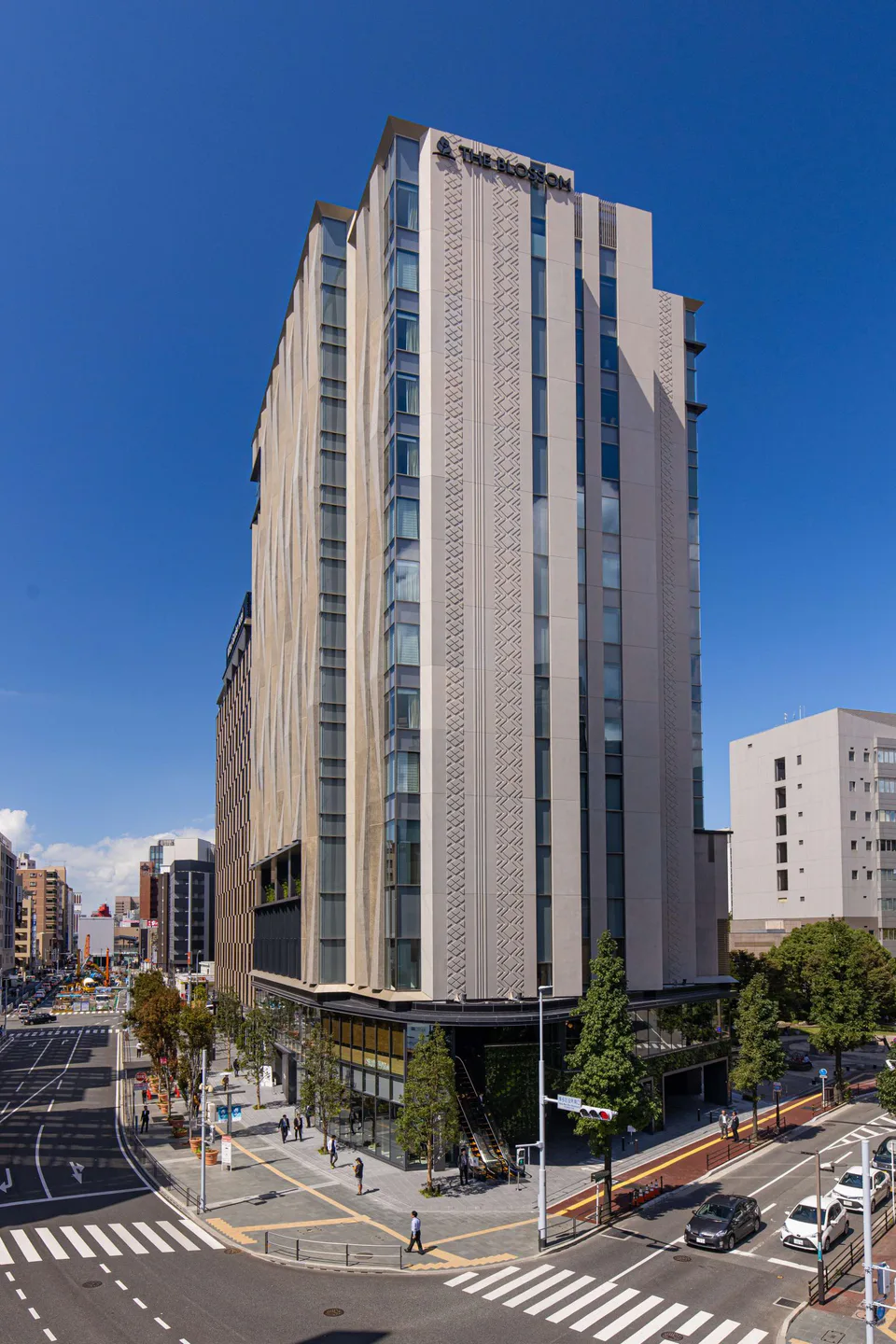
THE BLOSSOM HAKATA Premier is worth the extra walk from Hakata Station when you use it as a two-node city base, not as a station hotel that happens to be seven minutes away. JR Hakata Station is about seven minutes on foot, but Kushida Shrine-mae Station is about two minutes away, Gion Station about six minutes, and Canal City, Kushida Shrine and the old-town side of Hakata sit naturally around the hotel. Add a 30–37 m² Deluxe Twin and a guest public bath, and the trade becomes clear: give up station-door immediacy to gain room space, recovery time and a more balanced evening location.
If your stay is almost entirely early JR or Shinkansen departures, the answer can reverse. The seven-minute walk repeats every time you use Hakata Station. For a one-night transfer stay, that repetition is enough reason to prefer a station-front hotel. For a three- or four-night city stay with evenings around Canal City, Kushida Shrine or Nakasu, the same address can save movement in the other direction.
THE BLOSSOM HAKATA Premier: the 30-second decision
↔ Scroll table left or right
Your trip pattern | Verdict | Why |
One-night transfer, late arrival + early Hakata departure | Usually compare a closer station hotel | You pay the seven-minute walk twice but barely use the room, bath or city position |
2 adults, 3–4 nights, large luggage | Strong fit | 30–37 m² Deluxe Twin can make the room materially easier to live in |
Canal City / Kushida / Nakasu evenings repeat | Strong fit | Kushida Shrine-mae Station is about two minutes away and the hotel is not forced back through Hakata every night |
Three early JR / Shinkansen days | Recalculate | The seven-minute Hakata walk repeats enough times that a station-front premium may be rational |
Will not or cannot use public bath | Reduce the hotel premium | A defining hotel benefit becomes zero-value for that traveller |
3 adults sharing one room | Compare Deluxe Twin vs NAGOMI carefully | Extra bed and tatami-futon are different sleeping products even though both categories list capacity three |
This is a two-node base: Hakata is not the only station that matters
The hotel’s current official access page lists four useful transport points: about seven minutes on foot from JR Hakata Station, about two minutes from Exit 5 of Kushida Shrine-mae Station on the Nanakuma Line, about six minutes from Exit 5 of Gion Station on the Airport Line, and about one minute from the Ekimae Sanchome bus stop.
That makes the location different from a conventional Hakata Station hotel. A pure station hotel optimises the rail hub. THE BLOSSOM HAKATA Premier trades some of that hub proximity for a position that also works toward Canal City, Gion, Kushida Shrine, Nakasu and the historic core.
For a traveller doing two or three Kyushu rail days, this may be a bad trade. For a traveller mixing one rail day with several city evenings, it can be exactly the point. The location should therefore be judged by which direction you repeat, not by whether seven minutes sounds “close.”
If the whole district decision is still open, use Hakata vs Tenjin first. This hotel works best once you already know that central Hakata is the right compromise.
Count Hakata crossings before deciding whether seven minutes is expensive
A useful ValueNavi test is to count every time the itinerary sends you between the hotel and Hakata Station.
Suppose a four-night stay has three JR-heavy days. Three morning departures and three evening returns already create six hotel-to-Hakata or Hakata-to-hotel walks. Add arrival and departure, and the stay has eight Hakata crossings. Using the hotel’s published seven-minute walking estimate as a simple planning input, that is about 56 minutes of headline station walking across the stay before rain, luggage or station navigation.
That 56-minute figure is not an official door-to-door guarantee; it is a derived planning calculation. Its purpose is to expose repetition. A station-front hotel can plausibly earn a premium when it deletes much of that repeated last mile.
Now reverse the itinerary. If you use Hakata mainly on arrival and departure but spend three evenings around Canal City, Kushida Shrine and Nakasu, the seven-minute station cost happens only a few times while the more central evening position pays back repeatedly. In that trip, calling the hotel “farther from Hakata” misses what you bought.
The 30–37 m² Deluxe Twin is the room that makes the hotel different
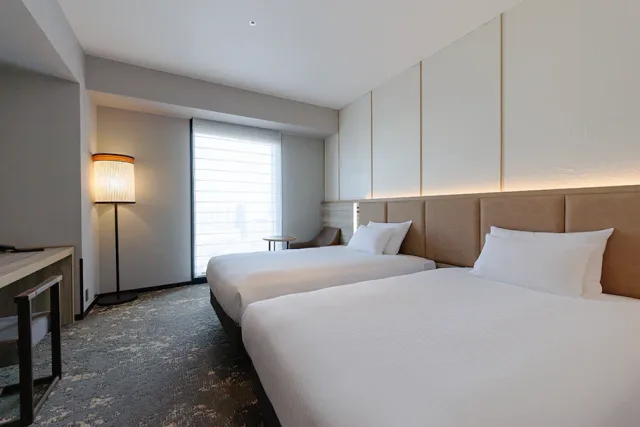
The hotel’s smallest standard products can still be perfectly rational for solo travellers or light packers, but the clearest reason to accept the location trade-off is the larger twin-room product.
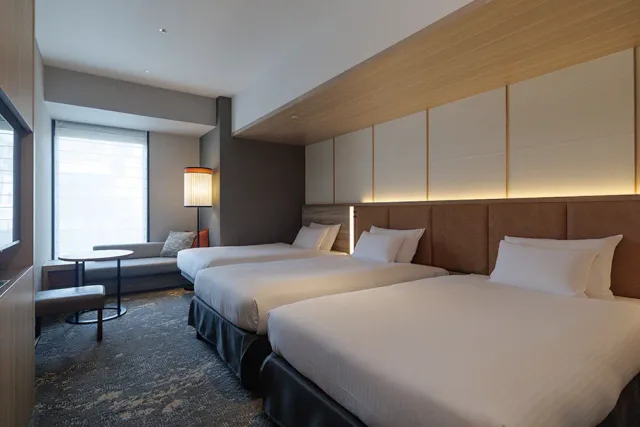
The current official room list gives Deluxe Twin as 30–37 m² for two to three guests, with two 120 cm × 200 cm beds and a bathroom with a washing area. For a third guest, an extra bed is used. The category varies by assigned room, so “37 m²” should not be treated as a guaranteed size unless the booking explicitly says so.
For context, the Moderate Double category begins around 21 m². Comparing the minimum published sizes, 30 m² versus 21 m² is about 43% more floor area. That is not a claim that every Deluxe Twin is exactly 43% larger than every Moderate Double—the categories have size ranges. It shows why the room decision can materially outweigh a few minutes of station walking for a multi-night stay with large luggage.
↔ Scroll table left or right
Room branch | Published size / occupancy | Best reason to choose it |
Moderate Double | 21–24 m² / 2 | Short, light-luggage stay when the larger room is not necessary |
Moderate King | 27 m² / 2 | One wide bed and more room without moving into the twin/three-person product |
Deluxe Twin | 30–37 m² / 2–3 | Two travellers with large cases, longer stay, or third guest using an extra bed |
Comfort Deluxe Twin NAGOMI | 31–32 m² / 2–3 | Tatami-style space and a futon solution for the third guest |
Three adults: Deluxe Twin and NAGOMI are not the same “sleeps three” room
Both Deluxe Twin and Comfort Deluxe Twin NAGOMI publish capacity for up to three guests, but the third-person experience differs. Deluxe Twin uses an extra bed. NAGOMI uses its tatami-style area with a futon for the third guest.
That distinction matters more than the one-square-metre difference between the categories. Three adults should ask who gets the third sleeping surface, whether a futon is acceptable, how much floor remains once that bed is deployed, and whether the group values the tatami sitting area during the day.
Do not compare a two-person teaser rate and assume the same room economics apply to three adults. Enter exactly three guests and compare the actual sleeping setup.
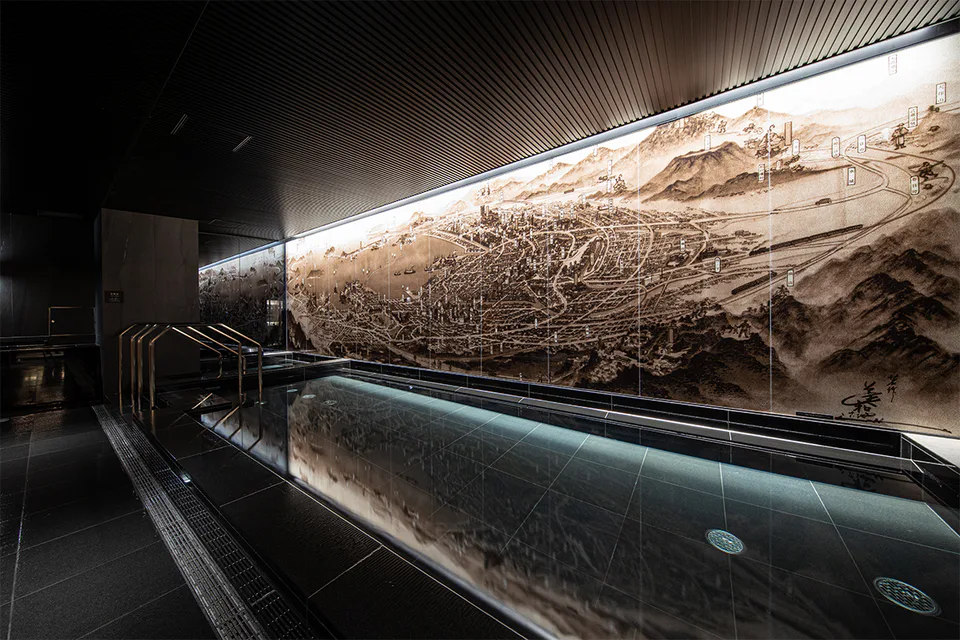
The public bath should be valued by usable sessions—and it has hard vetoes
The fourth-floor large bath and sauna are currently free for staying guests and operate 15:00–25:00 and 06:00–09:00. That creates two realistic use windows: after dinner and before breakfast/check-out.
For a three-night stay, two evening bath sessions can make the hotel feel meaningfully different from a simple station-front room. For a one-night stay where you arrive at midnight and leave before 07:00, the same facility may contribute almost nothing.
There are also hard policy boundaries. The hotel currently does not allow guests who are still in diapers to use the public bath, and it does not allow entry to guests with tattoos. If that applies to you or a member of your party, set the bath’s value to zero before comparing the room rate. Do not keep paying a “public-bath premium” for an amenity the group cannot use.
This is a useful red-team test for the entire hotel. If you remove the bath from the calculation and the larger room is not important either, the seven-minute walk becomes harder to defend against a closer Hakata hotel.
One-night transfer stay: the hotel’s best features may all go unused
Imagine arriving at 22:30 with two large cases, sleeping, and leaving Hakata early the next morning. The room may be large, but you barely have time to use it. The public bath may be technically open, but the group may only want to sleep. Kushida Shrine access contributes nothing because you are not sightseeing.
In that pattern, the hotel is competing on the wrong dimensions. The product you need is the shortest and least complicated station-to-bed chain. A closer Hakata Station hotel can be the better purchase even if its room is smaller.
This is why a hotel should not be labelled “better” in isolation. A feature set that is excellent for four nights can be wasteful for one.
Three or four city nights: the room and evening geography can repay the walk
The hotel becomes more persuasive when the stay is long enough to use the room, bath and two-node location repeatedly. Two large suitcases stay in the same 30 m²-class room instead of being reopened in a small transfer hotel. The bath can be used after several walking-heavy days. Kushida Shrine-mae becomes a useful return point from the Nanakuma Line, while Canal City and nearby old-town streets are part of the normal evening geography.
That is when the seven-minute Hakata walk stops being a standalone disadvantage. It is the price paid for a different daily pattern.
For a city-focused trip, pair this with the Fukuoka 3-day itinerary and the Fukuoka yatai guide. If those plans keep pulling you west toward Tenjin every night, even this middle base may no longer be the answer.
Breakfast is useful only if it does not consume the rail buffer
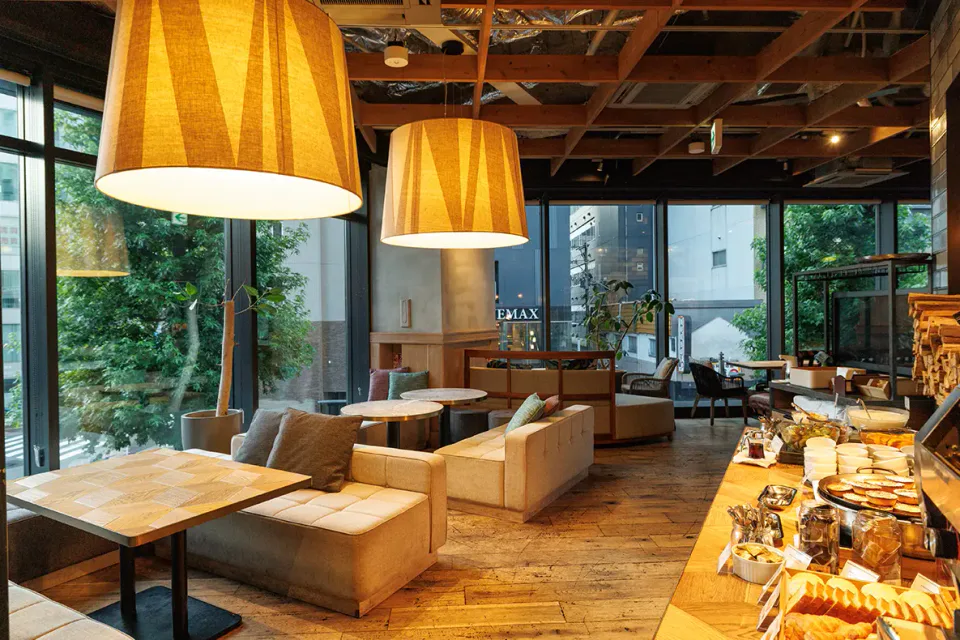
Nine Doors currently serves breakfast from 06:30 to 10:00, with last entry at 09:30. The current listed price is JPY 3,080 for adults and JPY 1,870 for children, with children under seven free.
For a city day, that can be easy to use. For an early Yufuin, Aso or Shinkansen departure, work backward from the platform. Seven minutes to Hakata is only the outdoor headline; you still need station navigation and boarding margin. If breakfast destroys the buffer that makes the morning resilient, use a room-only rate or eat around the station.
The hotel should not force a slower departure simply because breakfast was prepaid.
Rain and large luggage make the seven minutes more expensive
Seven minutes is not a fixed burden. In dry weather with one carry-on, it may barely register. In heavy rain with two 29-inch cases, the same walk includes crossings, wet surfaces, umbrellas and slower movement. Arrival and checkout days therefore deserve more weight than ordinary sightseeing days.
If the itinerary has only two luggage-bearing Hakata crossings but several city evenings, the trade can still work. If it has repeated luggage-heavy departures, a station-front hotel gets stronger quickly.
Use luggage forwarding when the wider Kyushu route can send the largest cases ahead. Removing one suitcase can change the practical value of this location more than a small nightly rate difference.
Compare the exact room and the exact itinerary
When comparing Booking.com, Trip.com and Agoda, hold the guest count, room category, breakfast, taxes and cancellation terms constant. Deluxe Twin and NAGOMI are different three-person products; a Moderate Double is not simply a cheaper version of a 30–37 m² Twin.
Compare THE BLOSSOM HAKATA Premier rooms on Booking.com
Compare the same room on Trip.com
Compare the same room on Agoda
Final verdict: is the seven-minute Hakata walk worth it?
Yes, when you use at least two of the hotel’s three distinctive advantages: the 30 m²-class room, the public bath, and the two-node location between Hakata and Kushida Shrine. A three- or four-night city stay with large luggage and several Canal City/Nakasu evenings is the clearest fit.
No, or at least not automatically, when Hakata Station is the repeated hard constraint. Three rail days can create eight Hakata crossings once arrival and departure are counted—about 56 minutes of headline walking at the published seven-minute estimate. In that itinerary, a closer station hotel can earn its premium.
For a one-night late-arrival/early-departure transfer, shorten the walk. For three adults, choose between extra-bed Deluxe Twin and futon-based NAGOMI deliberately. For anyone who cannot use the public bath, remove that benefit before comparing price. The hotel is strongest as a balanced Fukuoka city base; it is not the universal answer for travellers who simply want to be as close to Hakata Station as possible.
JR East Hotel Mets Premier Akihabara Review: Is a 17 m² Room Worth the 1-Minute Location?
The Park Front Hotel at Universal Studios Japan: Is the 1-Minute Walk Worth It?
OMO5 Otaru: Is a 9-Minute Station Walk Worth Staying by the Canal?
JR Kyushu Hotel Blossom Shinjuku Review: Is the 25m² Superior Twin Worth It?
Hotel Sosei Sapporo Review: Is a 39 m² Twin-Queen Room Worth a 15-Minute Walk from Sapporo Station?
Sources
THE BLOSSOM HAKATA Premier — official access · official room information · official public bath and facilities · official breakfast information. Checked August 25, 2026. Room allocations, operating hours, policies and prices can change; verify the exact room and stay conditions before payment.