
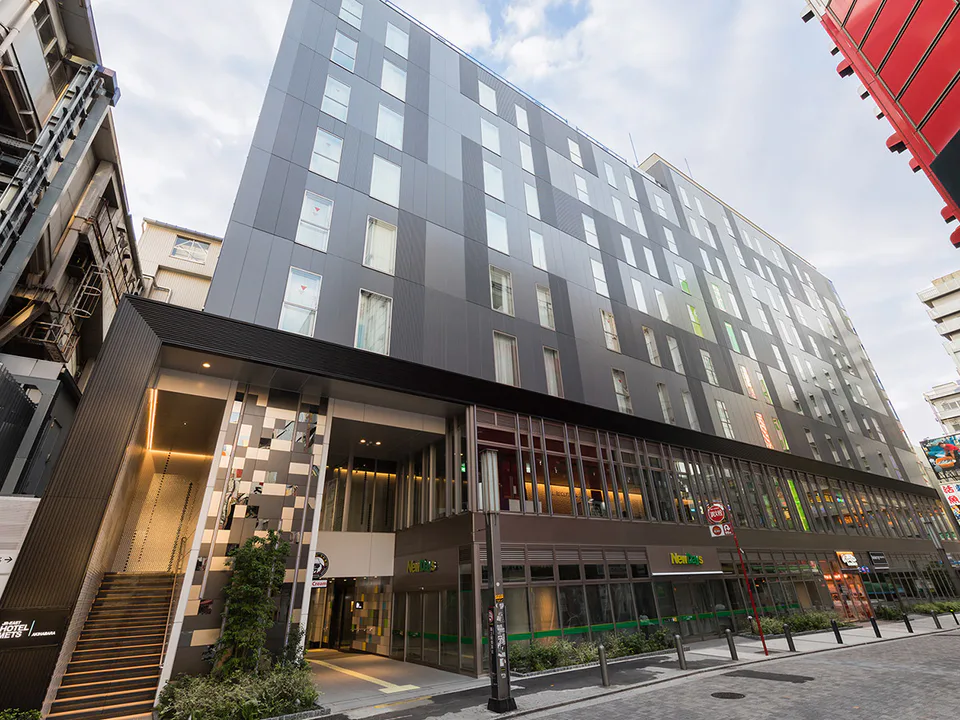
JR East Hotel Mets Premier Akihabara is worth the compact-room trade when Akihabara Station solves several journeys inside Tokyo, not merely because the hotel is one minute from JR. The property is one minute from the Electric Town South Exit, while the hotel’s own access references put Tokyo Station about four minutes away by JR, Ueno three, Suidobashi four, Shinjuku fifteen and Shinagawa sixteen. That makes the hotel a strong east/central-Tokyo rail hub even if Electric Town is not your main sightseeing interest.
The airport story is more conditional. The hotel currently quotes about 30 minutes from Haneda via Keikyu + JR and about 80 minutes from Narita via Skyliner + JR. Neither is a one-seat airport transfer. If arrival and departure are the only times you touch those airport routes, do not let two luggage-heavy movements outweigh four or five days of Tokyo geography. Choose the hotel by what repeats.
JR East Hotel Mets Premier Akihabara: the 30-second decision
↔ Scroll table left or right
Your trip pattern | Verdict | Why |
Tokyo Station / Ueno / Suidobashi repeat across the stay | Strong fit | The one-minute JR finish compounds across several short journeys |
Narita arrival is the only reason you chose Akihabara | Recompare Ueno / Nippori | Skyliner requires a JR transfer for Akihabara; the hotel is not a direct Narita product |
Haneda + east/central Tokyo itinerary | Still reasonable | Airport access requires a transfer, but the internal-Tokyo geometry can repay that one-time friction |
Solo / 1–2 nights | 17 m² Double can work | The room mainly functions as a reset point and one person feels the compact floor less |
Two adults + two large cases, 3–5 nights | Price the 21 m² Twin first | The room-size cost repeats every night |
Mostly Shibuya / Shinjuku nightlife | Compare west Tokyo | You are paying for a rail hub whose strongest short trips are not your repeated trips |
The one-minute claim is exit-specific
The official access page gives one minute from JR Akihabara Station’s Electric Town South Exit. It gives about two minutes from Tsukuba Express Exit A1, three minutes from Tokyo Metro Hibiya Line Exit 3 and six minutes from Iwamotocho Station Exit A3 on the Toei Shinjuku Line.
That distinction matters because “one minute from Akihabara Station” is not one universal walking route. If your daily transport is Hibiya Line rather than JR, or if luggage sends you toward a different lift or exit, use the route you will actually walk. The hotel’s strongest location product is JR Electric Town South Exit → hotel, not every platform inside the district.
Airport convenience is a one-time hand-off; Tokyo rail convenience can repeat ten times
The hotel currently advertises approximately 30 minutes from Haneda via the Keikyu Airport Line and JR Yamanote Line, and approximately 80 minutes from Narita via the Keisei Skyliner and JR Yamanote Line. Keisei’s current fare page explicitly describes Akihabara as a Skyliner trip with a change to JR at Nippori; the published adult total is JPY 2,630 on ordinary tickets.
That gives a useful ValueNavi distinction:
Airport hand-off: usually paid once on arrival and once on departure.
Base-location hand-off: paid every morning, every tired evening and every hotel reset.
If a five-night itinerary uses Tokyo Station twice, Ueno twice and Suidobashi once, Akihabara’s short JR links may repay far more often than the airport transfer costs you. If the trip is only one night between two Narita flights, the opposite can be true: Ueno/Nippori may remove the transfer that matters most.
Do not use “easy airport access” as a binary label. Ask whether the airport route is the dominant movement or merely two movements among many.
Akihabara’s real premium is rail-hub compression
The hotel’s own access references currently list Tokyo Station at roughly four minutes by JR, Ueno three, Suidobashi four, Shinjuku fifteen and Shinagawa sixteen. These are train times, not platform-to-room guarantees, but they show why Akihabara can work even for travellers who spend little time shopping in Electric Town.
Use a deletion test: if Akihabara disappeared from your sightseeing list, would the station still solve enough journeys to justify the hotel? If yes, the location has independent value. If no, you may be paying for a famous neighbourhood rather than the best base.
A simple count works well. Write down arrival, departure and the four most repeated or difficult trips. If Akihabara materially simplifies at least three of those six movements, the 17–21 m² room compromise has a clearer reason to exist.
17 m² is a short-stay room; 21 m² is the more honest two-person benchmark
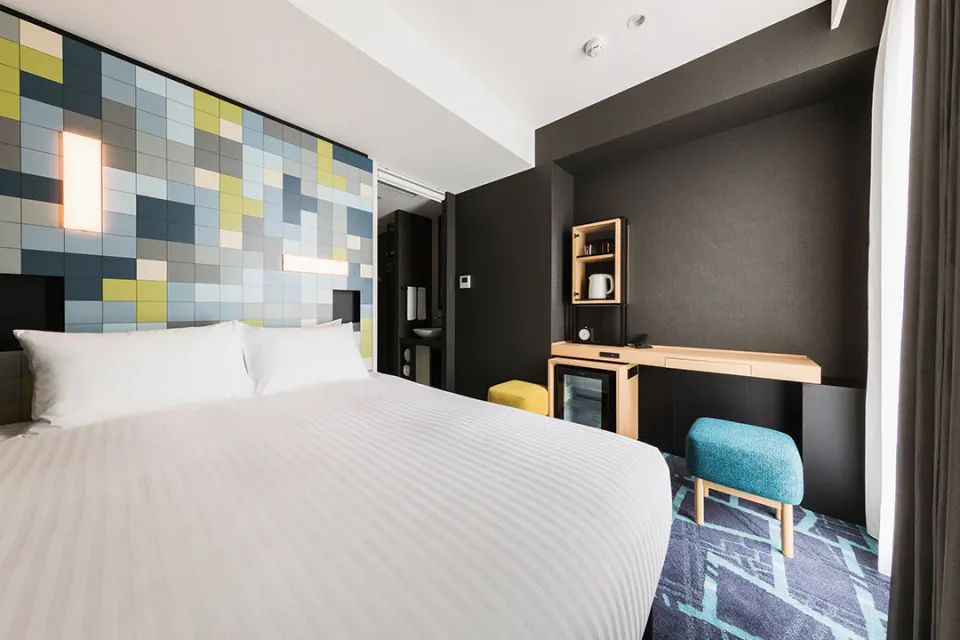
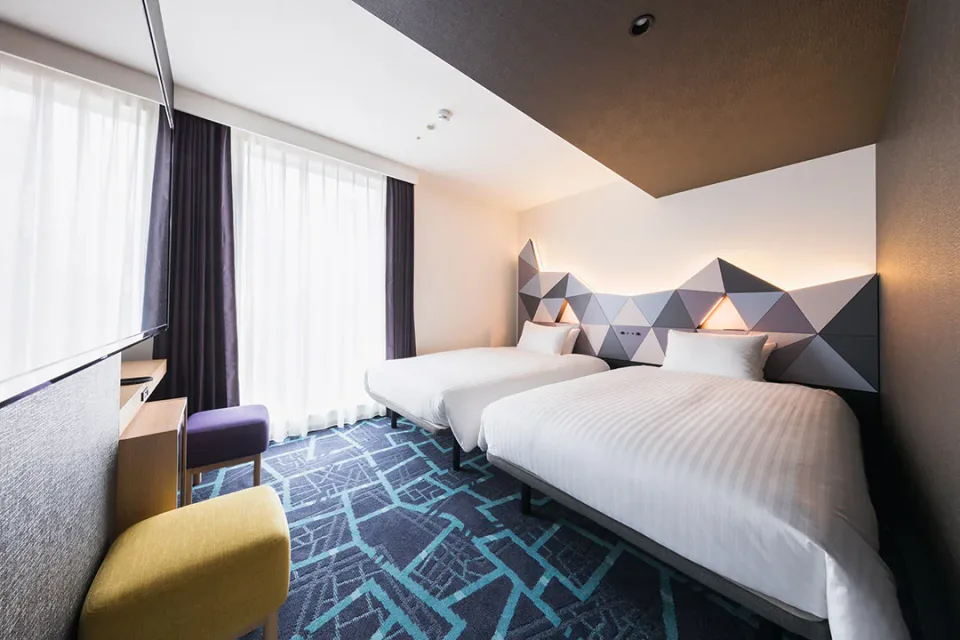
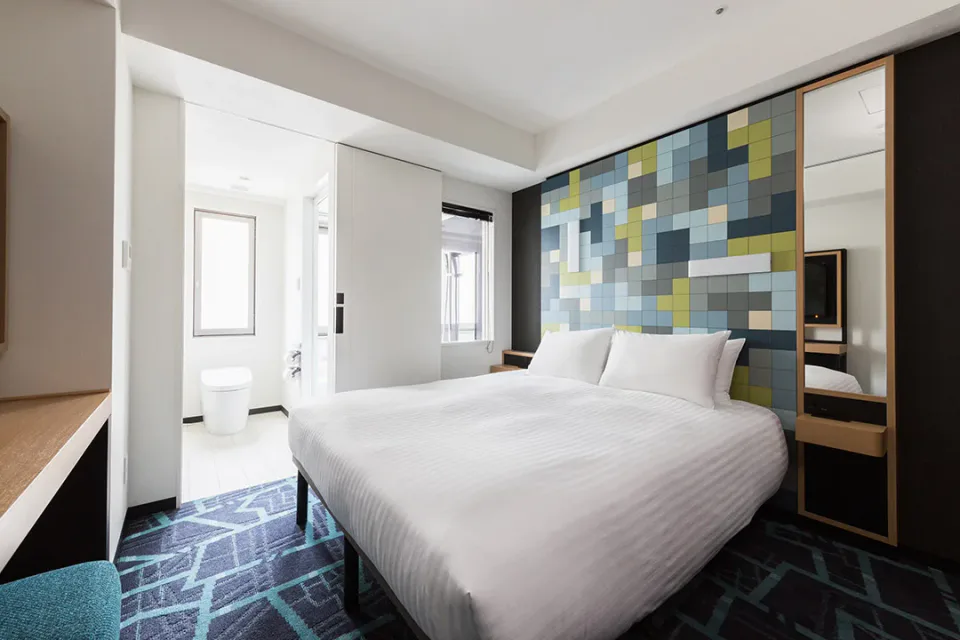
The current Superior Double is 17 m² with one 160 × 195 cm bed. The Superior Twin is 21 m² with two 120 × 206 cm beds. The Deluxe Twin is 23 m² with two 120 cm beds plus a 90 cm extra bed when used by three guests. Every room has a bathroom with a separate washing area.
Moving from 17 to 21 m² adds four published square metres—about 23.5% more floor area. That is not a promise of 23.5% more free suitcase floor because furniture differs, but it is large enough that two luggage-heavy travellers should price the Twin instead of treating the cheapest Double as the default.
↔ Scroll table left or right
Room | Official size / bed | Best use |
Superior Double | 17 m² / one 160 cm bed | Solo or lightly packed couple on a short stay |
Superior Twin | 21 m² / two 120 cm beds | Two adults with more luggage or separate-bed preference |
Deluxe Queen / Balcony | 22 m² room + 10 m² balcony / one 180 cm bed | Outdoor-space or larger-bed preference, not a twin-room solution |
Deluxe Twin | 23 m² / up to 3 | Three-person stay; third guest uses a 90 cm extra bed |
Do not keep upgrading inside the hotel without reopening the base choice. If the Twin or Deluxe premium reaches the rate of a materially larger room in Ueno, Tokyo Station or another area that fits the itinerary better, compare hotels again.
Families: the number of regular beds changes the free bed-sharing capacity
The official policy allows one preschool child to share each regular bed free of charge. The one-bed Double therefore supports one free preschool bed-sharer; the two-bed Twin supports up to two. Elementary-school children and older are charged at the adult rate.
For two adults with two preschool children, the Twin is the operational starting point before luggage even enters the comparison. For three adults, use the Deluxe Twin’s actual extra-bed configuration instead of assuming the two-person room can simply absorb another adult.
Cribs and bed guards are reservation-required loan items and quantities are limited. If either item is a hard requirement, confirm it before the free-cancellation deadline rather than treating it as an automatic hotel amenity.
The separate bathing area is most valuable on a room-reset itinerary
Every current room category includes a bathroom with a separate washing area. That is a meaningful feature when the room is used more than once a day: sightseeing → hotel reset → dinner → hotel. It allows the compact room to feel more functional than its area alone suggests.
If you leave at 08:00 and return once at 23:00, you still get the bath, but the station premium and room workflow are used fewer times. This is another reason to judge the hotel by repeated daily movement rather than the room photo alone.
Checkout-day luggage storage is unusually useful for an evening departure
The hotel currently stores luggage free on the check-in day and until 24:00 on the checkout day. That can protect a full final Tokyo day before an evening Shinkansen or flight without paying for a late checkout.
This becomes especially coherent with Tokyo Station only about four minutes away by the hotel’s JR reference: check out → leave bags → use the city → return once → collect luggage → JR to Tokyo Station. The hotel’s location and storage policy are working on the same problem.
For a multi-city trip where the next hotel is already fixed, luggage forwarding may remove even more friction than storing the bags until evening.
Driving is a poor reason to choose this hotel
The partner parking is reservation-only and must be reserved by 21:00 the day before the stay. The current hotel page lists JPY 1,500 per night and a hard operational restriction: vehicles cannot enter or leave between 22:00 and 07:00.
That is not a problem for a car that simply sleeps overnight. It is a hard veto for travellers who expect a very early drive or a late-night car return. The hotel’s strongest product is rail, so a driving-first itinerary should not contort itself around a parking rule just to retain the one-minute JR location.
Final verdict
Choose JR East Hotel Mets Premier Akihabara when the hotel simplifies several repeated east/central-Tokyo rail movements, not because it offers a direct airport ride—it does not. For a solo or short couple stay, the 17 m² Double can be an efficient location-first purchase. For two adults with large luggage, the 21 m² Twin deserves to be the baseline comparison.
Narita and Haneda should be treated as boundary tests. If the whole stay is essentially an airport transfer plus one night, a base with a cleaner airport route may beat Akihabara. If the airport journey happens only twice inside a five-night Tokyo stay, the repeated Tokyo Station/Ueno/Suidobashi geometry can easily matter more.
The hotel’s real product is one-minute JR last mile + repeated short east/central-Tokyo journeys + a compact but functional room. When your itinerary uses all three, the trade works. When the airport route, west-Tokyo nights or room-size requirement dominates instead, compare another base.
Southwest Grand Hotel Okinawa Review: Is a 45 m² Room and Pool Worth the Urban-Resort Premium?
Cross Hotel Osaka: Is a 1-Minute Dotonbori Location Worth the Premium?
KAZENO KURAYOSHI Review: Which Heritage Room Is Worth Booking?
Solaria Nishitetsu Hotel Sapporo: Is the Five-Minute Walk Worth It?
HOTEL ANTEROOM NAHA: Is a 12-Minute Walk from Miebashi Worth Every-Room Harbour Views?
References
JR-East Hotel Mets Premier Akihabara — official station and airport access · official room sizes, bed-sharing and luggage-storage rules · official facilities and loan items · Keisei — current Narita-to-Akihabara Skyliner + JR fare route. Checked August 25, 2026. Airport routes, fares and rail times can change; verify the exact travel date.