
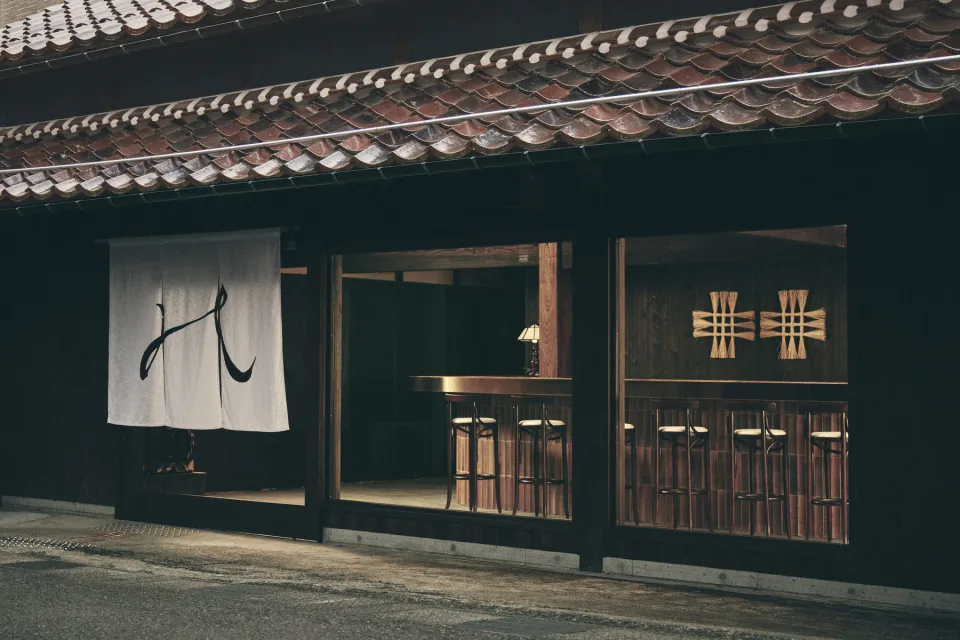

KAZENO KURAYOSHI is worth booking when sleeping inside Kurayoshi's protected architecture is one of the experiences you are paying for—not when you simply need a bed between trains. For a rail traveller, the strongest one-night version is to reach JR Kurayoshi Station in time for the 14:30 or 16:15 reserved shuttle, use the historic district before dinner, then keep the evening and next morning slow. If you arrive after the final published shuttle, need a genuinely barrier-free room, require guest laundry, or leave before breakfast, a conventional station-area hotel is usually the more resilient purchase.
The property opened on July 17, 2026 and has only 11 rooms across two historic houses, Ogawa House and Takata House. That makes this less like choosing a standard hotel category and more like choosing a specific floor plan inside a cultural property. Room 7 is officially described as having the fewest steps in the property; Room 3 is the largest at 164 m² but is a maisonette with the bedroom upstairs and the bathroom in a detached section downstairs. At KAZENO KURAYOSHI, larger does not automatically mean easier.
This is therefore an analytical booking review based on current official room, access and dining rules rather than a claimed first-hand stay. If the bigger decision is whether to sleep in Kurayoshi at all or move to the hot-spring town, use Misasa Onsen vs Kurayoshi first.
The 30-second decision: who should book KAZENO KURAYOSHI?
↔ Scroll table left or right
Your situation | Verdict | Why |
Architecture, old-town evening and local dinner are part of the trip | Strong fit | The hotel gives you useful time inside two cultural properties after ordinary sightseeing hours |
Rail arrival matches the 14:30 or 16:15 shuttle | Strong fit | The awkward station-to-old-town last mile is solved before it becomes a luggage problem |
Older traveller or family worried about steps | Room-specific fit | Room 7 has the fewest steps; the hotel as a whole is officially not barrier-free |
Late arrival after 20:00 | Weak fit | Published dinner last order is 20:00, check-in after 20:00 requires contact, and the heritage afternoon has already disappeared |
Very early train / one-night transit stop | Usually skip | You pay for heritage time that the timetable does not let you use |
Need laundry, lift-like simplicity or confirmed step-free circulation | Skip | The property lists no guest laundry and states that it is not barrier-free |
Want an onsen resort more than architecture | Compare Misasa instead | KAZENO KURAYOSHI is a heritage retreat, not a large communal-bath resort |
The shuttle turns this into an appointment hotel, not a flexible station hotel
KAZENO KURAYOSHI's official access page puts the property about 15 minutes from JR Kurayoshi Station by hotel shuttle. The published departures from Kurayoshi Station are 14:30 and 16:15. A current hotel notice says the shuttle should be reserved by 20:00 on the day before the stay, is first-come, and may be shared with other guests.
That creates a much more useful arrival rule than “the hotel has a shuttle.” If you catch the 14:30 departure, you arrive around the start of check-in and can still use the old town, room and dinner as one coherent afternoon-to-evening experience. The 16:15 departure still works, but the pre-dinner window is shorter. Miss it and the stay changes: you now need a taxi or another local solution while carrying luggage.
The public directions page lists the two station-to-hotel departures but does not publish a corresponding fixed return timetable. The hotel overview says pickup/drop-off is available, so ask for the departure-day arrangement when you book rather than assuming the inbound schedule works in reverse.
This is the first red-team test for the room premium: if your train cannot align with the hotel transport, is the architecture still worth an extra taxi and a shorter evening? Sometimes yes; for a transit night, usually no.
Check-in and dinner create a second hard clock
Official check-in is 15:00–20:00 and checkout is by 11:00. Guests arriving after 20:00 must contact the hotel. The front desk becomes unstaffed after 22:00, although there is no curfew.
The restaurant is in Takata House. Current official dining hours are 17:30–22:00 with last order at 20:00; breakfast is 7:30–9:30 with last order at 9:00. For Ogawa House rooms, the dinner venue is about a three-minute walk away. For Takata House rooms, dinner is in the same building.
This makes a late arrival more expensive than the lost sightseeing time alone. An arrival after 20:00 can remove the normal dinner window as well as the relaxed heritage evening. If you have booked a meal plan, treat the dining time as a real itinerary constraint, not a hotel amenity you can use whenever you finally appear.
There is a useful flip side: if you stay in Takata House, dinner requires almost no extra movement. If you stay in Ogawa House, reception is closer but dinner requires a short outdoor walk. Neither is universally better; choose which hand-off you want to minimise.
Room size is the wrong first filter — start with stairs and circulation
The official room inventory makes the key trade-off unusually clear. KAZENO KURAYOSHI is a heritage hotel, so floor area and mobility are not positively correlated. A huge room can contain more stairs and a smaller room can have easier circulation.
Room 7: the first room I would check for older travellers
Room 7 in Takata House is 66 m², on the first floor, sleeps up to three people and has three beds including one extra bed. The hotel specifically describes it as having the fewest steps in the entire property. It is also in the same building as dinner.
That does not make the whole stay barrier-free—the hotel explicitly says it is not—but it makes Room 7 the most rational first enquiry when knee problems, a child, frequent night-time bathroom use or step anxiety matter more than having the largest suite. The trade-off is that the front desk at Ogawa House is about three minutes away on foot.
Room 2: better than the biggest suite for three adults who want a flat layout
Room 2 in Ogawa House is 91 m², flat rather than maisonette, and accommodates three people with three beds including one extra bed. Reception is in the same building, while dinner is about three minutes away.
For three adults, that combination can be more practical than paying for a much larger suite whose bedroom and bathroom sit on different levels. If your priority is “large heritage room without internal stairs,” Room 2 has a clearer job than a generic upgrade to the biggest available category.
Room 1: the five-person room has a child-safety warning
Room 1 is 126 m², a maisonette, and accommodates up to five people with five beds including one extra bed. That sounds like the obvious family or small-group choice until you read the room-specific note: because the preserved second-floor passage has gaps, the hotel says it does not recommend this room for guests with small children.
This is exactly why legal occupancy should not end the booking decision. A room that accepts five bodies can still be the wrong room for a family with a toddler. Ask for the exact room number, not simply “a room for five.”
Room 3: 164 m² proves that the largest room is not the easiest room
Room 3 is the largest at 164 m² and sleeps three people. But it is a maisonette: the bedroom is upstairs, while the toilet and bathroom are in a separate detached section on the first floor. The room is designed as a retreat with garden and tea-room character, not as the shortest possible route between bed and bath.
For a couple celebrating something special, that layout may be the experience. For an older traveller who wakes several times at night, the same layout can be a negative. The premium is buying architectural drama and privacy, not easier circulation.
Rooms 8–11: dinner convenience, but all are maisonettes
Takata House Rooms 8–11 are storehouse twin rooms of roughly 46–56 m². All are maisonette layouts for two people, with dinner in the same building and the front desk about three minutes away at Ogawa House.
These rooms make sense for a mobile couple who wants the restaurant and the merchant-house atmosphere close together. They are not the obvious answer for anyone choosing Takata House because they assume “dinner in the building” also means fewer stairs inside the room.
Two buildings create a small but real hotel-within-a-town effect
Ogawa House contains the front desk and six guest rooms; Takata House is about three minutes away and contains five guest rooms plus the restaurant. That distance is tiny in ordinary sightseeing terms, but it changes meaning when it is raining, when someone has limited mobility, or when you are crossing between dinner and the room at night.
This is one of the few hotels where “same property” should not be interpreted as “same building.” Before payment, write down four things: room number, building, front-desk distance and dinner distance. The official room pages publish those differences, so there is no reason to book from the room name alone.
The preserved architecture comes with deliberate modern-hotel trade-offs
The hotel repeatedly warns that the restored historic buildings do not have the insulation or airtightness of a modern purpose-built hotel. The room pages also state that TVs, clocks and bright lighting are intentionally not provided in order to preserve the atmosphere.
The hotel overview lists Wi-Fi and luggage storage, but no guest laundry. It also says the property is not barrier-free and allows co-sleeping with children only through age six. Pets are not accepted.
These are not missing luxury features that should surprise you after check-in; they are part of the product. A heritage night makes sense when quiet, architecture and room time are worth more to you than a laundry room, a conventional lift-and-corridor layout or a bright television-equipped room.
If the trip is already seven or eight days into a long Japan itinerary and you urgently need laundry, that operational need can be more important than another special room. Use the luggage-forwarding guide to reduce what you carry, but do not assume forwarding solves clothing care.
One night is the default; a second night needs a second job
For most travellers, one night is enough to buy what makes KAZENO KURAYOSHI different: arrive in time for the heritage district, eat dinner, spend a long evening in the room, sleep inside the restored building and use breakfast/morning before leaving.
A second night becomes rational only when the middle day has a clear job—Kurayoshi plus Misasa Onsen, a central-Tottori activity, local craft, or a deliberately slow retreat day that brings you back to the room for more than sleep. If day two is simply another regional transfer with the bags stored at reception, the second night is mostly repeating the room premium.
Use a simple two-session test: does night two buy both another useful evening and another useful morning? If it buys only a second sleep, move the night farther along the San'in route.
Families and older travellers should choose the room before choosing the rate
Families should not use maximum occupancy as the main filter. Room 1 demonstrates why: it sleeps five but carries an explicit small-child warning. Older travellers should not use square metres as the main filter either; Room 3 demonstrates why: 164 m² still means multi-level circulation.
For a family or older couple, I would ask the hotel for Room 7 or another low-step option first, then compare the rate. If none of the available room layouts fits the group's mobility, that is a reason to choose another hotel—not a reason to accept a more expensive room and hope the heritage layout becomes easier in person.
What should rail travellers do if they miss the 16:15 shuttle?
Do not turn the missed shuttle into an improvised luggage walk. The hotel says taxis can be arranged and the station-to-property shuttle takes about 15 minutes, which tells you the old town is not a casual station-adjacent finish.
If you already know your train arrives after 16:15, price the taxi into the stay before you book. If the train is scheduled near 20:00, also ask whether the dinner plan still works. A heritage hotel becomes poor value when the first hour is spent negotiating transport and the second is spent apologising for a missed meal.
When I would choose a station hotel or Misasa Onsen instead
Choose a Kurayoshi Station hotel instead when the night is mainly a rail connection, the train arrives late, the next departure is early, laundry is important or you want the least complicated luggage route.
Choose Misasa Onsen instead when hot-spring bathing is the reason you are spending the night in central Tottori. KAZENO KURAYOSHI's private-room baths and heritage setting are not the same product as an onsen-town stay. Use Misasa Onsen vs Kurayoshi for that destination-level decision.
Choose KAZENO KURAYOSHI when you would still want the room even if it were not beside a major attraction. That is the cleanest test of whether the heritage premium is real for you.
Final verdict: book a room number, not a hotel name
KAZENO KURAYOSHI is a strong one-night splurge for travellers who can arrive on the hotel's schedule and want the architecture to be part of the itinerary. The 14:30/16:15 station shuttle, 20:00 dinner last order and 15:00–20:00 check-in window all push the best stay toward an early arrival rather than a late transit night.
The most important booking decision is then the exact room. Room 7 is the mobility-first option because the hotel itself identifies it as having the fewest steps. Room 2 is the stronger flat large-room choice for three adults. Room 1 can sleep five but is specifically not recommended for small children. Room 3 is enormous but deliberately multi-level. Rooms 8–11 put dinner in the same building but remain maisonettes.
If those trade-offs sound like part of the appeal, the hotel offers something a station property cannot copy. If they sound like problems you need to work around, choose the simpler hotel and spend your Kurayoshi time in the historic district instead.
Compare the exact KAZENO KURAYOSHI room available for your dates
Oriental Hotel Okinawa Resort & Spa Review: Is the 170m Pool Worth a 7-Minute Beach Walk?
Art Aquarium Museum GINZA Review: Is a ¥2,500 Living Art Installation Worth It?
MUWA Niseko Review: When Is Ski-in/Ski-out Worth the Premium?
JR Tower Hotel Nikko Sapporo Review: Is Sapporo Station Access Worth the Premium?
HOTEL ANTEROOM NAHA: Is a 12-Minute Walk from Miebashi Worth Every-Room Harbour Views?


References
KAZENO KURAYOSHI official overview · Official directions and FAQ · Ogawa House room specifications · Takata House room specifications · Official dining information. Checked August 25, 2026. Shuttle availability, dining slots, room inventory and operating rules can change; verify the exact room and arrival arrangement before payment.